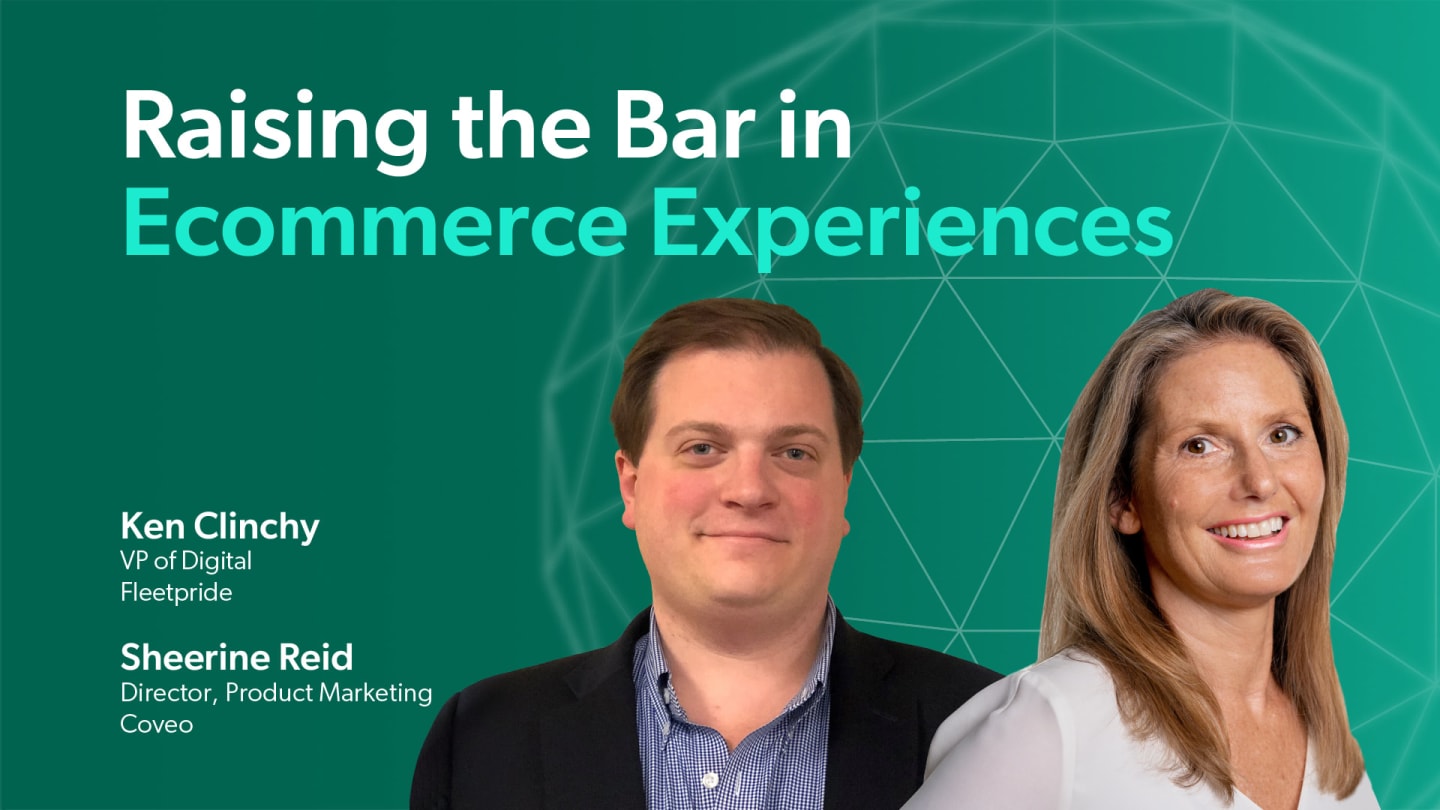
Hello, everyone, and welcome to our ecommerce track. So my name is, Shareen Reed, and I'm part of the marketing team product marketing team here at Coveo. Hopefully, you've all had a chance to attend our keynote session, and we're very inspired by our, guest, Scott Compton that was from Forrester. So our job here really now is to keep that relevance inspiration going with this session, and it is titled raising the bar in ecommerce experiences. So, of course, let me get some housekeeping items out of the way. If you've joined not joined one of our Relevance three sixty sessions before, then I wanna emphasize that we love making these sessions super interactive. So if you take a look at the right hand side of your screen, you should see a chat, poll, q and a chat. Please feel free to engage in the chat and comment on anything that strikes a chord while, we are presenting. And if you do have any questions, then simply pop them into the q and a, tab, and we will leave some time at the end to respond to some of those. We have my colleague Diane from our team who will be monitoring the chat and q and a today. So thanks, Diane. Shout out to you. And we are super pumped because we are joined today by one of our customers, Ken Clinchy, who is the VP of digital at FleetPride. But before I officially, introduce Ken, I wanted to just spend a moment to kinda set the scene for for today's discussion. And to do that, I wanted to ground us on in a couple of data points. So back at the beginning of, twenty twenty one, beginning of the year, Coveo published the results of a study that we commissioned that included about two thousand participants. And we pulled them on all kinds of things, but we specifically asked them to share their thoughts about their online shopping experiences. And what we discovered is that roughly about fifty percent of people said they were more likely to pay more if they could find what they were looking for in just a few flick clicks. Also interesting is that over a a quarter of the people would pay more for relevance. So things like getting personalized recommendations or finding supporting content when they needed it. And so that's really from a consumer perspective. But what what I also wanted to kind of emphasize is that for b to b transactions, and I'm sure many of you have heard this already, but and we're gonna be diving into this a little bit today with Ken, is the reality doesn't change that much. The fact that b two b buyers are consumers first, right, and foremost, and they're level setting against those online shopping experiences that they have as consumers. And people now, they really when they're coming to your site, they expect to be able to search like they do on Google, get those relevant results. They expect to have more tailored content personalized to them like they do on, let's say, Netflix, where they just keep consuming content that's suggested. And they also expect more relevant product recommendations, like they get on a a Wayfair site, let's say, or or even Amazon. And in the last year or so, we see that b two b on online buying has really accelerated. And you see here on the slide that, Digital Commerce three sixty set published the result at ten percent increase in in use. And, you know, it the pandemic has really accelerated this. It's been a big disruptor, and it's pushed this number up maybe more quickly than it would have without those kind of, interrupters that came into play. But I I don't think that anybody really believes that this is a temporary shift. So most buyers are not going to unlearn the convenience, let's say, of going to a digital portal and and simply clicking on something, placing it into their cart, and ordering it. They're becoming much more self sufficient, and and they prefer to interact that way now. And so the data tells us that people are willing to pay more for a better experience. Great. But I think what's more important is that they're also gonna leave. Right? If they find that a competitor site is easier to navigate, let's say, it's easier to find content that they need to make their purchase decisions, And, overall, it gives them a better experience. So whatever channel strategy you might have, you really can't ignore risk, can't risk ignoring your own thing. So if if you can differentiate about your, against your competitors, that's great. But, ultimately, that could also be a big way, to enable you to grow. So that's kind of a little bit about setting the scene. I'd like to now welcome Ken Clinchy. As I mentioned, Ken is the vice president of digital for FleetPride, and FleetPride is the largest independent parts and service provider in the heavy duty truck industry. So Ken joined FleetPride in two thousand thirteen, and he's held a variety of leadership roles, from pricing to merchandising. Before he joined FleetPride, he was also a strategy consultant focused on driving commercial excellence across CPG and distribution clients. So welcome, Ken, and it's great to have you with us today. Thank you. Thank you for having me. Excited to be here. Amazing. So to get us started off, Ken, I know personally, I don't own an eighteen wheeler. I don't know if anybody in the audience does, have one parked in their driveway. But can you tell us a little bit about FleetPride and what you do? Yeah. Absolutely. You know, not a lot of folks, have heard of FleetPride. I know I hadn't before joining, as most of us, don't don't work on, our own eighteen wheelers, as you mentioned. But really kind of think of FleetPride, as an AutoZone, as a Napa, as an O'Reilly's, but really focused on the heavy duty truck market. So we have two hundred and eighty locations around the country, fifty two service centers, so where you would pull a truck in or a trailer in and and we do the service, five distribution centers. We cover four hundred, different brands, and, currently, a hundred and seventy five thousand SKUs online and and a total catalog of over a million parts. And so we are, you know, as you said, the the largest independent, aftermarket distributor of of parts in the space, and truly focused on, heavy, and medium duty trucks. And so anybody can walk into one of our locations, whether you're a large fleet, a small fleet, or somebody that just owns and and runs their own, their own truck. And we sell everything from, you know, a a simple light to, overhauling an entire engine. Great. Okay. That gives us a good indication. I think we have, like, one more slide here because you you touched on this a bit. Who exactly are your customers? It's a bit of a mix. Right? Yeah. And it's it's very interesting. You know, often, we think about, when you think of an an auto zone or what we call light duty vehicle, most of those folks own their own vehicles and operate those vehicles. In the heavy duty and medium duty space, often these fleets are enablers to the business. Right? So they transport the goods, for that business. If you think about, in the, refuge and sanitation, right, or, agriculture. They're taking the goods to market. School bus, obviously, you're you're transporting children, municipalities, oil and gas, mining and logging, could be CPG companies, could be, you know, Coca Cola literally transporting, you know, goods and services. And so we're servicing all those as well as transportation, companies. And so we service all fleet sizes from, you know, one vehicle to thousands of vehicles, independent repair facilities, as well as distributors and resellers. And like I said, our our focus is really on the medium and heavy duty markets. Really, we don't we don't play in the the light duty markets, which is really where the AutoZones, O'Reilly's, and Nappas of the world, focus. Okay. Got it. So it's really a diverse audience that you need to target and and Yeah. Very diverse and very specialized very specialized parts. Got it. Alright. So a couple of years ago, now, FleetPride embarked on a digital transformation, most like a lot of other companies out there. And Yeah. I'm so happy that you thought of capturing this before picture, and I don't know if the audience can see it. But it this is a before screenshot. Correct? So what is this exactly? This is your experience before? Or Yeah. So and and I thought this is important to sort of set the stage because I'm sure a lot of, a a lot of b two b organizations go through this. Right? So to to give everyone an idea and and, obviously, everyone can go see our new website at fleet pride dot com, and and I encourage you to please do. This was our starting point. Right? So we had a, I would say, an ordering platform. Right? We didn't have a digital presence. We had an ordering platform. We We had an ordering platform, and then we sort of had a a marketing website. And I wanted to sort of show everyone what our ordering platform look like. Right? It looks like something that was built in the late nineties, and, it it was launched then, and we really never updated it. And it worked. It was transactional. You know, it had very, very basic search capabilities. If you knew a part number, you could find it. And it worked for a small, small subset of customers who knew exactly what they wanted. They reordered regularly. They could save lists, and that was fine for that period of time. But we knew that in order for us to truly grow digitally and to capture, you know, new customers, as well as grow with our customers, we had to reinvent. And so we, you know, we made a a large investment, and part of that investment being KaVao, you know, we launched a whole new platform, but but I think it's it's important to remember where you came from, and and this is where we started. And to to to be completely frank, we still have a few customers on this legacy platform, that we are working to to wrap up. There's a there's a few, bits and pieces here, but, there's a few laggard customers, that, you know, it change management is obviously a big piece of that that we'll get into. But, you know, it's it's important to remember where you came from. Absolutely. And I think a lot of people can identify with the screen, believe it or not. Still, they're at that phase. Alright. So you had a vision, for a better customer experience. Can you talk a little bit about that? Because I I have no idea what you mean by being the first click in heavy duty. Yeah. So at the end of the day, we're a distributor. Right? We sell availability, and for our customers, that's what it's all about. Right? These vehicles are revenue generating assets for our customers. They need that vehicle back up and running every time that that truck is down. You know, and it varies on the industry, but but it's somewhere between a thousand to two thousand dollars a day that that truck is down. And so parts not being on the shelf and readily available for our customers, is a problem. And so, you'll hear it across our industry. Distributors wanna be the first call, because when they go to pick up the phone, which is the traditional way of contacting a distributor, you wanna be the first call. Well, as we, you know, as you'll hear me mention and and we have it on a later slide, as as we kind of weave digital into our business, we wanna transform from not just becoming the first call, but also becoming the first click. Right? We wanna be who you think of first. And so, that's what we mean by saying the first click. So that's by providing a a frictionless transaction. And the way that you do that, as I mentioned, we have very complex parts, and we have a lot of them. As I mentioned, a catalog of a million plus, and that's really just scratching the surface. If you really talked about offering, the endless aisle and not that we'll get there, but but, you know, getting to just expanding to every part from every vendor that that is in our space, it's it's well beyond that. And in order to do that, we had to have a better search, we had a better search capabilities and a better search engine and a better search experience, and we couldn't do that manually. Right? And so we needed to put, a system and processes in place that could constantly, build on itself to be able to be running in the background to to have constant improvement, which is part of the reason that we chose, you know, Coveo for our platform. Got it. Alright. And then I'd say next is really getting a feel for and and you've said this before, but I love this quote. Our objective is to weave digital into fabric of how we do business. And there are different elements of that that we have up here on the slide. But can you kind of describe a little bit about how you operated before so we can get a a feel of the scope of the change that was required? Like, how did your customers typically order parts, and how did they discover what you had in stock? Yeah. So, you know, we're like most b to b organizations in that. It's very typical. We have outside sellers, and then we have inside sellers or or we call them counter sales reps. You know, the outside sellers are are visiting customers on a regular basis. We have some customers that will come in and visit us where they're calling a a a counter sales rep, and and that's sort of the the typical sales relationship. And and the challenge is is that, one, that sales rep has to know about the that we carry that part or the customer's gotta look in our catalog or remember that we have that part, in order to be able to find it. It it it's it's very disorganized. And and, actually, if you walked into one of our locations, you would see this huge book of catalogs. And and, actually, not that the audience can see it. Behind me, I have a very, very small selection of the catalogs that we have just as a reminder of of of all the print catalogs, that we've gone through over the years. But, I mean, monster, monster racks of catalogs, in our locations. And so digitizing all of that and not just driving that to a website, but also driving it throughout everything we do as an organization from how we drive, product merchandising decisions to, you know, how we communicate with our customers to, you know, how we drive our inventory stocking decisions to all the other pieces of the organization that can be touched digitally and making sure that we're making the best decision for our customer, and using as much data as possible, sort of from the digital life cycle of our customer, that we're we weren't able to do until we sort of connected all these pieces digitally. And, really, what it drives back to is it empowers our customers and it empowers our salespeople to be more effective, and allows us to engage with our customers in more ways that we weren't able to without digital. And what we found is higher customer satisfaction, where we are seeing, you know, in, frankly, improved NPS scores where we haven't before, and and better business outcomes. And so it's it's not it's not just driving, hey. I have more ecommerce sales. It's, hey. I'm seeing customers that are more satisfied even in the branches. They may have no ecommerce sales, and that's okay because, hey. That customer is going online, and they're checking inventory before they walk into the branch. And that's a great outcome too because they're they're happier because they didn't walk into the branch and are disappointed because, the inventory wasn't there. They checked before they were walked in. That's a great outcome as well. So it's not just they made a purchase online. It's being interconnected with that customer that, they're getting the solution they need from digital, whether it's an actual purchase or just interacting with us digitally. Yeah. That's amazing. It actually picks up on some of the themes that they were mentioning in the the keynote today is, like, really kind of the merging of service and commerce together and how those two have to work together in order to to ultimately drive revenue, but also leads to customer satisfaction. Okay. So you just confirmed that. So you had a bunch of challenges, when you were embarking on this digital transformation, and some of these are very related to what we were able to help you with, at Coveo. So you talked about the fact that you have a large catalog Coveo a million SKUs. I don't know if you touched on the fact that, you know, each of those you also have thousands of facets, which are different attributes for each of these different products that you carry in inventory. And can you so can you kind of highlight some of this of what your big challenge was? Because a lot of people, I think, in b and b in b to b are facing some of these similar things. We heard a lot from our customer base. Yeah. Absolutely. I mean, you know, I think everyone in VeVe knows that data is the lifeblood of of a distributor and and b two b as well. And so anyone is gonna have, you know, high SKU count and and and lots of facets because it comes from lots of data and lots of complexity. And so managing that data and managing that complexity and figuring out, you know, how do you organize it, what does the taxonomy look like, how do I make it customer facing, how do I make it easy for the customer to navigate, You know, how do I make it easy for them to search? Right? You've got manual rules with with no machine learning. What are my ranking algorithms look like? I mean, all of that without having a system in place is is very, very difficult to manage. And, you know, not having Coveo not having a system like Caveo would have been would have been very difficult. The other piece is customer specific pricing. Right? In b two b, of course, this is key. Right? One of the easiest ways to lose your customer is ask them to go online, tell them, hey. The the it's gonna be a seamless omnichannel experience. And the first thing they do is they're gonna call their sales rep, and they're gonna pull up the website, and they're gonna go, is the pricing the same? And if the pricing doesn't match, you're dead in the water. Now you can't account for the fact that your sales rep might give them a discount that's not in the system, and there's nothing you can do about that. But at least if it matches the system, you you're golden. Right? And so that was one of the things that was really key for us that, hey. The pricing has to match to the penny. There can be no discrepancies between the, you know, when they log in, what's in the system, in our ERP, and and what's, online. And so that was, you know, that was really key. And then, obviously, that drives personalization, above and beyond. Right? So, you know, what does the customer previously purchased, things like that. I mean, there's a ton that, you can do once once the the the customer logs in and what Kaveo can customize around personalization once you've got a a logged in customer. It is is really key because it makes the customer feel valued of coming back again and again. Right? Repeat purchasing is a big deal in b two b, and making the customer feel valued for coming back to the same website over and over again versus let me break up my purchasing, is a huge amount of value. The other thing for us managing it was the the search analytics. Right? Having the robust reporting and insight into what is going on with search. As I mentioned, having all of that those skews and all that data, you you have to have a robust way of looking at it and and Teveo's sort of out of the box reporting, and all the different dimensions and metrics that they gave us access to was a huge amount of data. Now it it absolutely takes some time to to figure figure it all out and work with the Coveo support team on what should we be looking at, how should we be looking at it. But once you kind of get the hang of it, it it is incredibly powerful to be able to figure out what levers to be pulling and and and not. And then the last thing I would say is, the the inventory piece. So I mentioned it before, and you'll see it in our journey. Right? Was one of the early early on pieces that we did was get inventory visibility out there. Right? Put it on the PLP, and and we had this interesting early on debate of, hey. If you show inventory availability, our competitors can see that, and and they can copy our, you know, our stocking strategy, which as a b to b distributor, arguably, is one of your competitive advantages. Yes. But it's also one of the most valuable things for our customers to be able to see. Right? Any of our customers Yep. They're not even there to transact. They just wanna see is it in stock, and I'm gonna run down to the store and get it. And so being able to expose that very early on, is of huge value. And so figuring out how to do that through PLP, do it in near real time, was a huge value to our customers, and from a technology standpoint, something very important. And from a speed, and this was something that we worked with Coveo on quite a bit, was making sure that we did not impact speed in doing that because, obviously, it's a very, very intensive call to do, from a technology standpoint to make sure that you're not slowing down, the speed of the website when you're making those types of inventory calls, every time you're doing a a search. So that was that was a really big deal for us. Okay. Great. So a lot of complexity, a lot of behind the scenes, things that need to be enabled as well in terms of improving the way you operated, efficiencies, getting insight into what people were doing, what what they were clicking on, what they weren't, what they were searching on. That kind of was what you were facing at the time. You didn't have a lot of that before, you were you went through the transformation. Right. Absolutely. Alright. So let's talk a little bit about the project evolution because you alluded to it before. And, you didn't take a big bang approach. Correct? You kind of, rolled this out in pieces. I wouldn't say over years, but, one piece at a time. And it was a very systematic and thought out process. So can you walk us through a little bit about why you did certain steps, over the course of, the last year, let's say? Yeah. So, we are, you know, we're on b to b commerce cloud. Is our back end, commerce system. And so we have a wholesale division which that runs on, and and so we had that set up in in back in twenty eighteen. And so that part was already set up and and up and running. And so when we decided to turn on the majority of our business, which, we did in we started working on in in April of, twenty twenty, we knew we wanted to move very quickly. And so, we stood up, the public site, in, September, which was very quickly, and wanted to move with with speed. And so the intention was not to get things perfectly. We wanted to get search up and add inventory availability as I mentioned. The biggest thing for us was put as much value out there to the customer as quickly as possible. We knew that we didn't have all the data we needed. We didn't have everything, as organized as we would have liked. But could we add some value to the customer beyond what we had today? The answer was yes, then put it out there. And so that's what we did, and we launched that in September. We added more functionality in October, even more in December, and and just continued to iterate on that. And, frankly, we continue to iterate on it today. And, what I would tell you is is that that has been very well received, and we did that because, one, we are relatively you know, it worked for us because, one, we're a relatively digitally immature, industry as a whole. We we don't have a lot of, folks out there. We don't have a dominant player in our space. And two, our our customers were asking for it. Our customers wanted to see inventory. They wanted to see pricing. They wanted to start to, have an easier way to transact with us online. And so, we wanted to get that functionality out there. And so for us, it was about speed, and about adding value for our customers as quickly as possible. And so we took the approach of, hey. If we can add, even a small amount of incremental value, we're gonna go ahead and move as quickly as possible. And that's what we did, and we were able to stand up very quickly, with the help of Coveo, and using as much sort of out of the box functionality as we could in doing that. Okay. Great. One thing that I remember I had asked you about, because because it kinda struck me, was the mobile experience being important. And you said it was, but not necessarily from a customer standpoint. Right? Yeah. So mobile was interesting. You know, most of our customers, we have relatively low mobile adoption. And, for us, the mobile was more important for internal adoption, and and the reason being is that the majority of our outside Salesforce is all on, tablets. And so we wanted to make sure that we got, mobile responsive, because most of our outside sellers are on tablets. And so in order for them to get, the adoption, we had to make sure that we were responsive. So we didn't you know, like I said, first and foremost, we were worried about our customers. So we got something else that was it was I'll call it mobile friendly. It was not very mobile friendly, but it worked. And then we came back a few months later and made sure it was mobile responsive for our sellers out in the field so that they could, get on board and and start using it. That's what was really key for us, to make sure we got that adoption. Okay. Great. And, maybe we'll talk about it later, but the recommendations part is really interesting to me. So when we get to that part, well, remind me I have a question for you on that. Sure. Yeah. Alright. Absolutely. Okay. Let's move on for now. So current experience. So here we are now, September twenty twenty one, and it's very different from what we saw before. Obviously, we have, like, a little, animation here running. This is your home page. Big difference here. So what I'd like to do is just spend a little bit of time walking through the experience that you currently have, and we'll kind of group them together into, you know, the features that correspond to different aspects of, the experience today. The first being all around findability, and I'll click on this again. Little animation will go, shows, you know, search for a battery with a typo, then, you know, looking for a partial part number lookup, and then search by VIN number. So this is all around findability, but these were, like, important aspects, of of the platform that, that helped your customer experience. Right? Yeah. Absolutely. So, you know, first and foremost, the AI powered, query search suggestion. So, obviously, this one takes all takes some time to build up. Right? And the the big push here and this one's a challenge because, like I said, it it takes time. And so it's pushing it's pushing volume to the site. It's getting internal and customer usage. But as this one builds up, it's very powerful, and it really it really increases click rank. It really improves the relevancy, and this is giving you, it's really driving the right results to the top. And when you've got such a big catalog, it really helps to, to to to help you instead of having to add all these manual rules. It's really, you know, where some of the, sort of, older search engines where you would really have to do a lot of this fine tuning yourselves on a category by category basis. Coveo is really doing it for you. And so that was incredibly helpful, for us in in driving this. It's also, you know, as you get into the the even the predictive typing in the query, searches themselves, it's incredibly helpful for the popular parts. Right? It gets you to where the customer needs to be much faster, and you start to see the trends much quicker than you would, otherwise. And for the customers, the customers Coveo it because it becomes much more of a b to c feel. That and which I would also call out and and I think you mentioned it earlier on is it's one of the the principles that that we feel very strongly about is a lot of our customers and as I said, we're a digitally immature industry. You know, we hear it all the time of, hey. Sorry. My customers aren't interested in ecommerce. Right? They they don't they don't do ecommerce. The reality is, yes, they do. Your customers go home every night and order something on Amazon. We know they do. Right? That that's the reality of it. They may not think about using it in their day to day job. And what you hear from a lot of customers is is I don't wanna lose that personal connection that I have, and and we're not trying to disconnect you from the local parts person. All I'm trying to do is is give you another avenue for interacting with that person. And so what we've done is we've tried to incorporate a lot of b to c functionality into our website and and searches being one of them, to make them feel more comfortable with using ecommerce. Because the more b to c functionality they see, the more comforting they're going to feel with using the website, because they're going, oh, this is just like Amazon or, though, this is just like using best buy dot com or this is just like using Wayfair or whatever the website may be. And we feel that's gonna drive more the adoption in a in a digitally immature industry. And so this is one of them. I mean, the type ahead suggestions is a huge one, that they see in in b two c, and so things like that help us to drive, conversion and adoption in in a digitally immature industry and are are are very important. The the other one, you know, partial part number match is another big one, especially for us in our industry. You know, we have a because we're the aftermarket, we're not the OE. We have a lot of cross referencing. Right? And so everybody puts prefixes, suffixes. They call part numbers slightly different things. And so being able to, match part of a part number, all of a part number, the first three digits, the last four digits, whatever that is, is incredibly helpful for our customers. And so that's been been very helpful. Then then the last piece is the VIN lookup, and that one is, really harkening back to automotive and folks who are familiar with the automotive space. Everyone who's ever bought up, a automotive part is you look up by year, make, model, engine. Well, in the heavy duty space, typically, folks do everything by VIN. That's how they know their vehicles is by their VIN because of how they do fleet maintenance and everything else. And so we're just taking that VIN and we're converting it into a year, make, model, engine and then telling you what fits, that part. And that was, something that Kaveo built for us, and and it it filters on the year, make, model engine, and has been very helpful for our customers to be able to tell them, hey. Here's what fits your vehicles, based on VIN. So it's been a very popular, feature on the website and been incredibly helpful in in, speeding up the the speed at which customers can find parts. Great. Okay. Let's move on to the next section, and that's all about less friction. So the, you know, you have people that are coming to your site that might wanna look something up. They wanna look it up quickly. They wanna do it, maybe buy buy something again that they have already purchased before. They they they wanna get on with the rest of their day. Right? So they don't wanna spend a lot of time necessarily here. They wanna just get what they need and and then get back to business. And there's also the whole idea around at the beginning, you mentioned one of the challenges is that you have, like, a huge amount of parts, but you also have a lot of different attributes associated with those. So your ability to balance really not shoving a whole bunch of, like, a long list of facets at people when they're doing that initial search, you've kept it very clean, and you really only start to to display those facets or show those facets as you drill down into the different, pieces or sub subfaceting, and then all of a sudden they come up because they're more relevant at that point. So maybe you can talk a little bit about that because that that's pretty cool. Yeah. I I would say two big things that that drive less friction here. Right? So real time stock availability and and buy in search. Right? So customers come in. It's a repeat purchase, and I need it now. Right? So what's in stock and what did I buy last time? Boom. I know. I grab it. I put it in my cart. I check out. I'm done. Right? That that is could not be easier, could not be faster. It makes the search experience so clean, so fast. I'm in and out. I'm done. The next level of that is I'm not exactly sure what I need. But, you know, in your example, hey. I need a, I need a hydraulic, coupling. And I know generally what I'm looking for, but, I only know a few of the attributes. And I don't want all of the specs thrown at me at once. And so I'll drill down to where I get to, you know, the sort of the subcategory that I, I'm finally in the subcategory that I know that I need to be in, and now I can start to get into the the the specs, that'll take me to the final product that I need to be in. Right? So now I know that, you know, I'm gonna select the the OD or the ID or, you know, I I'm not that familiar with hydraulic couplings, but whatever those specs are that I need, to get to where I need to be, to your point. Otherwise, I'm gonna be looking at fifty specs on that first page, and I might be a little bit overwhelmed, to be able to find that. So it it it does make it, it it does make it very easy. The other thing that we've done is if they then click into that, into that coupling, they would actually see the list of, part cross references. And there's actually a search feature inside of the PDP that's actually powered by Kazeo, that they can actually search the cross references. And so they can validate that the the original part, let's say, the OE part that they're looking for, is a valid cross reference to that part, inside of the PDP, if they found it by searching a a cross reference in in the PLP. So so we've got it in a couple different places. So if the if the search that they did on PLP took them here and they just wanna do a double double check, they can also do that from PDP too, just to make sure that, hey. I got the right cross reference. So, we've integrated Coveo in a few different places in the site, just to make them doubly sure that they're getting the right place, the the the right part because, like I said, cross references are such a big deal in our space, because we're aftermarket and and not the OE provider, you know, in in in parts. Also helps with returns, right, at the other end of the spectrum? Yes. Reducing returns. Huge. Definitely. Alright. So the last one we have here is more around engagement. So, you know, talking about recommendations, being able to personalize depending on where people are are coming in from, being able to show that localized stock, which we talked about. Can you walk us through some of the recommendation, strategies? Because there's one that you talked about, which was really interesting, which is complete the job. So maybe you can walk us through some of those. Yeah. Absolutely. So, obviously, we have personalization, and and the great part around Coveo is they're they're able to personalize personalize, query content around the logged in user. We can do that based on localized localized content. You know, as I mentioned, a lot of our customers are still very localized, from the standpoint of they're they're tied to a location. It's the inventory that's in and around that location or can be shipped to in and around that location. And so we can really base everything that I'm gonna talk about in and around what we can get into that location or what might be applicable. Right? So I'm not trying to sell, a snow brush to a customer in Florida. Right? I I can make sure that whatever I'm, whatever I'm driving is is relevant to the locale of that customer, which is very helpful, when it comes down to it. But, you know, obviously, I've got the recently viewed, which everyone is is used to now from, an Amazon standpoint. I've got the featured products, which, I'm doing from, merchandising. I've got recommendations, which is really just customers who have looked at this, have also looked at this. I also have merchandising recommendations. So, things like, substitutions. So customers who have looked at this, or sorry. If you've looked at this, you may also be interested in this. So this is a substitution. So if something is out of stock, this may have also this may also be of interest to you. And then the last one that you mentioned is complete the job. Right? So, obviously, a lot of customers who, come in looking for a part are completing a job on a truck. Right? I might be changing the oil. I might be switching out a clutch. I might be doing a number of things, and there are multiple parts that go into completing that job. And so with some, some work that we've done with Coveo, through some, proprietary data that we've worked with Caveo on, we've been able to come up and and build an algorithm together to figure out what are those parts that go together, to be able to suggest that to the customer to say, hey. If you're buying this part, chances are you're gonna need these four parts to actually complete the job. And so that's incredibly helpful for the customer, because they're buying the complete job, And, obviously, it's an upsell opportunity for us. But for the customer, they'd walk away satisfied because they know that they've got every single part needed, and they're not gonna have to come back and drive back to the store and go, oh, man. I forgot, you know, this small o ring that, you know, keeps the truck off the road for another two days because I gotta drive all the way back to get the O ring. So it it it drives customer satisfaction, but also, obviously, helps with the upsell. And so it's it's a great feature that we've been able to partner with, Coveo to to drive, which is great. And then It's very small, there's nothing you would have in Good. In retail where you're completing your outfit. Correct? Or you're completing the look for a room. Yeah. It's the same thing. Yeah. Yeah. Just not as pretty. You know, our our our products are not as beautiful. But yeah. And then we're also doing some, some personalization around, we're we're driving Coveo into our email marketing as well. And so we're using Caveo's personalization engine to drive in into our email marketing, to drive product recommendations into our email marketing, which is something we've just started as well. So so really leveraging that Caveo recommendation engine wherever we can, in the business. So really excited, with what we can do with Kaveo. Excellent. Okay. Thanks. That's a really good deep dive into, a lot of the functionality that you're using. And but I know that you have more planned on the horizon. So let's kind of take a look at what you've gained so far in terms of, you know, what you see in terms of results, business benefits, and then talk a little bit about how you wanna continue to evolve, the solution. So we have a quick slide here. So we talked, I think, in-depth about product discoverability, but we didn't touch so much on business control of the search. Right? So can you talk a little bit about that? Because that's something that is very interesting. Yeah. So I think one of the biggest things for us and and for my team is and when I talk about business control of searches is the physical control of the search engine. So Coveo has given us control of the levers that drive the search engine. And this is really key. As I mentioned, going back to many slides ago, one of the challenges that we had coming into this was the analytics around search. So analytics are fantastic. They don't do me it's not a whole lot of good if I don't also have access to the control levels levers to make change. If I have to go through a development cycle every single time when I change this to a search engine, it's incredibly frustrating. Coveo gave us the access and the abilities to make those changes on the fly and to run AB testing immediately. And so we run AB testing almost weekly, on the Coveo engine, testing, tweaking, making all kind of changes, as we go. And so that has enabled us to move a lot faster, and see results a lot quicker, in Kaveo. And so that that's, to me, one of the biggest benefits that we've seen with Kaveo, and one of the the unintended benefits, I think, that I was not expecting from the get go, of how powerful that would really be for us. K. Did you did you have any moments when you were looking at the data? Because you've talked about this before, and I I know with other customers mentioned stuff where, oh, we didn't realize that, you know, we're out of inventory of a certain thing, but it was really popular and we saw a huge amount of searches still coming through there. So we knew we had to, like, quickly restock because we were losing opportunities to sell more. Like, that's one quick example, but I I've heard a lot of of insight that can be gathered through that. Yeah. I mean, we've seen some interesting ones. So one one was interesting is was simply how convey how we handle spell check-in inside of Coveo. So, most of the time, we autocorrect spell check, and that works in a lot of applications. But, for us, it it actually creates an issue because the the changing of one letter, for us is the change in application. So if I have part one, two, three, four, it works on this truck. If I have part one, two, three, five, it works on this truck. And so if it changes even slightly, it it's two completely different parts. And so we we learned very quickly that we were getting very high returns on this part, and we couldn't figure out why. And the reason was is the search engine, people were actually searching for this part and and then was returning this part. And so we realized that the all the searches were happening here and all the results were happening here. And so we just we we we changed it to force the search engine to say, hey. If somebody searches this, do not do not change to this. And so there there were some interesting learnings. The the other one was, we learned that we were missing, data. So we were missing a a large chunk of parts that we didn't know from the Coveo database. So we we had all these no results, and, we we we well, it ended up being a data issue, but we were missing about twenty thousand parts from the the Coveo database, unbeknownst to us. But because of the no results in our analytics, it was a huge red flag. Right? So so the team reviews it weekly. They raised up the flag, and and we were able to catch it. Otherwise, we wouldn't we wouldn't have a way to know on the website that, hey. These parts are missing, from the website. I mean, it's the Coveo results that, hey. We're getting hits on these parts, and we're getting no results, that that alert us to these types of things. So that's that's really the power of the analytics, inside of the, the the the Coveo platform. Yeah. It's funny. Yesterday, someone on one of the sessions made a comment. They said they don't consider them content gaps, but content opportunities because they were talking about content. So I guess it's the same thing in a in a commerce perspective. They're not product gaps. They're product opportunities. If somebody's looking for something and you happen not to be carrying it, then maybe that's an opportunity that you should be get. Yeah. I mean, we we see it we see it all the time in industry trends. You know? There's a recent one where we saw an uptick on a particular water pump. And when we do the research, we find out that there's an industry wide shortage. Right? And so people are hitting our website trying to find it. The the reality is it's just an industry wide shortage that no one has it. And so you you definitely start to see these trends as we continue to pick up traffic and become an industry leader in this space. We see the industry trend as much as we see sort of the FleetPride internal trend. So, yeah, it it absolutely is a a really fascinating thing to watch. K. Great. Okay. I'm conscious of the time here, so let's move to the next one. Any results here that you'd like to mention that maybe you haven't mentioned before? Machine learning versus manual ranking. So that's that's something that you called out. Adoption. So how exactly are you measuring adoption? Yeah. So, I think, you know, the only thing I'll call out on adoption, obviously, is, as I mentioned, you know, we didn't really I I showed you the the old site. We we didn't have analytics on the old site. I couldn't even tell you what search adoption was in the old site. But the the internal adoption is more of what we're we're measuring today, and and so we continue to watch that increase as a percent of our overall search traffic, and that's the one that we're really as focused on as we are external because, we really wanna see, you know, our our our internal salespeople are the industry experts, and and they have a a ton of knowledge. And so we wanna make sure that if they're trusting search, then our customers are trusting search. And so, you know, we have actually set up reporting to to track our internal usage, and and we've seen that climb and climb and climb. And so, we have definitely seen that confidence improve over time, and we continue to see that, improve. And and the analytics let us, track internal versus external separately, and that's been very powerful to watch, over time. So, we've been very pleased with with the direction that that's that that's been going that that's been going. K. Great. Okay. So, can you kind of tell us what's next for FleetPride? It's just the beginning, I'm sure. Yeah. So I mentioned the personalization with Coveo and Salesforce Marketing Cloud, so, that's just in its early stages. So so the big thing and, obviously, you know, exciting for us is right now, we don't ship online. So everything that we've done in ecommerce so far has been around will call and local delivery. So that that's the majority of our business today anyway is, we will call and local deliver on our own vehicles from our, locations. We will be turning on shipping, in the next thirty days or so. So, we are really close. It's, obviously been a a huge journey. We're incredibly busy getting that online. I couldn't be more excited for it. It's gonna unlock a huge amount of opportunity for us. You know, for folks on the call, you know, please follow the journey on FleetPride dot com. Very excited for it. We're enhancing our analytics capability. So like I mentioned, the the capabilities that we have in search, pretty much surpassed what we've got in general analytics capabilities, on the site. So continuing to to really kinda bring our site analytics capabilities up to where searches, and then continual tuning. Right? We are we have brought search a long way. Right? We've talked about that, about all the improvements, everything that we've done. We're just getting started. We've we've seen phenomenal progress and and the results speak for themselves, but we also know that we've got a long way to go. Right? We we want to be a market leader, and we're going to become a market leader. And, to do that, we still have a a long way to go. And so we we feel like we've got the tool set. We feel like we have the foundation. But in order to do that, we have to continue to innovate and improve, and, we're gonna continue to do that. So we're we're really excited with for what the future holds and continuing to drive, traffic and growth. And like I said, becoming the first click in heavy duty is is, our goal, and and that's where we're headed for. And we're gonna drive we're gonna drive for that. So really excited for for what the future holds. Excellent. I wanna get to the questions, but if you were to call out one thing maybe that you haven't mentioned before, what is, wisdom you can impart on people that haven't started this journey yet? Or maybe they've started, but don't know what's next. Yeah. So, I would absolutely say, you know, start quickly and expand. And and then the last piece I'll call out is just digital transformation and cultural transformation. Right? So the the whole journey is is it's way bigger than standing up a website and selling something online. Right? It's it's about making sure that the the organization as a whole is ready for digital transformation, and that is what you have to make sure that you drive home, beyond just standing up a website in the search engine. That that's what I would tell you is is really what drives the success of this. Okay. Alright. Let's get you some questions here, quickly. How long did each phase take you? So I know we get this question a lot. How long does it take to deploy Coveo? And, you know, the big answer is it depends on what you're trying to do. And like you said, you went over a a a period of time, but, you had different pieces, right, that you had to put in place. Yeah. I think it took us I think it took us, like, five months, four months, four or five months. I I think it's the I mean and I know it depends, but I think it took us four or five months to stand up Coveo, maybe a little less than that. I think you could do it in about four months. And it really just depends where you're on catalog and all of the functionality that you're talking about. Yeah. Yeah. And it depends. I mean, we stood up we stood up, Coveo for I mean, it's it's on b to b commerce. I mean, that's the Caveo. You know, if you're doing headless Caveo, if you're doing a different Caveo, I don't know, but that's how what it took for b two b commerce, was was four to five months. Okay. And did you use the Kaveo JS UI? Because that's always a question that people ask because there's different ways to deploy. So you did? Okay. We did the JS UI. Yep. Okay. And what percentage of traffic is online versus in store? So your site is transactional. You just don't ship from the site yet. Correct? Correct. So I don't know if you have those details that you wanna share. Or I don't. I Okay. Yeah. I can't share that just yet. How much did the data have to change in order to work properly? Oh, yeah. That's always a problem. Messy data. Yeah. So it's a really good question. You know, luckily for us, we had, been working on the data for a little bit before this project started, and so it wasn't as bad as as we thought it was going to be. Coveo did actually help us quite a bit, in in how we needed to structure the data. And, again, we didn't wait for perfect. We took what was clean. We pushed it, and then we started working on cleaning up the rest. And and I would advise the same. Figure out what's clean, push it, and keep going, because there's always gonna be messy data. It it is what it is. Just gate whatever's messy and and put what's clean out there and move on. I mean, that that's that's how you've gotta go.
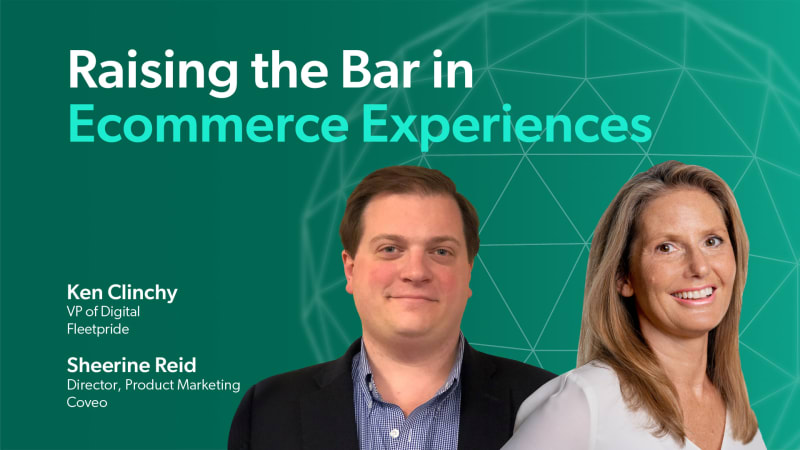
Raising the Bar in Ecommerce Experiences



Make every experience relevant with Coveo
