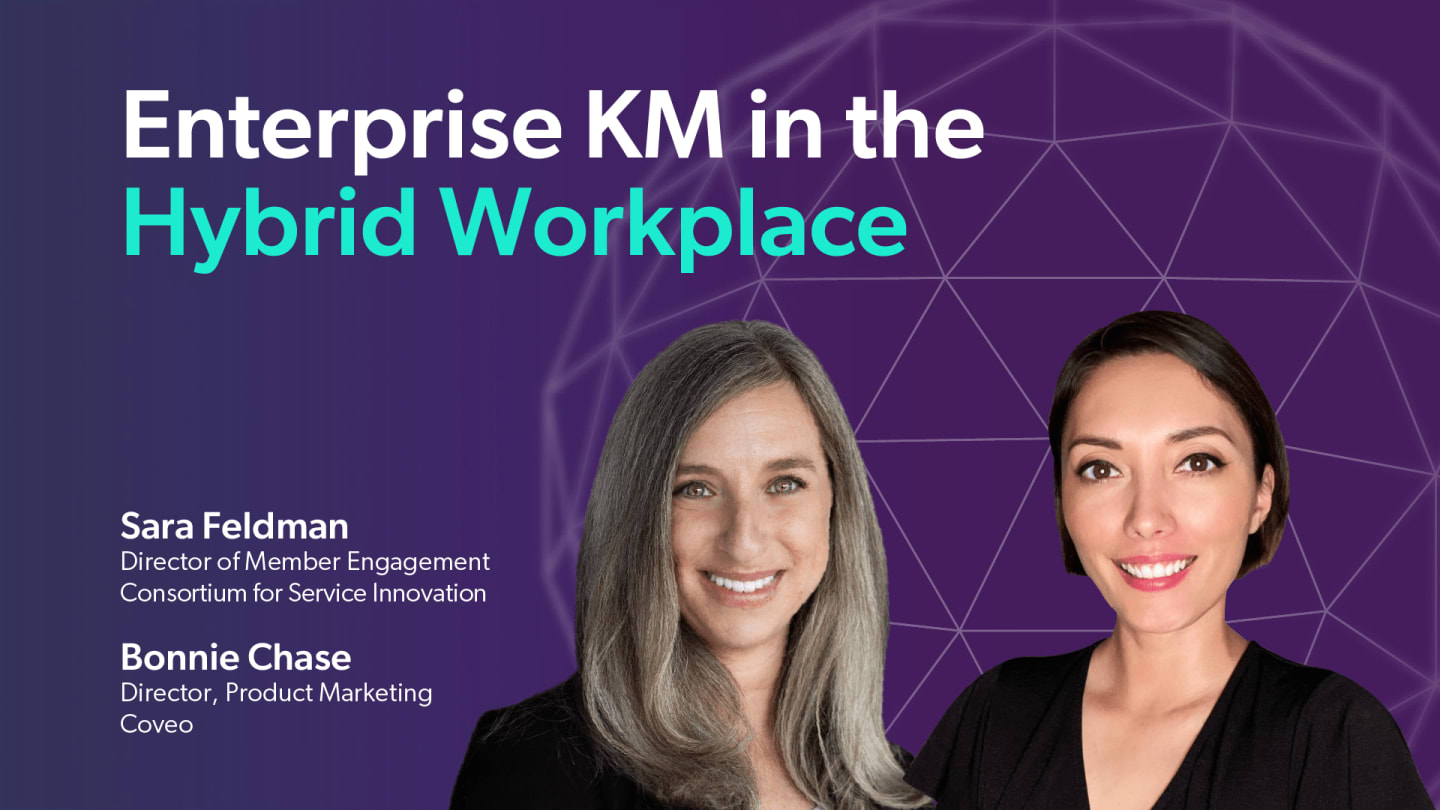
- Hello, everyone, and welcome to the session Enterprise Knowledge Management in the Hybrid Workplace. My name is Bonnie Chase, and I'm excited to be joining you today. Before we get started, let's cover a few housekeeping items. First, we strongly encourage you to ask questions throughout the session. We'll answer them in the Q&A portion at the end of the presentation. But feel free to drop in questions at any time. Please note that there is a chat for the entire event and one for this session, so just be sure that you're using the Chat tab labeled session so that your questions related to this one will get answered. This will also be the same room where our following session in the track will take place. So be sure to stick around for Discover Coveo for Workplace where we'll cover some new capabilities in our workplace solution. So with that, let's get started. Today's session is about enterprise knowledge management. It's a pleasure to be here today joined by Sara Feldman, who is the Director of Customer Engagement at the Consortium for Service Innovation. Sara, thank you so much for joining us. - Hi, Bonnie. Happy to be here. - Awesome. Well, can you tell us a little bit about the Consortium and your role there? - Yeah, of course. So the Consortium for Service Innovation, we're a nonprofit alliance of service and support organizations mostly focused on innovation in customer engagement, productivity, and ultimately customer success, which I think we're all trying to achieve and get better at all the time. Our organization is probably mostly known for developing the methodologies called KCS, Knowledge-Centered Service, which we'll mention today, and intelligent swarming. Those are some collaboration methodologies. But our members innovate and work on all kinds of interesting things around those topics. - Awesome. Yeah. And that's really why I was very excited to have you join us today because you do-- KCS is a knowledge management methodology created by the Consortium. And this is a really key topic for a lot of businesses today. And just to give a little bit of background behind this, we're currently in this hybrid workplace, right? When we look at the stats, 80% of companies plan to allow employees to work remotely at least part of the time after the pandemic. I know I work remotely 100% of the time. There are a lot of businesses who are trying to figure out the best way to meet their employee needs and their customer needs in this kind of hybrid workplace. And I think this is really why it's important to have that really strong knowledge management strategy because there are a lot of challenges with working remotely, especially if you don't have a great knowledge strategy in place. I remember when I first started at Coveo. Onboarding is one of the things that you really-- you get excited about doing when you start at a company. And I had to do that remotely for the first time. And it really highlights how important it is to have knowledge easily accessible. Some other challenges can be not having somebody to go and ask a question to. So if you're following one of your normal processes in your company, and you don't really know the answer of what's next, you really have to figure it out. So you either have to have the knowledge in place where they can answer those questions or you're collaborating online. So there's a lot of different challenges. Curious, Sara, from what you're seeing with the members at the Consortium in those businesses, what other challenges they're seeing as far as when it comes to knowledge in a hybrid workplace? - Yeah, great question. And it's very timely, definitely a challenge. I think one of the interesting ways to think about it is that traditionally, I think in our industry, we've talked so much about customer experience and enabling customers with the information they need. And so much of our work and our strategy is focused on that. And then sometimes-- you were talking about the employee experience, the employee access to knowledge. That sometimes takes a back seat. And I've even seen questions out there on LinkedIn and such like what's more important, focusing on employee experience or customer experience? And the truth is you really need to do both to be able to do both. So the challenge is trying to strike that balance. And I think a lot of our members are finding that when they're focusing more on that employee experience, enabling those employees with the information they need to do their job, that's actually the strongest way to create a better customer experience. - Yeah, absolutely. And really, knowledge is at the core of a lot of these things. It's adoption, it's onboarding, it's proficiency, it's efficiency, being able to do things faster. I think it's important to keep in mind when creating a knowledge management strategy or deploying one in your organization that each employee will have a different perspective of what's important to them or what they need in the context of their work. And this is really why personalization goes beyond customer experience. And it's also necessary for employee experience. I mean, we're all consumers at the end of the day. We all are used to working with personalized technology in our day-to-day lives. So why would it be any different at work? So I think we wanted to get a little interactive with the audience here today. So, Sara, you have a game to play. - Yes. We're going to play a quick game. This whole thing will take probably under a minute, but let's set it up on the next slide. So we want everyone out there to get ready. You're going to be answering a question on your own for 30 seconds. So however you want to take notes, whether that's a notepad on your desktop or a pen and paper, I hope everyone has something ready so that they can type or write some answers for 30 seconds, and then we'll show you the question. I'm going to get my timer ready too. OK, let's just hope everyone's ready. Let's show the question. So in 30 seconds, list as many animals that you can think of with only three letters. And I just started the timer. Bonnie, with these types of questions, do you feel like you're really good at getting a lot out there, or do you clam up under the pressure of 30 seconds? - Oh, I clam up under pressure. Yeah. I'm like, what are animals? I don't know. [LAUGHTER] - Yeah. I wonder how people are doing. We'll see. Typically, people only get just kind of a handful. You think of a couple and then there's that next one on the tip of your tongue and then you can't get to it. OK, that's time's up. So how many did everyone think of? You don't need to list the actual animals, but if you can type into the chat the number of three letter animals that you thought of. How did you do? - I probably would have thought of three. - Three? Yeah, three is common. I think when we've done this with groups before, five is typically the high average, right? Every once in a while, someone will get more than that. But it's, yeah. Single digits. - All right, let's see if we've got any numbers in here. - Any numbers from people? - Yeah, I've got three, nine, eight, six. - Nine? Wow. OK. - Four. Yeah. - All right. Good numbers. OK, let's see the results. So this is how many you could have written. I don't know how many of you felt like you maybe were getting close. I heard that eight and nine number. That's impressive to me. I wouldn't have gotten that many in 30 seconds. So we can see 18 here. Every time we do this with a group, there's always someone that says another one that's not on the slide. So I think the slide expands over time. And then the other thing to think about here is there's animals or there's types of animals or the wild card ones, bull and deer. Those are four letter words with only three different letters. So do those count? Well, maybe, it depends. And so if we think about this like a knowledge base article that employees might be accessing to do their job, if each of these folks had this question independently and tried to come up with the answer independently, or maybe we're referencing an old version of the slide, like I mentioned, they're not having that latest version of the knowledge. But if everyone's looking at something at the same answer, like we are now, then we know that each person is using a more complete answer to the question. Yeah. When we think about-- Yeah? - Yeah. I was just going to say it really kind of-- it shows we all have that different perspective. So I think there were a few who had the same number of answers, but probably not the same animal names, right? - Yeah. And that context we were talking about, those subsets, do these others variations count? Well, depending on the type of information you're looking at. Maybe older versions of your software, these versions-- these things don't work. And in newer versions, they do. And that's all part of again, context. Who's looking at the information, who is the information going to apply to, what is their context. We need all of that captured in a central way with a knowledge management and a knowledge-sharing strategy. - Yeah, absolutely. And I think in thinking about context, there are some ways that we can get there, some ways that we can create those contextual experiences. So really, with the background that context matters, that's at the core. Let's take a look at some of these building blocks that really is necessary to create this kind of relevant digital experience for your employees as well as your customers. - Yeah, absolutely. Of course, this whole process is involved and ongoing and unique absolutely to every organization. But there's some sort of foundational, high-level steps that you can think through align, access, evolve, and reinforce your knowledge-sharing strategy. So let's talk through them. So first, when we talk about alignment, I really think about this kind of in two main ways. There's aligning on the vision of a knowledge management strategy. Why are you doing it, what are the benefits. You want pretty much everyone in your organization involved to understand why you're doing this. Certainly, high level executive buy-in is important to understand. And then the second sort of way you want to align is a reality check, I would call it. You want to align on the current reality of how your organization is using knowledge. You might be doing things a certain way just because, and you haven't gotten around to questioning your assumptions or your current ways. Now is a good time to really dig into that. Back on the vision piece, you want to make sure everyone understands what are those long-term benefits of having a more efficient knowledge-sharing strategy. So employee efficiency just set it there. More interesting work if folks are taking less time to do the repetitive, mundane information seeking work. More time opens up to collaborate and do more interesting things, have better collaboration. And then ultimately, like we touched on earlier, you're going to have a better customer experience if your employees have better access to the current information. - And I like the point that change is necessary because this is one of those things that I think is really difficult. It's really difficult to make change happen if you're not aligned, right? So this is really key as part of that alignment because it's not-- rolling out a knowledge management strategy is not set it and forget it. You have to be aligned across organizations. So we talk a lot about the service organization and how they create knowledge in the flow of their work. But how does that knowledge relate to the product documentation knowledge? How does that relate to our onboarding knowledge? How does that all feed into each organization, add value across the org as a whole? And change management is one of those things that I think often gets overlooked, but it's very critical as part of this strategy. - Yeah. It sounds so basic and foundational, but having folks understand why you're making a change, in my experience, is the number one thing you can do to get them on board. And yeah, you need to know what's really happening. In a previous role, when I was getting started with a knowledge management change plan with them, I created a shared doc. And I just asked them to list all of the sources and the resources you use to answer your questions. Where do you go when you're helping customers to find the answer? Drop it in this doc. And I can't remember the exact number, but I think we had 50 plus different sources. And sure, some of that included external websites. The internal things you expected, a OneNote on my desktop, my notepad, that's a copy and paste of the guy who left the team two years ago. But I loved his suggested responses so I keep them here on my desktop. When I did this last time, I remember one of the things in there was a link to an archive of a previous CRM that they weren't even using anymore. But there was-- they knew how to go find what they needed in case history in that CRM archive. Just think about how many disparate and probably surprising places people go to find information. You want to get a sense of that reality before you start making any change so that you can accommodate that information that they are now finding somewhere else. - Yeah, absolutely. - And so next step, these are very big high level steps. But once you have a sense of what everyone needs and where they're going to get it, you want to try and bring everyone together. So everyone needs access to the same shared knowledge. So I already talked a little bit about taking inventory of what people access, how much of that is stale or dated content. How can you work with the folks who are referencing those other sources to move that knowledge into something central that everyone is looking at together and that kind of won't accidentally get dated because you don't have everyone looking at it at the same information. And then enabling it to be really easy. I think this is really important to call out. It has to be easier to find the information from the central knowledge sources than for them to ping their buddy on Slack. It's just like the path of least resistance. So that means you have to make it easy to search the shared knowledge. - Yeah, absolutely. And one of the things that I always think about is how many times are we slacking somebody, asking them a question that is probably documented somewhere. Have you seen this slide deck? Have you seen-- where do I find this information? Just go to the docs. And so we've kind of conditioned ourselves to ask before we seek. But that's because it's been hard to find information. If information was easier to just find, we didn't have to ask. And so I think that's really the key. From my perspective, being at Coveo, obviously, there's a few different ways that you can approach that access to shared knowledge. And there are a couple of ways that I've seen it. And one is federated search, and one is a unified search. Obviously, Coveo is a unified search. But I think it's important to call out because even as you're trying to unify knowledge across the organization, sometimes it can be very easy to just build your own tool, kind of try to federate things so that you're at least getting results in one place. But if the results aren't good quality and they're not relevant, then people are still going to have a challenge with finding the information that they need. And so I did want to call out some of the differences between a unified versus a federated search. And really, I think at the core, it's that you have one index really that is capturing all of that data and content that needs to be leveraged across the organization. Because if you do a federated experience, you're going to have separate results, separate facets. You're not going to have the machine learning that applies to all of these sources. And it's really going to require a lot of manual optimization. And so when you think about the change management perspective that we had mentioned, what is it going to take to manage one of these versus the other? If you're planning on rolling out a more complex federated experience, then you're going to have to plan for the maintenance of that, going to plan for the tuning of that, and all of the upgrades and things like that. And so really, just when you're thinking about how do you make sure that people actually get the right information that they need, that's where that unified search with machine learning comes in so that it can really optimize all of that content and make it easier for people to find. - Yeah, absolutely. And then once you get past the hurdle of making sure everyone's at least accessing the same shared knowledge-- and of course, you'll do this in phases bit by bit. You're not going to get all the old repositories transferred or updated at the same time. But as you go, then really the next level of a mature knowledge program is making sure that that knowledge can evolve. And knowledge evolves constantly. You want to make sure that your captured knowledge, the resources you have evolve along with it because we knowledge isn't static. So this really means enabling your employees to directly contribute to that shared knowledge. I mentioned earlier KCS, knowledge-centered service. That's a methodology that many organizations have found to be very useful for enabling and coaching employees, knowledge workers we call them, to contribute directly to shared knowledge. Lots of success in support and service organizations, but we've seen it in sales, customer success, HR. I mean, anywhere where you have employees interacting with knowledge that's evolving. So maybe anywhere in your organization, there's a way to directly enable your folks to evolve that knowledge as they work with it. And this ties into employee motivation. We were talking about that employee experience at the beginning. Employee experience, yes it's that sort of are they happy? Do they have the benefits they like and all of that? But do they have the tools and resources they need to do their work and be motivated to do their work? And a lot of research goes into behind motivation, what motivates folks. And it's autonomy, mastery, and purpose Daniel Pink talks about. And actually, enabling your folks to directly contribute to knowledge is a way for them to feel more ownership and independence in doing their job successfully and ties right back to motivation. - On that note, having employees directly contribute to knowledge, I can just imagine some people saying I don't like to write this. I don't have time to create knowledge. How do you actually encourage them to take that step and actually contribute? - Yeah, you read my mind there. So important to call that out. It's a very common sort of first reaction again, because people don't like change. And two things here. One, we often say, well, it's not more work. It's just a shift in how you're doing work. But I would say it's not even that much of a shift. Back when we used to be in person, you're walking down the hall and asking someone a question or in a meeting or now slacking or whatever you're messaging service is, you're taking the time to talk to each other questions, write out answers, find resources. Well, just put that in a [AUDIO OUT] instead of in a one-on-one Slack message. It's kind of as simple as that. They're already doing it is my point. You just have to point out that it's the same behavior. We're just doing it in a more collaborative, strategic way. It's not more work. - Yeah. And that's a good point. And I think once you actually start referencing content that you've created, and you're like, oh, I'm actually using it. This is very helpful. - Yep, yep, yeah. Yeah a lot of celebrating and highlighting the way that the shared knowledge is useful. We'll talk about this a little bit more, I think, in the next phase as well. But you want to continue to like-- you want to give people that positive reinforcement, right? A lot of these things that you hear again and again, you hear them because they're true. And we are human, after all. - Yeah, absolutely. Now, one of the things that you talk about from a KCS perspective is there's a solve and evolve loop. So there's that capture and creation of content. But then there's also this phase of improving it and making sure that it's optimized the best, it's relevant, it's still valuable. Is that part of this evolve building block, would you say? - Yeah, I think that's a great call out. So we're not talking about KCS methodology specifically in these four building blocks. But in the evolve stage in KCS, there is a whole second loop called the evolve loop where you are constantly maturing the knowledge. You're going back in a reactive or a retrospective way to make sure that the knowledge is being used, looking at who's using it, and how tying the use of that knowledge to customer success metrics. How is what knowledge helping customers achieve what they're trying to do so that you can then tie that back into improving your customer experience, self-service, things like that. - Yep. And you have knowledge analytics here. So what kinds of things are key to look at, at least from an employee experience when it comes to analytics? - So looking at what knowledge is accessed most often can be a really great place to start to see what are those topics. My favorite way to use that knowledge is what are those topics and how can we ultimately funnel that back to product improvement. That's the biggest win for everyone involved. Is any of this knowledge covering things that actually if we adjusted our services or our product or our onboarding, that folks wouldn't even need to be seeking out this knowledge in the first place because they already know it. It's baked into what we do. - Yeah, yeah. And I think that's important. I mean, we're creating this environment of knowledge within the organization. We need to make it accessible. It needs to evolve with us, especially as our needs begin to change. Again, it's within the context of each individual. And so there will be changes in what people are accessing, what they find valuable, and how you should be optimizing your content moving forward. This is one of the things that I definitely look at from an analytics perspective. You can really get in depth knowledge about your employees. And it's not just about what content they're needing, but where they're having those pain points. As you mentioned, maybe you're getting a high incident volume for new employees, and it's because you don't necessarily have the right onboarding content, or maybe you need to change something in the product to make it easier. You can really see what employees care about, where they're really engaging and finding information, how they're using information, and really what's important to them. So here in this example, we have a lot of employees who are curious about tuition reimbursement. So here, we know that our employees care about their education. And that's something that's really important to them. So if I'm in HR and I'm trying to create that good employee experience, that's something I'm going to want to know that I may not necessarily get from a survey. Those are things that come from the searches. And just as in the customer experience, the search can be an opportunity to hear the voice of the customer. And it's a good opportunity to hear the voice of the employee because they may not necessarily come to you directly and say, I care about-- I want to continue my education, but they might go in and search to get more information about how to do that. All right. So the next building block is reinforce. - Reinforce. So we've been kind of touching on this the whole time, that there is no set it and forget it with anything particularly knowledge management. You have to constantly reinforce, look at how things are going. Talk to the employees about how it's working for them, what are the pain points? Do they miss their old repositories? Are they secretly still looking at old things that maybe they shouldn't? That's OK. Judgment free zone. Like, let's just at least talk about it. Think about some reward and recognition programs. How are you really recognizing the way that a more mature knowledge management strategy is helping your employees and your customers? Talk about it. Tell stories about the painful before and the better after. That really goes a long way in helping folks want to get on board. We mentioned this. This was on a slide earlier, but looking at your metrics. So building into-- building this new behavior into your goals. Now, you want to be careful that you're rewarding the right type of behavior. You don't want to encourage people to gamify the wrong activity. But how can you build the outcomes, the positive outcomes of a knowledge sharing culture into individual goals. How can you connect this effort to your existing company values, which is ideas and concepts that everyone should already be bought into. How can you incorporate KCS principles into your everyday language of trusting your employees and making sure that they understand the big picture, and that they're contributing value to the organization and customers while they work. - Yeah, absolutely. I do like that idea of building it into goals, especially if you are a goal-driven company. And I think sometimes you can think, well, I have to get XYZ done. I don't have time to create content. But if content is a part of getting the XYZ done, then you don't have that excuse that, oh, I don't have time for that. Because it's built in to what you're doing already, which I think, that does tie quite nicely to the KCS principles, which is really about creating that knowledge and the flow of your work, not as an afterthought. - Yeah. And as you go back and continue to reinforce these ideas, as we say here, you have to look at people, process, and technology. And you're going to constantly go back to all three of those things and think, well, how can we tweak? What's the next level? What's the next way we can improve a little bit further? - Yeah. So let's talk about-- so you've laid out the four building blocks. But really, if I were going to pull it together and summarize next steps or what can you take away from this, can you talk through those best practices? - Yeah. I think with keeping those building blocks in mind, it sounds big. We just talked through a lot of change in a few minutes. But you want to start small. I mentioned my support team example. Pick one team. Pick the product engineering team or sales engineers. Maybe pick two. At a previous role, we started to work with both sales engineers and support actually to try and bring their shared knowledge more together first because we realized that they had such a strong overlap in the subject matter. But they'd been working for years with completely separate processes and repositories. But if you actually thought about the subject matter, sales engineers were helping prospects figure out how to make the tool work for them. Well, that's what support was doing. So try to find some connections, some strong connections that you can start with. In that case, when we started to do that with just a couple teams, it built interest in the organization. So then more folks said, wait, I hear about this thing you're doing. I want-- I want to get involved. And so you want to capitalize on that momentum. These things can be in conflict a little bit, the whole start small but capitalize a momentum. It's a little bit of a juggling act at time or tweaking as you go, which is you make your plan, and you want to do a little bit at a time. But then if you do see folks ready to get on board, get out of their way. What's the simplest, quickest way that you can get them enabled in the next step to keep going? And so it's not a linear thing. It's kind of loopy where you help folks-- some folks get more involved, and then you go back and bring some other folks along. Or maybe your processes are there, but your technology isn't. But you plan for next quarter to do the technology side of things, that kind of way. - Yeah, yeah. And just as an example, one of our customers, Jacobs Engineering, they actually started to do this knowledge management strategy in their sales team. And they found a lot of success in getting great results with their sales team. The sales team is very happy about having that improved access to knowledge. But that's exactly what they did. They started with that one area and built it out until they saw success. And even at Coveo, we're currently trying to roll out our own internal knowledge management practices. So we have-- we're starting with our customer success team. So obviously, our support team already follows it, but we're now rolling it out to success and seeing how we can continue to capitalize on that knowledge there. And then-- - I mean, you have to revisit all the phases. But the alignment phase that we talked about at the beginning, it's just a thing that-- make a monthly reminder to yourself to go back and look at some things and say, are we communicating the why? Are we aligned on what really is happening? Do I have champions in these different teams that I have a good working relationship, where they're telling me what's really happening in terms of our folks embracing this and constantly realign? - Yeah, absolutely. All right. So really, the four building blocks that we talked about, if I can just bring it back and wrap it up, access-- no, first one is align. So we align within the organization, making sure that we have the same goals, objectives. We know what we're doing, why we're doing it. Then we have access. So making sure that people have access to the knowledge that they need when and where they need it. And it's knowledge that's relevant to them in context of their work. We have evolve, which is really about continuing to evolve, not just your knowledge, but also the way that you're rolling out this experience. So evolving as you go, making sure that you're continuing to build value and meet those needs. And then finally, reinforce. And so really making sure that we're reinforcing the best practices. We're making sure that we're continuing to reward people for participating and contributing and continuing to make those changes. Anything else you would add to wrap up there? - I don't think so. You summarized it so perfectly. Great. Well, I think it's time for us to get to some questions. I do want to take a few minutes to answer some questions. The first question. For organizations that are concerned with security when it comes to knowledge sharing in a remote world, how does personalization support security efforts surrounding remote knowledge sharing? That's a great question. I think I can answer from a Coveo perspective, which is finding a tool that really respects those permissions. So one that can tap into your organization and know what you're allowed to see, what you're not allowed to see, maybe based on your role, maybe based on whatever setup that you have specifically in that organization. And then that tool should be able to pick up on that data and really provide answers based on the security that's already defined. - Yeah. Absolutely. - Would you add anything to that, Sara? - Just pointing back to one of the KCS principles, which is trust. I understand that there are laws and regulations in place for certain security best practices, and that absolutely should be respected. But also see if you can trust your employees to do the right thing. If there's not a real legal reason to prevent your employees from seeing something, you're better off letting more folks see more things because it contributes to the overall knowledge sharing strategy in a better way. And trust that they will do the right thing with that information. - Oh, that's great. OK, another question. You mentioned you don't want to reward on the wrong things. What's an example? - Yeah, great question. So the most common example we see of this is rewarding activities instead of outcomes. So in KCS methodology, for example, knowledge creation, article creation. Some folks will say, OK, if you create 10 new articles a week or a day or whatever or edit 10 new articles or 10 existing articles per week, if you reward based on that type of activity, you're actually encouraging folks to just kind of capture junk knowledge because everyone likes to win. Who wouldn't want to win the prize for editing 10 or creating 10 new things. So that's the most common example we like to give of that can encourage the wrong kind of behavior. - Yeah, that's a good one. OK, let's see here. How does AI contribute to the evolution of knowledge maturity? That's a great question. I'll try to answer that. And hopefully, I'm kind of answering from the-- answering the right way that you're asking. So obviously, there's a bunch of different ways that AI can be applied. So it really depends on the use case that you're deploying it. And so from a knowledge evolution perspective, I would say there are a couple of different ways. One is understanding what people are searching for in the context of that user. So based on what this user type is. So let's just give an example of, Sara, let's say that you're a marketing person. AI can understand that and say, OK, you're in marketing. You're going to care about these things. And I'm going to make sure that your results are optimized to you based on your role so that you have the information that you need. So that's one way AI applied in search can really help with that automatic relevance tuning. So making sure that your results are always optimized. So those are a couple of different ways. Obviously, AI can help with capturing those analytics and evolving the content based on those analytics. So I would say there are several different ways. It really just depends on the use case in which you're wanting to use AI. So whenever we get these questions about AI as a general thing, I do like to point back to the use case and just make sure that you understand the use case and what you're really trying to achieve with AI, not just trying to deploy AI for the sake of it. OK, another question. Actually, this is another one about rewards. So how do you measure the behavior you want to reward if it isn't account? - So it's outcome based. So how-- great one for KCS we like to look at is self-service. So if you look back at what we talked about enabling employees to-- and by the way, I just want to say when I'm talking about self-service and customers, it's easy to just picture external customers. But Bonnie, you gave the HR example, which is fine too. It applies, right? HR is the support and employees are the customers of HR. So same relationship, same idea. How are folks able to self-serve versus reach out and ask for help. So if your employees are able to capture knowledge and evolve the knowledge and make that knowledge available to customers through a knowledge base or through whatever your self-service delivery mechanisms are, the more that folks are able to find and use those answers, the better. If you're having less individual interactions come through, folks are becoming more self-sufficient. Another pattern we like to look at is new versus known. So again, how often are we repeating the same questions doing redundant work and redundant effort. If our knowledge management strategy is working well, folks are self-serving on that. And then maybe the volume of inquiries we're getting hasn't gone down, but is the nature of those inquiries more different than it used to be. That's a sign that your self-service program is working. - Yeah. And just another example, bringing it back to that sales example that I gave earlier. Maybe you want to drive more engagement from your sales team with the content that you have. You want to make sure that you're creating the most valuable assets for them to help them move down their sales pipeline. Well, in that case, maybe instead of saying, I'm going to create five new assets for the sales team, maybe you say this is going to be used by x number of people or it's going to help influence x number of opportunities. And so in that example, maybe you're going in and saying, OK, well, this has been viewed by the sales team 500 times in the last week. I think it's pretty valuable asset to create. So those are some different ways of looking at how you can track the progress of the content that you're creating beyond just the number of assets. - Exactly. - All right. So we have a couple of minutes left. So I think I'll just go ahead and close this out. Thank you so much for joining us today. And, Sara, thank you for joining. This was a great session, and really appreciate you taking the time to share these building blocks on knowledge management strategy. - Absolutely. I had fun. - All right.