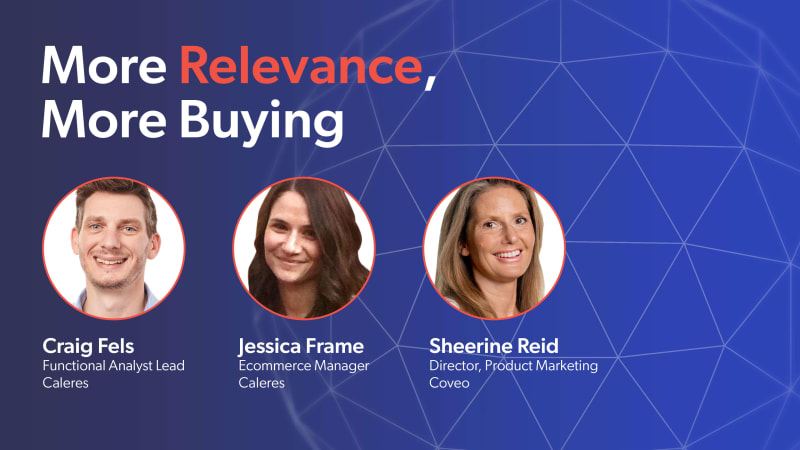
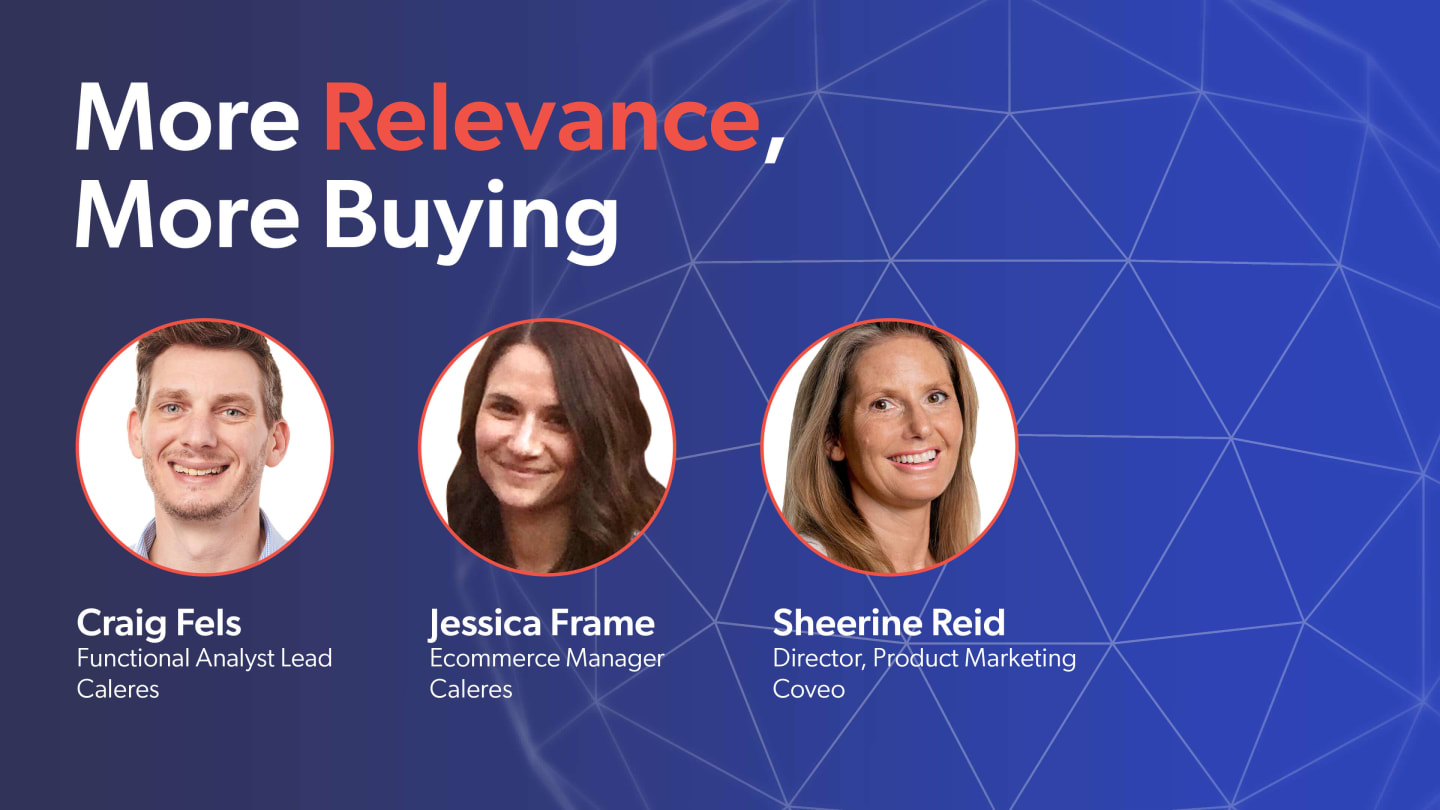
Hello, everyone, and welcome to our ecommerce track. So my name is Shereen Reed. I'm part of the product marketing team here at Coveo. And hopefully, you all had a chance to attend our main stage session, and we're really inspired by the amazing speaker lineup we had there. So our job here is to keep the relevance inspiration going with this session, and it is appropriately entitled more relevance, more buying. So to help us do that today, I'd like to welcome two speakers from our customer, Calaris, Craig Fels and Jessica Frame. So Craig is a functional analyst lead at Kilaris, and he has over twenty years of experience in infrastructure, ecommerce, and project management. He works, very closely with the teams building content as well as front end and back end developers as well as DevOps. Whereas Jessica is an ecommerce manager at Clarus, and she has over ten years of marketing and ecommerce experience. She's worked on learning and development design and web merchandising, and she's currently serving as a consumer experience manager responsible for the revenue performance of the Clarus online stores. So welcome, both Craig and Jessica. Really happy you could join us today for this session. And we also have, last but not least, our rock star a lead solution architect from Coveo, Vincent Bernard. And he will be hosting the the discussion today, and he's also gonna walk you through some of the new, feature highlights. So with those introductions, we will get started momentarily. Just wanted to let you know, before we do that if you have any questions for our speakers today, you can simply write them in or pop them into the q and a sidebar. The stage one, I was told to remind you, it's the stage q and a sidebar. And we will try and leave a few minutes at the end to respond to some of those questions. Alright. So just to set the scene a little bit for our discussion today, I wanted to ground us just in a few data points. And if you at the main session presentation, you heard Louis mentioned that Coveo conducted recent we hired a firm to conduct a survey that we recently published. And if you want, the information is available, you can download it on our site. Included about two thousand participants, and we invited to share also their thoughts about their online shopping experiences. Incredibly, what we found, and you see the number up here, is that ninety percent of those surveyed said that they expect their online shopping experience to be equal to or even better than the in store experience. So if we pause there for a moment and we think about that, it the bar is set quite high. And in reality, though, some companies are able to meet those expectations, but many others we know are still struggling to catch up. And we definitely know this is true because in that same survey, fifty percent of those same people said that they experienced problems when online shopping. So what is frustrating shoppers? Well, at the heart of the issue is that forty seven percent are having difficulty with website search still, basic functionality, forty three percent around navigation, and another forty two percent expressed finding information as being an issue. So, typically, information related to the products that they're trying to purchase. And then, of course, what that leads to on the retails retailer side or brand manufacturer side is low lower conversion rates, shopping carts that could be abandoned, and typically lower average order values. So definitely you can see by these results that there's a search problem. But at Coveo, really, we feel the core of what of what the issues are all related to relevance. So there's a relevance problem. And what do we mean we mean necessarily by an ecommerce relevance? Well, ecommerce relevance is truly about allowing a shopper to find what they need at the time that they need it, and then giving them all the information that they need around that to be confident in the purchase that they're making. So you wanna remove as much friction as possible from the process. When you think typically of an in store, or traditional in store shopping experience, You might walk into a store and be greeted by a sales associate who knows the layout of the store. Maybe they're familiar with the inventory in stock. And a lot of times in some specialized retailers, the sales associate can even provide some expert advice to you. Right? So I know for our family, we became first time puppy owners a little while back, and we went to our local pet store to make some purchases. And when we did that, we relied really heavily on the sales associate to lead us in the right direction and give us advice as to what we should be purchasing and what was best for our puppy. So when you think of creating that same or an amazing online experience, you almost have to replicate that interaction, and it's not very easy to deliver. Typically, it requires, you know, combination of intuitive search, navigation. You want personalized results, recommendations. And then sometimes you also need to couple that with the right kind of expert content so you can really guide the purchaser and and what they're doing in a digital framework. So with that intro, I'm super excited to pass it over to Vincent, Craig, and Jessica because they've been battling this, themselves in the trenches. And, they went on a digital transformation the last few years, and they're going to, tell you more about that. Over to you, Veysa. Thanks, Sherry. Thanks. And, I I think the best way to illustrate the relevant stories is with I'm really happy to be today here with Craig and Jessica from Caleras. We've been so hard on that project, so I think it's great that we can talk about today. If we move on the next slide, we'll see actually all the different brands of Kallaris. The story started a few years ago when we did a POC for a company on my end. It was Kallaris multi brand. We were not completely aware of the whole setup. So what we can see here is the portfolio. And, Jess, you are ecommerce manager at Caleras. So can you help us understand what is the setup here? What's the situation at Calaris? Absolutely. So I'm willing to bet that many of you have probably never heard of Calaris, and that's okay. Calaris isn't a consumer facing brand at all. It's definitely not a household name. But, hopefully, some of our brands are, and, hopefully, some of those brands are maybe even sitting in your closet. So Calaris is a two point eight billion dollar portfolio company. We operate in the footwear space with the majority of our brands being in the women's shoe space, with the exception of Allen Edmonds, which is our men's brand. Our portfolio consists of fifteen brands. Our largest division with probably the most brand recognition is Famous Footwear. So with Famous, we operate a large brick and mortar presence in both the US and Canada as well as our digital storefronts, famous footwear dot com and famous footwear dot c a. And then the balance of our brands, are diverse, and they span a lot of different lifestyles, including fashion and comfort. And our brands are sold at wholesale. So thinking about that, we sell our shoes to retailers such as DSW, Nordstrom, and then they, in turn, sell our product in their own physical store locations or on their digital properties. And then we also have our own branded ecommerce sites, and that's really close to my heart. I work on a subset of these brands, managing our d two c sites. Brands like Sam Edelman, Naturalizer, Doctor. Scholl shoes, Ryka are just some of the brands you see on this slide. And though we have a really diverse portfolio of brands, each with their own segments and markets and messaging, really, the core of what we are doing remains the same for all of them. We are here to really deliver on the best consumer experience for all of our brands. We want to delight our consumers. We wanna impress them and really build those relationships so that they remember us the next time they're looking to buy shoes, and they continue to come back and buy from our brands. Thank you. I think it's a it's a really interesting portfolio, really interesting company. So we think this business context, and we're gonna lay on top of it actually some business needs. So I wanna introduce here Craig Fels, who's lead functional analyst, but also my main partner in crime for the last two years for deploying all of that that we see here. So, Craig, can you tell us about the challenges you were facing back in the days when we started that whole journey of digital transformation? Hey. Thank thank you. Yes. Sure. We were doing a replatform. So it wasn't just Coveo, but we were retiring a legacy platform for our ecommerce, sites. So we needed to solve some some issues, faster launch of integrations and updates. We had, manual rules with no machine learning at all. And, another example would be, we had we have this large and complex catalog that we really had to, solve some some problems for. So in so while during this platform, this replatform, we partnered with, Coveo in Sitecore, and we really wanted to tackle these issues directly. Cool. So we have all these objectives here. We have the business context. I wanna talk a little bit about the timeline of the project because it's not an easy task to deploy, like, fifteen brands, one after the other. So I remember that we had in mind something like having groups of brands to deploy together and kind of a progressive deployment strategy. Jess, again, can you just walk us through what happened here, in the past two years? Sure. So if we take a look at this slide, this just shows the sequence of our thirteen sites, going live on new platform. And when we think about how we sequence these brands and chose what order they went in, we have to really go back to almost three or four years ago when we were migrating to, say, core CMS. So with that migration, we actually started with our largest site, Famous Footwear. Famous is obviously our largest and most complex, and we kind of worked backwards to some of our more simpler sites. And we learned a lot from that project. And one of the key takeaways that we kind of run with and the philosophy behind our replatform project was definitely start with our simpler sites first. So the first three sites you see in October twenty nineteen were Beezy's Franco, and Circus by Sam Edelman. These three sites have a lot in common. They are our simpler sites in terms of features and functionality. Functionality. They have a smaller robotic assortment, so we were really dealing with a a smaller catalog. They also are single gender and single category, so we are only focusing on women's shoes. We didn't have to worry about apparel or accessories. That would all come later with some of our other brands. And, really, this approach gave us the ability to really have a narrower focus, and kind of find our feet as we got introduced to a new platform, a new way of working, and it really worked well. After our first three sites went live, we took a little bit of a break as not to disrupt a high volume holiday time, and we came back in February of twenty twenty, and we launched our next group of sites. Very similar to our first group of sites, these are single gender, single category women's shoes brands. The only difference being that they have a little bit larger product catalog, so a little bit more skews to consider. And a good call out here is Zodiac was actually a brand new site. So we weren't migrating over from our legacy platform. We were actually standing up a completely new site, and we were able to leverage a lot of the learnings, and the foundation we had built from the first grouping of sites to really roll out this site, relatively easy in a short period of time. And then after the second grouping of sites is where we start to move into more of our feature rich and complex sites. So soon following was doctor Scholl's. This was our first multigender site. So we introduced kids' shoes, men's shoes, which is a whole different dynamic that we had to work through. It was also the first site which introduced some brand extensions, so different, brands living on one site, which would be a good precursor to what we would get into with Famous Footwear down the road, and then moved into more of our feature rich sites. Sam Edelman, Naturalizer, Famous, they all have an omnipresent, so we had to consider store inventory. Sam Edelman and Naturalizer ship internationally, so it was different integrations with some of our shipping partners. And this all led up to Famo dot us' go live in January of twenty twenty one. Obviously, our largest site in the portfolio and our most feature rich. So with Famo dot us comes a lot of complexities. So we had to consider, you know, Famous is a brand of brands. They have a lot of brands. They also have an extensive product catalog to consider. They have features such as buy online, pick up in store, and store inventory to consider, as well as a really robust loyalty program and a complex promotional engine. So aside from sheer volume, just a lot of nuances with that, and we felt really good with this approach. And last but not least, we have Canadian sites that inter, are considered our international sites. So that is Naturalizer CA and Famous CA, which just adds another layer of complexity in terms of a dual language, both English and French. And I would say, you know, the sequencing of the sites and how we broke them up and taking more of that iterative, approach is really what led to the success and our ability to really roll out thirteen sites in a relatively short window of time considering how large some of them are and just all of the different moving pieces. I think it's a it's a great story we got there. And, I I'm super happy to announce that actually the last site to went live, the last go live happened yesterday with Famous, Canada. So we now have the complete portfolio that the the story we had in our head two years ago is now complete finally. So I think it's it's a wonderful story, and congratulations to you both, for that. Before, so we have all these brands live now, and we have a lot of improvements that are directly visible on the site. But then, Craig, can you tell us a little bit about, what improved now that we have that new generation of experience available for all the different brands out there? Sure. We refer to this replatforming as our, world class storytelling project or experience based commerce project. We want we want to be able to provide our, business units, the content authors, the merchandisers, with the empower the ability to make changes to the site. So that first bullet there, business empowerment of sites, they're able to push out content whenever they need to. They're able to change merchandising rules. They're able to affect change on our search platform, Coveo. They can use ranking expressions and, query filters and and just really make that site do what they need it to do. That's the merchandising flexibility. They'll, boost or bury using rank ranking expressions based on flags in the data that we send. We also have the, immersive brand storefronts. So we have thirteen sites that went live. It's super exciting. And, yes, you you got to announce what we weren't able to put on that slide when the slide was due. That famous CA went live yesterday morning. So that really brings us to, to really it's not the end of the project. It's it's really the beginning where we get to just launch from here and go forward and make make things even even better. Leverage that machine those machine learning models that you have given us. Leverage the storytelling the ability for storytelling at the content level. And then that last that last bullet, personalization at scale. Of course, we heard about personalization in the, introduction, the keynote, here today. We need to use personalization more. Personalization across that those machine learning models, personalization across the content that we're serving up because it's expected at this point. We can't just serve up the same pages, the same content to every customer that comes to the site. I think, it's super interesting. And as you know, the next steps for for all of us is to deploy all the new feature and came up with new ideas from business needs that you guys have that we can materialize in the platform to to leverage directly on the experience, after. So I think what we see here is a bunch of new things that we can do with the website. I think we can walk through some of the features on the front end. We have a really complete demo at the end of session that will go through Google Cloud and also the websites. But right now, I want to hear you talk about everything that we see on the UI and all the cool features, and I think we're gonna use Famous Footwear as an example. So on the next slide, you can see different features. And, Craig, again, and, Jess, if you wanna jump in, just feel free to describe what we have as an experience today with, our search UI here. Sure. I'll get started. So this is this is Famous Footwear, and we have these areas that have been, boxed. So let's talk about each one of these. The first is that search box. This is what everyone uses, to probably get started on on finding something when they have a specific need in mind. So they'll type something in, and what you see here is query suggestions. Again, this is coming from the models, the machine learning models that Coveo has built, and they're tuning the those models based on page views. What are customers searching for? What are what pages have they viewed? What products have they purchased? All of that feeds into the machine learning model. So we get really relevant query suggestions here as opposed to what type ahead search was on our old platform, which was really just fuzzy logic, wildcard searching against a table full of terms. It there was no machine learning there. It was just trying to match what you've typed starting at three or four letters and show up something that matches that. This is real data. This is these are real suggestions coming from real data. The next box over to the left, it's it's the find a store. So we use Coveo to not just search products, but also search our store locations. Famous Footwear has about a thousand locations. We send all of the all of that information to Coveo along with the products that are available in those stores. So we can leverage KaVao's pipelines for searching for stores and searching for products within those stores. So you click that find a store, and we are going to auto we're going to, send your send your location to Coveo. It's gonna come back with a list of stores. You get to set that that store using the store locator. That, wanted today facet is our store facet. Again, we're we're pulling back the stores that are closest to you based on distance, and we're allowing you to filter the results set based on the store that you have selected. And then, the size facet is is is boxed out here. So we have a pretty complex catalog. We have a product that is the color of a shoe. We like to talk about Chuck Taylors because everyone knows them. So, a white Chuck Taylor is a sellable item. A white Chuck Taylor in a size seven medium is a variant of that item. And then, of course, we need to know where that size and width is store is is available. It's available online, of course. You're on our website, but there'll be a new feature coming soon. So it's online in store. It's on it's online on the it's in stock in store and online, and we have to roll all of that together and filter down to what, what's available in the store that you have selected. So the size with product and store, it all came together in the commerce catalog. That that feature that I said is coming soon, of course, you're shopping online, but we are going to have we have some products that are available in store only. And in a future code release, we will be querying against Caveo to show you items that are only available in store. So you'll be able to select that store. There'll be a flag that says this is in store only, and you'll know that when you get to that store, it'll be, available for you. Good. Before jumping on the demo, actually, I I'm really happy to see here all the features. So we talked about the business. We talked about the requirements. We see here what we have. We can see another cool example here of Famous. But then, before jumping at the end of this presentation with demo and a technical question, I wanna make sure we talk about, lessons learned actually and results. So results first. With all that being live now and we see user traffic and transactions on that new platform, what happened from a business side? Do we have anything to discuss regarding your results? And I think, Jess, you can, speak a little bit about what you see on your end. Sure thing. So, obviously, lots of exciting stuff. I think it's an important call out just to mention for Coveo. We're not just using it to power recommendations and on-site search, but it's really powering all of our category PLP pages. So that's really a powerful tool, that's reaching a large percentage of our users. So let's talk about the numbers because that's what we're all excited about. So in terms of the impact we're seeing with Coveo, right out of the gate, we're seeing increases in conversion rates for our on-site search users. On the brands that I manage, which is a subset of the portfolio, we typically see anywhere between ten percent and twenty percent of our users actually engaging with on-site search. And we know that that is super important because if someone's engaging with search, there's intent there. They really know what they want, and they're on their way to path to purchase. So for us, making sure that we're serving up relevant results is super important. And we're seeing that with Coveo. We are seeing conversion rate lifts associated with those users using search, well above what we were seeing on legacy platform. The conversion rate for those users that are using search compared to those who aren't is about a twenty to twenty five percent lift. So really exciting to see that things are working. And we're continuing to work with our Coveo partners on optimizations to increase efficiencies and continuing to make sure that our users are being served up with the most relevant results. We're also seeing more performant results powered by machine learning versus just manual ranking expressions. So as Craig mentioned, we came from a legacy platform where machine learning just wasn't a thing. It wasn't something we were used to. Platform where machine learning just wasn't a thing. It wasn't something we were used to. It's really brand new to us. So most of our states either went with a generic, out of the box, you know, out of the box, you know, sorting and ranking that was on every one of our pages on legacy, or merchandiser merchandising teams would literally rank every single product on a site in order to get the results that they wanted. So with Coveo, it's really been powerful that we can leverage machine learning, specifically automatic relevance tuning to power our results pages. And on the brands that I support, we've recently started to test these ML models, in our pipelines against some of those manual rules to make sure that anything that we've added to our pipelines makes sense, and is having a positive impact. Just in the last few weeks, we've been testing, you know, pipelines plans that have a lot of manual rules associated with them. And a lot of times that comes from subjective viewpoints of what we think should be boosted or what we think should be deboosted. And we're seeing great results there. We're actually seeing increases in all of our key metrics on the pipeline powered by ML. We're seeing a thirteen percent increase in click through rate on average. We're seeing an in, we're seeing the average click rank actually lower, and all that is leading to increases in conversion. In the last test I ran a few weeks ago, that looked like a twenty three percent increase in conversion. So all really positive and moving in the right direction. And we're also really excited just about the engagement we're seeing with, our facets. So on our category pages, obviously, facets are super important. Each of our web stores has the ability to really control and influence which facets they show on a category page or a search page, and it really allows us the flexibility to own the experience, you know, the business enablement piece that Craig really talked about. So on our sites, anything from anywhere from thirty five to fifty percent of our users engage with, a facet during their session. And we're seeing great results in terms of that engagement and what that is leading to from a conversion rate lift. So, typically, users that engage with a facet have anywhere from, a fifty to sixty percent lift in conversion. So all good numbers, all positive numbers, and things that we're really excited about. And like I mentioned before, this is just kind of the first step Now that we've completed all thirteen of our thirteen sites migrated to the new platform, now we move into the really exciting phase of, you know, optimizing and figure out ways to continue to improve the experience for our consumers. That that was great. And, actually, you're right. Now that we don't need to deploy a new, website, we can really focus on optimizing. And I wanna shout out here, actually, really a big thank you to the solution architect and CSM team on the Cognito side that are really, relentlessly, helping Caleras to go through that process of optimization. So now without, further ado, lessons learned. What do we learn during that that whole process that took almost two year? I'll start it on my end. What I realized is that shoes are complicated. It it it sounds like a joke, but seriously, you have these product models that are available in products of a variety of color with sizes and width, and then each one of them can be or not in stores. I thought I was only indexing shoes, and soon we realized that it was extremely complex. But then, yeah, challenge accepted. And to be honest, most of the challenges, the largest one that we had in the past years were coming from from Galera. So it was a challenging but but successful story at the end. That's it on my end. Craig, on the technical side, what have you learned? I think you're muted. Sorry for that. So as Jess said, as Jess said that, during that rollout, we, we learned during our CMS project that we can't start large and then go small. We had to start small and and and simple and then expand out from there. So, that was that was really important. We couldn't just launch a site with with buy online pickup in store or curbside pickup. And, Vincent, as as you've as you've mentioned mentioned to me before, some of those pieces on the Coveo side weren't ready, so we sort of worked together to build that. So that was that was really great. The relationship was wonderful. Aside from that, we, we really wanted to leverage those built those prebuilt SXA renderings. Since we are on-site core SXA using Coveo, we were able to get out of the box renderings, and it really allowed us to start simple, easy. We didn't have to build new facets. We didn't have to build the result templates. We didn't have to build any of that to get started. So that was that was great. But during the time between Beezy's, Franco, and Circus going live in October of twenty nineteen to getting Naturalizer and Famous launched, we did have to we did have to learn how to build a few things, store locator renderings, that that sort of thing. We had to learn about using distance functions and passing in lat law lat latitude and longitude to get that, those facets to work. But, really, the team has been great to work with, and, the lessons we learned have just been really making our platform stronger. So it's been it's been really nice. Jess, on your side, on the merchandising side, what happened? Because I know that it's quite a transformation in terms of how you guys worked and the tools that you have access to. So anything to see here? Yeah. Just to build off what Craig said, it really starts with the whole philosophy of this project was, you know, starting simple to more complex, and it's also about incremental change. And that was really our approach. So, you know, you have to kind of shed that those thoughts of we're gonna have everything, and we're gonna have it right at the beginning. You know, you have to start, you know, with stuff being small and starting simple and kind of working your way up. I work on a few of the sites that were part of the first launch in October twenty nineteen. And to think back to where we started with those sites in just over the last year and a half of all the small changes and optimizations we have been able to make, and that's by virtue of just being in the tool more, and learning more about it day in and day out and just our strong partnerships with the Coveo team. It's also about shedding some of those, you know, legacy habits, I call them. So we talked a lot about how on legacy, we didn't have machine learning. We didn't we had a lot of manual rules. So for us, it was really embracing machine learning and everything that comes with that. And, really, that all kind of builds into this. Not only was this a digital transformation and us, you know, bringing in new tools and solutions, but, really, that's leading to a cultural transformation of just how we think about things, how we work. I keep going back to machine learning because I think a lot of our legacy habits were grounded in subjective viewpoints of, I think we should do this or we should do that. And now we can really lead with data, to really understand impact and help make those decisions, and really understand, you know, what's driving the consumer behavior there. So it's a really exciting time to be part of Calaris, and to finally see all of the sites live on new platform. And now I feel like we get into the really exciting part of using the tools and continuing to optimize on them.