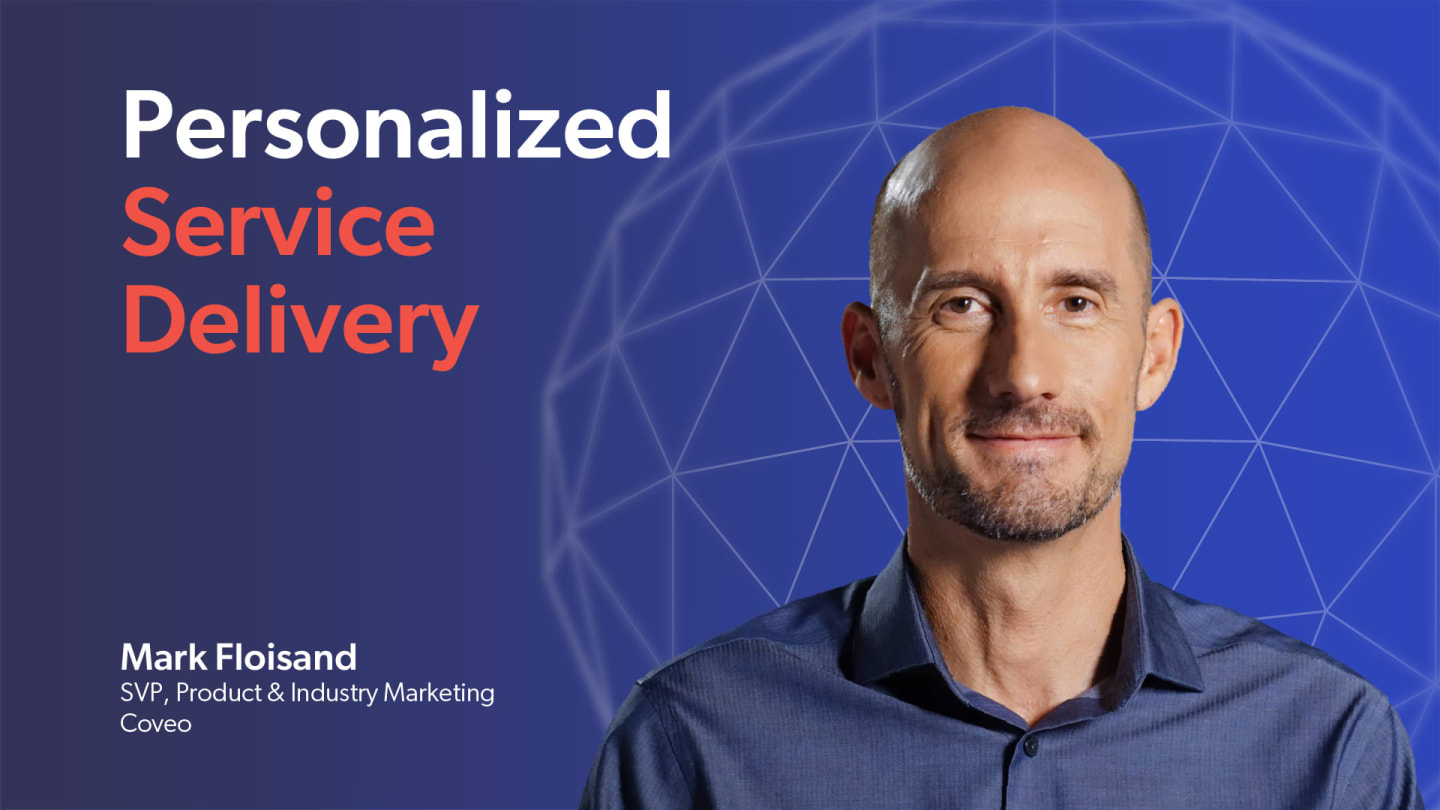
Hi. Good morning. Good afternoon. Wherever in the world you are, wherever you're joining from from. My name is Mark Floysend. As many of you know, I've been hosting the event so far. So, hopefully, you were dialed in earlier. In this session, I'm really pleased to really talk about personalized service delivery. Really an opportunity for us to look across different sectors and really beyond the ones perhaps that we all individually live in today to explore how other companies are thinking about service delivery. And what I'd like to do is just walk through a couple of company examples, some of whom are Coveo customers, some of whom are not. The important thing here is there's an opportunity to learn from each and every one of them. And so, really, by seeing what different companies have deployed as they're embracing more digital service delivery, it gives us an opportunity to then perhaps tie it all together and and think about a strategy moving forward. So without any further ado, let's kick off. I think the important thing to start with, of course, is that we as consumers have raised expectations. We heard this from Louis, this morning. And what that really means is that we are now in a position and a world where we're starting to show a clear preference. We're starting to, for example, show up as preferring digital channels ahead of things that are more traditional for service delivery such as contact centers. A recent survey by Forrester found, you know, fifty six percent prefer to be serviced by digital channels. And we've probably all got first hand experience of, you know, our our favorite hate call into a into a contact center, obviously, not to not to denigrate. But, you know, what we're seeing is a clear preference for fully automated channels. Thirty one percent of people would prefer service that is entirely automated. A further twenty five percent prefer assisted channels as well. And it's really a shrinking minority that are, preferring to continue to deal, if you like, in person. And, you know, the other thing we're seeing out there is a lot of leading companies are focusing not so much on the products that they had, but the people that are consuming them. Of course, it's not easy to do that because many organizations have grown having built and acquired perhaps other companies around particular product lines. And so as they think about the reorientation of, putting customers at the heart of this, it's very often an adaptation and a strategic change that a lot of companies have gotta do, thinking first about their customers or their shoppers or their members ahead of their products. And those that are doing that are absolutely winning. What we see, for example, let's pick on the insurance sector, is, a recent survey showed that some seventy seventy percent of customers expect insurance companies to now give them personalized recommendations, not just around what else they should potentially have insured, but even to help improve things like health and lifestyle, as well as offering things that align with their particular interests. So for example, you know, what basket of goods are interesting to them that are helpful to enable them not just to be covered, but actually to live well, and modify those offers accordingly. I think the other thing to bear in mind, of course, is that within this sector, we're also seeing an immense amount of dynamism, in competition. And so for sure, what we notice, again, if we pick on something like the financial services sector, is that competition's coming in from many different places. We look only at the so called famga, you know, the, Facebook, Apple, Microsoft, Google, and, Amazon, and and the inroads that they've made into things like payments, which have been more traditionally financial services. Account management is an emerging area that they're going directly to consumers on, offering credit and indeed moving into areas like insurance as well. And this isn't just for consumers. This is actually also supporting the infrastructure for banks themselves. We see Amazon, Google, and Microsoft involved in managing data on behalf of banks, and indeed providing cloud services. This to a sector that historically was very much cloud averse. And so what we see here is these companies are changing their offerings very much based on the knowledge that they have about their own customers. And so if we think of it from a customer point of view, the reality of it is that our expectations have changed. We as consumers all now expect these experiences to be relevant, as we heard from Louis this morning, coherent and conversational. In other words, they're aimed at us, they're for us, they're conversational in nature, and coherent, I. E. They're joined up across different channels. They're no longer segmented and siloed. So let's look at some of these different industries in turn, and and let's, again, start with perhaps insurance as a as a good place to run. You know, the thing with insurers, of course, is that they've been really leading the charge, around digital business models. But the irony of it is that only a very small number of them have achieved personalized insurance engines, if you like. Some eighty percent of insurance products are still sold offline, which is remarkable. And what this speaks to again is a history of a lot of these products having been established as separate product lines and product silos. And maybe as insurance firms have consolidated over the last fifteen to twenty years, they've been pulling these together, But frequently, to reorientate around the customer and to do that in a digital fashion is not something they've necessarily got to. However, you know, let's look at some of those firms. And, you know, GEICO and and brands like that we're very familiar with. What have they done well? They have really taken a very clean, web centric approach to engaging with customers. They are pulling together a lot of their product offerings. Many folks know them for car insurance. But equally, they're pushing hard on things like renter's insurance and boats and who knew what else, pulling together the variety of product offerings to make it available as they kind of humanize the experience through their friendly gecko. Similarly, we look at folks like, Progressive, who, again, you know, we know well as a brand. We're familiar with them. They have a variety of offerings that you can see that they're bundling first and foremost, making it centered around the the consumer's experience rather than having to go and kind of individually figure out that these different options are things that I might actually need. You know, their site lives up to its name. It's progressive. It's easy to get a quote, and and they lead with that notion of delivering service directly in the site itself, across kind of areas of ease, choice, and advice. However, there's no shortage of new entrants. And we look at, for example, Lemonade. So good case of really an organization that's really rethinking the whole approach. And they've taken a very different view, which is forget everything you know about insurance. They're leading with the fact that they're heavily well reviewed by their customers, and they're fundamentally making it easy, if we scroll down, to actually, understand the pricing of the product offerings themselves, centering around monthly subscriptions in this new model, making it really easy to engage, and it's very, very compelling. Insurify, similar animals. So if we think of Insurify as being, you know, a very simple approach to pulling together insurance advice, there's really a clean, centric view of making it super easy to get the sort of savings that that, you know, we're accustomed to when we go shopping for this across their product lines as well. They Barca completely removing any friction and complexity and being absolutely focused on personalizing the offers based on simple information like a ZIP code. So really, even as a as a as a new customer, it becomes very quickly personalized and tailored for me in terms of how to start saving on on my insurance packages. And then you look at folks like Ladder, who really are doing for this, life insurance sector what we've seen, Lemonade do for, for example, renters and and homeowners insurance in a strikingly similar way. They're making it very engaging. They're making it very simple, and it's very much focused around decluttering and hiding all of the complexity around it. So I guess the key thing is there's a couple of takeaways that clearly come from looking at these folks. You know, we're seeing this unification of product lines around people, a fundamental rethinking in terms of the digital experience to make it frankly fun again. You know, it's not just about coverage. It's actually about looking at your overall lifestyle and understanding where insurance can play and support in a in a very, forthcoming and and and suggestive way and hiding the silos, the systems, the complexity that are associated with dealing with these things. So fundamentally, this is an industry that's been through huge change as it thinks about digital service delivery, and we see the examples there. Related to that is things like wealth management. So still in the financial services sector, but if we look at the wealth management sector, what we see there in particular is that this group of so called challenger banks have fundamentally changed what our expectation is around customers. Some forty percent of US financial decision makers say they have a a fintech account, an account provided by a a financial technology company, not a not a traditional bank. And, indeed, if you look at the satisfaction of those, some ninety percent of them say that they're, you know, very satisfied or highly satisfied with that experience. There's this isn't just a a generational thing that perhaps, you know, people who are, you know, younger or newer in their careers are perhaps more likely to use a challenger bank. This has also, moved throughout other generations as well. Indeed, baby boomers, some twenty six percent of them rely on some sort of fintech account. So this is this is a general trend, not unique to one particular demographic or another. And overall, I think the impact of these challenger banks has been to raise the competitive stakes for some of the traditional wealth management companies as well, who have had to respond and therefore provide more engaging information in digital fashion. And we see that with, for example, companies like John Hancock, you know, a long well established firm who has really rethought how to do personalized service delivery. Clearly from the site, I can see that, you know, they're yes. They're in the insurance business. They're in, retirement. They're in planning. And and the first and foremost, if I do wanna talk to an adviser, of course, I can go ahead and do that. But the reality of it is that for many folks, I might be more interested in, for example, simply exploring the options that they've got. And they make that really super simple. What you'll also notice is that they're dynamically pulling together information that is giving people the kind of self-service information that they're looking for. Seven most popular questions about life insurance answered. Six minute read. You know, is your company's life insurance enough? More detail within that. These are the kind of frequently asked questions that may change over time. And having the ability to dynamically surface the most relevant content to people, even anonymously before they've logged in and have become customers, is super, super important in terms of attracting and winning new business. We see organizations like Aviva, over in the UK who, you know, traditionally have been more focused on wealth management and now are, for example, cross selling insurance. So here within my Aviva account where I have a pension policy, you can see that they are already tailoring to me specific additional items for, for example, car insurance, home insurance bundled together knowing my profile and able to make those offers, and personalized to me in a way that harnesses and utilizes the information that they've already got on me. Obviously, the information is therefore tailored to things like, you know, try our free midlife MOT app. Those folks that maybe have ever been in the in the UK, MOT is a certificate of roadworthiness for, aging cars. And so, I guess I qualified from a timeline point of view to be offered this midlife, MOT app. And you can see the content that they're recommending to me very much is tailored, based on what they know about me and my age. Another favorite firm favorite is Ally. And here we see within the Ally experience, they're making additional recommendations of things you might like around investing in retirement. Or if you're looking at mortgages, they understand and are automatically recommending additional articles that have proven to be helpful to other people. And indeed, if I actually wanted to go and search, what you can see there is they're preempting some of the most popular searches that are already, showing to help personalize the experience for others and utilizing that data as they go. The irony of it is that, Allied actually just recently did a website update. And what you notice here that was not on the prior one is that the phone number's gone. And so if anything, they are really doubling down on the digital delivery of these personalized experiences, making it frankly, recognizing the fact that most people are preferring to engage with them in this digital fashion. So couple of key takeaways. What we see in wealth management overall is that, again, this this rethinking of product lines, reorientating those around customers themselves, making it very easy to cross sell, upsell, and package them and tailor them based on what they know about us as customers. Making those recommendations tailored to us and indeed even to prospective customers who about whom they might not necessarily have much information yet. Utilizing the data that they've got about their other clients, and using AI to put it to work. And indeed, thinking of service, what we're seeing is that, the primary channel is online. And, certainly, what we're seeing is the contact centers are becoming almost tertiary channels of engagement. So general trend there is focus obviously on the online experience and the digital experience because that's primarily what customers and and indeed future customers prefer. We see this beyond these, these early adopter industries as well. If we start looking at things like health care, wherein, you know, the health care market in the US is some seventeen percent of the economy, And let's be honest, within the context of the, last eighteen months under the pandemic has been through huge change. Many organizations within the health care industry, whether they're health care providers, whether they are health insurers, or, groups that carry both within their stable, or indeed are, single payer, you know, government provided health care, for example, in Canada or in the UK, there's been an incredible volatility and a high degree of fluctuation in the demands on their time based on, for example, when we've seen waves of infection rates grow, when we saw, for example, early in the pandemic, the need that people had to contact their their health provider and find out if, they could, for example, come in and get treatment. And indeed, what we saw was a management of the health care services to defer things like nonessential, or, optional treatments that could potentially be delayed to free up capacity. Ironically, when that happened, their volumes of of, handling calls, for example, in contact centers even went down. So the point is there's been this high volatility driven to some degree by reinfection rates, by, you know, deployment or or hesitancy thereof for vaccine adoption and so on. And they've had to deal with their, with their service delivery in the midst of that. And that really drove a lot of agencies to think about how to utilize these digital channels to better effect. We saw that, and I'll pick on, for example, Atrium Health, who first and foremost realized that one of the things people are primarily looking to do is figure out where to get the the right care. So how to make that absolutely front and center into the experience and do it in a way that is super super simple, super, intelligent, and and get straight to the point of who is actually there to help and and and and, you know, provide the care that people need. We look at something like Arkansas's, or Arkansas Children's Hospital. And and what we see with these folks is, you know, they're at pains to very quickly show how, if you Barca, of a particular group, then they can tailor the experience to you. You can see personalize your experience on, up there on the right. But even if you don't do that, what they start with is this assumption that if you're looking for something, how do they dynamically give you what it is you're likely to look for? And so here we see even in their search bar, simply typing c o prompts COVID testing, COVID, and information about it. Why? Because those are the things that are dynamically of most interest right now. We know we live in a world where, you know, we're seeing mutants and variants of the, the virus, and the health responders are being inundated with requests for testing. Well, this is at least providing a self-service way very quickly. And the data under the hood is preempting and and and dynamically changing to give people the most relevant answers and the most relevant information based on their ever changing health care needs. If we look at someone like, the Mayo Clinic, of course, you know, a stalwart here in the US of, yeah, and renowned for their health care provision, what they're doing from a web point of view is making it extremely simple to, for example, request an appointment, find a doctor and the like, and you see, again, they're merchandising things like, you know, COVID information front and center. However, what's also super clear is that they recognize that we live in a mobile environment. And so how to take all of that experience into a mobile world, well, you can go ahead and, you know, download the app and and all well and good. What's super important though is that as we see these organizations providing, alternate channels and alternate routes, how does one make sure that there is an efficiency and a consistency of content that's being delivered in the background? Such that people aren't individually having to, if you like, support and update the content to provide service through the mobile app, in the same way that or in parallel to having to do online and indeed in parallel to perhaps having to do on a mobile optimized website rather than the app itself. And so as these channels start to proliferate, it's really important that underneath the hood, it's the same set of content, the same set of data that is informing what people are finding most relevant and surfacing that irrespective of which channel people choose to use. Let's also look at someone like Humana, who again have, you know, really reorientated and and and put their care, into a digital fashion across all of their different channels. And what you see with them as well is, you know, again, leaning into the fact that we as consumers, we we just wanna find the right answer. And so what you see in their search environment, for example, is these are the things that people are most frequently going to them with, which is to, for example, get a replacement card, change your mailing address, and the like. These are the kind of, you know, frequently asked questions that they are surfacing naturally and dynamically changing without needing to manually have to go and do this work in the background. And maybe one or two other examples, if we look at something like the Cleveland, clinic, again, you're seeing the same kind of capability. But, of course, starting to think, and I use this example, they are also recognizing that they have different constituencies. So clearly, they have information for their patients and information for their doctors. You'd think that this would be a very hard bifurcation of information. And, of course, in reality, there are some things that are, you know, obviously for doctor's eyes only, like, you know, physician recruitment and the like, versus for patients. But that doesn't stop the effectiveness of having a single system behind that understands things like access control, understands things like tiering and permissions and authorizations, and is therefore able to deliver the right content to the right groups of people, without needing to be a duplicate system. It should be a single platform that caters for all kinds of audiences and and what they, what they can and can't see. So what are the takeaways from the healthcare sector? Well, again, I think what you're seeing is comprehensive access to self-service. This notion of pulling together everything and centering it around these key constituents, whether they're patients and or practitioners, and and continuing to innovate on surfacing the most relevant information upfront to effectively defer or, deflect is a strong word, but help people not need to make that call into the contact center. We as consumers, as patients, as members, don't wanna do that. You've seen that in the prior data. And so what you're seeing from these healthcare organizations is a concerted effort and a consistent industry wide effort to enable us to self-service across these different environments. Now let's switch gears completely and perhaps look at the manufacturing sector. So, and and in the interest of really changing gears, let's look first and foremost at a company like FleetPride. In fact, those who may be interested in this, we have an entire session with FleetPride tomorrow, so feel free to dial in for that. What is FleetPride? They are effectively, an organization that's in the distribution and manufacture of parts for heavy equipment, trucks and the like. And so their clients are, retailers, they're fleets, they're people running a network of trucks and and and goods and services vehicles. And and, obviously, a large part of that is recognizing that there is no shortage of variety in their product catalogs. And so how to, you know, bring more personalized service delivery in this world? Well, clearly, if you already got a fleet and you have an account with them and you're registered, good. I'm interested though in what they've been able to do to really provide people with a way of this experience being personalized as first time shoppers. And so one of the things in the, in the in the vehicle industry, of course, is that every vehicle is unique in the same way that every individual is unique. The difference is that there is a public service for accessing VINs, vehicle identification numbers. And and one of the offers or one of the options on the FleetPride site is the ability to simply go ahead and do that. And so, for example, if I type in my VIN number here and, send it off, you can see that this is a two thousand and four Toyota Tacoma, and that's the precise vehicle. Now that is effectively giving FleetPride everything they know and, frankly, narrowing down the complexity for me as a driver looking for parts because across the variety of brand names and generic parts that they have and the multitude of product catalogs, it'd be very easy for me to get lost. Whereas now, at least with this information, everything that I'm presented with in terms of what's featured and and even be able to browse in by category is appropriate to the the the product that I've just been or the car that the truck that I'm actually driving. And so the important thing here is that you don't necessarily need personal information to personalize. There are other queues and other services out there that can be tapped to make the experience for the buyer, relevant for them even if we don't yet know who they are. You look at other examples and we take a company like Dell, who are a manufacturer of technology firms, both for home and for business buyers. And and very clearly on their website, they make that clear right up front, which is, you know, pre Labor Day, they have a, you know, they had a sale running. And, obviously, post Labor Day, here we are, and they they continue to to honor those discounts. And, and, obviously, a large push around that is enabling, both businesses and and home shoppers find what they what what offers are available, which is great. However, what I'm actually more interested in is looking for a particular product. And here in the search, I've started typing r u g. And what you immediately see is some suggestions popping up. Now I wrote rug. Of course, Dell is not a manufacturer or a seller of home furnishings. But what they are is a manufacturer of ruggedized laptops and tablets. And indeed, what you're seeing recommended to me are the most popular terms that other people have used, for this for this, for this search. And, ironically, the Dell seven two two zero is actually the one I'm looking for. So when I click on that, all well and good, I'm immediately taken to the products that I'm that are most relevant to me, getting me into a comparison of these three based on price. You'll also notice that a couple of things have changed in terms of, you know, really recommending to me the facets on the left that are likely to be the most salient next steps in my exploration here. Their own data has shown, for example, that pricing is more important than customer ratings for business buyers. And therefore, putting that pricing, filter closer to the eyeballs and pushing down the customer rating dynamically is about tailoring and personalizing the experience for me as an anonymized buyer to help me get my transaction done. So all of these are the kind of things that are being done to really bring more personalized service delivery using every shred of information and every bit of data that they have at their disposal, including, of course, what other people have previously looked at and taking advantage of machine learning and AI under the hood to recommend the right products, having kind of gleaned my intent. Just from seeing the letters r u g, they have understood that I'm looking at ruggedized tablets and that I'm very likely, probabilistically looking at the seven twin seven two twenty. So switching gears completely, let's look at something like in the apparel world. So doctor Scholl, a manufacturer of shoe wear, actually part of the Caleras Group who has about eighteen different brands of of shoes. I'm going to doctor Charles, and I'm particularly interested, for example, in what they've got in men's wear. And, I, I'm interested in boots. And so, of course, what you see very quickly is a tailoring of the, options available. But, of course, what's really important to me and and a key part of the decision making process in the selection of shoes is, and probably most important, is my shoe size. Ahead of things like color and choices. And so they've surfaced that up naturally. And and, of course, what it does is if I right now, I see that there are eight products in the boots line for men from doctor Scholl. But if I click on the eleven and a half, which is my size, it's immediately tailoring it down to the seven that are relevant for me. And, yeah, this might seem simple, but this kind of intuitive orientating around what the data says is most valuable for people in accelerating their journey, in getting them ultimately to the decisions they're trying to reach, all of this is about taking advantage of the information to to tailor accordingly. And and, you know, just as a brief digression, I'm a runner. So, obviously, boots are not for running in. But, you know, one of the most frustrating things as a runner is that your favorite shoes invariably go out of production. And then you're, like, scouring the secondhand markets and the e bays of the world and so on to find, you know, that that, out of out of print shoe. And, of course, you'll be remarketed with that same shoe, but in a size eight and a size fifteen, which is irrelevant to me because I'm an eleven and a half. So simple things like understanding what's salient to the customer within your marketplace and utilizing that that data is all important. So key takeaways here. What we're seeing here is that service is spanning across product lines. We're seeing that, you know, if we think of the the Dell and the and the Fleet product examples, it goes across departments. It goes across systems. It even goes across vendors. Excuse me. The effort is around minimal customer effort. What you're seeing is is is a real focus on making it simple for people to find the information they need and and really to be able to leverage that data both inside and outside of the organization, to to personalize from the very beginning and to deliver service that is, really as as optimally tuned whether or not you know that person. And so we saw again in the FleetPride example tapping into things like, you know, the van system. There may be others, in your industry that can also be utilized to connect to and to to make the experience, easier. So that's all well and good. We've seen some interesting examples here of service delivery channels. And, you know, if we think of, you know, we looked at the the health care example with, the mobile app from the Mayo Clinic. And and so we've seen some really interesting things. But I think one of the things I would lay down as a challenge is how to start thinking about that service delivery holistically. Not just channel on channel, not just website, not just app, not just mobile, mobile app or mobile site, or indeed, in the contact center itself. But how do all these things join up? And, you know, one of the things that or one of the ways to perhaps think about that is in this notion of a, let's call it the cost to serve curve. And, obviously, this is somewhat simplified. But on the, you know, the vertical y axis, think about that as the cost it takes to serve a customer, whether that's to, you know, answer a question about, how a product might work or help them understand a health issue. Who do they have to talk to and at what level of expertise to get that first answer? And as you kind of go down the curve on the right hand side and on the x axis, how many customers can be serviced or members serviced concurrently? So depending on the channel, obviously, if you have your your most, experienced, most expert folks on the phone, they are not necessarily in a position to talk to more than one person at a time. We're not very good at that. However, if they're able to understand or solve a problem and in, knowledge centered support or KCS, methodologies kind of document that and quickly make it available for other agents, then as that question may come up again, there's now at least a ready answer. And so that can be made more broadly available to folks who who may be dealing with these these inbound calls where that answer or where that information is is newly discovered. Well, clearly, that provides a basis for putting that information into things like chat systems. And, obviously, there are agents that can handle, say, three or four chats rather than just one phone call. So now they're able to service more folks concurrently at a lower cost per curve. Well, as you start thinking about using that same content in chat assisted, systems where the agent may pick up a a chat session after a certain number of interactions with further lowering the cost to serve and extending the reach. If you think of chatbot AI, which is effectively continuing to have a dynamic conversation and continuing to offer, you know, salient responses to what people are asking, now we're starting to automate it. Think of the wealth of information that exists amongst your own customers in their own community and the willingness that they have to answer each other's questions. Providing those kind of community portals, is a rich vein of of information generation from the customers and members themselves. That notion of a self-service portal where you're bringing all of this information together in one place is really important because it means people can affect Vico where they'd like to in the first place, which is to self serve. And now let's push it even further. Maybe you have a a digital product, and maybe it's an online service, where now you can actually even push that same information into the in product help. So, you know, Louie has talked about Xero, our cloud based accounting customer with about two billion two million small business accounts. They have really taken this to the hilt of really bringing all of the learning, all of the documentation, all of the, content that they have found that their accountant and small business customers need and built that into their very product. So that ultimately, those are even given signals as to what to fix inside the product itself. The point is that this is a continuum. It's a spectrum. And it ranges across a number of different services, and indeed a number of different systems. And this is the quandary because behind every one of these individual touchpoints, there's typically, a standalone system that's got a content management system of one kind or another and usage data about what's being utilized in there. And they're siloed. The issue is that not only are they siloed, but there are people actually parallel working on these different things. They're updating content in parallel to each other. They are perhaps not necessarily using the most common information across it. And so one of the fundamental opportunities in terms of personalized service delivery is to join these things together. Because, again, if we think of where we started, we as customers are interested in these kind of connected, joined up experiences that are relevant to us, that are continuous, and they're coherent across these different channels. And so that's really where we can help. Because what Coveo effectively does is unifies that content across all of these different silos, pulls it together in a way that doesn't require content to be moved from one system to another, which is very expensive, but draws from indexes and pulls together that content so that it can be put to work across all these different touch points. We also understand and gather together the usage data. We measure what people have found useful. And we're able to use that again across every other channel. So the purpose here is that as we start to see information being pertinent in one channel, it, of course, rises to the top in others. The fact that someone might be recommending a particular community answer from, one of the mavens in your customer base means we can take that that that review or that write up and make that available across these other channels, bring it into chatbot sessions, provide it proactively to the agent in the call center, or even build it into the self-service portal. So spreading that information and bringing the most relevant information to this service curve. And that, in essence, is is how, Coveo helps. We utilize the Coveo Relevance Cloud to do this. Louis touched on it. I will summarize in in in brief, terms. But think of this as fundamentally, AI powered relevance across all these different channels that ultimately delivers what your members, what your customers, what your partners, what your dealers, what your channels, depending on, you know, your business, what they're actually expecting. And we do that fundamentally by having the ability to discover that information, make it readily available, and personalize it through AI, by bringing machine learning models together that, you know, start with search and extend into things like very sophisticated recommendations, but are custom built, are well, are purpose built, if you like, for the delivery of personalized service and personalized relevant information across these different channels. And as a multi tenant cloud environment, we're able to gather that data and deploy our AI at a scale and a simplified fashion that means that for things like, I don't know, shopping events over the forthcoming Black Friday, we simply auto scale so that we're delivering the service that your customers expect with with no hiccups. And ultimately, that this can be built in utilizing, you know, your own partners, your own IT folks, your own dev teams, should you wish, through a series of APIs as well. And so the summary of it is we're here to help. Personalized service delivery is nontrivial. It's what customers expect. It's what they want. And and Coveo has a proven track record in doing just that for, for our customers.

Prestation de services personnalisés