Formica Corporation invented high pressure laminate over one hundred years ago. Today, the brand is one of the best known names in the design and construction industry. We are proud of our brand's history, but our catalog of global surfacing products comes with a unique set of challenges. Our surfaces come in thousands of size, color, texture, and pattern combinations. For our customers, finding the surface they want is critical to a positive brand experience. We turned to Coveo to help us connect our customers to the right product. When we integrated Coveo, we saw an almost immediate increase in people ordering samples and downloading swatches. With Kaveo's machine learning, we can auto populate suggestions while people type their search queries. We found these suggestions have been twenty seven percent more likely to get a click. And recommendations driven by Coveo's artificial intelligence have increased our clicked content by fifty one percent. It's clear evidence that Coveo helps people find the right product inside our extensive catalog. What's been so valuable about our Coveo partnership is not just the AI. It's also Coveo's service. The Coveo team helps us adapt quickly and customize our implementation so we can keep evolving and improving. With Kaveo, we've been able to improve almost every single business metric we have, from swatch downloads to sample orders to finding where to buy our product. We've watched our satisfaction score grow quarter over quarter, year over year. Most importantly, Coveo has helped us continue to deliver on the heritage and the global reputation of the Formica brand. Well, it's now my honor and privilege to welcome to this virtual main stage our founder, president, and chief technology officer, Laurent Simonon. Over to you, Laurent. Thank you so much, Mark. And, good morning and good afternoon, everybody. So next forty five minutes or so, I will go through our recent innovations, how it impacts customers, and also provide some insight on what's next. Then it will be super interesting to get Scott Compton's from from Forrester to get Scott's, perspective on the market as a whole. So it will be interactive. Mark and I will, will ask some questions to Scott. So it should be quite interesting. But first but first, what I'd like is, just wanted to give an update on how we look at our platform in the context of our four lines of businesses. And some of you are familiar with that already. So if you look on the left side here, this is where we have all of our connectors to get the information, to get the knowledge, to get the data from various, data systems in the enterprise and secured fashion inside our index. So that's what we call the classic enterprise search portion of our business. And then all of this gets, gets improved from an AI perspective using data events, queries, click stream, open pages, add to carts in the context of commerce that we get at the top of this that we get at the top of the screen. And all of this data is transformed through AI and machine learning to make search and recommendations intelligent. We do that across websites, commerce, service, and workplace, and I will get into the details of each of those, areas, in the next, next minute few minutes. So at the bottom in terms of infrastructure, yes, we have our classic our in our own index where it provides results to queries, in advanced fashion. We have our data platform where we put a lot of investment to this to, make the data better, to capture all of those events, make it, make it better organized. And, of course, we have our user profile that will organize this data across individual user respecting, privacy and all the security, requirements. So and, of course, when we look at that for for customers, so we have, we we are fortunate to have very large customers that will leverage this platform across all of those dimensions at the same time. For instance, in this in this example, it's Dell. So it's no secret that Dell is leveraging Coveo across, various use cases, including online and commerce, multiple supports and community sites, multiple intranets internally, and also, powering tens of thousands of customer service agents to make them more proficient, more efficient, and find the knowledge for the entire enterprise so they can respond more rapidly to customer inquiries. So we support all of those use cases from one single platform with obvious economies of scale. Some content may be used across all of those dimensions. Some, data will help us be informed relevance from one use case to the other. So we believe that from a we believe that Kavio needs to be a platform and needs to, scale across all those dimensions. So the core principles that we're using when we are investing in our platform. What do we care about? So first, we are not the experience in the vast majority of time, but we power the experience. So our job is to make experiences that are already there, smarter, better, have more reach into the continent, so on. And we need to do this in, high scale. High scale in terms of queries. So we have a lot of customers in ecommerce that, have to deal with Black Friday and holiday season and so on. We have to deal with high scale in terms of documents and number of transactions and number of users. We put a special focus on data because data so those events, clickstream, and so on. This is the raw material that is used to do great AI. So we believe that, AI is somewhat getting commoditized for simple things. What will make the difference is when you understand the data in the context of commerce, in the context of service, and you tailor your, your r and d according to that from an AI perspective. So we believe we have a great runway there. And, of course, all of this needs to be done, with the utmost privacy and security requirements. We come from a, we come from an enterprise background where we dealt with, the defense, some defense contractors, some security companies, and so on. So we have that in mind when we design and build the next iteration of our platform. So with that, I'd like to, get a little bit more into details of what we do in the context of service and workplace. So the goal here, of course, is to connect the knowledge with, the user either in an organization or a user that is trying to get, to get support or service from an organization in self-service fashion, for example. On the agent console side is what we do, with, let's say, Salesforce, ServiceNow, Zendesk to, make the person that's using the agent console more proficient, more efficient, and have access to the knowledge from the entire organization. And we're also, investing a lot in the core capabilities that are supporting all of that. So the first the first element the first innovation I'd like to highlight here is what we call smart snippets. So it's also known as question answering, and it's really the ability to go from getting links or results in a search engine to getting answers. So let me show you what we do here. So this is a this is a normal knowledge page that has the facets to the lab that has the query at the top. But I wanna highlight here, I wanna zoom in here on what's really, what's really cool about this. So this is a knowledge so this is knowledge search. Right? So people think that it's coming think that it's, on a think that it's on a website. And people are asking, so how how do I create and manage chatter groups? Well, so our deep learning infrastructure under the hood will parse documents in the index, will extract snippets of an potential snippets of answers, and will identify those headings linked to those snippets of answers and embed those headings into a vector space along with users' queries. Calculating a similarity store score to display or not a snippet is the key here. So when you're typing this query, if we match a snippet with the query with a high score, it will surface it here. What's, what's pretty cool also what's pretty cool also is the ability to see what are the related queries. So because a snippet can be linked to multiple queries from a deep learning perspective, we can also identify the other elements that people are asking around that specific topic. So sometimes there, it you may discover a gym or something to continue as as a user to continue discovering where the information is. And then you've got the, you've got the classic search results here. So this is, this is a big deal for us. We already have enterprise customers that are using this in production on their self-service, support site and some internal knowledge base. And, we believe that this will have a huge, huge impact. The second element that is, that we have, released in production and that customers are using is what we call intelligent case assessed. And in a nutshell, it's the ability to provide a guided workflow to those who are in the process of logging a case or entering, information to getting, to getting support in a self-service support standpoint. So this is an example. Actually, this is the Coveo website. And our they will ask to log an issue. So this is what will appear. Right? This is pretty standard. So, we're asking for the user or the customer to give us more information about its issue. And so subject description. Now typically, in the description, there's a lot of good information, but it's hard to parse or it's hard to understand. So with our deep learning infrastructure, what we've been able to do is surface metadata, around this specific description. So this is what the system suggest to the end user. Hey. We're thinking that you're talking about this use case, this product, and so on with the option for the end user to select or deselect and precise and get a little bit more precise on, what is what is, what is problem is. And then we're going to provide our best shot at results. And then the trick is that sometimes, the user may ask something that is hard to understand. Sometimes maybe the answer is not available on the knowledge on the knowledge base. So in this case, the user will log a case. But the good news is all this metadata and all this information that we captured in an elegant fashion during case creation will help the agent do a better job. So talking about the agent, the goal here has always been let's make content and context, part of the discovery of the agent so he's more effective and more efficient. And those of you, who know well Coveo will recognize this. That's the Salesforce lightning agent console lightning console, I should say. And Coveo so an agent is looking at a case and information about user and how to, address this problem. And then Coveo is on the right side here. It's embedded into the Salesforce console, and Coveo will surface knowledge and the best information that will help the agent solve the case that he's looking at. So this information may come from, yes, Salesforce, but also SharePoint, some databases in the organization, some websites, some YouTube videos, and there's relevance, involved in this so the agent may connect will find the answer more rapidly. Now what we're adding here is the ability, yes, to search, but to surface smart snippets in, the agent console. So this is a big deal because there's limited real estate in the Salesforce console, obviously, in the right side. So if we have a shot at providing the answer to a specific query right there, this has a huge this has a huge impact on, on the proficiency of the agent. Another thing that we've been, that we've been enabling for customer over the past year is what we call user actions. So it's the ability to surface the activities, the recent queries, and so on from the user profile of that person that just logged the case. So in this example, the agent will see, oh, this person has clicked on these documents on, the knowledge base, has read this, has opened that, has done this, and so on. So the agent will have more insight. But what we need where we need to go and what we're investing in is are the next steps of the agent console. So the goal here and the feedback we got from our customers is, this is great, but let's go a step further. Tell me what I missed. Tell me what I need to use. Tell me be more specific. Summarize me everything that we know about the user. So this is what we're currently building and testing with some of our customers here. So the first one is, I would say is, is a rework of the user interface here where we are embedding, yes, with their search, but there's also, there's also a view of the recent activities that are a little bit more a a little bit more visually attractive, but this is where it becomes really, really, really interesting. So let's surface from a user profile, the affinities. What is what is this? What are these, what are the interest of this specific user? Some engagement score, some engagement over time in a visual way. So instead of, instead of the agent going through the user the user action and try to make his own conclusion about this user, Let's provide some insight directly to the agent. So we are refining this right now, and we expect to, to have this in production in early twenty two. And then the other the other way for our users, to ask questions, to get support, both internally and externally, this is what we call the in product experience. So it's the ability to include Coveo in apps such as Xero Software that, that many of you are familiar with. Xero is, is an amazing company that provides accounting software for millions of businesses. And what Xero has done and this is the Xero, UI here. I'm looking at the invoice module inside Xero. So if you go on the top right corner here, so you will see a help button with a search boxes provided by Coveo, but also recommended content that is driven by what this specific zero user has been doing in his session and where he is. So, obviously, if you're invoices, you'll get recommended content that are, that are related to what you're doing. If you're elsewhere, it will adjust from an AI perspective. So this is working super well. And, from, and it's pretty obvious that if you're a zero user, you'd rather get help here instead of going on a portal in many time most of the time. So that's that is your Genpact. So now many of our customers ask us, yeah, that's great. But how could I have that for my internal applications and or my Internet? And the problem is that there's a lot of custom apps in there. There's a lot of custom, custom elements that would require a lot of work to integrate with for those customers. So what we are introduced what we what we have introduced yesterday, announced yesterday in beta is, our Google Chrome extension that will basically allow any browser session to have this little button that is all configurable, obviously, on the bottom right so you can have access to your internal content that is already indexed by Coveo. And you can search for it, and you can have a recommended content on it. And it's managed by an administrator. It's country rule for each user, so you can enable or disable in certain, for certain applications within your network. So we believe that, this will have a great impact. Instead of going to the Coveo page to search, then you can start your search directly, there. So this is in beta and, we're rolling that out to, to some, to some customers as we speak. And the goal here is always to reach to new audiences. So we are adding new integrations, to bring users closer to right content. This is, a full search page that is, going to be available inside salesforce dot com, and it's built so it looks great. Right? It's a great, it's a great full search page. You see on the right side, you've got recent searches, recent open documents. So it leverages the user profile. So we think that for agents, it will be, it will be a huge improvement. But what's interesting, it's built on Salesforce lightening web component and our new Coveo headless framework. So we call those components that are specific to Salesforce Quantic, and it looks way more native, way faster, way slicker inside Salesforce. Force. So this is something that we've built, that we've built with the help and guidance from salesforce dot com. There's a great blog post on medium dot com actually about, the story with Coveo and Salesforce and a partner using these new components to build, new user experiences like that. We've announced also the GA availability, the general availability of our Slack connector. And we announced that yesterday, and Slack was kind enough to, like our our tweet about the announcement. What's, what's interesting here is that it's built in a way that it can scale with bulk indexing and also incremental updates. So, this one is, this one is pretty cool. And also, LumApps, which is a great collaboration platform, they I've looked at it from the other side. They they have built a Coveo integration that's now available in their marketplace. So Coveo has now the right set of APIs and technologies and so on to make this available also for third parties like LumApps to build on their marketplace. Alright. So with that, I'd like to switch to ecommerce. And, in ecommerce, of course, we care about shopper experience, about catalog management, about personalization with user profile when we can, and some developer experience also. But key elements of differentiation in ecommerce would like to highlight, versus our traditional business that is, workplace and service. So in ecommerce, relevance is not about providing answers. Relevance is about providing great results with good quality, but with some sort with some kind of recall and discovery. Some people like to say is to provide the best results with the less pollution possible. So it's a little bit different. Right? And one of the challenges that we see and the opportunities at the same time in ecommerce is that catalogs are so complex now for large source that boost and bury rules will not scale with the complexity of those catalogs. There's always there's always a supplier that will come up with new metadata that will somewhat pollute the catalog, and the boost and bury rules may not be able to deal with that. One of the interesting, challenges in ecommerce is in b two c ecommerce is that personalization must be done for anonymous sessions. Our metrics tell us that about seventy five percent of the sessions in ecommerce are anonymous. So user profile may be awesome to provide insights from specific user, but if the user is not logged, it's it's a little bit harder. And we see a lot of a lot of traction for what is called bulbous in the industry, buy online, pick up in store. In other words, having the ability to provide store inventory in the online in the online experience is usually important, usually strategic. And what we're also seeing is that content. So think about videos, how tos, and so on, will enrich the experience of commerce. So having the ability to deal with both product catalog and content at the same time, has great added value. So let me give you a real example of that. So Bunnings, for those of you who may not be familiar with Bunnings, they are the Home Depot of Southeast Asia. So in Australia, New Zealand, elsewhere. So Bunnings is huge. And as you can see in the home improvement space, they have huge catalogs. They have a lot of, they have a lot of they've fed a lot of demand in the past two years also. And, we are powering search and recommendation personalization on the binding side, since March twenty one. So let me show you a few things that, are pretty cool in budding. So if you're on the home page, they will surface top product categories, here. So we see barbecue garden tools, smart home in the middle. And very quickly, if you click on barbecue, you will get on the dynamic page here highlighting subcategories at the top. And then at the bottom, the best results from that category based on multiple dimensions, starting with machine learning. So what do people really want in that, in that page? So, obviously, when you're looking at this, there are multiple ways to, there are multiple ways to to look at this and the category will the category page will involve. Presumably, they're selling more barbecues before the summer. In the middle of summer, they may wanna sell more equipment or more access more accessories. Right? So the AI and machine learning will deal with all of that with, of course, the ability of boost and bury rules to, override that when needed. So if I click on a barbecue here, so this is assembled from multiple systems, of course. I'm in Canada, so I don't have a local store here. But on right side, it will tell you the availability of the store and would also, it will also affect, the relevance of that specific result here. And if I scroll at the bottom so Coveo powers these kinds of recommendations you might also like. Right? But then if, let's say, I add to cart, frequently bought together. So when you're buying this barbecue, you should also consider buying these additional products. And then what's pretty cool is part of the product page, you have do it yourself advice. You have, some additional content from community. This is stored in Sitecore CMS, so we index that obviously, and we surface that, in the product page. So though the most relevant piece of content related to that product will be surfaced, And we believe it enrich the buying, the buying experience. Now, of course, we do search also. Right? So in the top left corner here, you see a, a search box that when you click in, it will offer what's trending in searches, what's trending in products. It always changes, obviously. Right? Driven by AI and machine learning. Search for barbecue, but I'm looking for a barbecue thermometer. Guess what? A lot of people are looking for barbecue thermometer at this time of the year. So I will get to barbecue thermometer. You will get great results from Coveo. There's a store availability filter at the top. Those categories and price range and filter and sort, elements. So all of the so it's really Coveo powering a great experience here with, a lot of a lot of, great capabilities. And, of course, if you want to search on content at the same time, so how to use a pellet smoker, how to, use an offset smoker and all of that, well, this is all part of what we do for a living. Alright. So let's get to, let's get to personalization. The as I said in commerce, there's no need for user profiles since seventy, seventy five percent of visitors in b two c are first time visitors. So we need to have a different approach on how to address that. And what we've released recently is what we we call personalization as you go. And the goal here is to leverage a technology that we have under the hood at the catalog level that represents products in the multidimensional vector space. So how this works under the hood is the product in the catalog, the products in catalog have proximity vectors with other products based on different dimensions. This is created and maintained using behavioral data. So session becomes a score in multiple dimensions. Dimensions are not explicit. They are discovered automatically through machine learning. And behavioral data will identify different dimension, like catalog allowing products to cluster around it. Our friend, Cheryl Greco will have a deeper, presentation on that this afternoon, actually. But let me show you a demo of this, how it works. This is a this is a, sports apparel company that sells all sorts of things, running shoes and skis and boots and all of that. Right? So let's say I am going to, I am going to search here. So see that since I'm a first time visitor, so the query suggests will show me what's kind of popular, with no insights about me. So very quickly, I will search for golf pee. So it will surface me golf pants. It will recommend me golf pants. Okay. Fair enough. So I will go select some golf pants here or visit some golf pants here. Right? And then while I'm here, now I will start searching again for gloves. Well, guess what? Because I visited golf pants and the category golf gloves is similar or is close from a vector space to golf to golf pants, it will suggest me right away golf gloves. So it's not about, hockey gloves. It's not about baseball gloves. It's about golf gloves, obviously. Right? So then, I will, I will look at golf gloves. And then when I come back to the home page, because of all of that, I'm starting getting recommendations about what I may like on the home page and what is interesting and so on. So this, we believe, is a big deal in b two c commerce. We call that personalization as you go. And, Ciro Greco will provide more insight on our research, supporting that later this afternoon. So in commerce, it's also important to support the merchandisers and to provide the ability for them to understand what's going on so they can take actions. So we, we've just released a, a new series of commerce dashboards that will that that go more into the business metrics in this example, but also better understanding sessions and, where there are some issues, content gaps, and so on. So this is, this is being used by our customers as we speak in commerce. This is being released to our to those customers, and, we believe it's huge improvement. What's coming also, later this year is what we call the product listings manager. So it's the ability for an administrator to, manage directly in the admin console, those product listing pages and or those category pages by filtering, ranking, doing some merchandising on the results. So, again, this will be available directly into the admin console. Some additional integrations that we're building. So Adobe AEM is, is, often the front end in, those commerce websites and also websites in general. So we, we have now an integration that'll be a, yeah, for administrators to drop Coveo components in their web pages, instead of rebuilding everything with APIs. They now have the ability to, they now now have the ability to use those components directly into the admin pages. So that would be it for for commerce. Now I'd like to spend a little bit more time on what we're doing as what we call platforms a product. So Coveo has always been great for large enterprise and mid to large mid to large enterprise. What we, what we have been working hard to do in the past, I would say, eighteen months is make it easier for departments in large enterprise or mid sized companies that want to experiment with Coveo or prototype with Coveo or test Coveo. So what we, what we have recently launched is a trial of Coveo. So in a few minutes, you can start a trial of Coveo and start indexing content with it. We've also invested substantially into the developer experience, and I'll show you some of that, including training and documentation. So what's interesting about, what's interesting about the trial is, about eighteen months ago, what was kind of good enough for the enterprise but could have been a little bit simplified, we decided to put a lot of energy on that. Because in the context of a trial in a few minutes, it's gotta be simple. Right? Well, by doing the all of those efforts of simplification to the admin console and making the whole thing more seamless, we benefit to all of our customers, obviously. So this is the new source creation panel here. So in one click, you can start multiple of those connectors. We also have the ability to create hosted search pages directly into the admin console. And while sometimes customers may wanna have a tighter integration, their own experiences, of course, using APIs and so on, to at least prototype very quickly and understand what the content looks like and what relevance looks like and so on. It's pretty useful. So we have this new editor that is on top of our headless framework that allows administrator to design and select the facets that they want to, that they want to use. So see in a very so in a few clicks, you can build those, those experiences very rapidly directly into the admin console. We think it's quite important, and this will evolve. Right? And, of course, if you, if you want to build a do it yourself search page, that's on the right of this screen, then we have the documentation and the examples and the tools to help you do that. So in, the theme of enabling a great developer experience, first, we provide a headless framework. We've also built what we call atomic component library, which is visual library on top of head loss. Talk a little bit more about that. We have a common line interface that some of you may, may, may see it with the acronym CLI. We have a chatbot SDK. So we have the ability to connect to various chatbot frameworks with our SDK. And we have a new search API that is rest that is, that is more modern, that is more up to date. So all of this has been introduced in the past six months. And it's really in our push to, to get closer to developer experience, to make it easier to do business with Coveo and integrate Coveo. So if I if I summarize this, so we have our rest APIs that are stateless low level APIs called from anywhere. Right? And some will go directly, using that. We have Coveo headless on top of the rest APIs. It's agnostic, but it provides a lot of a lot of this, intelligence organization on top of rest APIs. And then we have our visual library, visual component library. So Atomic is, is our standard on top of headless, but Quantic is what we built for Salesforce lightning components. So this is, so the headless and the rest APIs were used entirely to build bunnies, what I presented earlier on. We have launched our training platform that is called LevelUp. So it's about text videos, of course, interactive training content. We have badges. We have native, support for events. We have done a hundred and fifty something, training until now. We have Slack integration also, to interact with our people, with the people who are getting training. And what's great also is we have developer certification now. It's online. It's free. It's self-service. It's scalable. And we have those, those built in certifications. So right now, we have certified platform developer, one and two, and we also have, Salesforce prestige certified. So the goal here is to support both the administrators and the developers that wanna that wanna use Kaleo. So it's pretty interactive. Right? So here you see achievement and progress, path towards a certification. We've got video training and so on. So this is, this is right. Now I'd like to, I'd like to end with some comments and highlights on the core infrastructure. Earlier on, I said it's super important to scale in a seamless fashion, but it's gotta be super reliable too. Right? So it's gotta be scalable. It's gotta be reliable. Security is critical, and we need to have a global presence. So speed matters, especially in commerce. So we need to have a global presence. Wanna highlight a few, a few metrics from our platform here. First of all, monthly, more or less, we're going to index about four billion, documents. So this is this is a lot because considering that a lot of those documents are large PowerPoints or, PDFs and things of that nature. Right? So that's a lot in a month. We are supporting more than twenty thousand active content sources. So remind remember my connectors on the second slide. So for all of our customers, we're managing twenty thousand content sources that will, and that will either refresh each and every day or may reindex each and every minute. So that's a lot to deal with. Year over year, we, and I think that commerce plays a role into this. We now have, three times more queries than last year at the same period. So that's that's a lot. And from a scalability perspective, needs to be the platform needs to be designed to handle that. Right? We are always up to date. We have one code base. We release about two thousand times automatically a month. So all of our customers will have the latest release, and some new capabilities will be made available through feature flags. So customers have the administrators have the option of enabling or not new features when they are, when they may be in pilot stage or maybe it's the first version of it. So they may or may not enable it, but nevertheless, the code is there for all customers. And because of all of that, we we have had zero surge downtime, and we're proud of that. Right? In the past in the past six months, seven months ago, we had, one minute in Ireland that, we are deeply sorry for it. But overall, we've built a platform that is reliable, that scales, that is secure, and that is also, global. So the way we have designed our platform, we are we have multiple regions around the world. There are independent regions that are there to deal with local scalability and and, reduce latency to minimum, but also, to deal with, data residency requirements that, some customers in Europe may have, for instance, or in the US. So we are currently having these, these, four regions, physical regions, because in the US, we have two of them. We have USCs, but we also have HIPAA, that is to, that is to deal with medical information, medical records, and so on. Canada is in our road map, and we're aligning this with demand. And there are others that, could come in the next year or so. US West is a mirror of US East, and we have a few other ones also like that that are coming. So Coveo can scale globally, and, it's, fairly easy from a technical perspective to open new regions based on demand. So with that, I'd like to thank you for your interest and intention. I'd like to, bring back Mark for our next segment. Excellent. Laurent, thank you very much. What an awesome update. And it really speaks to the the frankly, the sheer rate of innovation that's coming from the team, obviously enabled through having a multi tenant cloud platform and being able to deploy this innovation really quickly out to our customer base. What we now have the opportunity to do, though, as Laurent said, is perhaps hear an outside view. And so what I'd like to do is introduce our first special guest, which is, Scott Compton, who's a senior analyst at Forrester Research. Scott is a he's a retail ecommerce specialist. He's got over twenty years experience with direct to consumer marketing. His research is very much focused on the strategic and technological approach for stores, and out of the grocery sector as well. Lot of experience in and expertise in customer experience, digital marketing, user experience testing, and conversion enhancements. And, more recently has become fascinated by advances in AI, automation, personalization, privacy, and frankly, how data and insights enhance the entire customer experience. So a warm welcome, Scott. Yes. Thank you. Thank you for having me. I'm super excited to be here. I heard yesterday was a big success. So, we look forward to a a a few more great sessions today. Excellent. We really appreciate you coming on board. I thought what might be helpful just to kinda warm us up here, Scott, is, you know, we read with great interest. You wrote a report recently called drive shopper relevance with AI driven digital commerce search, which sounds like right up our street. Can you kind of summarize the key messages for the audience from there? Yeah. You bet. So as you mentioned, I come from a practitioner background, largely focused on search, both incoming search as well as on-site search, and really got, really got deep into it, so much so that I was information architect on a product team, for an ecommerce platform when we developed search and then even did a lot of strategy sessions in tuning search. Now I've been out of that practitioner shoes for about five years now. And when I was re exposed to what has happened with the technology in this space over the past few years, I was literally, I was number one, very excited. Number two, very jealous that I didn't have these tools just a few years prior. So I I was literally just excited to say, hey. Can I take this coverage area? I've got some expertise here. Let's let's jump into this one. We need to cover it. So needless to say, Forrester said, yes. Let's do it. If you feel there's a a need here and there's a, you know, a valid market, let's go in. So started doing research on it and was completely blown away at how much has changed. So, you know, old school search has been very prohibitive in terms of the manual intervention that it takes to do tuning. Most merchants out there could only focus on, let's say, you know, the top twenty percent of of queries that are coming through to really tune those in for the right relevant results, but the tool sets have evolved quite a bit. And on the front end, now the the possibility to take, tons of different points of contextual data to get a better picture of what what that person is doing on your site and their intent for being there, has come miles and miles in the past few years. So we couple that with AI and machine learning, being able to decide quicker and faster than human beings can do it, and you basically have a recipe for pure relevancy for your customers. Right? And the convergence of data is really at the core. It's it's completely at the core of all of this. Five years ago, you would be piecing together little points of data that would break here and there, and it was basically just just not scalable. So nowadays, we've got, you know, AI powered and machine learning powered tool sets that make it easy for the business user to tune results for the best best scenario, whether that's higher margin, best promo, get through clearance items, whatever those goals are. And, you know, there there are a ton of new use cases as well in terms of the inputs and outputs of these of these search tools that provide relevance through basically every touch point. And that is that is what really excited me is the ability to take, what you know about, the intent of that customer, what you've derived in terms of intent, and bringing that knowledge throughout the organization so that your so every touch point is informed by that intent. So, that that's it in a nutshell. So much easier to use, so much more powerful than it was, and the results are so much more relevant as a result of that. So, so, Scott, I talked earlier about a new feature called personalization as you go. Right? And it's about the concept that in commerce, there are a lot of sessions are anonymous. Therefore, it seems to be a challenge to personalize anonymous session. So what's your perspective on that? What's your view on that? It is very challenging. So, number one, it's challenging to to personalize on that first page load no matter if you know that customer or not. And secondarily, completely agreed, an anonymous session is like gold out there, but it's very hard to personalize because you don't know that much about the visitor at that point. Now there are there are a few ways, to to handle this and that the the tool sets, you know, within this category largely support these kind of endeavors. One way is to make sure anything you do know about that visitor is coming across in the session. Right? So if they came across through, let's say, you know, a coupon code that you that you had put out through an affiliate program, then you know they may be a price conscious shopper. Right? Or if they came through on, a search ad where they use the word, you know, savings or coupon or discount, then then you know, okay. This is a price you do you can start to piece together even the the quote, unquote anonymous shopper based on where they're from and also their geography, so where they're searching from. So what they're coming to the table with and where they are are two great indicators. So you can actually pull those in. But once they arrive at your site, being able to capture the behavior that, the on-site behavior, the click stream that they use to get to where they're going can be super, super indicative as well and really help you get closer to understanding that intent. And, I've been calling this click stream personalization. It's exactly the same thing that you are talking about, which is anonymous, maybe even first session users, and being able to fine tune that, that experience for them even with just a few clicks. Right? And it, you know, a few years back, this wasn't this was literally not possible. I I I just a few years back, I remember hobbling together a personalization engine that was built through an AB test tool because it was too difficult to, to actually change the front end on the fly. Right? So we had the back end engine, driving personalization, pieces and content, but the front end couldn't display it fast enough. So there there are all of these historical problems related to doing this, but but the tool sets are there now. And I love the idea of being able to the trial idea, that that you guys just mentioned as well. The ability to just go ahead, plug it in, give it a try, test it in, and then come then come buy it for real. I mean, that it it's an amazing way to play, and it it really does speak to one of the, benefits of of search and recommendations as engines is that they are very easy to implement, compared to lots of other integration pieces that you'll deal with in the MarTech stack or in ecom. They're they're very easy to implement, and the return is very, very quick. So, it's a great place to start. Yeah. Great answer. Thank you. Hey. Just on that, Scott, you know, you you alluded to the fact that this used to be really difficult, and this whole notion of trying to figure out intent, you know, that it requires marketing information, behavioral information, understanding of different channels, whether we call that omnichannel or multichannel or whatever channel flavor of the month is, geographic stuff you mentioned as well, semantic data. What have been the sort of challenges that that you've seen your clients have to kind of cope with? Why has this been so hard to solve? First of all, most of the first of all, it's because the data was fractured to begin with. So most of these organ most of these organizations are operating to a large degree within silos. I know we've been talking about this for at least a decade about breaking down those silos and really working together as a team, But people are still genuinely measured on individual performance, and so we've got this conflict of the employee experience that makes it somewhat difficult to truly collaborate in a very meaningful way. So there's two factors here. One, the tool sets were very fragmented. So your marketers who are driving acquisition campaigns know all about and have all the data related to, search programs that they're running out there, paid search programs. Right? But they're handling it, and they they're like you know, they've got their their focus on their job, and that's what they're thinking about. And then your merchandisers know, okay. Let's say they know all about the product information, but they have their focus only on that product information. It's that kind of siloed activity that really creates a hindrance when you try to bring teams together. Not only are the actual data data sources disparate, but they but they also they're also sometimes not even aligned in pure definition of terms. Right? So it's really about the convergence of those data sources into one place where it's being there's hygiene, it's being cleaned up as you go, And all parties that are involved that are going to be using that data agree that this is our source of data, in the way that it's being structured, in the way that it's being cleansed, those kinds of things. So, basically, you get all stakeholders to agree, you know, that this is our source of data, and then you can start working together, really developing context for those users. Right? And that's the goal, is really understanding the context of the user, not so that not so that the organization can use personalization. Right? It's so that the organization can provide the most relevant experience possible for the customer because they now expect it. And, these expectations are rising as folks are shopping more and more across brands, especially over the past year and a half. And, most brands are seeing more anonymous sessions than they were a year and a half ago and more digital traffic combined. So they're seeing more digital, and they're seeing more anonymous sessions as a result. So if you're wondering, hey. Would this, you know, personalization as you go concept work for me? Man, I I would say you have nothing to lose with the way that you are structuring this and the ability to test it in. You have nothing to lose and you should give it a try right away. That's great. So so, Scott, we and I think our heritage in, in service and workplace makes us makes us, I would say, better positioned to also add commerce, to this. Right? And I gave a few examples as part of my presentation where commerce and service are linked together in the workplace, and we see great value. So what is what is your view and your perspective on the importance of these multiple dimension or use cases coming together in the future? Super important. And like I said in the previous answer, it's really all about that customer experience and being relevant through for them throughout their entire entire journey with you. So we have to, you know, basically break down the ideas of working in silos, work together as a team to solve their problems, not our problems. And that's a challenge for a lot of organizations. We wanna put our names on, you know, exciting projects at work, and, sometimes we can't get behind those that that don't seem exciting. I'm telling you this one this one is exciting. So in terms of connecting ecommerce, customer service, employee, knowledge management, things like that, all together for the customer experience. I think what you'll find out there, if you look at this category of tools, what you'll find out there is relevance is a key term. You're gonna see that across the board. AI and machine learning is pretty much baked into most of the solutions out there. Now how they're used and how that data is used is very different among the solutions that are out there. So if you're looking to really impact, other parts of the organization and what's beautiful about that is you also it also builds momentum throughout the organization when the success starts happening. Right? So accept a success in, you know, the old saying. Right? If a tree falls in a forest and no one's there to hear it, did it make any noise? Well, that's very, very similar to siloed success. Right? If if you're in marketing and you've got a great success, but no one else knows about it and no one else can use the success that you just built, then you're not doing your organization a service. You're just doing your own career service. Right? So we have to think bigger as employees. Now the tool sets have evolved to be able to let this happen. And some of the solutions that you'll find out there are very, very good at capturing the data points and distributing them to the places that are needed so that you can impact the customer touch points. So let's say, for example, knowing if someone came in on a on a search query from Google related to, and they're price conscious. They arrived at the site. Now they're shopping for red size five shoes. Okay. Then when they call customer service to talk about fit, this customer service agent should know when they pick up the phone that they've already come in. They're a price conscious shopper looking for red in size five. Right? And, that kind of enablement creates a friction I hate to say frictionless because there's always friction. Right? And and in every experience, there's always friction, but creates the most friction free experience that could possibly happen when the customer is on the phone, when they're dealing with a store associate in person, all of these different places. So once once we've once we've understood intent and we attach that to the customer record, essentially, then it can be used all throughout the organization. Especially in customer service, I'm seeing a lot of use cases there because they are literally on the phone with the customer. In addition, it can inform chatbot interactions. So you know something about that customer when the chat actually starts happening. It can and on the back end, the business users are also able to see all of this data. Right? So what's beautiful about this is now now your merchandisers know what your marketers are doing because they can actually see it, not just hear about it in the weekly meeting, weekly update meeting. Right? So all of these all of these sources of data, not only there are they easier to bring together, but but they're easier to see and they're visualized in a way that makes all of the end business users who have a stake in the game now, informed. Right? And that that kind of information, that kind of empowerment, is really, number one, what keeps people happy at their jobs. And number two, what what what, ultimately drives great results, in terms of the initiatives that you're putting out. So lots of great opportunity in sharing that data, across the org for those touch points. And and So how often do you actually see that? I was no. I apologize, Laura. I was just gonna follow on from that because it struck me, like, does is this common yet, or where are we? Not common yet. Not common yet in retail. I will say that for sure. In retail, we're still we'll we're still discovering that, AI and machine learning can power relevant results in ways that, never were possible. And then the next step, to me, it's like the hidden secret sauce of of of of these types of solutions is that that secret sauce, which is, okay. Guess what? Now you have all of this information about the user and their activity on the site. How can you bring that to bear for their experience when they touch you in new ways? And I I think this is, like, next level thinking. There are a few progressive retailers out there who are on this path, but a lot of retailers are still stuck in the the way that the tool sets, had had made their jobs prior, which is, you know, I I can only impact these certain things. I don't have impact across the org. And, that that has really, really changed, but it's changing slowly. And really, the tool sets have enabled it. So it's really just our job to get the word out now. Got it. You know, one of the things we spoke about was, this notion earlier you I think you heard in Laurent's keynote the the idea of connecting to many of these other sort of digital experience platforms, platforms, things like Sitecore, Adobe, Salesforce, and the like. There's a lot of energy and attention going into these, and there seems to be this, on the one hand, kind of consolidation of trying to do everything in one platform. And on the other hand, you know, people using different elements and best of breed services. What what do you see going on in in in that whole digital experience platform world? It's a it's a that's a complex question. I'll try to give you a simple answer. So, a few years back, it was all platforms, and then things exploded, and then it was basically all services. Right? You could plug and play, you know, APIs and services, however you needed to concoct that best solution for your customer or your, you know, your your business scenario. At at as a result of that, kind of, headless services first, way of thinking, what some organizations came up up against was the challenge of having having so many disparate services running that, it became hard to actually compose the experience. Right? So we're starting to see another another replatforming, kind of, movement happening where there's still there's still services, plug and play, you know, API first. All of that is still still, the way things are going, but there's a there's a composition layer on top of it. There's a platform and a a way to compose all of these services for the biz to make it easier for the business users themselves. Right? And, to me, that's that's that's where we're headed. That's what's different about it is that you can actually see all those disparate data points and then, you know, be able to to manage that experience for the customer across different solutions. Now you can be what's beautiful about some of these some of these solutions is they can be entirely in the background if you need them to be. So if you're a marketer or a merchant out there and you're thinking, okay. Gosh. I would really love to try this. I would really love to try more relevant search results for my customers, but I don't necessarily wanna go through an entire, you know, two to three month redesign, redesign project in addition to the back end work to get to get this in front of the customer. Right? What you can do is use, you know, use these as a service, don't change the front UI hardly at all, and just use the engine as the background driver for which products get shown for what queries. Right? So you can literally plug these tool sets into the back end without doing a redesign on the front as and I'm saying this, clearly as a a a proof of concept. Right? Ultimately, some design work is going to need to happen. You're gonna wanna go there anyway. But, but it's really, really simple to plug these guys in, start seeing results, and then that builds momentum on the next larger initiative, which might include a redesign or diving deeper into product attributes, things like that. Did that make sense? Yeah. It does indeed. And, you know, it's ironic, Laurent. This very much, I think, speaks to a term you used earlier in your in your keynote about us being kind of the intelligence behind a lot of these things, not actually the experience itself, but powering that experience. And, it certainly rings true. You know, Scott, does that sort of resonate with what you're what you're seeing when you talk talk about that notion of that that kind of layer, that that composing layer perhaps? Right. That's exactly right. And, that's that's what makes it, very simple to plug in and test with a proof of concept very quickly, something like search and recommendations. Right? Is that you can plug it in in the background, without doing a full redesign on the front involving, you know, three more teams at work. Right? So you can move very quickly to get to that initial ROI. And like I said, once once that ROI starts coming, that in that momentum tend tends to build pretty quickly. And let me let me throw one other piece in here, because we do I do tend to hear this from our end user customers, is there's there's, there's a a genuine fear of AI creeping into the workplace, and we all know that it's coming. We've heard, the disaster stories and the good news stories as well. Right? So, just wanna point out that what tends to happen in organization is there is some fear at first related to AI. And the way that I would think about this is, like, the first time let's say the first time you get behind us the wheel of a self driving car. Right? I guarantee the first time I get behind one, I'm not sure if anyone on on chat or on the line here has been in one. If so, love to hear about it. Put it in chat if you want. The first time I get behind a car that drives itself, my hands are gonna be pretty close to the wheel. Right? I have a lot riding on the decisions that this machine is now making. And it's the same thing with people's career. Right? When they, previously, it was quote unquote, test testing or I'm sorry. Trusting the black box, right, is kind of where AI for most of us practitioners, when AI first hit the market, that that's how it was. It was black box. You really didn't kind of know what was happening in the background, and it's really difficult to put your career at stake, to make those kinds of decisions. Right? Those are challenging. So what what the tool sets have evolved now to basically show the users what's happening on the back end. Right? So so rather than the decisions just being made, now it's saying, here are here are the decisions that are being made. Here's why we made them, and here are the results. So it's much easier for the business users to assimilate what's happening on the back end. Okay. So now we're back sitting in our car. In my car for the first time, I click autopilot. My hands are gonna be pretty close to the wheel. Shortly after, after I start trusting it a while and I start to see the results come in, meaning, okay. I didn't get in that accident that if I was driving, I might have hit that guy, that this car can make faster, more accurate decisions than I can, suddenly, I'm able to relax, let my hands off the wheel, and let this and basically just get in the get in the car and tell it where to go. And I really think that this metaphor has some applicability to this category because that is essentially what you're doing. You're you're getting in the driver's seat. You're going to test it in, and you're able to do that with most of these tool sets. You're able to test it in against your own manual settings if you want to. You'll see pretty quickly that your manual settings likely don't compare. And then once that starts get once, you start getting results, it's people just want to put their name on it. Right? As soon as you've got AI and machine learning powering real results that wind up in dollars on the bottom line, you're gonna you will have a harder time turning away help than you will trying to find help because people wanna be involved in successful projects, and AI is one of those exciting things to work on. So, there's a lot of advantages related to that business user. Hopefully, that answered your question. Yeah. Very helpful. Thank you. So that's that was super interesting, Scott. Any any other thoughts you'd like to share? I would just you know, if you're thinking about for the merchants out there, if they're thinking about search, I would say I would say, stop thinking about it as quote, unquote search. It's it's easier now to it's probably easier now to make a list of what isn't search than to make a list of what is search. Right? Search, the way that retailers think about it is basically a product query, and we have to destroy that thinking. That thinking is way too old. Search now includes things like, you know, content with customer service or deep product content or searching through videos related to, the product that you are comparing with one with another product Or, or even, how even queries like in store queries. Right? Like, you think about these omnichannel use cases on mobile nowadays. So looking up a wait time at checkout, that's query, that's a search. Doing asking a question through a chatbot, that's a query. That is search. So, basically, the biggest the biggest moment for me over the, you know, as I was re exposed to the technology out there was were were two things. Number one, it it is so much easier now to make a massive impact on the results in search because the machine will tell you what your next best choices are and allow you to test algorithms along the way. Right? So you can test, measure, adjust to your heart's content, and that's the world I come from and it makes me very happy. And this secondly, the actual results for the customer, for the end user are massively different. And we're talking about I'm not talking about your simple queries where someone says red pants. Okay. Queries like red pants are are very simple to basically get to a nice nice clean, result set. Right? But we're talking about queries like, show me vegetable, show me, vegetarian food near me. Right? Mobile queries that are much, much different, largely conversational, hard to interpret, and have lots and lots of words, okay? When the queries get long, your job in search gets harder to determine intent. And the queries are getting longer because people are searching on their phones. Right? So, really you have to bring AI and machine learning to bear if you're going to compete with the other, merchants who are out there. Because as customers are shopping across brands, like I said, more than they have been, in the past year and a half, they're shopping across brands and having great experiences. And any place they have that great experience, they're gonna bring that back to you and expect it from you as well. So it's not just keeping up with the Joneses. Right? It's actually, it it's actually making sure you stay afloat. And, the the impact that search has and that these engines can have across all of the touch points, is far, far bigger than most retailers are imagining. So that's that's what I would leave with in a nutshell is the impact here is a lot bigger than you think. The time for a return on that investment is much quicker than you think, And the effort required to both implement it as a first, initiative and ongoing tuning is the effort is much smaller than you think. So, that to me in a nutshell is what has changed over the past, let's say, five years. And that's what got me excited about this category once again.
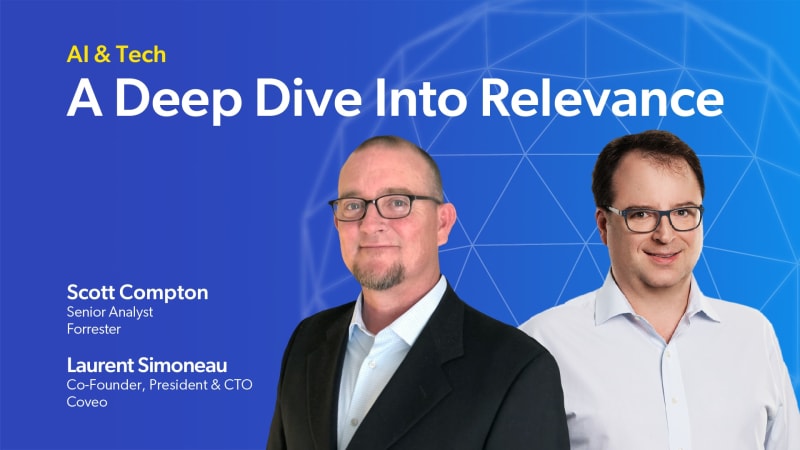
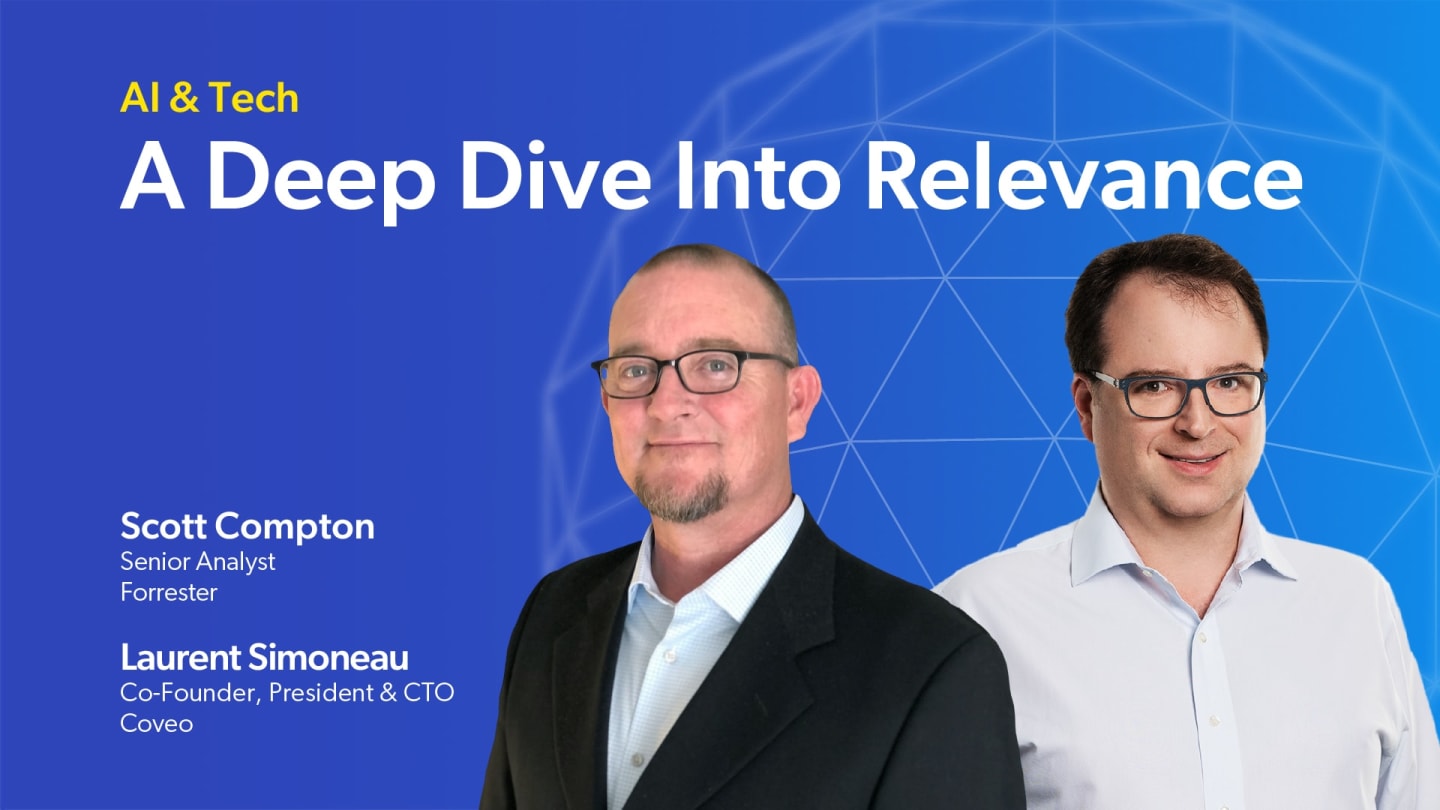
AI & Tech : Une plongée en profondeur dans la pertinence
In this talk, Coveo co-founder Laurent Simoneau interviews Scott Compton, Senior Analyst at Forrester, about the challenges of delivering true relevance, including personalizing experiences for anonymous users. Plus, they’ll dig into the AI and tech foundations required in a truly transformative relevance platform.