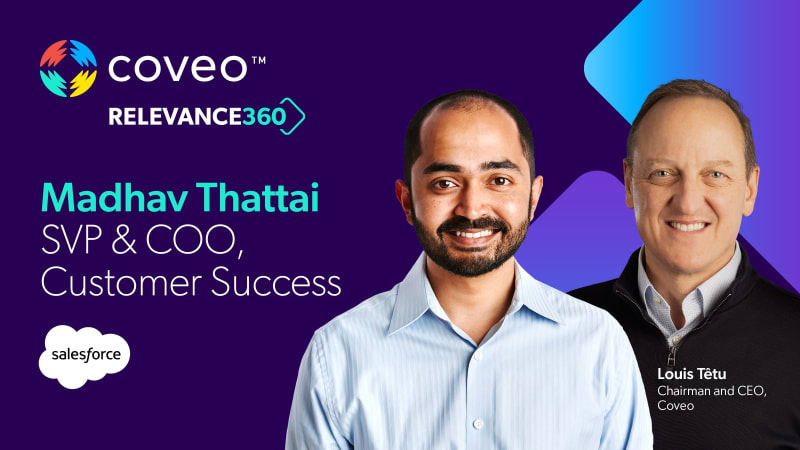
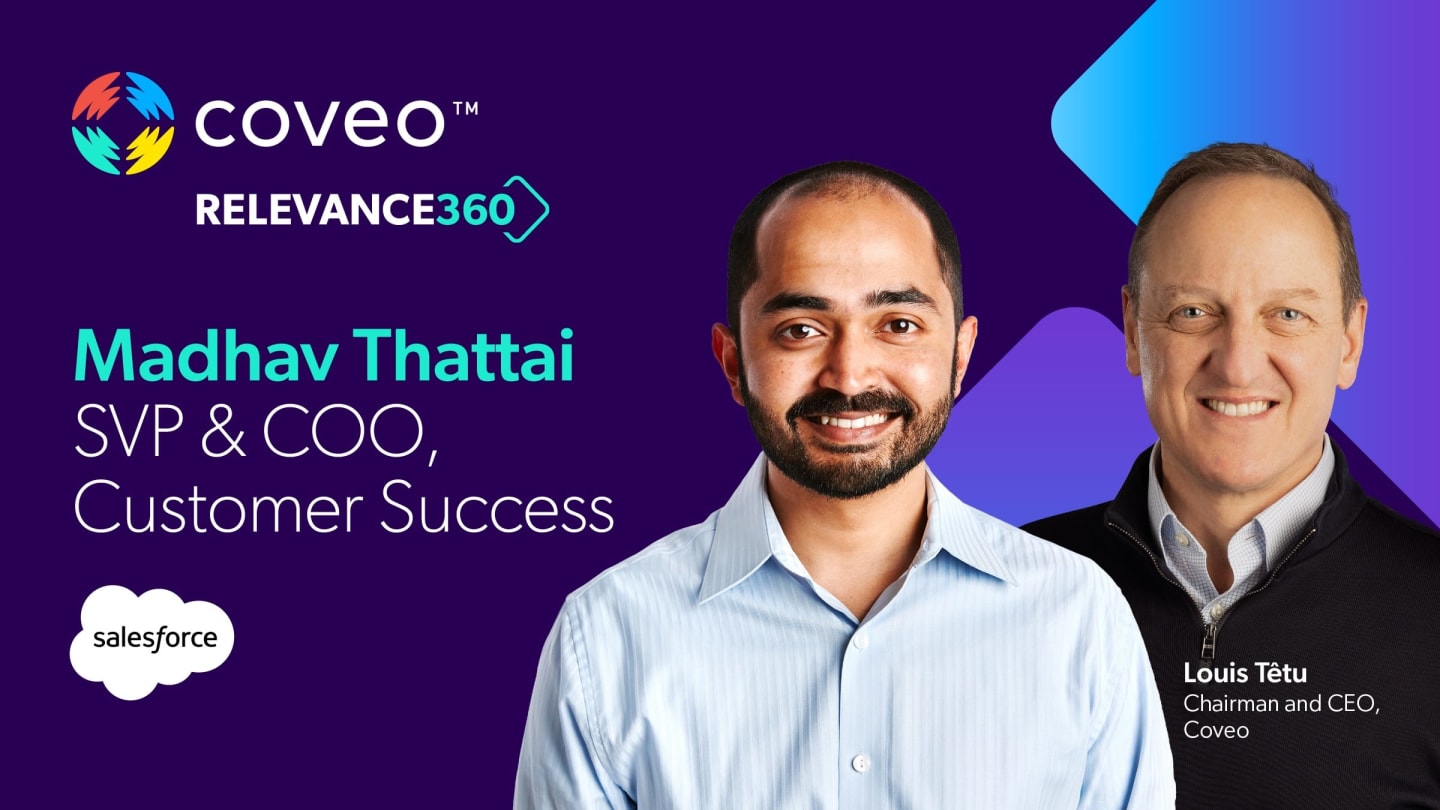
With me today, I'm very excited to welcome Madav Tathai, who is chief operating officer of Salesforce Global Support. Madav, welcome. Thank you. Really, really a pleasure to be here. Appreciate you having me. Madav, there's so much to say about your story and, and, and your experience. You worked at Dell. You worked at Google. You worked now as a as the COO of customer success globally at Salesforce. How does Salesforce think about its customer experience? What what what role do digital channels play today? Yeah. Well, first of all, I wanted to say another big, big thank you to you and the team at Coveo. We've we've gotten so much from this partnership, so it's a real pleasure to be here, to share a little bit of how we think about, our experience in customer success and, where what we think the future is gonna be. So when we start, thinking about our experience, it really starts with, our service offerings. So we provide, service offerings that we call success plans, that every customer gets access to. So our success plan start with, of course, our included standard offerings, which have a heavy emphasis on self-service, and self help resources. We have our premier offering where customers get access to twenty four seven technical support, developer support, more technical capabilities, and start to be able to leverage some of our more proactive capabilities around, expert coaching and education and learning, which is really important to our, to our customer base. And then our talk to you, of course, is called Signature, which is for really our large and complex customers, getting them access to named resources, technical account management, really proactively addressing, any issues they have, helping them get to the best implementation, the best outcomes from their offerings. So that's really where our experience begins. Underneath that experience are a multitude of capabilities. And so when I think about how we design that experience for customers, it's really along two axes. One axis is the multitude of channels we have. So we've got all of our self-service channels. So think about in app capabilities, our web capabilities, our community, social channels, and then transitioning into your traditional assisted human support channels, which, of course, chat, email, phone, all of the ways in which we interact with customers. So that's one access is the channels. We also think a lot about how we interact with customers. So as you know, customers initiate conversations with us. They wanna engage with us to understand something or something isn't working that we can help them with. And so there's kind of a reactive motion where we respond to a need from a customer. There's also very importantly a proactive motion where we anticipate that the customer has a need and how do we get ahead of that need for customers. And so that's a very critical and important part of our experience, particularly as you get to premier and signature, offerings. And when I look at those, those quadrants of that experience, whether it is, digital or human, whether it's reactive or proactive, far and away, the most interaction we have with customers is on digital channels. So to give you a sense of scale, we have well over a hundred million engagements that we get with customers on digital channels like our help portal or community, which are very, very active ways in which customers engage with content from Salesforce or with each other. You put you you you juxtapose that with our actual support cases that we get every year, which is in the range of a little over a million cases. So, really, over ninety nine percent of things that we are doing with customers exist on those digital channels if you add up all the ways we communicate with, with with people there. So just a massive, massive scaling opportunity. Our customers love the ability to self serve. We have the kind of product where people wanna quickly learn, get educated, develop, and move on to the next next best thing. And so digital channels, I think, are a really, really significant strategy and an important scaling, scaling mechanism for us. Wow. One hundred million engagements and one million cases at that that scale, on a global basis, obviously. So when you when you think about that, you know, we've worked together now for years. How has Coveo AI platform helped Salesforce deliver that experience? I mean, we know that, you know, we work together within the product. We don't even sometimes want the users to leave the product, then they can go on the Trailblazer community and, and get self help and ultimately carry that experience into service cloud, into the contact center, and linking into Trailhead and so on. So how have has what was the role of AI? How has AI helped Salesforce deliver an experience that increased customer satisfaction while lowering the costs? Because that's a key consideration. Yeah. We've had some incredible progress that we've made, you know, partnering with, with critical partners like yourselves on on how we improve these experiences on these channels and, really, as you said, through the life cycle of the need that a customer has. And so I'll give you a few examples. We've made a lot of improvements on our help website. So the help website alone gets well over sixty million engagements, annually, and customers are typically coming to help because they're in search of a critical piece of information. They wanna understand how they solve a problem. They wanna use that as a way potentially to contact us for support for something more complex that they're not able to solve themselves that they need our help with. And so really, really critical path for customers and a critical journey for customers. We've revised the stack and the technology stack completely on our help portal here, over the last year or so, really driving better satisfaction for customers, better content generation for customers, and the role of our search experience, which is something that we built, with your team. The role of our search experience is really critical. Customers wanna get quick information. They want access to a multitude of content to be able to serve whatever's best for them. And so we've seen a dramatic improvement in click throughs, on search to make sure that customers, at their time of need, are really getting to the right channel, getting to the right content at the right time. So better CSAT, better performance on our website with our new stack, better click through on the content, a lot a lot of great improvement, on the help website, kind of a critical part of our, part of our experience for customers. You mentioned service cloud. Obviously, our internal engineer experience, is extremely important in the same way as we wanna be able to serve about content quickly for customers. So we partnered with your team, on our internal search experience as well, implemented within service cloud so that as our engineers are, dealing with a particular issue on behalf of a customer, how do they quickly get access to the entire knowledge base? How do they get access to all of the content that might be available outside of the knowledge base? How do we make sure that we're able to give them the best suggestions, the best recommendations for them to really be able to supplement their own knowledge and take those right solutions to customers? Again, seen a lot of improvement from a performance perspective, a lot of improvement from usage, for our engineers, which is really validation that our ability to surface that information for them at the right time in the console, has really helped them. So, again, huge wins on the service cloud side. A third one, which we've been really, working on here more recently, is our case submission process. So anybody that has been through a case submission process knows what you don't wanna deal with is multiple pages, multiple questions, a whole lot of information that you want to that you wanna put into that. So we've done a lot of work to simplify our case submission process. We took it down by some eighty seven percent in terms of the number of questions the customer needed to answer. And, really, the way to do that is to make the submission process more intelligent. So as a customer is giving you information about what their issue is, can we dynamically figure out, okay, what kind of case is this? Which product are we talking about? What kind of issue are we talking about? Let's give them suggestions so they don't need to spend a lot of time trying to figure out, well, how do I classify this thing? Where do I send it? So that's been a really big innovation. Also, we've also started to work on giving customers content during the case submission process. Now we have to be careful about this because a customer at that point wants to make sure they're able to get some assisted support, and we wanna be able to provide that for them. But there are instances where providing the right content at that at that time, it might be something a customer hasn't seen before or they haven't searched for. Let's go surface that. And if it helps them, go solve that issue. Great. Otherwise, let's get them to a human to help them. At each of those stages, really great work, I think, between our teams at Salesforce and your team at Coveo to go implement those solutions, build the right technology stack that is high performing for customers, but also driving the right outcomes for them, at each stage of that, of that journey. Well, it's really the power of AI, in fact, to personalize knowledge, from multiple sources in in a way that that drives that self-service intelligence and and and removes the friction, obviously, creates these these highly highly efficient and effective, experiences ultimately leading to to deflection. Look, how do you envision the future, of digital customer experience given given right now all the excitement, and and democratization, that's happening in the AI space, including around chat GPT and the the rise of of expectations around conversational experiences, as a complement to to traditional search and, and so on. How do you envision that the paradigm shift and and the future? This sounds so exciting. Yeah. It really is. I mean, we couldn't be more excited, I think, about what the future of customer success is as a function and a capability at scale, in enterprise software companies. So I wanna step back for a second because I think we've gone through an evolution of how we think about the notion of customer success, over the last year. Traditionally, in the industry, people typically think of support, and they think of customer success, and they think of education and training services as three separate capabilities. Our view is there's a huge opportunity to bring all these capabilities together, and that's really what we've done. So when we talk about customer success at sales at Salesforce, we talk about the things that that customer success would traditionally do to help drive adoption, help drive growth. It's also the things that support us to help educate customers, help solve their issues, but also the things that that training and learning and education capabilities would do to really drive that expertise in the customer base. So one thing we've done is put all that together. As we put that together, we've also changed the notion of how we think about customer outcomes. If you think about, success organizations historically, they've been held accountable to well, are we driving attrition? Are we driving growth? In our view, those metrics are really important, and we want customers to be loyal to us. But those metrics are really about our success as a company. What we really wanna anchor on is is the customer successful? So we've been experimenting with a new concept around customer health. How do we think customers are using our product? Are they actually able to get value out of it? Are they engaging with our capabilities and our services? Things like the things we offer in success plans, and are the products performing for them? Are they available? Are they performing at the extent that they need in order to drive their outcomes? Being centered on customer health, we believe, is really the next generation of customer success capabilities, balanced out always with how we're continuing to drive growth and success for customers and for the company, but really critical to focus on customer health. When you think of this notion of customer health, where that leads to is we wanna be able to drive the right experiences for customers at the right time based on what are we seeing about their health at any given point of time. So the opportunity for AI in that framing, I think, is just significant and massive. I mean, I don't think we can Coveo overstate it. Foundationally, we should be pulling in all of these signals we have about customers and making intelligent decisions about what kinds of experiences do we wanna drive for them. That, I think, is a significant opportunity in the AI space to say, do we understand from these signals? What is it that this customer needs? What's the best channel to deliver it on? What's the best content we wanna send them? What's the best engagement we wanna do with them? So significant intelligence opportunity, I think, foundationally at the data signal intelligence layer to orchestrate these experiences for customers. And then at the channel layer, to the examples that you gave, AI driven experiences, particularly on digital self-service channels, I think we're just scratching the surface of it. Using these orchestrated signals to actually drive an interaction with customers using better chat capability, better search capability, better integrated capabilities across the life cycle, I think is really, really critical. We we really see a future in which ideas like a search modality or a bot modality all really come together into a single conversation based interaction with customers where we're able to supply them not just here's where you go to find the information, but let us give you the information directly. Let's answer the question for you. Let's put it in a way that it it suits the environment and the context in which it you are searching for it and it's personalized to you. So significant opportunity, I think, for AI there. I really think from our perspective, there's kind of two big things that we wanna focus on here, that I think are opportunities for everyone. One, how do we think about this single data layer that can actually drive all these experiences, I think, is a massive opportunity for the industry because you want that in order to be able to drive better decision making across all of these channels. The second thing that I think is really critical is we've thought of these AI use cases as independent use cases. So let's give you a use case for AI when we are interacting with a bot. Let's give you one for kind of content suggestion. Let's give you one at these other parts of the journey. It's really gotta be one. You really wanna be able to tie all that together based on what the customer needs, who the customer is, what their context is, and intelligence about what they might have done already or what they might have worked on, what they might have tried so that at each step of their journey, we're really giving them a comprehensive opportunity there. Again, I think significant opportunity for AI at kind of every layer of this journey that I think is gonna unlock a lot of value for customers. And and and, Madav, how how when when you think about that, when you think about not only the scale of Salesforce, but, you know, obviously, you guys, you know, are operate at a tremendous scale. You talked about a hundred million interactions and a million cases and etcetera. But, you know, even even even a a a smaller company, how could you possibly or how could you possibly deliver such an experience without AI? How could you deliver a million different experiences to a million different individuals if you don't have AI? Do you think that's gonna be possible? No. I don't think yeah. I think you're exactly right. I mean, even if you step back and think about both the evolution of support and success, traditionally, a lot of the value has accrued in the human interaction, and that human interaction is still extremely valuable when you have, a technical account manager, when you have a success manager, or you have a senior support, engineer or architect that's interacting with you. There's a tremendous amount of value that customers get from those human interactions. However, scaling those human interactions to the extent at which we need to is simply not viable. It's simply not something that we could do in a way that we could, a, operationally run or, b, be able to provide that scale with consistency and quality to customers. And I think particularly for smaller companies that are thinking about this, as you wanna scale your business, I think you really have to think about some of these technologies and creating some of these experiences for customers up up ahead so that you're not in this boat where you are attempting to solve these problems by by by scaling up humans as quickly as possible. It'll be much, much harder for a smaller company to be able to do that. And so these technologies, I think, allow companies at earlier stages as well to be able to scale that experience very quickly across a a high growth of customers. Now we're we're also we're also collaborating together on the app exchange, in this case, to to create a better a better, apps recommendations journey on on on on that, huge marketplace of of business applications. We're also collaborating on Trailhead. Do you see a future where all this comes together in the context of a customer interaction even within the product? You know, you're gonna you're gonna prescriptively be able to, maybe anticipate issues, help the customer, in a proactive and prescriptive fashion, but also potentially recommend, the next Trailhead badge or or or an app, that could, from the app exchange that could solve a specific problem. Aren't these worlds all converging together? So we've absolutely flipped our notion of how we think about customer success. It is a valuable, valuable part of the experience. Now we don't exist independent of the product. Right? Customers want our products. They wanna use our products. But, we think of our services and our offerings as accelerants towards how do you get more value out of those products. Are you using them in the best way? Are we giving you the right support, the right education, the right capabilities at the right time along your journey so that you're able to maximize that potential? Completely agree. I I I do think that that's the direction that the industry will go. So service might very well be the gold mine, in fact, not so much a cost. Right? But, I think that's right. I mean, the other thing that I think is interesting is, as a use case to the point that you made, and I'm a little biased here, but as a use case for how we think about single data layers driving signals and driving action into a multiple multitude of touch points, I think there's a lot more to do in service than there is in the presale kind of sales part of the journey. Right? We interact with customers on so many different channels in so many different ways and so many different context. It's just a very rich area to to think about all of that together. It goes back a little bit to what I said before. I think as an industry, particularly in the in the post sales success and support industry, it's also incumbent, I think, upon us to not separate these capabilities out. To some extent, I don't think we've done ourselves any favor by thinking about success separately and support separately and education services separately in those kinds of silos. We think there's a real opportunity by thinking of all of those holistically, which then leads to how do you create these holistic experiences for customers in their journey. I think it's a I think it's a huge opportunity for sure. Well, that's why we created the Relevance Cloud. Madav, I feel we could speak for for hours and, and, you know, we've worked together for years and, it seems like, when we when we hear you, we've only scratched the surface. So we look we look forward. We're so exciting to, to our collaboration and shaping the future together and, and and, I think a very exciting future. Thank you again, and I'm sure, the audience really enjoyed, all your wisdom here. Thanks. Thank you so much. Really appreciate being here. Thank you.