
Folks, I'm delighted to be with you today. This was, I thought, a great session between Neil and Nick. And and really brought home how quickly well run e commerce companies can grow. And that's a great segue into next section. Which is, what do you do about managing customer relationships when you're growing that fast? We exist at Coveo because we want to accelerate the application of AI platforms within enterprises. So they can deliver great experiences profitably. And we're gonna spend quite a bit of time on that duality, during this session. For more than a decade, we've been involved in applying AI, working with leading brands across the world and helping them with it with our AI deliver great experiences. And and and and we believe that we've created from that perspective industry's leading platform. Why this is important is we believe that AI will be a tsunami. That possibly it will be perhaps even bigger or at least as profound as the Internet transformation. Internet democratized in in many ways. Access to information and access to people and access to products, services, and goods across the world. AI might be a very polarizing technology in a way that it will distinguish between companies that adopt it and companies that don't. And we've expressed many of these views, in in, over the years and and around how to deploy AI and how to compete with AI and and and and what are the means to adopt that. The bottom line is that customer expectations have been forged by digital leaders. The competitive bar is raised by non competitors, new entrants in almost almost every segment that changed the way that the experiences are are delivered. Personalization data and AI are really shaping the digital experience economy. It's no longer about digital experiences. It's really about experiences, themselves. And how AI and data can power a new set of experiences that is highly personalized, designed just for me. You know, the ability to deliver very coherent customer journeys and and experiences that are also prescriptive, prescriptive that can basically anticipate your needs. The key question is, how do businesses do that while at the same time making money? And this is a very big topic. This is here an article by McKinsey. I would say a feature article by McKinsey last November. And and that talks about, you know, using using data. That talks about how personalization itself has become a crucial capability. How now seventy percent of consumers expect it. But on the flip side, you know, how organizations using AI can actually achieve growth, can actually achieve benefits, profits, higher levels of customer satisfaction and so on. And that's really the balance that is the real opportunity within, you know, AI. We think that every business wants to compete in the experience economy. And in order to do that, they need to do essentially two things. They need now to serve all their audiences in the way that these audiences expect. And that means an audience of one, often times. And number two, what they need to do is they need to make profit. Because one doesn't go without the other. Personalization at all costs is not necessarily something that is desirable. Business is fundamentally at its simple, in its simple expression, it's about meeting people's expectations but through their lenses. And and that's what we call relevance. Being relevant to one person at a time, that's very possible. We all grew up may maybe in neighborhoods where we had the local boutique and the local clerk. And they understood how to be relevant to us because they were working with possibly a limited number of interactions and consumers. Leading businesses now are able to compete by being relevant to literally one million individuals at the same time. And this is what we refer to as the major move from persona to persons. The ability to serve one million individuals in one million different ways. And this is obviously only possible with AI. For one simple reason, is that without AI, you could end up in a situation where you're delivering personalization at all costs. And so you have to figure out how to deliver competitive experiences while at the same time optimizing essentially things like NPS and customer satisfaction on one side, but also costs and revenue on the other side. So let's look at this in the context of a customer service journey. You know, when we grow customers, when we grow fast, we naturally grow customers. And that means growing customer support needs as well. So here's the challenge. The challenge is as you scale up your customer acquisition. How do you make sure that your service and support costs don't grow as quickly? Basically, you're you wanna build profitable customer relationships, but you don't wanna do it at all cost. Is there a way to keep the support cost curve as flat as possible while revenue grows and while NPS grows at the same time? And that's fundamentally the change that technology and AI in particular enables. So part of the answer is about choosing the right channels. This audience, I believe knows extremely well that obviously a field engineer on-site visit towards one single individual is certainly, you know, much more costly than a digital than than a digital self-service interaction that solves a particular customer issue. So your ability to answer to a large number of consumers concurrently, obviously, is intimately linked to the choice of digital channels and and, you know, along along that curve. So digital channels fundamentally in customer service and agent enable scale. And and many of our customers have obviously realized that and realized tremendous amount of benefits by applying these these, these technologies through digital channels. So how do you optimize now the customer journey? What you really wanna do is look at how to optimize both NPS, Net Promoter Score or in plain English, customer satisfaction on the one hand. And then optimize your p and l on the other one. So how can you maximize customer n p s and satisfaction while actually reducing costs and even possibly finding opportunities for revenue in the p and l is really what we're interested in. Certainly as a company. So we all understand the benefits of self-service. And and and this is where you know, you can truly deliver prescriptive answers that, help customers solve issues. And the beauty of self-service is not only it can reach a lot of people at scale, you know, at a very low cost. But it actually, you know, data shows that it actually drives NPS up and customer satisfaction up. People would normally rather self serve in most occasions than than not. Case deflection is a key area where technology plays a key role. And and we're gonna talk about that. But, you know, how can you intercept a case a costly case submission, actually, before it reaches an agent by in real time as you understand the issue by using technology to proactively suggest solutions before that case is submitted. Obviously, as as the customer hits the agent and and and and talks to the agent, which in certain circumstances might be desirable, we'll come back on that. You know, there is an opportunity to leverage technology to make that agent more proficient. Obviously, understanding the context of that specific customer using technology, natural language processing, and contextual search to understand the specifics of that specific consumer. So that the agent can obviously, immediately, so he access the right content. And and so this whole idea of upscaling agents with proactive content in the course of a case submission is extremely, extremely powerful. And of course, taking that to field service and enablement. So sometimes, you know, a a an agent interaction will lead to a service, interaction in the field. And so how do you carry the experience? What's really interesting in addition to that is the whole idea of issue avoidance. So how can you essentially provide solutions in the moment of need, in context, right within the product. Because right now increasingly, most products, most most devices, most machines, and most, services in fact even are delivered digitally and have some form of digital channel to push content. And so, how could you possibly avoid issues and avoid even the self-service by providing the solution immediately within the product? And it becomes really interesting with the ability to to, optimize that because the cost of serve, obviously, across these channels is is really different. And as we discussed, the NPS is really different. So how do you think about optimizing that equation? And then how do you find within service data's, you know, opportunities for even even going further with which is issue anticipation, Which is the ability to predict problems before they happen and inform customers. And then finally, probably my favorite and and and what a lot of our customers are talking about and asking us is, how can you use data and AI to find revenue opportunities within service data? You know, in what circumstances can you turn service into revenue? So when we talk about the ability of data and AI to really optimize the journey, That's really what we're talking about here. So from, you know, the ability to predict issue and reach customers, with with proactive, information to prevent even even them having an issue, to the ability to drive self-service, which is which is again really an an an ability to drive NPS up and and lower the costs, you know, which is clearly an area where we should all invest heavily. To the ability of deflecting cases, so that, you know, you avoid the necessity of an agent in this case. To the point of making the agent more proficient at solving cases and possibly finding, you know, the opportunity for upsells in this case. So there are circumstances where self-service interactions might be actually better served from an overall p and l logic perspective by agents. Because agents might have the ability to sell something in certain circumstances. So how can we identify that? And by the same token, create a better agent experience so that agents are happy. We all know that being an a being a customer service agent is is often time a very tough duty. And and and so we've seen that, you know, technology that empowers agents makes them, you know, much more, not only not only, proficient to solve cases, but also happier in their role and successful in their role because they have the ability to solve customer problems. And so that ability to sell, to serve then sell is an ability that we're interested in at Coveo and that can bring, you know, a lot of lot of benefits. So it's about reducing cost, but it's also about, you know, bringing revenue. And then and then again, the ability of issue avoidance altogether. How can we what percentage of our service could be avoided altogether if we could inform customers ahead of the curve of of along their their journey. If we could create a real connected customer experience along the journey that would be, more proactive and and keep customers altogether out of the service, process. You know, the cheapest service is the one, you never get, in a way, and that satisfies, customers. So this is a wonderful segue into our next conversation, a conversation I was really looking forward to. I'm delighted to introduce my special guest, which is Jeff Harling from Zoom Video Communications. Jeff is the head of global digital support at Zoom, where he's built out a very scalable customer service program. And right in the height of the pandemic. Remember when Zoom's growth rate was really taking off like a rocket ship. Jeff introduced Coveo into Zoom and they just went live recently, but it's definitely not his first rodeo. Prior to Zoom, Jeff was at RingCentral, where he also led all digital support and was a great Coveo customer there too. And Jeff has a long history in service and support, having also served at Zendesk, Comcast, and Avaya. Jeff, welcome to Relevance three sixty. It's great to have the opportunity to talk with you. Thank you for having me, Louie. Really appreciate you guys taking the time out to to hear our story as well. Well, absolutely. Look. We're, first of all, we're mutual customers, and, congratulations on, going live with, Coveo with Zoom. That's quite an accomplishment. Yeah. Absolutely. And thank you so much for using Zoom webinars. I'm very excited to see We always do. We can use here. So I I, you know, I have, I have been in self-service for for the better part of two decades and, currently with Zoom for about the last year and a half, joining in late twenty twenty, prior to that with RingCentral for a number of years, heading up their digital support practice, prior engagements with, with Avaya, Zendesk, Comcast, and AT and T. All of those have been really focused on building out a relevant customer experience, always on the services side, really working hand in glove with our sales and marketing partners to to build a holistic experience for our customers. So with RingCentral most recently, I was, was a customer of Coveo's. I'm a customer of Coveo's again, with Zoom. And I have to say, my experience with, Coveo so far has been phenomenal. We've been using, Coveo Relevance Cloud and really, beginning to build out, this, Cloud and really, beginning to build out, this this personalized search that is, rife with recommendations and, you know, great capabilities around, that intelligence search across the entire enterprise and the entire customer experience. We just rolled out with Zoom, just about a month ago, already starting to see some successes. Very excited about what we can do, here at Zoom as well with Coveo. Well, we're gonna talk about that. And, thank thank you for for the kind comments. Our team works, so hard, but our teams, work, so well together. So thank you for your your amazing leadership there. Before we get into the details, I'm sure the audience is curious, you know, what brought you to Zoom, you know, right in the midst midst of a pandemic? I have to say, joining joining Zoom in the eye of the storm, post COVID or during COVID, was was was quite the experience. Certainly, you know, certainly facing, what Zoom what what Zoom might be like working for them, you know, leading up to my joining Zoom, in twenty twenty. I there was some fear for sure because there was so much going on. Zoom, as a company, was just catapulting itself into the stratosphere and, you know, coming from an IPO just a little over three years ago to to where we are today. It's it's been a phenomenal journey. I have to say, you know, coming into Zoom, I certainly was, was thinking about, how we could address, what was happening with COVID. What was what was going on with the user experience? How they were interacting with Zoom and really necessitating, response from Zoom to help them with their, you know, their home office setups, help really create a relationship with them. I would say that that all of that happening in the midst of, you know, what I equate to a hurricane, you know, was was it's it's probably something historical that that few, if any, companies will ever experience in business again. So, you know, stepping into this space, it was exciting. It has been just adrenaline pumping nonstop since I joined. I can tell you we're we're not slowing down. Zoom is we're continuing to to dominate, and I I think, you're gonna you're gonna be seeing so much more from Zoom. And and and and that it's amazing. As you said, you came you used the term the eye of the storm, you know. You you suddenly literally became the one app, the one most necessary app. You know, I remember, you know, school children's and, you know, count relying on Zoom, you know, for classes. And, you know, basically, the ability to scale and deliver that all over the world. I mean, behind the scenes, it it must have not been easy. You know, what were the key challenges you had to tackle? That imagine a, a a the one support organization that's used to dealing with a certain level of interaction with our customers, and then suddenly, almost overnight, the the number of interactions going up by more than a hundred x, it was it was phenomenal. Again, you know, I think historical is probably putting it a bit lightly. But but really seeing the impact that Zoom has made just globally on our culture, on how we how we engage with one another, in our personal and our business life. I I I think, our CEOs famously said, you know, we're we're we're with, we're with our customers in in every aspect of their life. We're there with them to do their job as well as we're there for births and funerals and weddings and birthdays and all of the activities in between. So as you can imagine, those customers are are looking for, looking for responsiveness from Zoom that is, that is is second to none. Low level of effort, simplistic, straightforward, quick. And and I and I have to tell you, one of the most overwhelming, feedback that I was receiving is, like, in my neighborhood are a number of teachers, and them coming to me and just saying how thankful they are for for what Zoom has done for them and for their students and their ability to continue teaching and really, you know, keep continuity, in their lives, in the lives of those children, for example. So it's it's it's and and it's amazing. It's, it's it's really heartening to to hear that. And, and, you know, it's when I think about that, and you're right, it's it's it's literally going from, you know, one to one hundred x literally within thirty to sixty days and and and so on. So thanks for sharing the challenge. It's, I can only imagine just the the scale, you know, operating at that scale. It's it's a it's a it's a great question and and it was one that I I asked many times, through the interview process and to joining, prior to joining Zoom. I knew coming in that that this was gonna be a tall order. You know, Zoom, was was a toddler, you know, vaulted into, teenager status and young adulthood, as you said, overnight. So building out processes and platforms and, really understanding where our gaps, existed. Just some of the most basic functionality had had not yet been, developed or put into place, like it would in any kind of organic growth that you might see within, businesses over years and decades. So so certainly, right away, you know, doing an immediate analysis of of of what we had and what we didn't have, and frankly, where we could do better. I think that that was probably the first set of key challenges. And I think that, you know, that led into building out prioritization of how we deliver this. If you could start a company from day one and being, you know, been given a, an order to to build out a customer experience, you know, what what are the things that you would think of first? You know, certainly building a website, building an amazing experience for for folks to come visit that is both mobile and tablet friendly, building out, massing, content and, ensuring that that content was, you know, robust, solved the majority of our customers' needs, created an experience around that that was simple to use, maybe personalized if you could get there. But none of these things happen overnight. There was an incremental process that we had to follow to begin with the website and the content and then build from there. And that's that's really when our our key challenges what our key challenges over the last, year and a half have been. I've been building out the space from from almost nothing. Yeah. How how does Coveo fit in in in an environment like that, you know, and and and into your plans? And and, and and and we'll talk about, you know, specifically the road ahead and and the future of AI and etcetera. But how does that how how, you know, what what do you have in in store and, and and how did how do we fit in in that environment? Well, if if the user experience is the is the body and the content is the the blood through the bloodstream, really I like it. A platform like a platform like Covea really is the it is the central nervous system for us. You know, we're building out AI and AI capabilities, you know, expanding our chatbot, experience. We are, you know, we are becoming more search centric. We were not search centric before. It was very, very difficult to, to find content or to to, you know, come to our website, search across, any of our experiences for Zoom. But now that that with Coveo's help, it's is much, much easier. So now that we have this, as I said, central nervous system, folks can come in. They can pretty much find any content from any location, and that's and that role is expanding for, Coveo for us. That that I think is is is really where it begins. So get get customers to the most base their most basic need, which is the the solutions to the answer or to the question that they're they're asking. Right? So so bring that to the forefront first. First. And then the next stage is for us is really how do we then take that experience and wrap it around the customer? How do we how do we make it a a more personalized experience? Anticipate, certainly, who they are, what segment of, the audience are they part of, what geographic location, all the demographics that come with anyone that visits this experience. And then and then anticipate maybe based on, you know, prior searches, prior recommendations that they've, they've leveraged, so forth. And then, build a build a predictive model around them when we come in. We welcome Louie to the website or to the experience. We, anticipate what you might be here to ask for. We might associate it with some existing cases that you have open, potentially some recent interactions with our sales team. All of that really comes into an algorithm that, you know, builds out the, the most embracing experience possible. You guys are right at the forefront here. That's that's impressive. What what would you do differently, if anything, you know, next time around, you know, for the folks on the call here? Well, certainly, I would have invested, in more Zoom stock earlier on. That's for sure. We all would. We all would. If I could time travel back to two thousand nineteen, I think I would have played a bigger role there for sure. But but I think that, you know, each time that I've I moved to a new organization that is really, you know, kinda junior or really evolving around the space of of user experience and and the customer experience. It is like going back to kindergarten all over again. As you can imagine, it's it's, you you take the experience that experiences that you've had. You take the lessons that you've learned. You take take the the things that have gone wrong. You you you adapt. You, tune, and you build based on that. So I'm a builder by nature. I love to do home improvement projects. I love to do, I love to do, you know, landscaping. Anything that involves tearing something down to the to the to the skeleton, to the to the studs, if you will, and re envisioning what it could be and rebuilding it, in a better way that it's more, more more efficient, more useful, more pleasant. Just really a more abrasive experience. So I think what I've learned with getting back to your question, is that is that you you cannot underestimate the power of the customer experience. I think that that it is more important for you to build up where you want to be and then lay tracks to get there than it is to build from organically from step one to step two to step three. You really need to understand what direction you're headed with your customer experience, which which certainly means coming in immediately understanding your customer base, understanding the users that you're looking to support, your partners, if there are any, etcetera. And then building out what that end state vision should be. And I think that, lesson learned there is you cannot underestimate the power of of understanding where you're going, and and, of course, your stakeholders, Marquise. Well, Jeff, we we we we certainly it's it's it's loud and clear that you're very passionate about this, and, and that's why you're right at the forefront. Look. Tell us your big idea, if you can share your big idea for the for the future of of, of the connected, customer service journey and how to optimize it. What's your big idea? So, Louie, that's a that is a outstanding question. One that I'm always happy to answer. I I will tell you, I haven't been in the customer support, space for for two decades. I I I think that customer support has is generally has a, a bad rap, if you will. It's a it's it's assumed that it's a, a means to an end. It's a place where where customers end up when they can't get a the the answer, to their question anywhere else. They chat. They call. They email. And, ultimately, it's an it's an answer provided to them, hopefully, and they hang up and and they move on. But, you know, customer support is is not is not the caboose on the train, that it used to be. Customer support, it it is an opportunity for us to bring customers into a space, understand the really the challenges that they're going through, and be able to to to define or infer opportunities from that and convert them. So innovating in such a way that customers really enjoy their customer support experience, they almost look forward to it despite the fact that nobody really wants to ever have a problem understanding or, you know, bumping into issues or errors with any platform that they use. But when they do, the experience should be overwhelming for them. They should be they should leave that experience deep and be ready, and and primed to to think about how they want to adopt and use your products even more. And in our case, for Zoom, ultimately, the big idea that I have is is is really engulfing them in an experience that brings them back, puts them in a space where they're they're ready to convert, they're ready to enhance their their Zoom adoption, buy more products, spend more time with us, be more loyal. And I think that ultimately that that we all win in that, in that, idea. Wow. I feel we could talk, for a very long time. Jeff, you're passionate. You're an innovator. You're a great leader. And, you know, to us at Coveo, it's a real privilege to to to to work with you on that journey. So on behalf of all of us, I wanna I wanna thank you for being with us today and being so so generous. And I'm sure, you know, everyone in the audience learned so much and, from you. So, thank you again. It's been a it's been a true honor. Thank you. Thank you to the Coveo team as well. I I really appreciate, and, looking forward to a continued partnership with Coveo. Thank you. Wonderful. Likewise. Bye bye. Have a great day. I thought this was an amazing conversation. So thanks again, Jeff. So we now wanna move on to talking about, you know, the the AI opportunity in business. And and, you know, I wanna say right out of the gate here, we're not talking about an opportunity. We have a strong point of view at Coveo that this is about an imperative, and and we're gonna talk about that. The AI opportunity is not limited here to relevance and personalization at scale. We actually believe that increasingly in business, this is table stakes. The real opportunity to use data and AI is in the optimization of personalization to maximize business outcomes. This is what digital leaders do. What's happening within enterprises right now is that experience, we see it more and more. Experience is at the epicenter of the digital transformation conversation. It's actually becoming more and more even a boardroom discussion. What can be more important in business than serving people well? And it's certainly a good place to start to earn revenue and and earn a position in any market. Now, within the experience conversation at the core of it is personalization. One can't go without the other because the minute you talk about experience, the minute you quickly realize that what people really expect and experience is about meeting people's expectations first and foremost, our personalized experiences are to be served individually and oftentimes in even prescriptive ways. You know, software technology that actually can help anticipate needs. Now, the more mature companies, or I would say the early adopters of technology in almost every segment have also made the p and l and the margin conversation right at the core of the personalization conversation. The reason is very simple. The cost of personalization can be very high. Can be sometimes too high and actually affect the p and l. We're gonna show you some examples of that. And the loss of personalization can also be very brutal. In terms of loss of revenue, loss of customer NPS, loss of reputational capital, loss of margins. Only data and AI can solve that challenge. It's that binary. What you're up against right now, obviously, is a macro environment first and foremost. And there's no shortage of external headwinds. But the reality in addition to that of every company is is to is to figure out how to compete profitably. Because at the end of the day, it's not only a digital war, it's it's obviously a war for efficiency, for p and l efficiency as we discussed. So the reality of most companies is that e commerce profit is a challenge. Most companies don't make a whole lot of money if any online. Because for one reason, Amazon sells costs for the simple reason that Amazon makes most of its money, not actually on on commerce, but on digital advertising. And we can talk about that later on. Price comparison shopping. So it's easier than ever to buy online, buy on price alone. Merchandising rules simply don't scale. Rules that even merchandising teams were using five years ago no longer scale. You cannot deliver on individual people's expectations by programming rules manually. It's just too much, especially within large enterprises. Recommendation tools are not geared to optimize business. And we're gonna spend quite a bit of time about that. And personalization tools either. They're not designed to optimize margins and returns. Things like returns and many other things are eroding margins, you know, more than ever. And so personalization needs to be optimized again along the customer journey. And so it's really a matter of leveraging AI, and and that's really our vision for the future at Coveo. And what we're working on and what we've been working on was really this whole idea of not only delivering personalization, which frankly, we've been doing for a decade. But really thinking about how to optimize personalization to maximize outcomes. So if you think about commerce, it's about delivering person of course, giving people what they want and delivering them, you know, personalized experiences that convert. But more importantly, you know, how you do that while making money. In customer service, we already talked about that earlier and we talked about it with Jeff. It's about maximizing NPS and CSAT, but not at any cost. You still have to make money and actually figure out how to impact the p and l. And of course, you know, broadly, you know, within digital experiences, it is about creating experiences that drive value in terms of employee satisfaction or user citizen, patient satisfaction. And and and and probably enabling more self-service and proficiency. But you need to figure out, you know, how that also impacts metrics, which are really the ultimate most important metrics of any business, which are cost, revenue, efficiency, and ultimately, long term customer value. So our point is very simple, is that there is no way to balance that equation without using AI and data. So from that perspective, I made the statement at the beginning that AI was an imperative. AI is an opportunity. Yes. But it's also a threat. You can use AI to compete in business, or you can decide to compete against companies that will use that competitive advantage. And the and and and basically, the sum total of that equation is fairly binary. And and, I would refer you to, something I read during my last holidays, which I would highly recommend, which is the latest book from Eric Smith and and, Henry Kissinger called the age of AI, Which precisely talks about the fact that the world will be divided between companies that use AI and companies that don't. And we know pretty much, you know, how that equation will unfold. Customers have to deal with company silos. So they deal with a number of systems of engagement. You know, they'll go through websites and then commerce channels and be transferred over to service. And ultimately, you know, kind of a customer lifetime experience. And that tends to be waterfalled in most organizations. And we all know over the past couple of decades how the systems of record underneath were built to support those. What we're talking about here is a new layer of software that we refer to as systems of intelligence as opposed to systems of engagement and systems of record. Systems of engagement that can actually consolidate in very agile ways. Data and signals from the record layer. And and signals from the engagement layer layer. And then return into the engagement layer the right set of decisions that drive personalization in a profitable way. And so if you think about examples of that, you know, if you think as as it applies, you know, we'll use commerce examples here. You know, managing leaders manage to trade off, for instance, between delivery cost and return cost. So you can't just think about a customer value model in terms of the revenue that a consumer brings and then stop there. You have to factor in, of course, the margin. If a customer always buys at a heavy discount, that's probably not a good thing. If a customer, you know, is is is buying things that, you know, carry a large delivery cost, And then in turn, if that specific consumer has a tendency to return things more often. Well, this needs to be factored in the equation as well. So how would you recommend the purchase experience differently if you knew that a customer had a propensity to return more of what they do? How would that change, in fact, the relevance and how would you adjust the experience? How would you recommend differently a set of products if you knew that the that specific consumer would have a propensity for in store pickup? A TV is a great example. Most people will shop for a TV online and immediately they'll jump in their car and go and pick it up. So knowing that, would you actually promote something that's out of stock? Or for example, would you promote something that's overstock instead? So that, you know, you know that the cuss that consumer will come and pick it up, and that you'll actually be able to use your overstock in a more intelligent way. And make sure that, you know, you're not luring the customer elsewhere because you're out of stock. And so those are very pragmatic, very simple examples that show that actually using data, you can actually dramatically impact the p and l. Some consumers may not be attracted by promotions that you offer. May not be, you know, turned on by, you know, the buy one, get get buy three, get one. May not be, you know, lured to that kind. And and instead, you know, maybe prefer to treat be treated with some form of invitation or or in more exclusive ways as you can see on the right hand side. And so the ability to identify that given their historical buying pattern and and behavior can be of immense importance, you know, for the p and l. And, obviously, if consumers, as you figure out, wouldn't see much of a difference between from a utility perspective between two products, how would you change the experience using data and AI to actually recommend products that have that bring a higher margin to you because the consumer at the end of the day wouldn't even see any any difference. So those are examples where, you know, this, you know, the the the ability to look into data and look at the complete consumer, profile in terms of not only revenue and margin, but also in terms of cost to serve, in terms of loyalty, in terms of propensity to either buy or return as an example, may have a huge impact. And this is where we think that AI and data will come in, now and in the future with much more powerful solutions to the point where companies that use that and think about that will dramatically outperform those who don't per my earlier reference, of the McKinsey, writings in fact. And ultimately, it's about understanding the complete customer life cycle. You know, Amazon after three shopping experiences builds a model, a long term customer model of me. And understands actually at about ninety five percent accuracy, what's the likelihood that I'll bring a certain amount of margin over the next three years to them? And because they understand the customer life cycle, the entire customer life cycle and can actually move. And this is this is a great example within an insurance business where we can actually move a consumer from a single product. And then understanding life cycle and life events, propose, in fact, a number of products in a very timely fashion that will actually hit the p and l in a very positive way. And avoid costly acquisition cost for other consumers that we don't have. So bottom line is we believe that over the next years, this is very exciting that that a personalization will leverage AI and data in new and unique ways to really understand the entire customer life cycle. And that's where what we're at work on every day, to continue to build. But already today, you know, we can do things like optimizing ranking personalization and recommendations and a whole digital experience content and experience. And really individualize it, but in a way that can create not only higher shopping conversion, but really revenue lift. That can, you know, introduce AI in real time in merchandising so that we can do real time badging for it as an example. And multiple apply multiple, personalized techniques that ultimately are designed to maximize margin. If we if we can consume the margin data, ultimately, we can factor it in the models. And, and and create experiences that maximize margins and ultimately understand each and every customer, each and every consumer, you know, from things like returns and, and propensity in ways that can can really substantially, improve the business. And so at the end of the day, the conclusion and my takeaway of all this is that it's a balance. That personalization alone is not sufficient. And that AI and data is really gonna be a revolution, is already a revolution in every segment in the sense that it can create and manage the optimum balance between personalization and profits. So I wanna finish this presentation by giving you a little bit of an update on Coveo. And and we talked about it abundantly, you know, why we exist. We're in this very exciting category here of of of leveraging AI. And this is really our mission is to accelerate the adoption of AI within the enterprises so that they can deliver great experiences profitably. And that to us is is is a mission that we're committed to and one that is extremely exciting. And we're trusted and we have the privilege of working with some of the leading brands in the world for both shopper personalization and then, you know, as well as, service personalization. And ultimately, our goal is to tie it together and and and create the ultimate, data and AI platform that will optimize, the entire customer journey, to maximize the business. We're very proud of the company, since the last time, we did Relevance three sixty. Most of you are probably aware that we're now a public company. And we stand at around seven hundred and fifty people and six hundred customers globally. And a hundred and fifty systems integrator partners that work with us to deploy AI, but not only to deploy Coveo as a platform, but really to expand it and optimize the benefits, afterwards. Because once Coveo is deployed, we can obviously leverage the data and the AI to continue to optimize the p and l. What we're really proud of is our ESG. And I wanna, talk about that today is upon IPO, Coveo actually pledged one percent of its employees' time, one percent of its global data processing and AI capabilities and products. But also one percent of the entire company equity to worthy causes, especially around the democratization of education and knowledge across the world. We think that knowledge and education are the ultimate equalizers. And we're also continuing to invest very heavily in research. Coveo has been, over the past two years, one of the most prolific organizations globally in terms of publications in, in AI research and and multiple scientific publications around AI semantics. The use of machine learning and deep learning in business and, and customer experiences and so on. And you see some examples of that. And we're very proud of our team and our ability to bring that into our products. And so with that, I'll turn it over to Laurent, who, will talk to you about the Coveo relevance platform and really the road ahead. You know, what some of the capabilities are today, but really how we're thinking about the power of AI and and moving along this exciting journey. You know, with the platform, but specifically in the areas of commerce and, and customer service and ultimately linking the entire customer journey together.
Établir des relations rentables avec les clients grâce à la pertinence
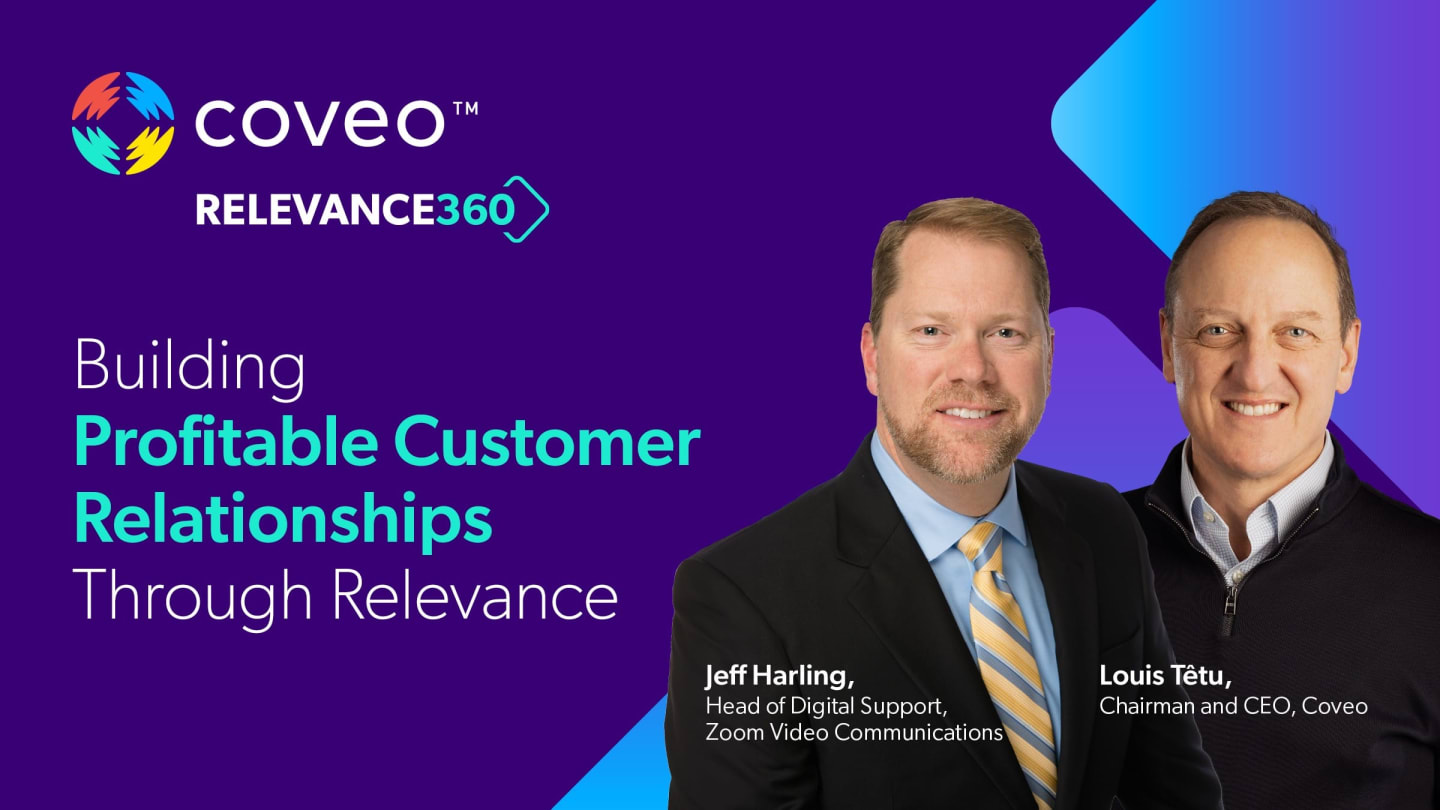
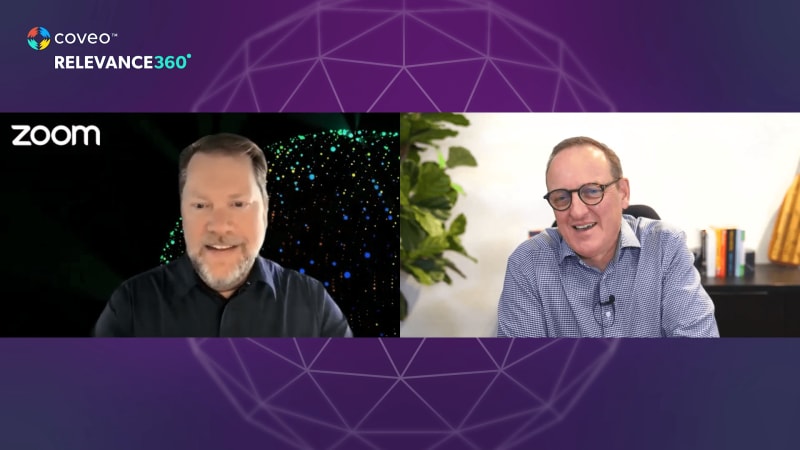
Jeff Harling, Head of Digital Support at Zoom Video Communications, joins Coveo CEO Louis Tetu to talk about how Zoom scaled its support to meet literally millions of customers' needs during Covid. Harling relates how leading enterprises are taking a holistic view of customer journeys. This helps maximize long-term value by acquiring, serving, and keeping customers happy, with relevant interactions throughout.
Here are some insights they explore:
- How AI can provide insights on revenue opportunities within customer service and support
- Why customer support isn’t the caboose on the train; (it’s an opportunity to understand customers better – and convert them)
- What Zoom chose to prioritize - as it scaled to 100x growth during the pandemic
- Why an AI-powered relevance platform is like the nervous system for customer experience