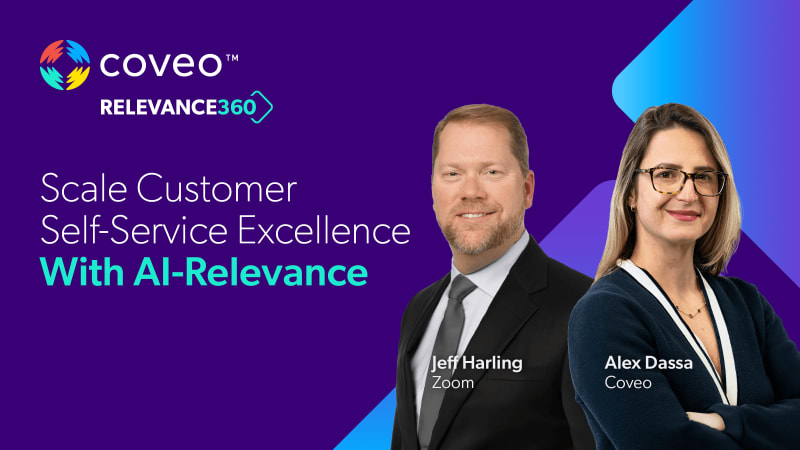
Hi, everyone. Well, thank you for joining us today. We're here with Jeff Harling from Zoom. Everybody knows Zoom. Everybody's familiar with it. We're using a Zoom window right now. Jeff, tell us about your role at Zoom. Hi, Alex. Thank you so much for letting me join you today to talk about this. I I'm I'm I'm super excited. So my name is Jeff Harling. I am head of the global digital customer experience for Zoom, which includes our all of our digital support assets, our support website, our chatbot, AI practice, as well as our content knowledge management, search engine optimization, Zoom community, and our social media response. It's a whole lot of entry points for our customer to come to us to kind of, like, seek out Zoom, assistance, get, responses to any kind of Zoom inquiries that they may have, and and and beyond with their day, frankly. I've been in this role for about four years, joining back in twenty twenty, as you can imagine, right when things were going haywire with COVID and the Zoom boom. So, super excited to be here, but, let's let's talk about AI. Okay. Awesome. And first, tell us a little bit about, what you love about your job. Tell us about your team. Yeah. I I love how this this role has grown from just a one person deep position when I first joined. We didn't really have a self-service practice. We did not have a whole team of people that were ready to respond to our customers in in digital means. You had to effectively call us or or email us to get, Zoom help. But but we grew from a very small company to a a a pretty significant sized company in just a matter of months. And and and during that time, the experience that we wanted to build was one that was really wrapped around the customer and provided them with digital capabilities that not just supported Zoom meetings, but also the growth of Zoom as a company. You know, as we've we've become more than a video company. We've introduced Zoom team chat, Zoom contact center, Zoom phone, AI companion, and all these other capabilities. And as you can imagine with that, the the issues or the questions that are coming to us are much more complex. And so we had to build a team of experts, that were adept in in designing experiences, whether they were chatbot experiences, search experiences, content experiences, community and champion experiences that were, ready to respond to the customer instantaneously. And so that what I love about my job is the fact that I've seen this team grow from really kinda coming in, scratching our heads, and collaborating for the first time to now a cohesive, I think I think, frankly, well run team with or without me that is delivering amazing digital support experiences for our customers. Right. Oh, it sounds like you have a great team of people, that are, supporting the delivery of of customer experience at at Zoom. So you touched on the Zoom boom a little bit in twenty twenty. Everyone was working remotely. Take us back to Yeah. Me too. Take us back to, right after that, twenty twenty one, twenty twenty two, you know, as a strategist and leader in your organization, what were you doing to learn about AI? What was the overall thought process, and how did the advent of GenAI impact that? Yeah. I I love this question because it you you think about, you know, going back a decade or so. Anyone any of one of us that have been in the contact center space or providing customer support, we know that it's been long predicted the, the the end of the contact center agent or the the, you know, the the point at inflection point in which, you know, the contact center agent will be replaced with some kind of AI robotic mechanism. And that's been coming for a long time. And then, of course, in, you know, in, in in twenty twenty one, twenty twenty two, we started to get really excited about what AI was beginning to provide, you know, to us as as, users in the customer support space. Twenty twenty two, of course, ChatGPT and Copilot and those things begin to roll out late twenty two, early twenty three. So we knew we predicted that all of this was coming. There had been so much conversation for literally for years about this this evolution being on literally on the horizon for us. And so for us, in building a the horizon for us. And so for us in building a plan around how are we gonna take this digital support practice from from ground to to, frankly, to outer space, we we were able to create an experience that created space for AI advancements, growth into those AI spaces. We put the foundations in place. We built a strong content knowledge management practice. We built a strong web experience. We built, you know, built a a great chatbot, engagement for our customers. And all of those, you know, digitally biased, resources that would now be ready to, build up or scale up when AI capabilities advanced. And here we are. And so specific to, you know, when Gen AI happened. Right? Governance is a top priority, I'm sure, Atoun. Can you walk us through how you're able to create action plans that put in place what you needed Gen AI to deliver in the customer experience strategy? Yeah. That absolutely. And I think that, one, you know, one unsung hero of the the Gen AI revolution is, of course, content. You know, Building large language models and building, you know, adaptive AI capabilities are really dependent on content. Sources of information that can be then aggregated and coalesced to provide an experience or an answer to a customer based on many different, you know, sources of information, whether that's, champions collaborating in the community, whether it's a a vast array of knowledge bases and so forth. So our strategy was really around ensuring we had content, ensuring that our content was robust, dynamic, vast. And so, my team, my knowledge base team actually was focused on building out, content across all of our product bases, ensuring that we had, FAQs captured, that we had, you know, break fix issues, that we were leveraging, philosophies like knowledge centered support in our contact centers so that we were capturing information, capturing new issues as they came in so that now, Jenny, I can learn from that. And that that strategy has really proven to be fruitful for us. You know, in twenty twenty three, right, you were evaluating search. ChatGPT had occurred. We know governance was a big priority for Zoom. You guys are enterprise grade. So, what were the key considerations in the action plans that you were creating around GenAI for customer experience? Yeah. I think I think key for us is is the customers were demanding a a much more quicker response to their to their inquiries. So so where could we put, an experience that was both adaptive to them, dynamic, considering the rapid advancements of our platform and capabilities, the complexity of the products, and so forth, and really bring that all together in a space that they would be happy with, and also we could ensure that we were providing them with reliable, correct, accurate solutions very quickly. And we knew putting putting this, you know, Coveo, capability right on the front door for us or right at the front door was really the like, that was the right answer for us. We know that about sixty or seventy percent of our users begin with the search query. They start with a a simply navigation is dead long ago. Like, they're look. Folks are searching for what what they need, and that generative capability that CRGA provided us with, right on the front door, immediately begin to show results for us. So we were very excited to to have this potential put in put before us. When Coveo came to us, we immediately raised our hands and said, yes. We wanna do this. We we like to be, you know, leading edge, as Zoom is in the AI space, and this fit very nicely into our ecosystem. Now we've gone through kind of twenty twenty, a little bit twenty twenty two, twenty twenty three. Let's jump in the middle. Let's talk about twenty twenty one. Right? Zoom became a Coveo customer in twenty twenty one. Can you tell us a bit about how Zoom uses Coveo today? Well, I can tell you from personal experience even going way back before twenty twenty one. I was I've been a user of Coveo, previous to my time at Zoom. And I and just the my experience with this, company being so responsive and and frankly adapting to, new capabilities and and, being a a leading edge provider of search capabilities in the Barca, we knew that Coveo coming in the door was was the right solution for us. We went with Coveo in twenty twenty one. We implemented, across our entire, web landscape. Our marketing websites, our developer, our support websites are all using Coveo. And it has been a, nothing but a very positive journey for us. We have, we've we've we've seen, you know, amazing results, from this Coveo tool that have increased our satisfaction almost double in the last four years. And can you tell us a little bit about, beyond satisfaction, how has, Coveo's relevance to narrative answering, driven some of your business objectives? Yeah. So the we did a proof of concept when, Coveo first introduced, relevance generative answering. We were one of the first people to raise our hands and say, we we want this. Right? We're interested in in delivering an AI based capability right on the front end as our customers are coming in the front door trying to seek, solutions to their questions. And so so bringing CRGA in, we did a proof of concept. We rolled it out to about fifty percent of our audience. Immediately, deflection, we saw, rose by almost twenty percent. So we saw that, that user for leveraging self-service even more at a rate, you know, twenty percent higher than what it was previous to that. We were, you know, just ecstatic with those results, and and, of course, it was it was an easy decision for us to continue to to roll that out universally across our entire web landscape. That's amazing. Did that have an impact on your cost to serve overall? Yeah. We we saved a a pretty significant amount of money on our our our cost of delivery. So, because we're delivering, you know, across multiple service delivery channels such as web ticketing, IVR, chat, etcetera, like, we were able to cut that, live synchronous interaction, levels or excuse me. The numbers of synchronous interaction's way down. And for us, that's where the the, you know, that's the win for us. Right? We we wanna create experiences that are closer to the customer. We don't want you to have to, you know, fall to a live agent, sit in queue, wait for, you know, you know, wait for some, you know We've all been there. Exactly. Exactly. It's just just not a space. We we have a question. We want a quick answer, and generative AI was getting us there quickly. So CRGA was the right tool at the right time for us. And, frankly, we as I I had mentioned earlier, we we were still coming out of, a COVID experience. People were not completely hadn't completely returned to office yet. We're still in this hybrid state. Zoom is still, you know, being leveraged by new users every single day. And so that that CRGA solution for us was, like, it was was absolutely the, right place and right time. So how have things evolved since then? How are the analytics looking? What are you observing? Yeah. We've seen our CSAT, increase in, in fact, spike recently. You know, across all of our entry points, we we've seen CSAT, and I think generative AI being the front door for all of that. It has been, it has been, you know, I would say, remarkable to see an almost eleven percent improvement in our CSAT in just one year, across, self-service. And that I, you know, I couldn't be more ecstatic about that. To see just a a few points of movement in CSAT, in the current era is, I think, you know, remarkable in itself. But now to see something that isn't, you know, into double digits and and it's continuing to grow every month, month over month for us as we, you know, integrate, this AI capability across more and more entry points. Well, let's talk about what your focus is next because that's really exciting to bring on the agent side. What opportunities are you taking on to improve your digital experiences even beyond the, you know, self-service and and agent, traditional agent perspective? Yeah. So so we're, you know, we we've, implemented agent self-service, as I said, on the contact center side. And so now those, agents that are, number a little over a thousand are are integrated fully with the self-service, workflow. So if a customer does is not successful in the self-service space and happens to fall through to a live chat, live phone agent, Now those agents are, not only using our our, universal knowledge base, but they're leveraging AI capabilities to then infer, based on an aggregation of many different, knowledge sources, some of them internal, some of them external, available to the customer, and then and then provide a better solution to our customers in real time. That then becomes the basis for new knowledge that is now shareable across the self-service, web sphere. And so that that is we've really kinda completed a full circle of, knowledge and knowledge sharing. And is there, in your, strategic planning or your your next objectives, for, for the customer experience at Zoom? Are you starting to think about the role that Agentic, can play? Yeah. Some exciting news around Agentic as, you know, Zoom is, leading the pack as far as building out AI companion and AI based experiences ourselves. And so we are looking at, you know, leveraging our Zoom contact center as well as the Coveo capabilities to deliver in a better, agentic experience. And that agentic experience for a lot of folks is it may seem new, but the beauty of this is that now we have, with Agentic, soon we'll be able to not only understand a little bit more about you, the the type of account that you've had, the previous inquiries that you've made, the tickets maybe that have been opened and closed with you previously, other sales conversations, potential upgrade, upsell opportunities. All of that kind of, like, packaged very nicely, and the agent now has a a conscious understanding of every every interaction that you've had with Zoom. That then agent now becomes, a a steward for you to get any any kind of questions that you may have or any questions that might be implied answered much more quickly. It can talk to other agents, whether they're sales agents or renewal agents or solution engineering agents, and and together kinda collaborate in a space such that they can come back and advise you on better experiences and better outcomes for yourself as a Zoom user. The agentic is going to be a game changer for us. Absolutely. Well, it sounds like you guys have made such good bets in, your customer experience strategy. You've demonstrated amazing results, keeping your customers happy, driving down cost to serve, while just rolling out innovation after innovation in this next phase is even more exciting. So congratulations to you and your team. Thank you so much for taking the time to tell us a bit about all the great work that team Zoom has done and and your journey through it. This was awesome. Thank you, Jeff. Thank you, Alex. I really appreciate your time. Thank you again to Jeff for joining us today, sharing his success, learnings, and what's next with Zoom. With that, I'm happy to introduce John Ragsdale, distinguished researcher and vice president of technology ecosystems at TSIA. John, welcome to Relevance three sixty.