Hi, everybody. Thank you all so much for joining us for today's customer roundtable, the race to ROI with AI and GenAI. My name is Patricia Patzil Yang, and I work in product marketing here at Coveo. I have the honor of being joined by our incredible customer, Cora LaRose, the senior manager of digital customer engagement at Forcepoint. Together, we're going to explore how Forcepoint, a leader in global cybersecurity, is winning the race for delivering customer service excellence. We're also going to discuss how leveraging new advances in AI like generative answering can really help transform your customer service operations by scaling customer engagement while also improving agent efficiency. We're also going to have a few polls during today's webinar as well, so we would love to hear from you during the talk. And, of course, we're going to do a little bit of housekeeping before we start. So for now, everybody is in listen only mode, but we do want to hear from you during today's presentation. So if you can use the q and a portion of your screen to ask us questions throughout the webinar, we're gonna get to them right at the end. And, of course, this webinar is being recorded as well, so please look out in your inbox for the webinar recording in the next twenty four to forty eight hours. With that out of the way, let's get started with the webinar. I'm just gonna show you a quick agenda. We're first going to be covering the state of service in twenty twenty four, taking a look at advances and impacts of generative AI across service and support experiences. Then we're going to dive into Forcepoint's incredible customer journey vision. And so, Cora, thank you so much for joining us today. I would love to do a bit of a practitioner spotlight with you. If you could just tell us a bit more about yourself. Absolutely. I'm the senior manager for our digital customer engagement team here at Forcepoint. We're a global team of six. We're responsible for our customer hub, which is support dot Forcepoint dot com, and that's the customer experience in its entirety when the post sales, basically. Once a customer joins Forcepoint, After that, everything they do to interact with us comes through that support dot forcepoint dot com. So That's wonderful. And can you tell us a bit more about your career? How many years have you been doing this for? So I have been in high-tech or IT for over twenty years. I've been with Forcepoint since twenty eighteen, and I've been in this role for four years. Oh, that's incredible. I'm so excited to look deeper into the wonderful things you've been doing at Forcepoint. Thank you so much. Alright. So before we dive in, we're gonna take a quick look at the state of service and customer support in twenty twenty four. I think Matt Dixon really said it best. Customers spend a lot of time and effort bouncing between channels only to pick up a phone in the end. And so designing really great customer support experiences really has to be a very intentional process, I believe. And, of course, in twenty twenty four, customer service is continuing to evolve rapidly, driven by the latest advances in technology and changing customer expectations. And so here's a few key stats that really highlight this evolution. According to Gartner, eighty eight percent of service journeys now start with self with self-service with customers preferring to resolve issues on their own, and we're seeing this a lot as well with Gen z. Harvard Business Review also found that seventy seven percent of customers say that offering poor self-service support is worse than not offering anything at all, And McKinsey found that one billion dollars in profits is about the average that companies can make if they prioritize developing employees, agent experience, and really delivering on top tier profitability. And, of course, these trends really underscore the importance of effective self-service and employee engagement to deliver these exceptional customer service experiences. So let's start with our first poll of today. Exciting times. Where do you see the greatest value in implementing generative AI across your enterprise? Is it enhancing customer support for higher CSAT, automating internal processes for better employee efficiency, personalizing customer interactions to improve engagement, optimizing operational efficiencies to reduce costs, refining strategic business decision making, or other? Please let us know in the chat. What do you think, Cora? I think those are so many great options to choose from. It's hard to choose just one, but I would say, enhancing the customer experience one hundred percent. So we we wanna hand them what they need on a silver platter, basically, make it as easy as possible for them to find what there. Agreed. Oh, that's so cool. Alright. So we're gonna give just a few more seconds for this poll. Oh, these are great. We have answers all across the board. I should have included an all of the above, response, I think, but it's true. A lot of people here here, I'm gonna share the results. A lot of people here are very interested in improving their CSAT, really enhancing employee efficiency as well and engagement. These are all great answers. Thank you so much, everyone. Perfect. So moving right along, let's take a look at the latest advances in Gen AI technology and their impacts on the, tech ecosystem and landscape. So the race to Gen AI ROI has really been a huge and and really fast undertaking. Analysts agree that the impacts of generative AI can really change the way that we practice customer service forever. And so as we can see in the latest Coveo industry report that we'll be unveiling in the next few weeks, forty percent of customer service staff see tools that are generative as a means to spend less time searching and really resolving cases more swiftly. And, of course, the Boston Consulting Group also found too that about fifty thirty to fifty percent in workplace efficiency gains have already been achieved by employers who are adopting new AI innovations like generative AI. And they also found too that even in heavily regulated industries that, you know, have to be a little bit more careful in the ways that they implement technology, leveraging AI has really led to significant improvements, in ways like about thirty percent increases in customer recommendation scores and forty percent increases in engagement too across their enterprises. So some really exciting stats about the future of generative AI and customer experience. Of course, at Coveo, our AI search and generative experience platform has really helped to revolutionize the entire customer support journey across self-service to agent support with several key benefits, including enhancing self-service resolution to provide accurate and timely responses at scale to really help customers resolve issues independently and quickly by also reducing the load on customer support teams to enhance CSAT too. They were also helping to to supercharge, agent proficiency as well. So this means giving agents access to crucial knowledge, contextual information about customer interactions to help them resolve these issues more efficiently and with greater confidence. And, of course, to improve CX and EX with AI powered insights too. So our machine learning models really do continuously improve both relevance and personalization to ensure that both customers and agents can quickly find crucial knowledge and content, in the heat of the moment. And we can really observe these impacts transforming the way that global leaders like Forcepoint approach customer support across different channels and throughout both the customer and agent journeys as well. And so this can be on a dot com website, a service portal, intranets, through service management, applications as well, CRMs, or within a bot too, or if we think about in product experiences. And we can really see this here too when we're thinking about unifying the end to end customer experience, by generating answers for them and using analytics to to improve a lot of the content that's out there as well, and hopefully to help reduce cost to serve and operational costs as well. And, of course, enhancing the agent experience too with quick answers and instant case insights. And I think at the end of the day, a lot of these goals is to make these experiences both for employees and customers as frictionless as possible. Onto our second survey question. Woo hoo. What are the biggest challenges that you're facing in implementing GenAI across your enterprise? Is it high implementation costs, technology integration challenges, are you trapped in JSUI, Lack of skilled resources, uncertainty about ROI, resistance to organizational change, which makes sense. Reinventing the wheel can sometimes be a huge task that involves change management or other. Please let us know in the chat. This is exciting. We'll just give twenty more seconds, but I can see there's a lot of resistance in organizations. That's so exciting and interesting to hear about. Very nice. Thank you all so much for joining and and for for replying to this poll. So let's see. Yeah. The highest answer is resistance to organizational change, a bit of uncertainty too about ROI, which makes sense. I feel like the KPIs for generative AI initiatives too sometimes, they're they're still being built out. And with all this new technology, there's there's a lot of uncertainty there. Yeah. And we can see too lack of skilled resources. And that makes a lot of sense too when we think about the the the landscape as well. Very interesting. Well, thank you all so much for answering this poll. I'm so excited to get to the next part of this presentation because now we're going to talk about Forcepoint's customer journey vision. Perfect. So before we interview the amazing Cora, I'll just give a quick overview of ForcePoint's service journey. And so Forcepoint is a leading cybersecurity company that not only safeguards organizations, but drives their digital transformation and growth. Forcepoint has really achieved remarkable success by leveraging Coveo's AI search and generative experience platform, and they have a really wonderful digital customer engagement team that's always innovating and looking for new ways to better serve customers. And so if we take a look at some of Forcepoint's latest achievements, these include some of these two these are from the beginning of their Coveo implementation, some of these as well. So this includes across the Force Point customer hub, a ninety seven percent increase in CSAT scores, a two hundred percent increase in case deflection, and a twenty five percent reduction in time to resolution. And, of course, more recently, we've also observed since going one hundred percent live with Coveo's relevance generative solution across fourth point's private customer support portal, a fourteen percent improvement in implicit case deflection, which is an improvement to self-service success in the community with CRGA. And, of course, Cora, I think you can speak to this a bit more about your unique vision for the customer service journey. Sure. So we have, like most companies, resources scattered across multiple places. We have a training interface that's separate from our customer hub, where our customers go to receive training, and we have so many resources available there. We have a documentation team. We have all these different locations and places where information is stored, and it's so wonderful that we can use Coveo to go and index and pull from those locations and have one search kind of to rule them all where we can pull all those resources into that one location and share that information out with our customers. It's very, very powerful. And I think now with leveraging AI, something that is so exciting is that you even the the case deflection model, which was our model prior, is wonderful. And we were able to build our AI model off of that. So we were able to use machine learning we already had. So we kind of had a a head start with that. But with machine learning, you no longer have to sift through a list of is your answer in your top five documents, is it in your top four, as you're trying to bump that up. Now that answer is right there and the documents are cited at the bottom, and you can click on them and go and look at them. And there's no more searching through knowledge based articles or documents to see which one has an answer. So it saves so much time both for employees and for customers, because we use it in our insight panel too. So That's so great. And so to dive deeper into these topics, I would love to do a bit of a roundtable discussion with you. I'll be interviewing you, just to see more about how you and your digital customer engagement team are really innovating the service experience. And, also to to learn more insights from you as well and your expertise on, different factors affecting the ROI of AI, your unique approach to the AI solutions, any obstacles you faced as well, and why self-service might be one of the fastest paths to achieving return on investment for AI. So I'm gonna stop sharing my screen. Perfect. So, Cora, what were some of the primary challenges that Forcepoint was facing in terms of customer service before implementing AI? I think we're at a place and time right now where we have a unique customer, set where we have you talked about earlier, our younger customers who are so used to the digital platforms and who very much wanna engage and wanna self-service all the way to, customers who've been in the industry for a long time, and they just wanna pick up a phone and ask someone to tell them the answer. So we have that full range of customers all the way from I'm service all the way to I paid for support, and I want you to just give me what I want to know or what I need to know. And I think I think meeting the needs of that broad, with one solution is sometimes a challenge, and I do feel like we're able to do that with the solution we have right now. If customers aren't customers who would have typically self serviced, where we have implemented case assist, with generative answering writing case assist. We have a three page form. On page one, they just put in their problem and and a summary, and we guide them. We have prompts that say, you know, when did this begin? We give them just examples of things they can include in there. And that generates on page two a fully formed answer with citations for them. And at the bottom of the page, if their question is not answered, they can click to continue submitting a case. And on page three, they'll fill out all those forms. We don't have them waste their time on page one filling out things that would not provide a generative answer to save their time too. Right? So I think in this way, a customer who has not gone to our unified search and looked for an answer may still receive one, on page two right before they submit a case. It may just tell them exactly what they need to know, which was not the case prior to generative answer in your case assess. If they didn't attempt to self-service, there was no intervention or no, hey. This might help you. We had the case assess model where on the side, it would generate a list of knowledge based articles. But, again, you had to interact and click on that article or group of articles and sift through them to see if you find the answer you want. And with the answer already being generated and populated and right there for you, we're seeing customers who in the past have not self serviced now, beginning to do that, which is very exciting for us. That is exciting. And it really sounds like the the experience is becoming a lot easier. And also too, I would say, like, probably a lot less abandonment as well then to with this. Yes. It's interesting because with our, self-service model, prior with our case deflection model, if you went to the site and typed in your information and had generated list on the side of applicable knowledge based articles, and you abandoned that case create form, it was a one page form, we consider that per TSIA's definition, a case deflection. So, you begin creating a case and you abandon that case, that's a case deflection. Deflection. With Coveo, you have a higher standard than that even where you had to interact with or click on that. And we call that, a resolution or solution, provided where they actually clicked on the knowledge base article, and we could see that click. That was a deeper level of deflection. With CRGA in case assist and with three pages, it's a little more complex. We can still see those abandons on page one, two, or three, but we can also see explicitly on page two where that answer was generated. At the bottom, we have a a box where they can check to say their answer was was given or their issue was resolved. We're only a month in. We're hoping to see a lot of those clicks, but, we can differentiate and tell, did they just abandon the case, or did they truly receive their answer? That's so exciting. And that's it too. Like, it's been really exciting. Already off to a great start to Forcepoint, which has been really great. And, also, too, I think it's it's been really interesting to see this movement from case deflection to case resolution. It's it's been very encouraging. Yeah. Yeah. And that's something on our team, we really like to focus on was their issue resolved, not so much was the case deflected or abandoned, but did they get what they need. Right? Because the answer isn't just to push the customer away or you know? I think sometimes when we talk about case deflection, it kind of feels more like, we're trying to deflect the customers. Right? And I I met somebody with shields up, you know, deflecting things as they come in. Whereas we're trying to provide a resolution and trying to give them what they're looking for. So we look at it a a little bit differently in that, Was the situation taken care of? Was the issue resolved? Was the answer received? Were we able to just serve up just what they needed at the time that they needed it without interaction with the tech? Wow. Friction as you talk about. Friction is a great word. We wanna remove friction. Right? And it sounds too like you're really going above and beyond, and so it's not just good enough and did they get it like, it's really thinking about are they being supported? Are they getting the care that they need as well? So, oh, that's so exciting to hear about. And I think one thing that's really exciting about CRGA within the case assist is they don't have to wait for someone to reach back out to them. They don't have to wait for a response. If that answer is generated and it's right there for them right now, it's much faster for them. And I think as you talk about, you know, the younger generations too as they come in, that's what they're looking for. They want a self service. And I love that there are citations at the bottom of the generated answer. So they can go right to those documents, and they can verify, and they can see, yes. This is valid. This is the correct answer. This is what I needed. I love that those citations are there for them also. Right. I Coveo being able to do the extra research as well. I'm so glad to hear that. And so I think you we already touched on this a bit, but I would love to hear more, about the specific AI tools and technologies you've integrated into your customer service flow. But, also, why did you choose these ones specifically? So the first one we chose was the, generative answering in our integrated search. So we chose that specifically. We have all we have really doubled over the last couple years the number of customers coming to support that force point dot com and looking for answers and using our knowledge base. And this makes their experience so much more seamless. They don't have to sift through that list. They don't have to think, do I have to look at three articles before I find the correct one? The answer's generated with the citations right there, and it's so much of a easier experience for them. The reason we added it to the insight panel, we are a knowledge center, support or KCS center. We do require knowledge based articles to be attached to eighty five percent of our cases. Our text attached right through the insight panel. And as they, first start opening the case, they receive our case assist model. So they see that list of KB articles. Once they do a search and type something in, they receive that generated answer. We default to the generated answer with the numbers. So you have three versions of your generated answers that you can reformat and you can choose. We choose to default to the highest level, which is a numbered these are the steps you need to take, and that can be used as an action plan right in their case. It's like a lifeline form. Right? It pulls in everything. It gives them the answer. It's not a copy or paste from a knowledge based article. It's a unique answer that is integrated from documentation, knowledge base articles, whatever we have included in that search. It's it's then reworded and put into words that they can share with their customer and put in their case as an action plan. And then they have the citations at the bottom again that they can share. You know, these are the knowledge based articles or documentations that we use to, come up with this answer. And it gets a very fast action plan, which is really exciting. Sometimes as a tech in the world we're in right now where we have so many who are now working remote, who, are maybe in a hybrid model, not in the office every day, can't, like, ping their neighbor next to them, we still, you know, very effectively use chat and other things to communicate and ask questions. But this is just so so easy and and such a time saver. Even before we implemented the gen Gen AI and using the Coveo deflection model inside our insight panel. We, as you said, saw a twenty five percent decrease in our time to resolve just by our text consistently using our knowledge base and consistently using the insight panel. So That's so great to hear. And I think a lot of this too, it's it's so interesting being able to generate answers for the agents to reply to customers. I think a lot of this too mirrors a lot of the research we've been seeing with things like chat GPT and even helping doctors write answers for patients as well, being able to provide a very comforting and holistic overview too. Sometimes the AI can do a bit of a better job covering everything. Yeah. No spelling errors, punctuation. Everything's there. I mean, you know, really, it just is an an excellent tool for them to use in that way. The only thing that we really had to, be careful for and we're still talking about and still making considerations, well, we are very conservative in what we put into our gen Gen AI on our customer hub. So we use our knowledge base, and we use our documentation, and we use things that we have control over. We don't use our community or things, case notes or things where customers could type in something that's not correct or have anything. So we have to be very careful in what we choose. And, we're talking about with our tax and with our insight panel, we've chosen that same conservative method. And now we're talking about, could we expand this a little bit? Can we include maybe our escalation or Jira notes? Could we are there things we could expand to give our text even more, while still avoiding hallucinations or avoiding, issues with answers. So we're kind of looking at perhaps expanding and pushing our boundaries a little bit there to see what we can include and what we can do in that insight panel in addition. So That's so fascinating. And I agree too. Content cleanliness has been a really interesting topic too for Gen AI. The specific sources you choose to index to. So it's great that you're doing this experimentation, and, I just think it's that that's really satisfying to hear too about the the very intentionality and selectiveness of it, because you really are curating then the best answers for everyone. Yeah. We we can absolutely ensure, the content when it's content that we curate and that we control. So our our product documentation from our documentation team, our knowledge base articles that we, obviously go through and have a QA process for and are sure that the content didn't mark correct, those type of things, we can rule out, hallucinations and errors and things of that nature. So, and totally control being a cybersecurity company, our legal team had to meet with your legal team, and we had to go through and have, really explicit requirements, to ensure that our model never sees any of our customers' names, data information, and we don't. None of that is shared, and and our learning in our model isn't shared. And so it's interesting, the way that we're able to absolutely close and contain what we do what we do use for our GenAI and, control that. It's essential for for us, and it's not difficult to do. So Wow. I mean, it still sounds like a very sophisticated practice that that you and your team are carrying out. So that's that's really, that's really wonderful. And so you've you've Coveo into this a little bit more, but I'd be curious to know too some other hurdles or challenges you've encountered as well across AI driven customer service, solutions and experiences. Cleanliness? Or So we have been very careful in our content cleanliness and what we choose to include in our answers. One thing that we did, a gotcha, if you will, that we did find is we have a lot of, product matrixes, graphs, and charts, and things of that nature that, obviously, a large language model doesn't read a graph or a chart. So you need to now, or we need to now with our product matrixes and things like that, ensure that we have written out the content that's also clearly shown in a graph because a large language model won't read a graph or a picture. Another thing that we have done is include, in our index now, the transcripts of our videos because we have so much information in, videos that our team has curated that we can use those in our generative answers now by indexing the, transcript of the video. So that's been a great thing to be able to do. Just thinking outside the box and thinking, how can I include this source that's a visual? And there are ways there are ways to do it. So Yeah. That's very innovative. I I love those solutions. Wow. And so what are some of the ways that you measure the success and ROI of your AI initiatives across your digital customer engagement team? So we track, self-service success. So when a customer comes to the site and they engage with GenAI. So if they come to the site and they do something else, we don't include it in self-service success. They do have to come and engage with the Gen AI. They have to explicitly ask a question, perform a search, and then they do not open a case within twenty four hours, that's considered a self-service success for us. Or explicitly, if they come in, they begin opening the case, they receive their answer, and they abandon or do not open that case. That would be explicit. Time to resolve is another one that we talked about earlier where our time to resolve has come down. Of course, we, have a question in our CSAT to our customers, about the customer hub and their experience on it. We wanna be careful at the level of effort that customers have to put in to resolve cases. So we wanna reduce that level of effort, make it as easy as possible. Those are all ways that we, look at ROI, as well as the ultimate way that we're really working around is lower lowercase volume. Right? Customers are speaking and their volume goes down. Our product we're finding our products tend to have a they're very complex, so they tend to have a high contact rate. So bringing that contact rate down will be the ultimate ROI, if you will, also. So those are all areas where we look at better experience, cost savings, all those different things contribute into the the ROI. That's so fascinating. And that's it too. I feel like effort and engagement too, especially in the world of things like AI search as well, can be so hard to track if someone gets the answer they need, and then they just leave. And it's like, what do we do with that sometimes? Yeah. It it's true. And and I think seeing the number of customers that engage on our on our hub on a monthly basis. When we look at a a very large or high percentage of our customer base does actually come and and engage in our customer hub, which is really exciting. So we have the opportunity to reach them and to, have influence. And so seeing them, come to the hub, seeing them perform a search, seeing them find an answer is very satisfying. It's really exciting. And on the other side of that, employee experience is just as important and having this in the inside panel and having our text be more efficient, having them be accurate in their answers, having it so that if a customer works with one tech and then they work with another tech, they're gonna get the same answer because they're using the knowledge base and they're using Gen AI and they're using these things. They won't get one answer from one tech and another answer from another tech, which is, you know, can obviously be an issue. For sure. The worst is being transferred to another rep, and they have no context under your experience so far, you have to re explain everything. Terrible. Right. And so this is a really great tie in to my next question. How do you balance the use of AI for both self-service and also the need for human agents to handle these complex customer interactions? It's it's very robust. It's a huge mandate. It it is. It is. I think, so as you talk about complexity and things of that nature, you don't wanna impede or slow down, a customer if they have a large need and they need a human or human interaction. So as we submit a case, we don't have any, any stops or anything at this time that makes it difficult to submit a case. So, basically, as I go through the process of of getting a case ready to submit and entering in their information, case assist kind of steps them through that. And it means when a case is submitted, it has quality information in it. It has what the techs need in order to hit the ground running and help the customer. And I think, there's nothing worse than when you need to talk to somebody and you're stuck in, like, a a phone tree that doesn't let you get to a human or you're trying to submit a case online and it just keeps coming up with a pop up or other things, we don't have those barriers in place. Obviously, we want to offer self-service, and we wanna make it really easy for the customers to do that. But on the other side, if they need a human, we wanna be there for them. And then we want that human to have the knowledge that they need by using the knowledge base and the documentation and, them also doing those kind of searches. Right? And even as they're working with the customer, being able to show them, you know, share your screen and do a search with them and say, oh, let's follow this knowledge base article together, or let's, you know, look at this generated answer. It gives us these seven steps. Let's work on these together. Let's let's start. Have you done step one? Let's go on to step two. And and show them that you're following that too, and you have confidence in it, and they can do the same thing. Yeah. It's so true. Knowledge is power, and the customer really does share so much knowledge and information about themselves both implicitly and explicitly throughout the journey. But oh my goodness. Also, the worst is to it's true. It's trying to get that agent experience being trapped in the call tree and being like, I wanna speak to a human. Yes. Let let me talk to an agent. Yes. Yes. Yeah. That's so fascinating. So I think we've touched on this a bit, but I would love to hear more about different solutions and innovations. What are some of the best practices and lessons that you've learned across Forcepoint's AI journey that some of the people who are watching this webinar right now might find useful? So I think one of the reasons it was easy for us to transition to generative answering and to add it into our portfolio is because we had a really strong knowledge base and a lot of documentation. I think if you have big content gaps, it would be very difficult. So I think having a a KCS practice and having knowledge available and documentation available, product guides, whatever you need to generate that answer, is key. If you do not have a robust library of documentation, it would be very hard for Gen AI to be successful. So having having that in place, having a dedicated team has really been huge for us. Our techs who are on the floor and work with customers do also write knowledge based articles. We have a documentation team, that is separate from our team that product documentation with our product. So we write from the technical support perspective, and they write from the product perspective, and we marry those together and have both of those, types of documentation available. We do more troubleshooting. They do more how do I we do how do I also. But I think having that big robust amount of knowledge and documentation is is so incredibly important. Low low like I said, low content gaps, adding transcriptions to your videos, understanding if you use a lot of screenshots and a lot of pictures, the impact that will have and how you can describe those or add captions or things that will help GenAI. Yeah. And that's it too. Not only is it a win for Gen AI, but in a lot of ways too, a win for accessibility as well for different people. Win for accessibility. Yes. Oh, that's fantastic. It sounds like your team is so knowledgeable and dedicated. That's that's really wonderful. And so before we jump into some of the audience questions, what are some future advances in AI and Gen AI that you're feeling very excited about and looking forward to maybe one day implementing in your customer service strategy? So one of the first questions that, our chief customer officer Ryan had was, can I ask a follow-up question? As he's going through and, you know, asking questions and getting answers, he's like, oh, I wanna ask a follow-up question. And I went to Coveo with that, and they're like, oh, we're working on that. You know? And so that's in the works for later this year. Your Gen AI will be able to answer follow-up questions, which is really, really exciting. We are looking to add it into our product. So right now, as you go, and as techs are in our insight panel, as customers are on our on our portal, they can access that GenAI. But from right inside our products, we would like them to be able to ask a question there, and that's gonna be our next step is being able to integrate, GenAI right into our product and have the documentation and those things just readily available right there with those questions. So that's the next step for us that we're really excited about. We're working with our product team and with your team, and, that would be the next step for Coveo, with Forcepoint. That's so cool. And that's it too. It sounds like you're really designing a very unified end to end journey for the customers too. So oh, that's really cool. And multichannel as well. Yeah. Let's see. Oh, we have a lot of questions. This is so exciting. I'm so happy. The audience loves you. Let me see. Okay. Woah. There's a lot of questions. Woah. Audience, thank you. Okay. I'm gonna start off. I think, I think I'll start off just in order. So did Forcepoint need to make updates, expanded metadata, or other enhancements to to the multiple data sources you're searching? Yeah. What role does metadata play? That's awesome. So we do use metadata, obviously, tagging things. We use metadata heavily so that the right documentation comes up along with our KBs. And we did this for our case deflection model. And so we were able to build on the model we already had in place. This is where we were so incredibly fortunate. We had machine learning in that model also, and we were able to, basically move this and and implement it right on top, which was wonderful. We did have to upgrade. We were on JS UI. We did use a a beta version for a bit in JS UI, but we have moved fully to Quantic, which is the preferred platform or or or AI. So we did have to, upgrade our which we needed to do anyway, upgrade our version from JSUI to Yeah. And that makes sense too. It'll allow for more customization in the future. And, again, that content cleanliness, metadata includes that too. So It does. It does. And we had to make those decision include what do we not include. And, ultimately, for us, we included all the content that we have one hundred percent control over what it says, that no one else is gonna edit or change. You don't want links with, like, a a Wiki in your, a Wiki that someone else can go and edit because you don't have to Wow. Okay. A great question from Ryan. What was the process to build confidence internally with generative answering before you released it across customer experience? I think it's about internal buy in as well and stakeholders. That's a great question, and we're still working on, we're still working on that. I believe we have great buy in. So interestingly enough, Ryan is also the name of our chief customer officer. He, he demoed this at our sales kickoff at the beginning of the year, and, we went to our our different teams. So technical support. We went to our team that does implementations for customers. We reached out to some of our product team, and we said, hey. Here's our model. Ask it questions. And we worked really closely with the developers at Coveo, and we made a long list of questions. These are questions our customers ask all the time. Here's the answer we expect to receive. Here's the answer we received. And we did the comparison, and we just went back. And so we, we had over forty beta testers from within different areas of our company, and and we kind of use them as brand promoters, if you will. We got them excited about it. We wanted them to ask any and every question that was technical. Of course, you can't say who's my product manager or, you know, something that would require personal information, technical questions only. And, that's how we got by it. We were just able to share it out. And I think, you know, as a tech, when you are working on a case and when you have a question and when you can type it in and you already know the answer because techs are smart, and they're like, oh, why am I asking a question that I already know the answer to? Because then you know your customers are getting the right answer to, and you're typing it in, and you're double checking for us too. Additioning additionally to that, my team was created from the technical support team. So I was originally part of this technical support manager, and all the people on my team were technical support engineers, and they were top tier for their products. They were, some of our more senior techs. So they they know the product, and they know the answers as well. And so that's really, really helpful that we can verify and justify and do that. Yeah. Yeah. Yeah. Yeah. No. You go first. I I was gonna say, I I think for us, for tech adoption, the number one challenge that we had, just to share that out there, many people are used to a keyword search, and so we prompt them right on our page. But it's not prompted right in the inside panel. And so we have to make sure as our text tested it, those who used keywords didn't get great answers. They needed to ask a question. So generative answering is made for questions. So don't don't put in three words and expect to get what you're looking for. Ask a question. How do I do x, y, and z? Or what version is compatible with x, y, and z? Ask a question. And once we train them to ask ask questions, it was very exciting because they were getting great answers. And I think it sells itself once the answers start coming. That's incredible. It's true. The change management piece is so hard, and sometimes too it's yeah. The better the prompt, the better your answer will be too. So One hundred percent. Yeah. That's exciting. And another great question we have is, are you tracking the success rate percentage with a thumbs up or thumbs down from customers customers to see, to really determine the quality of your answers? We do. So we have that in multiple places. We have the thumbs up and thumbs down on our knowledge base articles. But at the bottom of page two, we have, did this answer your question? But at the bottom of page two, we have, did this answer your question? And they can click yes or no. I wanna go on and create a case. Okay. And then for the text and the insight panel, they can also do that. The thumbs up is down. Very nice. Oh, and I think we have time for one more question. What role you've covered this a little bit, but I'm curious to know too about the content gaps. So we have one question. What role does analytics play in your customer service approach? Oh my goodness. So I haven't even talked about this, but Coveo has amazing analytics, and we are so fortunate for that. We love the dashboards and the analytics. You can go in and see exactly what your customer types. You can see your number one queries. You can see your most hit and most used documents, and we do use that. We even break it down by product. We go in and we match, and we ensure most of the time for us, a content gap is because they entered in a case number or something that's not gonna give them an answer. But if there truly is a gap, we fill it. So I think that analytics play a huge role. We use, the analytics to tell our product what our customers are looking for, to tell our product what our customers are are having difficulties with, what areas are they always needing help with, yet why is it so hard to create a policy? Why do they ask how to create a policy? We need we need policies to be easier to create or that, you know, whatever the example might be. We're able to give that feedback even outside of technical support across the product, across the company, what experience our customers are having and what they are seeing. And the dashboards, are customizable, so we can see what our partners do separate from what our customers do. We we really, focus a lot on those, and we're hoping, or planning, I should say, to use outside of those customizable customizable dashboards right in Coveo. You give us access to Snowflake, and we can take everything in Snowflake. There's so much goodness available there, and we can export it into Tableau and do anything we want with it. So yeah. It's very powerful. It's a I'm so glad that question was asked because the analytics are so powerful. I love that. You love data. I do love data. Data's the best. Oh, that's so fantastic. And this goes to show to you again, like, how much your team really does care about the customers and really going into the weeds and looking at the this rich data to to better understand them. That's that's so exciting. So time and energy, you can see how many seconds they spent on each article. You can see, did they read this for five minutes, or did they look at it for three seconds? You can go all the way down to, you know, this user logged in twenty times this month. This user logged in once. This user spends an average of ten minutes every time they log in. I mean, it just depends on how deep in the woods you wanna go. Yeah. I love too that you use the bullet points and, like, the numbered lists too for the answering. Yes. I feel like attentions attention what is it called? Like, the this attention spans are really decreasing these days. So having a number checklist sometimes could be really comforting. I think it really is. And when you have the summarized answer, so you can just do the summary, which is just going to basically give you a few sentences or a summary. You can do bullets or you can do the number answer, which is like an action plan. And where we're troubleshooting mostly and where we're looking for steps to take, those action plans or numbered answers are just, so valuable. And and we do have to rephrase your answer, and we do I mean, the text totally know how to do that. I don't know how many of our customers are savvy enough that they've figured that out yet, but we, we have ours. I don't know if that hardware is probably not the right way to say it, but we have ours defaulted to set to the numbered answer. And so they would have to change it to go to a bulleted or a rephrased answer if they wanted to because we want them to see the action plan. Yeah. That's so satisfying, and there's a lot to be excited about in the future, I feel. So wonderful. So alright. I'm gonna go back to presentation mode. Cora, thank you so much for that wonderful q and a section. So as we can see, customers really can experience the power of simplified security with Forcepoint. They can access consistent security across any app, device, or location and control it from one platform with world class support provided by Cora's amazing team throughout the way. At Coveo, Gen AI is at the core of our customer service strategy, enhancing both customer and employee experiences alike. We aim to set new industry standards by integrating generative AI across customer service and even workplace and agent initiatives to really help to reinforce Coveo's status as a leader in innovating support solutions. And, of course, we can really feel Gen AI's capabilities across enhancing different knowledge management and knowledge discovery use cases to really help to foster that connected, intelligent support environment that not only boosts agent proficiency, but customer satisfaction. By unifying access to the right information for people at the right time, we really wanna help empower teams like Cora's to resolve these issues more proactively and to help deliver very efficiently, these superior individualized support experiences to customers globally at every point of experience. A huge thanks everyone to Cora LaRose from Forcepoint for really sharing her wisdom with us today during our roundtable discussion. A huge thanks to everyone in the audience too for the great great questions you had today. And, yeah, if you have any, if you have more interest in Coveo's generative answering solutions, we have a few exciting offers for you today. Some upcoming webinars to look out for and different events too and also ebooks. The first one is your blueprint to generative answering in self-service, which is really great way to learn more about the different results that our enterprise beta testers achieved, when implementing RGA across across their own self-service solutions. And, of course, we also have a Forrester master class on June fourth that I can't wait for, which is featuring Rowan Curran, who will be talking about, winning generative AI experiences, really helping you to leverage the transformative power of generative AI by elevating your approach to search. And so that's everything I had for today. Thank you all so much, and thanks again, Cora. You're the best. Thank you so much for joining us today. Bye, everyone.
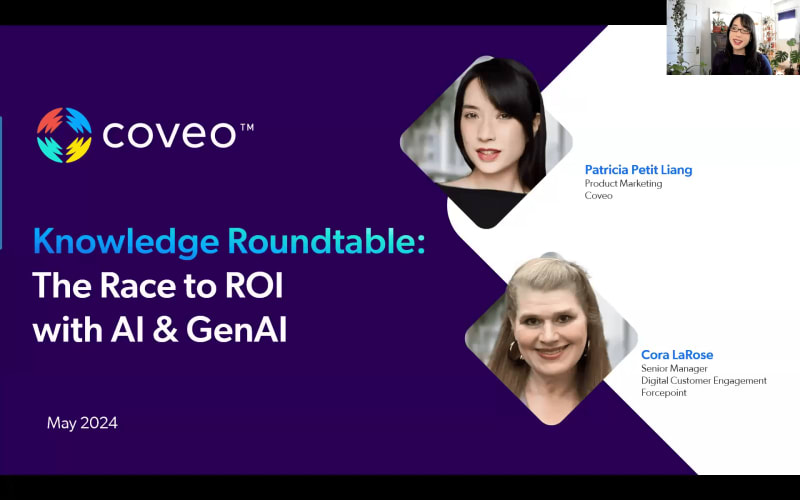

Comment abordez-vous la course au retour sur investissement avec l'IA et la GenAI ?
Les entreprises s'empressent d'exploiter la puissance de l'IA, en particulier de la GenAI, pour stimuler l'innovation, rationaliser les processus et acquérir un avantage concurrentiel.Pourtant, le chemin entre l'adoption et le ROI peut être difficile, entraînant une perte significative de temps et de ressources.
Cette table ronde réunit des leaders de l'industrie pour explorer le rôle central de GenAI dans l'accélération du retour sur investissement, avec un accent particulier sur le libre-service, l'efficacité des agents et la satisfaction des clients.
Joignez-vous à Cora LaRose, cliente de Coveo et directrice principale - Engagement des clients numériques chez Forcepoint, alors qu'elle partage les facteurs affectant le RCI de l'IA chez Forcepoint et la façon dont ils pensent au GenAI, ainsi que les obstacles communs, la mesure du succès et la raison pour laquelle le libre-service est le chemin le plus rapide vers le RCI.
Rejoignez-nous et tirez des leçons précieuses de ces experts et soyez prêts à poser vos questions afin de pouvoir reproduire le succès dans vos propres projets.

Rendez chaque expérience plus pertinente avec Coveo