
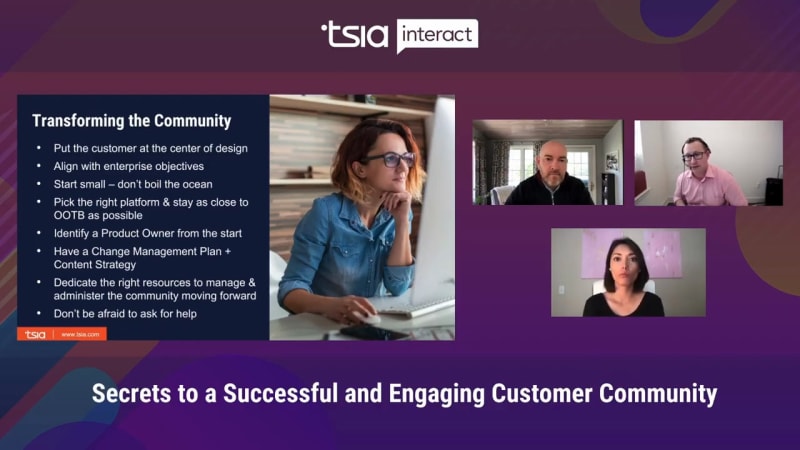
Welcome to today's TSIA Interact session, secrets to a successful and engaging customer community. My name is Barca Najjar, and I'll be your host. Before we get started, here are a few housekeeping items. We'll be having polling and q and a during the session, which can be found in the tab with a bar chart icon within the audience engagement panel to the right of the session player. We encourage your comments and questions at any time throughout the session. We also encourage you to complete the session evaluation before you leave the session, which can be found in the tab with a question mark within the audience engagement panel. I would now like to introduce our presenters today. Matt Krebsbach, senior manager at Boomi, Adam Brown, VP and senior account executive at Seven Summits, and Bonnie Chase, director of product marketing at Coveo. We have a lot of exciting content to cover today, so let's jump right in and get started. Matt, Adam, and Bonnie, over to you. Thanks so much, Barca, and and thank you all for joining us today. I'm very excited about today's topic. And and today I'm joined by Adam and Matt who will be really sharing their wealth of experience and knowledge around communities with you today. Before we get started, I do want to just kind of set some context for the conversation today and really get into, you know, why we're talking about communities. And, really, at the end of the day, that that customer community is a big part of that, and it's an important part of the customer support experience as a whole. You know, this is one of those many places where customers will go to find the answers for their questions and issues. They go here to get advice from others who are experiencing the same things as them. And, you know, customer communities are a great channel because it not only provides an avenue for customers to get those answers, but it also gives us an opportunity to reach more people who have the same questions and then also get some insights to bring back to the organization. And so it's really you know a great where way to share that knowledge across the community and the organization and it also provides a lot of value to the organization as well You know, just just looking at some stats from the state of community engagement report, you know, whether you you have an average community or an advanced community, you're you're able to really get some ROI from that because you're able to really get ahead of those support tickets, and really, you know, answer those questions before they get logged, as a case. You know, as we look at communities, however, we do see that forty three percent of average, community platforms are not integrated with other channels or systems. And this is where, you know, we start to to get into some issues with that experience. Right? And so, typically what we're seeing, you know, what we've seen from, a customer support journey and and what many companies offer through their support, experience happens to be very disjointed. So we see that you know companies roll out as they're as they're going through their digital transformation they may roll out a community a support portal you know they'll have different ways that a customer can interact with them as an organization but those things aren't connected. These disjointed experiences really cause issues with with help having the customer find the answer that they need. And if the community is not integrated into that experience and is not seamless, it can create more challenges for adoption and findability. And, you know, we're moving away from this because customer expectations change. And so what we're seeing today as far as what customers expect in an experience is that they want it to be streamlined, they want it to be personalized, and they wanted to to follow them across their journey. And so this is really, you know, what we show as what the customers expect. No matter where they they search for the answer, they should be able to find it whether they're in the community, the website, the support site, wherever that may be. Now this is, you know, from a preference perspective, you know, from a holistic customer journey, but there are also preferences around that community experience as well. I wanna take a minute, Adam. You've you've implemented many, many, customer communities and worked with a lot of large organizations. What are some trends in in what you're seeing with with communities and the experience that that people are expecting to get there? Sure. Thanks, Bonnie. So for several years now, communities have been, they're they're continuing to gain traction across the enterprise. And it's both from your external customers. You can have communities that deal with your b to b partners as well as your internal, employees. What we found is we used to have to educate clients a lot on what a community was. What's the difference between a website versus a portal versus a community? That seems to be more understood today. But what we're seeing is that we're getting a lot more traction now, especially since the pandemic hit, of accelerating the time to market, of getting these communities out there, of of creating these digital experiences. Tape I I I would even go as far to say communities are considered table stakes now from a customer facing perspective. It used to be just a checkbox as you're looking at at working with a company. Do you have a community? Is that a one channel available for support? And today, it's you know, they're getting to those second and third level questions of, alright, we expect you to have a community. How active is it? How fresh is the content? How relevant is the content? Is it personalized to what I'm looking for? Do you understand who I am as your customer? Do I need to tell you every time I contact someone from support? So the the the they're moving along that kind of digital adoption curve. With the pandemic, again, a lot of companies that we have seen pull these initiative forward. Maybe they were on more of a two to three year plan. And especially in some of the industries that have typically lagged behind from a technology perspective, thinking about financial services, health care, a few others. So they got solutions to market very quickly, but it was more of a function over form, scenario. So now we're seeing a lot of stepping back and saying, alright. This worked, and it worked quite well. Now we need to invest in some of that user experience layer to make sure it's intuitive and it's providing what our users are expecting. Because the bottom line is today, you're not competing just with your typical in industry competitors. You're competing with your customers on a user experience level. So you might be a bank, but you're competing against their experience in dealing with Airbnb and Uber and other, you know, online apps that are very streamlined, intuitive, easy to use. So the competition shifted a bit from that perspective. That's a that's a great overview, Adam. Thank you. And and, Matt, for you, you know, how is that impacting you and what are you seeing? Yeah. A lot of the same things. So it is it is really table stakes. So I know an evaluation point for us with, Gartner Magic Quadrant evaluating us versus other vendors in our space was saying, you know, what is the robustness of your user community? How are you allowing users to self-service and be successful without having to engage support? It's actually a competitive differentiator between us and our competitors, how robust our community is. So, I one hundred percent the same the same thing that Adam's saying. It is table stakes to have a community and now it's becoming having a great community is that, competitive differentiator. No. Yeah. Absolutely. No. Really, what what I really wanted to dig in today is is this experience and this transformation that Boomi had with their community, which Matt led. And, you know, just to cover a few points here, they they had transitioned from an older system to Salesforce. They, implemented Coveo as an intelligence layer and then worked with seven summits, to really make that implementation successful. And so with that transformation, there were a few goals, which were to improve the search result accuracy and user experience, offer personalized content recommendations, indexing a variety of content and video sources, and then gaining holistic customer journey analytics. So those are really the goals of the transformation. Now to take a step back, I wanna kind of show people where you started at, Matt. Can you share a little bit about some of those challenges that you experienced prior to this transformation? Yeah. Definitely. Thanks. So, it started out I I think we had a good community. We had everything of the table stakes. Right? So we had forum peer to peer forums. We had knowledge articles. We had a support portal. Everything that you'd expect from a community. But for us, the one of the first challenges we saw is it doesn't matter how much, you know, depth or breadth of content we created and that we had within our system. If it's not the most relevant content for a user at that point, then it was all for not. So all of our efforts needed to be around relevancy. So the first thing for us was understanding the search results to impact on a user experience, even the personalization of content and the recommendations. You can have a breakdown to say this is a customer and this is a partner and here's an internal stakeholder and here's what content they're allowed to see, but it it's not enriching the value of the experience for them. So for us, we wanted to say, alright, What are ways we can collect more information from these users and and really drive a custom experience? So for for us, we didn't have necessarily personalized experience beyond, you know, your relationship to Boomi. We didn't have a custom search experience. And you had to go to multiple places to get content. Right? It wasn't the one stop shop. It wasn't a single paying view into, all of the knowledge that Boomi had. And those were the main things we really wanted to drive, is create a good holistic user experience, and that allowed people access to everything they needed when they needed it. So, those were kind of the the past state and leading into some of the things we wanted to address from a from a overall standpoint with our community. And that's a great thing to add into that is, you know, there's there's a lot of folks that have legacy communities out there that have happened for a while, and they might be active and very well run. But, you know, platforms evolve, platforms change over time. When you Boomi was was in a situation where they were migrating from a legacy platform. And the great thing is you can take that as more of a greenfield opportunity. So you understand what works and what's there today, what you wanna retain. But you also think about, alright, what are these user needs and what do we need to do? And, you know, to Matt's point, it was all about that hyper personalization and having relevant content and bring being able to layer in working with Coveo and with some of the artificial intelligence and then some of the data and analytics behind it. You can really drive the business forward with a lot of the data and the insights you're gathering within these communities now, but you shouldn't think of them just as a lift and shift in those, situations. Mhmm. That's a good point. So let's talk about that transformation a little bit. You know, you you underwent this major transformation. How are you able to do all of that successfully? And, you know, obviously, Seven Summits was a partner in this. So maybe, Adam, you can share some details about that approach, and and you guys can share a little bit about that. Sure. I think, you know, one of our core tenants as as we design communities is we put the user at the center of everything. Again, whether it's your customer, your internal employees, and you can have all all the above interacting within these communities. So you wanna understand what's gonna make this a valuable experience for them. You know? What's gonna what's gonna help them get their job done better or or delight them from a consumer experience? So you wanna start looking at at those needs. What channels are they interacting with? What's their state of mind? You know? When are they frustrated? When are they excited? When are they happy? When can they find what they need? So you start looking at those pieces, but then you also wanna look at the enterprise objectives. So as an enterprise, what's keeping your c levels up at night? You know? Is it top line you're trying to grow revenue? Are you trying to drive support, cost out of your support organization? Are you trying to reduce customer churn? So where you start to look at these user needs specifically on an audience by audience basis, and you combine those with these enterprise objectives, you know, where those intersect, that's where you crystallize and start to build out the use cases for the community. So we mentioned don't boil the ocean, and that's a big I I hate overusing that term, but it's a fact. I mean, it's a lot of these platforms have so many features, so many functions. And I've worked for organizations in the past, and we had internal intranets where IT would say, just flip all the switches on and you guys can use what you wanna use. And it makes an overwhelming experience. You don't know where anything's at. It's not intuitive. And you end up just creating a ton of bookmarks and trying to get to what you need. And that's that's the opposite of what you want it to be. So what you wanna do is take some of these high value use cases with the lowest effort that you can do out of the box or with very minimal customization, and then do these phased releases from there. You wanna try to get to market quick. You wanna prove the value of the community. You wanna get users in there, and you wanna understand how they're using it. And is it aligned with how you thought they'd use it, but have the flexibility to course correct and adjust as you're moving forward. But doing these in kind of twelve, sixteen week chunks at the most helps you, you know, prove out your point. You've got KPIs and metrics so you can start to track the the the efficacy of the community. KPIs are great because that's how you're gonna go back to your leadership and continue to get funding to evolve your community. If you don't measure it, it's not working. Let me take a quick breath there. Matt, you wanna layer anything or I can keep rolling? Yeah. I mean, I'll I'll jump in on two of these. The first two bullet points, but I'm gonna start with aligning with enterprise objectives. So I when I look at a community, community is really a force multiplier for your business. So when you think about what you're trying to achieve from a top towns standpoint, like, community is the thing that can have a multiple effect to it. It's not a one to one anymore. It's a one to many. And so whether your community is focused on self-service and you wanna, explicitly deflect support cases or you wanna drive people self serving and finding the content, implicit deflection, if you will. Right? So whether you're driving self-service, whether you're driving customer advocacy and you say, I want more customer referrals. I want more customer advocacy programs. I want somebody to engage in use case stories or be be champions. In our case, we created a customer advocacy program called champions, Boomi champions. So whether we want them to engage in advocacy or even revenue. Right? It's a force multiplier for revenue. When you think about taking a lead or a prospect and saying, what are the activities I can get you to engage in in the community that will get you to convert faster? Right? That'll that'll have a higher impact than you converting. And or what what does a current customer need to be able to retain? What are the activities we can do to drive retention for them? We're a software company at Boomi, so it's all about subscription for us. How do we retain our existing customers? So we think about lead conversion, we think about retention, and we think about expansion dollars. How do we get you to use more of the platform? And so we use our community for revenue generation, for self-service, for customer advocacy because it's a force multiplier. So when I talk to our execs, I say, here's what we can use our community for. We can have more than a one to one relationship. We can really have, and drive the outcomes that we want from a business through our community. One way I've always talked about community is, you know, you want them to engage initially, continually, and increasingly. And whether that's revenue based or self-service or, you know, through customer advocacy programs, that's what we're trying to to get at. But it is really a force multiplier. Hundred percent. I I I'd even jump in also just from a technology side, and I'm probably the least technical guy you're gonna talk to this week. But you do wanna pick the right platform as well. There's a lot of competing platforms out there. Some are better than others. Many of them have a lot of parity. But, you know, we found think about things like, to Matt's point, they're constantly evolving the Boomi verse. They're constantly coming up with new use cases and new ways to engage their audiences. Do you have a platform that's extensible and scalable and flexible that's gonna meet that? You know, is the company that you're picking for this software platform, do they have some gas put behind it where they're gonna continually keep evolving? What's their release calendar look like? Is it once a year, once every eighteen months, multiple releases per year? As you have those releases, do you need to go back and and remediate everything you just build and do it from scratch, which is kind of will keep you away from pulling the trigger on releases? Maybe you're gonna release every other update. Or are you, you know, quote, on the rails where you can do these customizations and evolve the community and you don't have to worry about the core product releases? Change management is a is a huge aspect. You can create a great intuitive, beautiful community that you don't need to really train anyone on. When they get there, you can tell what you need to do. Again, going back to those other examples, think of Amazon, think of Airbnb and those others. You know, you don't you don't have to say, you know, how do I or help me do this or that. But if you build it, they won't come to go, I'm from the Midwest to use a bad field of dreams example. But, you know, you have to have a plan around how you're gonna communicate the value of what's coming. In particular, if you're looking at a migration like like Boomi had, you wanna start early and often and kind of proactively and transparently let your users know there's a change coming, whether it's to the core platform, whether it's to the front end user experience. But not just that a change is coming, but explain why it's coming and why you're making these changes and what the value is, what they're gonna get above and beyond what they're doing today. You know, share some comps, share some screenshots, share some, you know, prototypes, tease it up. But have that plan in place that you're talking to them ahead of the launch, during the launch, and hyping it up, and even post launch. Give them a chance to ideate and provide feedback on that. You also wanna make sure, you know, that communities, since they are more two way well, they're absolutely more two way than a than a dot com property or a website. You can't just have a webmaster that's just watching it. And whenever you need a content update, you tap them on the shoulder and they go out and update the page. This is more collaboration. There's a lot of engagement and interaction happening. So you wanna have the right folks internally assigned that can monitor and manage and make sure questions are getting answered. No one's hitting the dead end. You know, they're they're they have a a a vibrant content calendar. A community is as good as the content. Matt's touched on that. But it's not something depending on the size, it's typically not something you wanna do off the side of your desk. You wanna have at least one person that's looking at that just from a business perspective, not even from an IT and a administration and, you know, we need to create a new page or add this functionality. Just making sure that it's vibrant and the users are engaging and that you're taking those insights, you're looking at those analytics, and you're running these reports. Every data point, every interaction in the community, whether it's a like, a share, you're registering for an event, you're searching for content, you're not finding content, you're consuming content. It's a data point. And when you layer in things like Coveo with their machine learning and, you know, specifically for for support scenarios, if you're looking at different artificial intelligence tools, whether it's Salesforce, Einstein, IBM Watson, all these other ones, When you combine those now with a lot of the data visualization and some of these tools for BI that are out there, like Tableau and and and OBI and others, the analytics you can get are just mind blowing, and they're truly, transformative analytics and insights that can help you to drive the business forward. Last thing I'll add, then I'll I'll ask Matt to layer back in is don't be afraid to ask for help. I mean, Boomi partnered with us seven summits. We've been doing this since two thousand nine, but there's a lot of other SIs out there as well. It's just, you guys know your business better than we ever will, but there's also SIs out there that know these platforms and do this for a living. So bring the best of both worlds together and make sure you guys are doing what you need to be successful. Yeah. I think Bonnie touched on it when she spoke about personalization of content recommendations being one of the challenges we had and one of the focuses we had with Caveo. And so we we do really wanna enrich to the first bullet point, put the customer at the center of design or the user at the center center of design. One, it's just an interactive and and, you know, integrated experience for them hitting your community. Right? You want it to be intuitive, and you want it built and designed with them in mind. The other part's that personalization. If I can get more context to who Bonnie is or who Adam is and what drive them and what are the things that they they want and need. Sometimes they might not even know what they want and need, but we can tell because of all the events and all the things they're they're clicking on, they're uploading on, their their search queries, every event that takes place within the community. And every time we have a customer advocacy program like our champions, we got more feedback from them, and we we did a form so we could learn more about them and their interests. So then we can be really intelligent about what their experience is. So it's not just you get one of three experiences. It's depending on who you are, you are getting the custom content that is that matters to you. Right? So putting the user at the center of the design, the first bullet is saying, how can we put you at the forefront and make this work for you as the user? Because if you have a vibrant user community, you're gonna be successful as a company because you're you're just you see that's the parallel between all of these different, you know, software giants and and companies that have tons of success is they have a really vibrant community of users who wanna participate, and the content works for them. You know, the experience works for them. It's designed with them in mind. So almost that design thinking principle. And I I think Adam touched on it. Like, we do design tool gates. We'll do voice of user testing, like, to understand what does it behave the way they think it's gonna behave? Does it meet the needs that they're trying to do? We have full visual, functional requirement docs with, you know, full prototypes of what the new experience are gonna be, and we validate that with users before we make make, you know, wide scale changes. But, you know, the first two bullet hit on the head for me, like, customer at the customer first or user first, and does it map to your enterprise objectives? Like, out of all the ones in those, those are the two that resonate a lot with with us internally and with our team. Yeah. And oop. No. Go ahead, Adam. No. I I mean, we could literally talk about this all day. One thing that that we didn't touch on, Matt just closed out on it on his last comment is, you know, having executive oversight and having an executive sponsor. So Boomi did a fantastic job. We're talking up to and including CEO, COO level that we're fully behind this program and and, you know, looking at the Boomi verse to drive this engagement, drive the business forward. But if you if it helps to have that executive sponsorship because you're going to get the funding, you're going to get the right visibility, but more importantly, you're gonna be able to have a cross functional team that's built around this. It's gonna be IT. It's gonna be marketing, corporate communications, sales, customer service, and support, the product team. Everyone's gonna have a hand in this. It's not just one community team that kinda does this in a vacuum. Everyone's gonna get benefit out of it, so you need all those folks at the table to help figure out what they need to make this valuable. Absolutely. And and that's kind of the you know, that was similar to the point that I was going to say, you know, the executive buy in piece of it and and the communication as well. You know, you mentioned the marketing team. You have to be able to to express the value internally and externally, and that's really where marketing, can really help in in, you know, amplifying that message to your customers. One of the other things that I that I I loved about, you know, Matt, what what you guys do at Boomi, and you have full executive support about the community. It's built into the culture. You have a mascot. I mean, your your your company is all into this community. Yeah. So we we when we relaunched, we we relaunched our community, we rebranded our community, we really used it as an opportunity to use our community as a brand extension and to actually make our users feel like they're a part of something bigger than themselves. Right? So our community got branded as Boomi verse and it's I have a title of senior manager Boomi verse and it sounds super made up when I tell people my title. But, you know, it's the really the universe of knowledge around Boomi. And so we actually leaned in really heavily as an org and said, hey. Our brand identity is tied to making our users successful for our community. So, you know, with BoomiVerse, we said, alright. So we're gonna have BoomiVerse in this universe. Each one of the products and services we offer are planets. So so they all have their little planet design within this universe. And then we have a mascot, you mentioned b, just the letter b, and b is an astronaut. Right? Within within this Boomiverse theme. So it really became this thing, this living, breathing, organic thing, and it it acted as an extension of our brand itself. And it allowed us to do some really cool things for our users is not just give them really cool swag for for participating in events and and having, like, bee on it, having the astronaut on it. We have, you know, a person physically in an astronaut costume at Boomi Worlds when they were when they were in person. But it really allows us to extend the brand. So if you can, I strongly suggest creating an extension of your brand and who you are as a company through your community, and make the users of your community feel like they're part of something that isn't just self-service? Right? That they will want to participate in it. That every action they have builds into something, because, ultimately, it is that force multiplier. Every event, every action that takes place in the community drives success for every other user in that community. So you want them to want to engage. Yeah. But we even go ahead, Matt. Sorry. Didn't mean to interrupt. Go ahead. No. I I was gonna say that even ties back when we when I opened and we were talking about just some kind of trends that we're seeing. One of the big trends is you're starting to see a lot more communities serve as the front door to the enterprise. So dot com sites are slowly, you know, kind of merging with communities. And we have several clients that we've seen where it's starting to actually take the place where your community property is your, you know, client facing website. You know, it's it's it's all about the the interaction and the the the the voice of the customer now. Yeah. Yeah. We do have a couple of questions. So I'll go ahead and and ask them and and invite the audience to feel free to to drop in some questions as you have them. The first question is, this is from Whitney. How do you balance your feedback from customers on what they need on the Ford Master Horse? Sure. Matt, I guess I can I can start, and I'll throw it to you guys because you have a great ideation? So, what you wanna make sure that you do as far as getting feedback is you don't want people to feel like they're shouting into the void. So whatever feedback you get, you wanna make sure that the user understands that they've been heard. So at seven summits, we've actually built, you know, kinda mini applications around, ideation where users can submit ideas. You can upvote them. You can downvote them. Almost like how you guys are are submitting questions here. But we also have the concept of, you know, call it a a a pizza tracker up top that'll say, this is submitted, this is under review, this is now on the road map, or this has been implemented. And it can change depending on your use cases, depending if you're a technology firm or a services firm or what have you. But you just wanna make sure that that user understands that they have been heard. Even if it gets deflected or or kind of thrown out, you know, somehow close the loop on that. Matt, you wanna talk a bit about how you guys are using it? Yeah. So we we use the ideation tool that that Seven Summits provided for us. So people can upvote they can they can say, here's the thing that's really impactful for us. And then what we do is we qualify that with our product management team. So it's a constant dialogue with our our PMs who are helping kind of innovate where we go as a product. They understand what the users are are needing from our our product by up votes and down votes within, ideation within our community. The interesting thing is, at some point, some of the things that people are asking for aren't always product enhancements. They can be process enhancements or they can they can be enhanced through knowledge. So, hey. We wish the platform could do x. Well well, actually, you can get to x. You just do it by this, and it could be a knowledge article that that helps walk them through that process to get to where they're trying to get to from an outcome standpoint. So, we use it holistically. We always anytime somebody posts something against ideation, we check to see if it's we can merge it with existing ideas that might already exist out there so there's some moderation that takes place. It's understanding, you know, what what's the business case behind it because we do wanna understand the framework of it, like, how pervasive is this. This is something that you're bringing up that Adam says, hey. I need I need my company, but, you know, it actually applies to all of our customers. And so we we wanna understand the business case. We work with the product managers, and then we try to close the loop with that user to say, you know, here's where it fits within our product road map, and we've delivered, I think, seven percent of all of our, ideas into actual product enhancements. And then, I don't know the exact figure off the top of my head, but a bunch have been resolved through knowledge artifacts as well. So Yeah. You guys have a crazy success rate as far as incorporating ideas. Usually, it's somewhere around, like, three to five percent, I believe, and you guys are blowing that away. But one thing that that Matt mentioned there, and then we can get to some more questions is, you know, when they say that they they look to see if if ideas have already been submitted, when you start layering in things like Coveo and some of this machine learning that we're talking about, you get case deflection based on that. So within our app, as you're typing it in, it'll surface based on just keywords or what you're doing if there's similar ideas that have been posted. So before you even submit, you know, submit my idea, you can see if it's already out there, and you can go vote on one that might be a duplicate or might be something that's similar where you just wanna comment on it, upvote it, but then comment maybe with your specific flavor of of of what's happening. But there's a lot of automation taking place right now to keep you from getting this glut of things that are created that might be duplicative. And I do wanna say we we do use Caveo components to do that as well. So we look at, like, all of, like, the Caveo knowledge base. Just look at the metadata behind all the comments that take place and say, like, is this something that is alike? So it's natively happening. So as someone's typing in a ideation or even a form question, it's looking across our existing base of knowledge to say, this might resolve this before you ever ask the question or before you ever suggest it as an enhancement. There might already be an answer to it out there. So we we actually do use conveyor for that already. Yeah. And and I would just add, you know, few things that that you definitely want to avoid, I would say, is, you know, saying that something's coming when you know it's not or if there's no time line. You know, I I've I've encountered this where, you know, you you submit a request and then they say, you know, it's going to happen. We're on it in the backlog. It's in the backlog. It's in the backlog. And then get to a point where you just stop believing them. Right? Because that's something you wanna avoid. You wanna be very realistic, and, straightforward with your answers and honest. Right? The other thing is making sure that, you're not letting that feedback go into a black hole. So making sure that you're responding to customers even if it's an automated message saying, we thank you. We got your we got your feedback. You know, this will be triage or whatever that response is, making sure that you're not sending it into a black hole because if they feel like it's a black hole, they'll they'll stop submitting that feedback, and then you'll you won't get that engagement. Before we answer some more of these questions, I do you know, you mentioned some of the success that you're seeing, Matt. I do want to kind of talk about that a little bit, you know, the the success that you've you've been seeing, the reaction from your customers. Can you talk a little bit about that? Yeah. I mean, there's gonna be some there's some ridiculous numbers on this slide that I think everyone's probably like, how can I do that? So the first one, case deflection. So, obviously, there's elements of self-service that we wanna drive through it. So, there there's always going to be a limit on the number of people you have in support to answer questions. So what we wanted to do was say, how can we deflect cases before they end ever end up hitting support? So, you know, we we attached it to our support portal, Cabello to our support portal. So as folks are looking to open cases, it's looking across subject description product, so many other fields, and the metadata. And it's finding the keywords that might match between our six sources of content that we indexed through Coveo and brought into that experience to help find answers before they end up opening support. And so we look for explicit deflection in this case. So it's, you know, they searched across this, they clicked on this content, and then they never ended up opening a support case. And we can get that granular. And so that's how we're measuring the case deflection here. So, from month one to month four, we saw a three hundred percent increase. If you actually look to our out of the box deflection we used before that, it's probably in the thousands of percent increase in deflection, Coveo versus the out of the box deflection component we had. So, we actually saw a really great success within case deflection. The really telling one for me is, support. So, like, we we it's not just deflection that matters for self-service. It's explicit deflection that is. It's implicit self-service. How can users find the answers whatever without ever having to engage support? So when we looked at, you know, our point one of implementation, and we did two major Caveo implementations. One just being indexing a multiple source of content, pulling it through search, seven s, and then we did another one where we actually, took Caveo and the intelligence and the machine learning AI to create experiences across our entire community, which happens, like, within three months of each other. And what we saw after that second one of the UX redesign and incorporating the intelligence and and relevancy, into the experience, we saw our total support volume, which actually went through the roof for COVID. It went up probably fifteen percent at the start of COVID as people started working from home. And so now after we we made those UX changes, we've actually seen it not just plateau, but decrease. And so we're even though we've onboarded thousands of new customers over the last few years, I think we we average about five new customers a day as a as a platform that we onboard, and our support case volume is is where it was three years ago. So we're actually driving the support case volume down even though we're driving the number of customers we have as a business up. And that has been a blessing for us because, obviously, support teams can only handle so much. And so to be able to say, hey. We're impacting x number of support engineers. So what we're doing is actually driving potentially revenue to the business. It's it's experienced to revenue and and impact on the number of head count we need. And then you see, obviously, the engagement numbers, overall system engagement page views. One that's not on here, which is really telling, is pre pre implementing Coveo and the the user based personalization and intelligence. We had, like, a sixty percent bounce rate from a single page within our community. After implementing it, we have less than five. So people are not they're engaging in the content that's on the pages. So, you know, a twelve x decrease in bounce rate from our community. So the we've had a a ton of success, and I it's really just understanding what we're trying to drive from an organization standpoint, understanding what the users need for, like, at the individual user level, and then how do we craft that experience for it. But, you know, we've we've had some borderline ridiculous statistics around driving value here. Well, it's been it's been definitely been great to see. You know, you're getting so much engagement. You have the executive buy in. Your customers are are happy with the experience. A couple of questions from the audience. So one of the, concerns so there's a concern from our senior leaders about handling detractors. How do you handle negative discussion that may detract from the positive experiences of your customers? So I'd say two pieces to that. Number one is I'd rather own that conversation than have it happen somewhere that I can't control it because if people are complaining, they're gonna complain on Facebook, Twitter, LinkedIn, you name it, and you have no control over that. So if you direct that conversation, even if it is negative feedback into your community, you can be a lot more responsive. The other part is you will see if it's if it's just someone complaining about your product or whatever, it might be a legitimate beef, and you've got the chance to address it and do it in a visible fashion that other people that might have that same problem are experiencing it. So it's just a way for you to get ahead of the curve on that. If it's someone that's just being mean spirited or mean hearted or just, you know, doing stuff, there's there's there's moderation controls. There's ways to, approve post before they get post. You know, you can throw it into a moderation queue. There's a lot of things like that. But what we found, this hasn't been as much of a deal in the last seven, eight years. We we find that in these larger communities that that are highly activated, like Boomi's, your customers will advocate for you. If someone's saying something that's blatantly false, not true, there are other you don't even need your own administrators to go in there and kinda tamp that down. Other users will jump in and say, there's no way that's true. Give us an example. Here's what we did. Here's what we're seeing. We're happy with this. So it's one of those things where it's tough to let it go sometimes, but it's also it's a good way to get feedback, and it's it's you'd be surprised that people people have been online for a while now and interacting in these kind of experiences, and it's there's kind of some unwritten rules, I guess, that people follow and and other users will be happy to jump in and help you help you get through that. Yeah. Matt and Yeah. Have the terms and conditions about how people should behave in there. That's basic. Right? But I I'm with Adam. What we see is if somebody says, I'm having this problem with Boomi. Like, this doesn't work. Right? More likely than not, there's a solution for it. They it's just not the way they've done it before. Right? And that's the same with any technology or any anything you're using product you're using. You might have done something before using a a competitive product or something, and you have some context on how you think it should work, but it works differently. And a lot of the times, that's where our users will jump in and say, what are you trying to solve for? And let let's understand the business use case of what you're trying to solve for because there's another solution for it. But we we we look for those opportunities because if someone's a detractor and we can get them turned around, they're gonna be way more loyal to us than someone who never had a problem. So we we actually encourage folks to say, like, through ideation, through forums, like, how do I do this? Like, if something doesn't work or behave the way they want, we wanna know that so we can we can fix it for that user and fix it as product as well. Mhmm. And that and I think that interaction being visible to others will will show, you know, how how you respond to those types of issues, and I think that can be a good thing to to to show as well, making others feel comfortable with, you know, expressing their concerns and seeing that it will get resolved, or, you know, they'll they'll get a response. Right? So let's take another question. So is there a change management program or system you recommend to work through changes for your community? I we can Adam, hear me. Well, I I've I've I think we both I've I've answered the past couple to start with. Well, why don't you do this then I'll I'll layer it. Yeah. I mean, for us, we will capture through, like, Git any changes we have within code within our system. Anytime we do a major update, we do do snapshots of our environment ahead of time. So if we do need to roll anything back, we can. But we we do capture the behavior of every page and every component within our system so that should something happen to me or folks on my team and they they leave in for a better opportunity, whatever, like, we have everything documented about the behavior of everything that happens everywhere. Even if we make a change towards one of our query pipelines within within Coveo, we have that documented within the change log in there about what's happening. So, for us, I think you could use a lot of different programs for it. It just depends on what you're most comfortable with, but it is important to capture the the intent and how everything's behaving so that it is easier to understand, you know, the implications of that change. Yeah. I'd say I'm not I'm not as familiar from an OCM perspective as far as specific methodologies or tool sets or practices there. But just as a general, you know, going back to what I mentioned earlier about not boiling the ocean here, you know, look at things on a release by release road map and just kinda figure out how this community is gonna evolve, but then you layer in with that ideation with these feedback mechanisms. Coupled with just reporting, I had mentioned some of the data points and things you can do. So a good community moderator, admin, manager, whatever hat you wanna put on in there will kinda keep all these things in mind and watch how that day to day usage is happening. And a lot of it comes back to, do you have a content calendar or some kind of a plan there that'll usually align with your road map? But a content calendar is more more flexible that you're gonna look at the day to day use in the community and how that's happening. So change can happen in a from a lot of directions, but just from a content perspective, it's it's kinda keeping that larger road map in mind, but being flexible. If you're talking about change from a more technical upgrade, like like Matt was saying with, you know, repositories and being able to roll back and have fail safes, I'd I'd defer to him on that, but it's, yeah, I'd I'd wish I could go deeper on that. But I mean, you bring up a good point. Like, with the change management, there's the element of, like, having a holistic tagging and taxonomy structure to how you you surface everything too. I that was one of the things that we we didn't necessarily have in place when we initially launched our community. And as we look to incorporate more and more Coveo intelligence into our community, we actually had to go back and do that. We had to actually understand, like, what is the structure of our tangent taxonomy that allows us to be flexible but also scale. So that could be something within change management is understand, you know, the underlying tagging and taxonomy between all these systems and sources of content and, how to surface that in a way that's intelligent and, intuitive for users. It's good also to just call out, you know, as you're going through and kinda designing these experiences, you wanna look for the different kinda things that could jump out, you know, all those gotchas, the organizational and the technical, considerations that you need to bring in. It can be things like we were talking about with con content reporting. It could be things like single sign on and how different systems interact together on on the back end. But trying to get all those things above board to start with so you can make sure that you bake them into your plan as you move forward Doesn't mean that every release you have or everything you do is gonna touch on every one of those, but at least you know that you need to take these under consideration for every change that you do. It's a great overview. Thank you. And, you know, we just to kind of, wrap up, just wanted to just summarize the best practices that that were shared today. And and, obviously, Adam and and Matt into some great went into some great details. So this will just be a high level overview. But, you know, what's really important is having that strategy that overall strategy. Right? You know, what are we trying to accomplish? What are we trying to accomplish today in in the next six months, etcetera? And having that executive support behind it can really help to make it successful. Focusing on user needs. So again, you know, making sure that we're doing that outside in thinking. What are our customers trying to achieve? What is that experience going to look like for them? Flexibility, making sure that from an organizational and a technology perspective that there's some flexibility there. There's a bit you know, the the ability to expand, to customize, to make those changes and evolve, unifying that content. So being able to have content from multiple repositories so they don't have to jump around to different places. Relevance is important. You know, this is really where we where we say, you know you know, it's not going to be helpful if they can't find it. So making sure that you're able to surface the most relevant information, providing that intuitive user experience, and then having that excellent change management behind it. So I hope that these best practices were helpful for you, and feel free to reach out to any of us if you have any further questions. Thank you so much. Yep. Thank you everyone for joining us, and thank you, Adam, Matt, and Bonnie for a great presentation today. Take care. Thank you.

Secrets to Engaging Customers in Your Ecommerce Community


