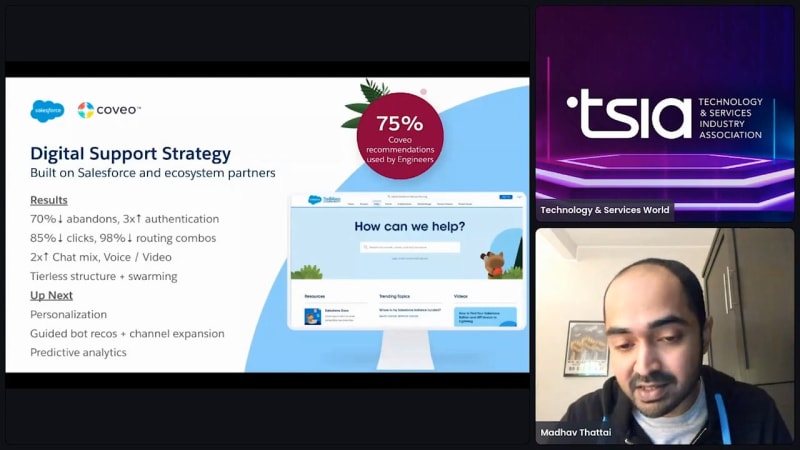
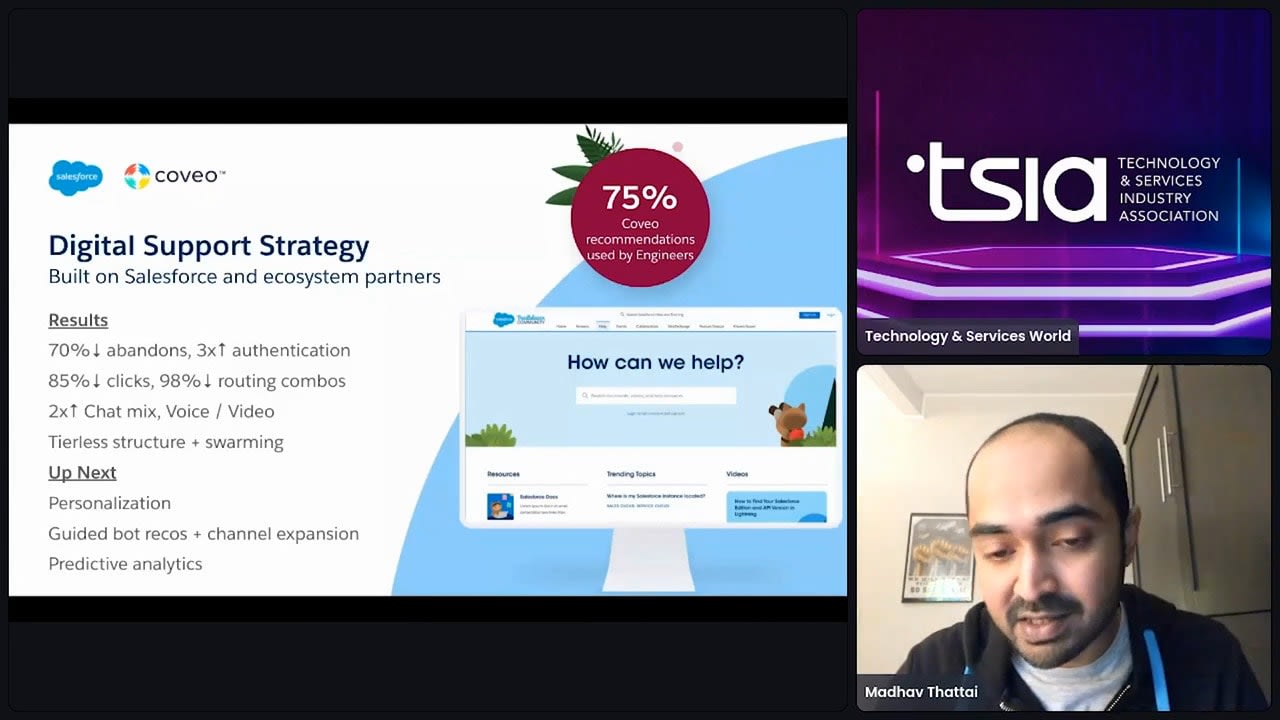
Hey, everyone. I I I trust you can see us. Welcome to the session. We've had some, technical challenges here. So Bonnie is actually dialing in, on my phone, and, hopefully, everyone can hear her. If you cannot, you know, throw something in the chat, and we'll try to make sure that she, that, that we can we can repeat whatever the question is or whatever she said. But, Bonnie, I will hand it off to you to get us kicked off here, and I will, run the slides. Awesome. Thank you, Nav. Hello, everyone. Thank you so much for joining us today. Very excited to be here, a part of, this conference. My name is Bonnie Chase. I'm director of product marketing at Coveo. And, really, today, what we wanted to do was, talk through how to deliver relevant support as deals. So, I've I've I'm joined here by Manavasatai from, Salesforce. He's VP of strategy and operations there. And we'll just talk through a little bit about their approach to, you know, how they deliver relevant support at scale. So just for a little bit of background, but not on the second side. You know, just to tell you a little bit about Coveo, we are a market leader in enterprise applied AI for relevant digital experiences, which means we're the intelligence behind your, customer support and service experiences, offering content and data from across the enterprise, proactive recommendations and intelligent search, cross cloud and cross channel delivery and insights, and purpose built machine learning that starts learning from day one. And so that's a little bit about, Coveo. And really, you know, in this role, what we do is is we're we're connecting with people and really understanding how to deliver that better support. Now when we think about delivering better support on the next slide, as you know, customer support is the front lines to the customers. It's critical to be able to scale your support organization to meet increasing customer demands. And we know that the better your support is, the happier your customers are, which in the end adds more value and creates deeper relationships with your customers. The challenge is we're often trying to balance both a good experience and cutting costs. We want to be efficient, but we also want to be effective. Next slide, please. And so, you know, when we think about these customer interactions and and why it's so important to, ensure that we're creating good customer experiences, you know, one of one of the the things that I like to point out is that it actually costs less to maintain an existing customer than to invest in new ones. And so instead of thinking about customer support as a cost center, you know, really, this this is a part of the organization that is adding more value to your relationship and that customer like that value. So a key piece has been thinking about scaling is considering what your customers want. And so on the next slide, just a couple of stats to share, you know, really personalization is key. If you if you, you know, look at the stuff that are out there, people want to have experiences that are relevant to them. You know, we have we're kind of consumed with an overwhelming amount of content. You know, we have knowledge created in a bunch of different parts of the organization, and customers are met with information overload. And really, you know, when they're, engaging in these support experiences, they don't want a ton of information in their face. They want what's relevant to them in that moment. And so when we look at the the these stats, you know, we we often get a lot of information about consumers. But b to b, you know, is no different. And, you know, people just expect businesses to know their unique needs and expectations. And in order to deliver, you know, a million unique experiences to a million unique users, you need AI. But it's also a combination of things. Right? It's it's technology, but it's also people and process as well. And so with that, you know, that that question remains on the next slide. You know, how do you scale to meet increasing demand and volume? And this is really why I've I've asked Madoff to join us here today. You know, as a customer, Salesforce has has achieved a lot and really wanted to kind of share the story. So, so, Madam, could you tell us a little bit about yourself and, your role at Salesforce and what your team is focused on? Yeah. Thank you, Bonnie. I'm really glad to be here, with all of you today. Looking forward to this to this session. So, I've been at Salesforce a little over a year now, actually getting close to a year and a half, and I run strategy and operations for our global support organization, and I'll talk a little bit about our organization on the next slide. But we manage a couple of key parts of our transformation journey, in our support world. One is, we have teams that focus on, each part of the experience and think about how can we improve it from a process perspective, a technology perspective to really drive the outcomes that matter for our customers as well as our, our support engineers internally, and so that's a key focus for my team. In addition, my team also runs all of our central business operations activities, to help manage and scale our organization. So really happy to be here and happy to talk about this more. And, you know, you have a huge support organization. Can you give us an overview of what that looks like? Yeah. Happy to. So we are a global organization and we support, a large majority of Salesforce products. Some of our, more recent acquisitions still run independently, but we but we support all of our customers globally across regions, across different industries, and across all products as I mentioned. We've got multiple hub locations globally and about, close to three thousand five hundred people actually now. This slide is a little out of date, but, about thirty five hundred people, across our our support engineer organization, in multiple languages. What's probably good to know for this group is, our engagement on our cases today, runs at about one point two million cases a year, and our engagements on digital, which is the the vast majority of our of our support interactions with customers are in the, you know, eighty five to ninety million range. So a large percentage of our interactions with customers through their, support life cycle, is on digital platforms, with really some of our more complex, issues that come into human assisted support. Great. And, you know, you you mentioned, you know, you're you're supporting a large number of of customers and, you know, with so many customers, how do you think about customer journey And how do you make sure that you're you're mapping that correctly and understanding what you really need to focus on? Yes. So we started this transformation journey, in our support organization at Salesforce, about a year and a half ago. And our objective was really to think about what are the ways in which we can fundamentally improve the experience our customers were, were having across all channels, whether human or digital. And so as we began this work, we really started grounded in what is the journey of our customers? What is it that they want? What are their pain points? What are their needs? Who are the personas? Who are we really serving? And we felt that this was really critical for us as, important grounding insight before we Barca on a transformation and said, hey. We need to change this. We need to change that. And as we really think about what journeys customers have with us in their support journeys, it's really comes down to a couple of key things. One is we think a lot about the resolution journey. So this is probably the one that's most recognizable for anyone that's in a, in a support organization, which is we need to solve problems. We need to make sure that customers have questions. They they think they have things that they need help with. There's a bug that they found, some issue that they have, and we need to resolve that issue. One thing really interesting, though, that came out from our research was there is a parallel journey for education that is really critical. So Salesforce customers, of course, have a deep engagement with a lot of our education capabilities, whether it's Trailhead, our success content. And so education is a big part of the value proposition that we bring to customers, and the support journey is no different. When customers engage with support, they do wanna find information that's gonna continue to increase their expertise to really think about their value, to how they engage in their community. So there's a lot of value to that education journey that really jumped out at us as we did this entire, mapping of what the what the full journey needs to look like. Yeah. That makes sense. And and when you think about, you know, as customers are going through their life cycle of, you know, when they when they start using you as a customer, they wanna learn how to, you know, set up the system and, you know, maybe some best practices for getting started. And even as they move along later in their journey, you know, they've been a customer for five years. They, you know, they have they interact in different ways with your organization, you know, just an issue. But also as as you're saying, being able to learn more and to grow, and the more you can offer them that education piece where they can continue to learn and grow, that just strengthens that relationship between you and the customer. Yeah. That's exactly right. I think I mean, we believe that that education, particularly delivered proactively, goes a really, really long way in driving value to customers. It allows them to get ahead, of issues or questions that they have. It provides a better experience for them when they interact with us. So, yes, I think the education component is a really critical part of the value proposition of support in general. Yeah. And, you know, one of the things that we talk about is customer intent. And as they interact with you, they may have one intent versus another, and I think it kind of, highlights that a little bit. But, you know, how would you say that your support team, you know, how how often are they, leveraging content that may be related to education rather than break fix? We actually think it's we actually think it's about fifty fifty, Bonnie. So as we look at our data, customers that are coming into, assisted support, about half the time, those are definitely education opportunities for customers and things that we can start to push back into content on self-service, content in the application, content that we identify proactively that we can push to customers depending on where they are in their life cycle, whether they are in the early setup as you said or they are more mature users who are looking to add more functionality. So there's a lot of signal that comes from our assisted support. Now our digital channels have, you know, between an eighty to ninety percent success rate for customers. So customers are engaging on content a vast majority of the time to really help answer their questions. And there, again, there's a strong, strong bias towards education type of content versus, you know, I have this particular issue or this particular thing challenge that I'm that I that I need some help with. Yeah. That makes sense. So, you know, you you your your support organization is huge. You have thousands of customers, multiple journeys and intent. So can you talk talk take us through your support strategy and how you're able to kind of meet all of these different needs across this entire journey? Yeah. Absolutely. So as we did a lot of this journey work, our philosophy here was we really wanted to make sure that we used the best available technology to provide experiences to our customers. A lot of the technology we use, whether it's Salesforce technology, Coveo, any number of, of other technology partners that we have, have years of learning from the market on what are the industry best practices and the things that we should bring to the experiences. So we certainly wanted to start with saying, look, we have to be deeply, deeply grounded in what our users need, which is what the journey map really tells us, but we want the technology that already incorporates so many of the best practices to lead us there. And so when we thought about our overall strategy for support and we think about our transformation, it really comes down to two very simple things. Now it took us a long, a long time to get down to something this simple, which I'm sure many of you on the, in in the session can identify with. But we really wanna deliver an easy and export experience to customers across any interaction that they have with us. Now those words are relatively simple, but they mean specific things to us. When we say easy, what we really mean is we want the experience to be low effort as well as high speed. So really driving customers to have the least amount of friction in the journey, have the quickest access to the content and the expertise that they need, that's really what easy is about. Export also is about two very critical things. Customers come to us because they know that we are experts in our products. So do we have the right amount of depth? Do we have the right content, that's available across all of our sources? And this is where we get help from, from, companies like Coveo. Do we really provide the best comprehensive available data, about our products, and the content that's available about our products to customers. So that is a huge part of export. There's a second critical part of export, though. We need to be experts on the product, but we also need to be experts on our customers. And you talked about personalization and how important that is for customers, particularly, as the acceleration is accord, for customers to engage on digital channels. Personalization is a hugely important part, of our journey as well, and we've got a lot more that we can improve, on that front as I'm sure most of the industry can to really say, do we understand the context of this user? Where are they coming from? Where are they in their journey? What are the kinds of things that they need? What are the kinds of things they're trying to accomplish? And make sure we are tailoring our capabilities, whether it's on digital, whether it's in the human assisted side, really tailoring those capabilities to satisfy their specific needs. That's great. So, you know, when you were talking about, you know, making it easy and and, you know, being experts, I I I love that you've simplified it to two things because what we often do is we over complicate we over complicate strategies. And so, can you take us through a little bit more on, you know, what what this entails? Yeah. Absolutely. So when we think about easy and export, the next couple of slides here will show you kinda how we think about, how this breaks down into our delivery model. So easy in our world is really about the channels. So what channels are we providing support to customers on to satisfy those journeys that we talked about. And we have a variety of channels as I'm sure many of you do as well. Starting from digital channels like in app, that which is in the product. Of course, the web channel is a significant channel for us. Community is a huge channel for us. Social. And then as you start to go lower in the list, you start to see some of our more human channels. So email support, phone support, chat support. There's now a lot of traffic and a lot of, interest in messaging applications or Slack. And so what we wanna make sure is we are providing an easy experience across all of our channels. Low effort to move between channels, high speeds of response, and you can see, in the top left of this chart, we have different channels available to customers depending on what success plan or what entitlement they have with us. So that's the easy part of the equation. When we move on to the export side of the equation, we think expertise is really about content. And this is content that can come from documentation. It can come from the knowledge, of course, that is in all of our deeply trained engineers. It can come from now a huge ballooning in video content that is both community created as well as, created by us all the way into other types of community content, webinars that we create for customers. And then at the bottom, on the content side are a couple of interesting pieces of content. This is really content that comes from our products themselves. Right? So how well is our infrastructure performing? How well is the product performing? These are all incredibly useful pieces of information for us to give customers as they engage on these different channels. So if you really boil down this framework, the way we think about our support experience is to say we wanna provide an easy experience across all our channels, and we always wanna have the right export content that is both deep in our product expertise, but also contextual to our users. The last piece of the framework is really the direction in which we interact with customers. So traditional support, and this is true at Salesforce and everywhere else, most of our volume tends to come from reactive motion, meaning the customer comes to the channel and they are looking for information of some kind. As we evolve our offerings, as we evolve our capabilities, we really wanna drive to the more proactive motion, which is we wanna have the right tailor made content and drive it to the right channels for customers for them to actually understand, and get ahead of their questions. Whether these are education outcomes, whether they are resolution outcomes, we wanna more proactively get ahead, of their, of their challenges, their issues, their needs, and really drive that content to the channels in which they wanna interact with customers. So we take easy and export. It boils down to a couple of simple words. Obviously, there's quite a bit underneath that. But as we frame our overall support organization, this is really the framework we use to think about, okay. Now where do we wanna go improve things? Do we have opportunities in certain channels? Do we have better content that we can get from our product or from our infrastructure? How do we create more proactive motions to actually drive this content to our users? So this acts as one framework for us to use to really think about how do we wanna improve and transform our experience. Yeah. That's great. And, you know, I would say this is a this is a very mature way to to look at, an approach. You know, what I I see so often is, you know, the support orgs that are really focused on the great fix. Right? And then they're really focused on case deflection and how to prevent people from submitting cases. And when you look at it from this lens where you have, you know when you're looking at the whole journey, what customers need at each point and when you know that, you know, support is more than break fix, then it doesn't really make sense to focus on, you know, a single metric like case deflection when we want, you know, we want those customers to engage with us to continue to, to grow and and be educated. Right? So what are some what are some ways that that you look at measuring success? Can you share a little bit about your results and on what that looks like? Yeah. Absolutely. And and you make a really key point, Bonnie, In our world as well, and I think the pandemic has helped accelerate a lot of this, we've seen a huge increase in the amount of digital engagement that we have with customers on self-service channels, particularly as they're starting to adopt a lot more of our technologies as well as other technologies, here in the last couple of years. And so our relationship with customers also has changed. Right? When customers come to us for help and for education, it really is about what value are they getting out of the products. It isn't, you know, a pure transaction. Now to be clear, of course, we get a lot of simple questions and a lot of transactional things that we help customers with, but you can really see over time the level of complexity, of the nature of the issues themselves is really starting to trend up, which has huge implications for us on how do we think about digital capabilities, how do we think about personalization, how do we drive better content to customers. It also has big implications for us on how do we think about our assisted support. Right? What is the level of skill we need in assisted support now to handle these more complex issues? How do we wanna run this organization in a way that actually delivers better results for customers? So we are still relatively early in this journey, but, you know, I would love to share some of the things that we've been doing, and certainly with key with key partners, such as Coveo. As we have evolved our experience across different channels, we've started to see some pretty good improvements. So we we replatformed and relaunched our our website. As I said, our website drives a tremendous amount of traffic for us. It's really the vast majority of our engagements, happen on our web portal. And we see a lot of customers coming in, via via SEO, to the right content and then continuing their journey to say, how do we search for the right things? How do we get the right content to those customers? We see self-service success rates in the eighty to ninety percent range. And with some of our recent changes, including with some of the improvements we've made partnering with Coveo, we've seen a huge drop in the number of abandons, as customers are, engaging with our content and thinking about, do they now wanna go submit a case? Do they now wanna actually move into assisted support? So that's been a really positive result. We've also improved our authentication, so anyone that runs, you know, a significant digital platform knows, authentication is a big portion of driving a more personalized experience for users, and so driving up that authentication number allows us to bring the best experience to our users, so that's been a big improvement. We still have a big a long way to go there. We've also made changes to simplify the journey. So we talked about easy. As customers were submitting cases, we had an incredibly arduous process, multiple pages, multiple data points. We've dramatically reduced, the amount of information that customers, need to give us in case submission, and we've also simplified the number of different selections they needed to make on what kind of product or issue are they seeing. Now this simplification, though, comes with a key need for us in really ensuring that we are getting the right information from customers on the digital channel. So simplifying case submission alone isn't sufficient. We really have to now focus on how do we still gather the right information as customers are engaging with content, as they are searching on our website, as they might be engaging with a bot in the future, to really make sure that by the time a customer says, hey. You know what? I'm not able to serve myself. I really need help here. I need to help I need to talk to somebody. We can get all the right information for them, but a lot of progress on that side. We continue to evolve the way we think about our channels. We've seen a huge increase in our mix of chat, because we now offer that capability in a much easier way for customers to get access to. We've started experimenting a lot more with voice and video capabilities that we've, that we've evolved. But, really, the future on the channel side is as customers engage through the digital channel, how do we get them to the right place? How do we look at what data, are they looking for? What content are they looking for? What is it that they're trying to accomplish? And then direct them to the channel that makes the most sense. So if we say, hey. This issue is probably something you can easily solve with a live chat with somebody. Great. Let's get you to somebody on live chat. Or if we say, hey. This issue is actually more complicated, and we need to engage with you. Understand, you know, what you've been doing in your code. Understand what you've been doing in your product setup. We need to actually talk to you about that, then we direct them to the appropriate channel. So a lot of opportunity, I think, on the channel side. And then finally, on our structure in assisted support, we've really moved to a to a completely tierless structure. So we are now, swarming across our entire organization of thirty five hundred people, and, really, the goal there is to bring the right exports to the issue versus take customers from export to export in order to get them, get them the right resolution. And that creates a huge change in the customer experience. Our engineers love it as well because now they feel like they have better access to expertise in developing their own skills. This is another area where our ability to drive and deliver content to our engineers becomes really important. So our Coveo implementation internal to Salesforce, where engineers use the right content and can find the right content becomes really critical, because we are not simply handing off cases from one tier to the other, and so we really wanna make sure there's federated availability of all of our content. So in the up next, I think there's a bunch of, important things. We've touched on a few of them already. Personalization, you touched on it. It's a huge, huge need, I think, for customers, particularly as the level of complexity and the level of context goes up, for what customers need. I mentioned already making channel recommendations, using box upfront in our digital experience to drive customers to the right content, to the right channels, we think is really important. Continue to expand our channel footprint, experimenting a lot more with messaging capability, really reducing the friction by which customers wanna interact with us, both synchronously as well as asynchronously, we think is really key. And then finally, we think there's a lot of interesting work happening on predictive analytics, both, on the digital side as well as on the assisted side. How do we get ahead of issues that are gonna escalate? How do we predict sentiment better? How do we actually find the issues that we think we need to actually engage on or swarm on ahead of when the customer actually gives a signal for it, there's a lot of interesting work that we think we can do on the predictive side. Yeah. No. That's great. And, you know, just to to kind of summarize some of some of those points, you know, when we think about looking at, you know, scaling that support digitally, it's going beyond looking at customers as transactions. Right? It's looking at that entire journey. And I don't wanna say from start to end, maybe, like, that whole cyclical journey because it always comes back around. Mhmm. And so it's really you know, we can't look at our customers in silos and we can't provide them information in silos. So we need to be able to look at that whole journey and see how we can offer, you know, what they need wherever they are. So, you know, with that, you know, I I do have to ask, you know, could you share a little bit about, you know, how Coveo has enabled you to scale your business? Yeah. Absolutely. I mean, Coveo plays a critical role, as I said, both in customer facing applications as well as our internal support engineer facing applications. On the customer side, we talked a lot about wanting to have access to the right content available for customers as they are interacting with our digital platforms, particularly given how heavily digital we are in our customer interactions. So Coveo plays plays plays a really big role there. And then as we start to drive some of these more personalized experiences, we drive up our authentication. We wanna really drive more personalized delivery of content and capability to customers on the digital channels. That's another really, really key role, for Kubernetes to play with us. And we find that, you know, the the technology, our ability to administer it, the fact that it works, out of the box with our own platforms, is a huge advantage for us. And a lot of the intelligence we can extract from the, from the platform, I think, helps us a lot as we continue to evolve this more personalized experience. The same things apply internally to us. So our engineers, use their search capability for content in a big way, and and with some of the help from Coveo, we are seeing a huge adoption, in the amount our engineers actually use recommended content. That cuts down a lot on time, particularly in this tierless structure as we are kind of bringing experts in and out. That access to that content and that ability for the engineer to continue to build our expertise is a really, really big part of our strategy, and so that's another really important way, in which this partnership has really helped us. That's great. And, you know, and I I'm not sure which slide you're on, Madam, but, you know, Coveo at Salesforce. I Yeah. I'd move to your next slide. Oh, great. Perfect. So, you know, just an overview of of where, you know, Coveo is in Salesforce. So as you interact with, you know, AppExchange or the help center, you'll be able to you're you're interacting with Coveo search technology. And, you know, I have to say we're very proud to to have you as a customer. You've been a great partner. And it's been really exciting to see the success that you've had at Salesforce. I do want to give, attendees the opportunity to ask you questions. So, for those of you who are in, in person attending the conference, I am also in, at the at the event, so please come see me at the booth. So let's take some questions from the audience for it up. So if anyone has any questions, if you'd use them in the chat, then I can repeat them to our speakers or raise your hand, and I'll give you the microphone. I'm not seeing any questions here in the room. There's not We have one question on the chat, from Mohammed, which is how do you manage and stuff all these channels? Yeah. It's a good it's a good question. Mohammed, we we one piece of context for us is, the majority of our interactions with customers are on, the asynchronous channel. So so using, the portal to submit cases is really where we see the majority of our cases. Now more recently, we have started to see, an uptick in customers asking for more synchronous capability. So we've seen a huge uptick in chat, as I mentioned. There's also a lot of demand for some of our, messaging capabilities, which again can be a mix of both synchronous and asynchronous. So we really do, staff quite a bit, on the asynchronous side today and really manage that channel, most significantly, but we are now starting to evolve into how do we start to staff and think about some of our more synchronous capabilities. We definitely think that, we have the ability to scale and grow there a little bit more because there's a set of customers that really want that experience. Great. Thank you. I see there's another question here from Motorola Solutions. How do you reduce the number of engagements per representative? Yeah. Let me make sure I understand that. I I assume the question there is, how are we being efficient in the number of cases that each of our engineers needs to needs to handle? That's that's how I interpret that question. This is a big focus for us. So one of the big things that we think about always is how do we deliver more effective capacity. That's really the best way to think about, scaling is to say, hey. We have this much capacity today, and how do you actually scale that capacity? Now there's a couple of ways to think about scaling capacity. One way to scale capacity is obviously to reduce the number of customer engagements that you need to actually come into human assistant support. Right? So everything we talked about on better digital content, having bots, you know, and more personalized delivery of digital capabilities on, our website is a big way to think about how to reduce, essentially, the volume of cases that are coming in. And and Bonnie mentioned as well case deflection and those kinds of metrics are good ways to to think about that. The other way to do it is also to scale your capacity itself for your engineers. Right? And one way to scale that capacity, of course, is to continue to hire, the best experts, to continue to train them, to continue to build their capabilities so they get naturally more efficient over time. But we believe that some of our tierless capability and our swarm structure actually also drives more effective capacity. So as we move away from a model of tier one, tier two, tier three, really bringing in exports and having a more mentality of swarming to an issue, we think over time will also drive a lot more effective capacity because you're only needing and engaging the exports for the point at which they are necessary while the case owner still holds that entire case. So that's another way in which we think we can really scale, the amount of capacity and the number of engagements each of our engineers really needs to handle. I hope I understood that question correctly. Mhmm. And they had a follow on question as well. How do you integrate the mergers to use all the same software productively? Yeah. This is a really great question. So one of the functions on my team is managing all of our, all of our m and a's, and we have an incredibly comprehensive playbook that starts all the way from, strategically, what's our objective from a product integration perspective, and then what does that mean for us from a support perspective. So there's really a few things we think about there. Number one, you have to start with making sure that the offers from a success, from a support, offering perspective are aligned. In our world, we call them success plans, but we really have to start and make sure that we are offering the right capabilities to customers from a support perspective. So that really starts there. Once you've defined, okay, we now want a consistent experience for customers and their support offering, then you start to think about the experience itself. You look at your digital channels and say, do you have a consistent way in which customers are interacting with digital capability? Can they authenticate into the same website to look for the same content? This tends to be a pretty big channel challenge, particularly as you're pulling customers together. Can you submit cases the right way, and can the path by which customers get to humans be integrated in the same way so you don't have disparate experiences for customers? Then as you start to get into the human channels, it is, can you route cases in the same way? Can you get cases to the right people in the right way in this in a consistent way? And then, of course, fundamentally, which is the always the biggest rock is, are all your engineers using the same CRM and application? Now, of course, we use, we use our own implementation of service cloud, but we've had acquisitions that had different implementations of service cloud or other CRMs altogether. And so bringing all of that to the same place with the same customer data, making sure you have all of that information available to our engineers is a huge undertaking. So we put entire teams on this. We have these things happen over multiple months working with our technology teams to really drive that integration together. But, yeah, that's a good question. Great. Thank you. Now the folks at DreamBox ask, I'd like to hear more about the tierless structure and how that positions the staff with the right skill set to solve the problems presented. Yeah. It's a really great question, and you have to have a couple of things in place in order to actually implement the tierless model. Number one, you have to feel confident that your cases are getting to the right experts at the right time upfront. So we spend a lot of time thinking about how do customers submit cases, how can we simplify the way in which those cases are submitted, and how do we create an easier experience for customers. So upfront, at the top of the funnel, you have a much, much simplified way in which cases get submitted. Then once the case comes in, we route that case to the right set of experts, and even here, we've simplified things dramatically. We used to have, something like eighteen hundred combinations of product and issues that cases could go to. We've we've dropped that by ninety eight percent, basically. Now we have in the range of, like, eighty to ninety combinations. And so there's a lot of scale that we get then as we actually get cases to the right place. But two challenges come up when you do that. One, as you scale these capabilities, you need to make sure all of your engineers have the right expertise for whatever their area is. So you wanna get them trained up. You wanna get them export to the level that says, okay. For this body of work, we really think that these folks are gonna be able to handle ninety percent, ninety five percent of the issues that really come to them. And then when they cannot is where we put in practices like swarming. So our swarming implementation is using Slack, and the way we actually run it is we have sets of swarm teams that are set up where our engineers can engage and say, hey. I have a simple question that just needs a simple answer, or I actually have an issue that requires other expertise, and we have abilities for these other for these experts to actually get engaged via, via our Swarm technology and actually come into the issue and assist, that particular engineer to solve the problem. So that is the way in which you you you kind of implement this tierless structure is to say, hey. Whoever gets the case is gonna solve that case. They are on point to solve that case. They're not gonna hand it off to a tier two or a tier three, which creates, we believe, a much better experience for customers. But when they need help, we're gonna give them multiple mechanisms by which they can engage that help. Either, you know, a simple informal way in which they can quickly ask questions and answer technology, you know, content technology, better search technology for them to actually get that content, or make it much easier for them to bring the right expertise to those cases to actually solve the problems. Great. Thank you. Now Brent at Twilio has a couple of questions here as well. With so many types of customers using the product differently, how accurate are the customer journey maps? Yeah. It's a really good question, Brent. I I I think as with any journey map, you have to treat it as a starting point and think of how things iterate over time. Our customer use cases can be very different for very different products, and that really does matter. Right? But as we looked at the journey map, there were clearly some commonalities in, fundamentally how they wanted to engage with support. Right? I wanna be able to have access to a digital channel easily and have access to the right content on that digital channel. Well, that tends to cut across a lot of different products and capabilities. The education capabilities and we talked about the education job to be done where a customer says, hey. As I'm interacting with you, I wanna make sure that my expertise also gets built along the way so that I don't have this issue in the future, or it just continues to further the goals that I have. And so we think about, okay, when a customer has a case, how do we educate them after that case? Right? How do we say, hey. You had this particular thing you really wanted to solve. We helped you solve it, but now here's some content for you that that that takes the next step on this journey that you were in. And so there's a number of opportunities we think to actually be able to personalize that support. However, one of the key things, and we didn't spend a lot of time talking about it, is we're we're thinking a lot about how do we start to integrate some of these experiences contextually in the product. That is a really, really important channel today, and our customers today use that channel a lot. We've got guidance. We've got help. All of those things available in most of our, in most of our major products. But you wanna start to extend that capability to say, okay. As a customer is contextually using the product and facing challenges or attempting to do something, how do you more proactively provide content in product to actually do that? We think that's a really big lever and something that we're gonna be focusing on in the near term. So and I think you touched briefly on this, second part of Brent's question, which is, is Salesforce included contextualized support at all entitlement levels, and does this compete with your support offerings? Yeah. It's a good question. We wanna make sure that we're driving this easy and export experience across all of our entitlement levels. So that is fun foundationally what we wanna do. However, some customers do get access to more channels depending on what their level of entitlement is. So that is one way in which we drive differentiation. Now on your point of driving contextualized support, we do think that as customers are accessing our digital capabilities, that anyone should get access to that kind of personalized content. There are some fundamental rights that customers have, we believe, to the right information, the right content, the right capabilities that every customer needs to get access to. Now what happens is you get more, the higher entitlements is the engagement tends to get more and more proactive over time. So we offer, for example, at our premier entitlement, we offer, expert coaching and guidance, which is really more tailored coaching to help you accomplish your goals. As we get to the signature entitlement, which is our top entitlement, we start to offer more proactive product performance information. Again, customers can get access to that type of information. However, when we start to engage more proactively to say, hey. We've identified this thing. We think you need to take this step. Here are some guidance on what you need to do. We're gonna help you manage this event you have coming up or this deployment you have coming up. A lot of that proactive engagement starts to become a much larger part of the engagement as you go up. So contextualized content, I think, should be available to everybody. How you use that content and engage with customers, is where we start to think about some of the value addition of our higher entitlements. Now we have quite a few questions that have come in, and, our we only have time for one more, but rest assured, the team will get back to you post conference in responding to those questions. But the next one is from Par Technology, and we've got about a minute to respond. Any delivery best practices to deliver a consistent customer experience, the expert piece, resource based, when it comes to supporting multiple product lines, including service support and marketing clouds? Yeah. So the the, as I mentioned, we we foundationally think about how we wanna bring skills, to our engineers based on what products that they are supporting. We recently changed our entire organizational structure across all thirty five hundred people. We changed the organizational structure to be aligned to our product teams that support each product. And the reason we did that was for exactly this purpose, which is even though the prior kind of horizontal way in which we were behaving, had some scale advantages to it, we really think product depth is an incredibly important, important criteria for providing the right experience. So one, we we lined ourselves up to actually drive this incentive. Now if you think about our support organization, our support leaders, our managers, our engineers interact directly with their product counterparts on a daily, weekly basis to think about how do we improve the content that we have. How do we give feedback back to product on what things we think we're seeing that we think need to be features? How do we partner together to make sure as we're launching new capabilities that we're really trained and ready to be able to support these capabilities? So that depth, drives a lot of value, we believe, for customers as well as for our engineers to really continue to develop their own expertise. So I would start there to think about how are you aligned from a product depth perspective, and then think about what kind of expertise do you wanna build, as you as you go from there. Great. So I wanna thank the folks from Coveo and, obviously, Salesforce for their participation in this session, and thank you so much for coming. Thank you. Thank you. Bye bye.
Salesforce's Secret Ingredient for Delivering Relevant Support at Scale