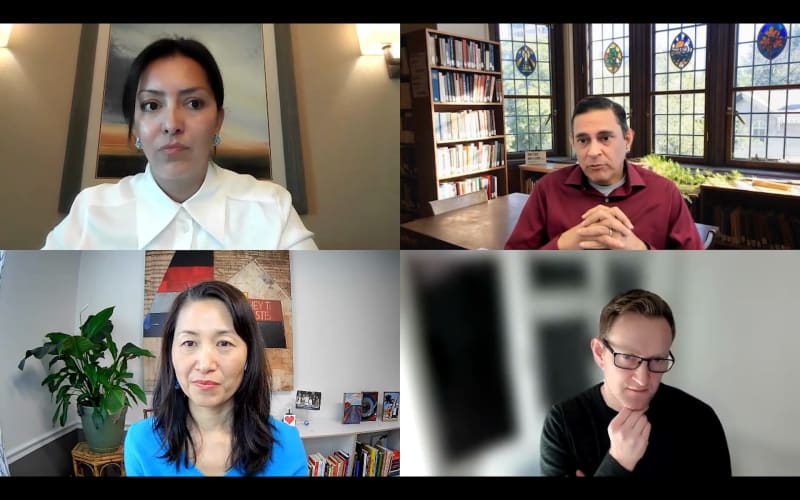
Okay. We are just a couple of coming on a couple of minutes past the hour. We do wanna, welcome you and get started with our presentation and our content for today's session. If you're just joining us, thank you for joining us. At a time when there is so much change and uncertainty in the world around us, it's great to be able to have a place to have an important discussion about the future of work and technology. I'm Juanita Oguin, senior director of marketing for platform solutions at Koveo. And today, I'm excited to introduce you to this all tar all star team of enterprise architect leaders with us on the call today, and they were hand selected for this presentation, and you'll soon find out why. Just a note that we will be recording today's session, and you can also engage with us on the q and a in the, Zoom panel here. I'd like to start by introducing our panelists, starting with Ash Kanagat, who is director of enterprise architecture at Bain, where Ash provides internal consulting on technology strategy and direction. Prior to Bain, Ash was also at another large consulting firm, BCG, and has over thirty years of experience providing technology direction, including managing systems for a four billion dollar line of business at Verizon. What I think is awesome about Ash as well as our other panelist here is that he's not afraid to dive in to test technology directly. So welcome, Ash. Next, I'd like to welcome Hope Yin. Hope is SVP of engineering and engineering engagement at US Bank, where she helps to ensure the workforce and engineers specifically are ready and enabled for the future of work in areas of cloud and digital transformation. Prior to US Bank, Hope was at JPMorgan Chase and helped to implement a large scale HCM solution impacting two hundred and fifty thousand employees. Hope is an active member of her community, an executive, and leadership coach, and we met at Forrester's Tech and Innovation Conference where we bonded over the importance of investing equally in EX and CX. Thankfully, Hope agreed to join us for our session today. Welcome, Hope. And last but certainly not least, we have my colleague, Luke Martin, who is director of consulting in EMEA at Coveo. Luke has over twenty years experience of building, implementing, and defining IT systems systems for companies of all sizes and in various industries. I've enjoyed working with Luke to help guide companies on their unified AI powered, search journeys. Luke, welcome. It's great to have you here. Thanks, Marissa. Yeah. Delighted to be here with everybody. So what's one thing I'd like to point out, that's so great about our panelists here is that they're experts in their particular area, and each of them brings a slightly unique viewpoint. Ash has more of an internal focus at Bain, Hope who has both an internal and external focus at US Bank, and then Luke has an external focus at Coveo. And interestingly, Luke would be interfacing with people like Ash and Hope when we when we go into those technology selection decisions. So this should make for a very interesting conversation. So do wanna encourage you to send any questions you have in the q and a, panel here, but we're gonna get started by looking at trends in the market today, which are represented by three statistics that you see from leading organizations. So starting with the first one from Gartner, we see that four out of five CEOs are increasing digital technology investments to counter current economic pressures, including inflation, scarce talent, and supply constraints. We also see that Forrester is predicting that eighty percent of companies will shift their innovation spending from creativity to resilience. And lastly, on the right, we see that eighty four percent of CEOs believe innovation is critical to growth, but only six percent of CEOs are satisfied with their innovation performance. So I would like to bring in our panelists starting with Ash and get your thoughts on what you're seeing here. Thanks, Manita. Firstly, thank you for the eloquent introduction. Appreciate that. Thanks for the invite. I'm gonna pick Mackenzie over here since you already mentioned that I work for Bain and I work for BCG, and, Mackenzie kind of is in the same space. So that resonates a lot with me. I agree that, you know, ninety four percent of the CEOs are dissatisfied. I'll try to kind of dig a little deeper into this and share my view. Firstly, what exactly is innovation? I think we need a definition for that. And it comes from a Latin verb called innovare, which basically means to renew. And, you know, you renew a product, you renew a service, you apply new processes, introduce new techniques, establish some ideas, successful ideas, and you create new value. That is the definition of innovation. And innovation can, there could be several objectives for innovation. The cost optimization efficiency is one that I think resonates with most people. Differentiating strategy needs innovation. Everybody wants a differentiating strategy because that's a competitive advantage. A good example is if you really wanna look at innovation and how it's done and the benefits, look at startups. Startups bring a differentiating product. Right? They bring innovation to the table. They bring all the things that we can actually do ourselves without being in a startup. So to innovate, I think the objective needs to be clear. And if the objective is clear, I think we can change that ninety four percent number. Great. Great. Great thoughts and comments. Hope any of these really resonate or stand out for you. Yeah. I I learned a lot from Ash's sharing. I would say that innovation is hard. Right? Because it need new ideas, new way of working, new ways of thinking, sometimes it is really think outside of the box. Probably that would contribute to some of the reason why CEOs are not satisfied with where they're going for innovation. What is the result of the innovation? Because a lot of times, when you measure innovation, it's many, many, many years, and sometimes the generations. So that quantification is hard. It's not easy to measure. And the other thing that, going back to some of the other statistics you shared, Juanita, I think if you think about the pandemic, the past three years, a lot of the business were impacted severely. But some of the, businesses that actually strived, one of the reason is because of the technology they have, the platform they have. You know, just see the restaurant quickly to be able to offer online curb, service. All that is changed by technology. So it's not surprising that the CEO, CIO spend more time, more money, effort, and resource on the technology to counter some of the, potential economic challenges. Back to you. Yeah. I think that's that's an important point as well, isn't it? We probably everyone on this call is fascinated and passionate about technology, but, ultimately, that's all sitting in the broader context of of the economy. And as as we know, things are things are changing. There's some tough things happening at the moment. And I I think that's the the forest point in the middle is that, actually, if some of that sort of, you know, amazing growth that we've got used to, that's suddenly changing a bit. We might have to, yeah, shift our plans and where some of that ambition to be creative, might have to get deprioritized over something that's perhaps a bit more defensive. I think, yes, you know, On one hand, it's just a different type of problem to solve. Obviously, it's, it's I think we all all prefer innovating and being creative rather than, being defensive, but I think that's probably also part of the part of the role, isn't it, in order to support the business with the best sort of technology? Yeah. I agree. It's, you know, going back is the objective of innovation given the parameters as Hope also mentioned, changing environment, the pressures that we have. You gotta consider all of that. And you can innovate in a nice growing happy Barca, but when you're in the current situation that the world is in, you need to you need to tweak that a little bit. Back to you, Juanita. Yeah. No. That makes complete that makes complete sense. I mean, you do have a pulse on what's going on. You're agile enough to evolve what you're doing. So that all makes sense. Thank you all for those comments. You know, as we're thinking about technology direction, obviously, no technology project is successful without the right talent. And so what I wanted to highlight and share with everyone here is the number one job in America this year. Number one job in America, for those of you on the call, is an enterprise architect. I hope as you read this and and you find this out, you know, I'd love to hear those of you, your thoughts on the that are joining us, in the audience. But for our panelists, what do you think about this, Ash? Is this surprising to you? Honestly speaking, it is surprising, but when I think it through, maybe not. I'll try to explain what I mean by that is. By the way, I I welcome this perception that it's the most exciting job. I wouldn't be surprised because there's a high satisfaction level personally for EAs. I think, you know and I love to hear from, Hope and Luke as well what they think about it. One thing about enterprise architecture and enterprise Barca is on a in my perspective, not everybody could do it. Just like a good UX designer. Know, you have to have an aptitude for it. And in enterprise architecture, you have to see what I call a see the unseen. You have to have that ability to see the unseen. And, I would I would love to see enterprise architecture, take a center stage going forward. All of us need to evangelize the role, make people understand what value it brings to the table. And I do believe that, you know, the c levels and firms that understand the value of EA are going to benefit the most. Thoughts hope? So, first of all, I am happily surprised that we have the best job. Very happy to hear that. Second of all, I'm happy to hear what Ash mentioned. Not everybody can play a EA role. I totally agree. Because when you're looking at EA role, it need to be able to have that big picture thinking, innovation, creative automation, and to be able to even communicate. Right? A great communicator. So there's a lot of great attribute needed for a great enterprise architect. But I would say that, going back to, Ash, what you talked about, the role of EA are playing. And, normally, it's a larger scope. The impact influence they're making is enterprise level, and sometimes it's a multiple across the industries. So when you think about the meaning of work, the purpose of the work, the scope, the impact of the influence of the work, it really gave me personally a big satisfaction. So I'm hoping that is also, one of the reason why people think EA is the best job because we're able to make a difference. What do you think, Luke? Yeah. I think that's a key to it, isn't it? In in terms of what what makes people happy, it's it's often the research is often point to, having some sort of meaningful work to do and, obviously, what's meaningful is different for everybody. But I suspect those of us that in, this this end of the technology world are are people that enjoy solving problems and creating solutions sort of Barca, you know, and naturally sort of fall into enjoying that sort of task and that sort of work. So, hopefully, that's a good fit for people because, obviously, that that that's the a key part of the role is to be able to tackle these difficult business problems and provide some form of tech usually, technology solution. And so that's a that's a great big set of puzzles to work with. So, certainly, I I enjoy doing that and very very satisfying seeing, customers that we work with, you know, go live with new new projects and so on. So I know I certainly enjoy that aspect of the job. Well, adding to that, I would love to for for each of you to go a little bit deeper and tell me obviously, we had the pandemic and the state of the world and business world continues to change. So I can imagine the role of EAs continue to change as well. So I would love to hear from you on your views. How are things changing in this role, and where are they going? Ash, you wanna start this one off? Yeah. This is, this is something that I try to do on a daily basis as I, communicate the value of enterprise architecture across, the firm where I am. But let's first agree. Enterprise architecture used to be ivory towers for decades. You know? Let's just admit it. Smart people generating complex diagrams using unfamiliar terms, and the audience really would just sit and listen. They're like, okay. I we know that you're doing a great job. So there there was no clear, value that was coming out because people really didn't understand what was being done. Today, I think the shift is towards understanding the business for an enterprise architect and spending more time doing business architecture than what I call as technical architecture. And the reason why this shift is happening is is is interesting. And my view is that there's an easy availability of sophisticated technology and tools today. So in the past, enterprise architects were trying to improve processes. They were looking at, well, you need to use this tool because it's gonna be better than that tool. Well, today, there's very little difference between different tools. Then the cloud has leveled the field of technology. Anybody can fire anything up, sign up for AWS, and you have the most sophisticated tools that are being used by the best companies in the world at your fingertips. So how do you make, a change? How how how do you make a difference? You have to focus on the business. You have to focus on the business that you're in, understand what it's doing, and then help adapt those technologies to the business. And the shift really in my in my head is from the how to the what. And so the enterprise architects really need to define what we need to be doing and then get the firm to actually go behind that. So, hopefully, that's, that helps. What what what do you see, Hope, based on where you're sitting in in your organization? I I certainly agree with you, Asher, on that shifting of solving purely technical problems, to the enterprise business problems. And as a matter of fact, again, our team, we have, certainly a group of, target stage architecture team to work with the CIOs to solve business problems at enterprise level. The other shift I see is how can we become from that governance pleasing to value addition? What I mean by that is we're constantly thinking about how can we remove the frictions of the engineers because they are the one to make the software or product or serve, offerings available to our customers and making revenues. And so how do we improve their experience, including what I do in US Bank, to how to help them upscale, how to make the connections so that they can be cross pollinated and sharing best practices. Like you mentioned, right now, services are readily available. However, does that mean it's available for the organization? Can you reuse a certain framework? Right? Those are the common values. And the other thing I see is really looking at a CICD pipeline. How do you have a framework that can be shared through all the engineers throughout the enterprise? So those are some of the shifting that I can certainly see, including data driven governance. Instead of you need to fill in this form. Let me check manually. Instead, you're looking at the data systematically. You have a dashboard automatically pull the data to show you how well are you doing in terms of your application development. Are you doing unit testing coverage? How how much is your unit testing coverage? Are you doing resiliency and things like that, automation? I I love that phrase, Hope. I think from shifting from governance police to value creation. I think that's that's really the in a nutshell that that that certainly what almost as in my role kind of a as a as an observer of, of enterprise architects. I get to meet a lot of of of people, you know, over the years, and it's definitely shifted from, you know, IT led procurement being sort of the the order of the day. If you go back a decade or two to now, it's much more, yeah, what is what is it that the business needs and and then the the the the technology function alongside, you know, as an adviser almost as that. We're all used to sort of HR being a business partner now. I think we're almost seeing the the technical functions, the EAs maybe, almost as business partners now, which I think is a really interesting dynamic. It's finally getting to sort of, you know, yeah, solving problems and delivering value rather than, yeah, defending, principalities and turf wars and things like that. So, yeah, it's a good it's a good shift, I think, in my opinion. I'm gonna let you steal that phrase. Sorry. On top of that, something just struck me, and I wanted to kinda throw it out, is because there is a shift towards understanding the business more, I'd be kind of reading various articles on what is the organizational structure for enterprise architecture. Where does the enterprise architecture team really, fit within the hierarchy of the not let's not call it hierarchy. Who does it report to? Does it report should it report to the CEO? Right? Because of the decision making over there. Should it report to the CIO? Because it's got a technology flavor to it. Most people identify enterprise architecture as, well, technology people. Right? But it's really not technology. It's business architecture and, you know, technical architecture. So they have insight into both of these. And so companies, I think, need to rethink how they structure their enterprise architecture organizations because placement of the EA team is very important when it comes to the adoption of what they produce. So just wanted to kinda throw that out as a as a discussion point, and, you know, you can hope jump in if you have any thoughts on that. Yeah. I think that's a great point, Ash. I do want to comment on that. Reporting structure is important because it may impact how the decision is made or what kind of decision is made. But I think equally important is the mindset of architect. Architect shouldn't be the job of only a certain group or certain people. Right? I think everyone need to have that mindset. However, we also know people have different skills, different experience, and we certainly need to have a group of people who are really close to where we're going in terms of an enterprise architect, and what are the new technologies available to us? What are the new platforms? What are the new business areas? So I I see that, everybody need to have the mindset, but, also, there is a need for a group of people who does excel in this area. And I think if you think about the agile and the product model, and that's where no matter where you're sitting, the group are working together. Right? And we share the aspect, expertise in that team so that we can make a decision together. Yep. Yeah. Just to add I mean, that's made me think of a a couple of scenarios where, part of the shift, has been, it used to be the business and IT, let's say. And then in the last, I don't know, five years, let's say, we've had, you know, digital transformation has become a thing. And it's almost like that's a third group of stakeholders in the middle. And, yeah, I'm not sure that sometimes that dynamic works, and sometimes it hasn't because, actually, yeah, the the IT guys are still doing the the the the governance policing, and it doesn't matter what the, digital transformation team come up with because they're not really the people with the, the powers of all the strings. So, I mean, I it yeah. I'm not sure what the the answer is to that, but it's sort of it's it's an interesting reaction, I suppose, to the way that some models work, and it makes no sense for a company to be infighting. You know? So, yeah, I I guess Barca to Ash's point about what is the right structure for that. Because, of course, you have to have governance, but, of course, you have to have the creativity. And so, yeah, I don't know. What what is the best ask? How do we balance those potentially conflicting requirements? Great discussion. And I'm sure every company approaches it a little bit differently. I wanted to take us to, another another topic area, which is as we're thinking about the role of technology and the changing role of EA, what are some of the characteristics that go into your technology decisions? And so, we work with a a a gentleman, Isaac Sikolic. He's a former CIO and CTO at McGraw Hill and Business Week, And he wrote a white paper where he talks about force multipliers that accelerate digital transformation. And he talks about five characteristics of these force multipliers, which you see on the right here, and I'll quickly read through them. Force multipliers have the potential to affect revenue and cost savings. They improve both customer and employee experiences. They enable IT and dev ops to work smarter and faster. They accelerate transformation by developing leaders and maturing digital practices. And lastly, they deliver innovation while enabling companies to transform culture by working safely and securely. So I wanted to, get the panelist's thoughts on this one. Do these resonate for you? Do any of these, stand out for you? Any thoughts there, Ash? Yeah. I agree with all of these. You know? I think, Isaac is right on the button with these, but with varying degrees of importance. Right? Number one is slightly more obvious. EX and CX are becoming more and more important. I wanna touch upon security a little bit because kinda embedded in, the DevOps and IT, enable IT and DevOps piece, and it's also, you know, innovation enabling, working safely, and securely. So this morning, I I read my newsletter, which says we've got a data breach. And the data breach is for a a password application, you know, which we all use. I I I won't really you you can look it up which one it is. It's pretty obvious. It's it's hit the newswires. It's where I keep all my passwords. Every single password. From my four zero one k, my bank accounts, I don't know, Facebook, whatever. It's got a data breach. And and that's the one that I feared the most, saying if if they breach that, the two hundred, three hundred passwords that I have, I was using a tool, trusting it to keep it secure. Now the tool is breached. So I think security is becoming so important and so important for enterprise architecture and the the you know, when we talk about accelerating digital and digital transformation, we have to think about security right from the onset of an idea. It has to be ingrained in the design. It has to be ingrained in the strategy. Now you can do, and most companies are doing it, you you put it on the applications to handle security. So application a, you handle security this way. Application b, you handle your security. Application c, make sure that you follow this these, security principles. Now what's really happening is not all applications have the same level and depth of expertise or based on the behavior of the application, they may or may not be protecting things that you think they should be protecting. But if you have an overall framework of security and you're saying, like, look, we're we're doing digital transformation, and by the way, we absolutely it's mandatory for us to follow certain principles for security. That becomes very, very important. So I think ISAC, by by actually pointing these out, he's also conveying it through the bullet points that, you know, IT, DevOps, even the customer experience, employee experience, everything over here. You, you know, you struggle with experience and you think, well, the experience is great, but if I put in some security control over here, I'm gonna let them actually log in thrice. I think that resonates with a lot of people. Right? And from a CX perspective, if you know, the user is like, why do you want me to log in thrice? You already know who I am. I just logged in to my laptop. You know exactly who so, anyway, I think we all get the point. And I think ISAC's, right on the button with all five. Oh, Penny. Wow, Ash. That that's such a great example. Sorry, Juanita. I just got excited. I want to comment on that. You're right. Right? When you rely on our fundamental technology to, do certain thing and all of a sudden that one is broken, the impact is huge. So I certainly completely agree on, not only going faster, quicker, but also more secure, safer. When I think about a force multiplier, I think about really people, processes, and technologies all work together. So without repeating what you're saying, I think one of the other important things that I resonate with me is number four, the leaders, developing leaders. Because for any transformation, the leaders are leading the way or they're blocking the way, because no matter how much we want to change the culture, the psychological safety, people still want to look upon their leaders, how their leader doing, what do the leader need. If you want to go agile but your leader is still doing some sort of waterfall status update, then that become a blocker to your more agile mature maturity. So that's where I think leaders need to evolve with digital transformation, which, in our workspace, we spend a lot of time, looking at how do we develop our workforce, including our leaders. So I think leaders' role is super important in this transformation. I agree with you, Hope, completely. That's, that's a very good point that you picked. And developing leaders is one of the keys to successful digital transformation. Yeah. And I think as well, if we're looking at the sort of points, points five as well, sort of trying to deliver innovation, you know, my so natural inclination, of course, to think about the technology, but, of course, you know, right, that has to be wrapped up in a in a project, which is part of a program, which is part of a a culture of innovation, and and all of that requires, yeah, a good, bullet point for people actually the leadership being involved in that and preferably from the top down to to avoid some of the challenges we talked about in the previous section, actually. So, yeah, I think they they they certainly knit together. And that culture of innovation is is is also very interesting. I know from my from my perspective, sort of as a as a as a tourist in in different organizations, it's fascinating to see the the way that we get to to talk to different stakeholders that are either, yeah, you know, really passionate, really motivated about innovation and want to, deliver that digital transformation. And then maybe others who are just quite happy doing their job and and would prefer not to have everything messed around with. Thanks very much. So, yeah, very interesting to see how that problem can be solved. And I think it ultimately boils up to that sort of leadership and culture question, not just about the technology. Absolutely. Thank you for that. I'm wondering if our next topic would, help to ruffle some feathers or get people to take action, and that is weighing build versus buy decisions. So I know, Ash, you and I spoke about this a little bit. And one thing you told me was that oftentimes, some of these decisions aren't made with the right best practice in mind, but rather based off of the skill set and the comfort with technology that exists. Could you elaborate more here? What are your thoughts on build versus buy? Yeah. Let me let me put a let me think this little better so I can communicate it. This is something that I I'm actively working on, build versus buy. And, my, the leadership in my organization expected us to come up with some sort of guideline, expected the enterprise architecture team to give some advice in this. So let's define the problem statement first. Right? So let's take a look at build. And and by the way, this is a contentious thing. Right? So there's no easy answer, but I'll give you my perspective on that. So build requires employees. Build requires infrastructure. Build requires skills. Okay. Now infrastructure is free. We already spoke about infrastructure is available to everybody. Same infrastructure is available. Like, provided you have the spending budget for that. And the cloud has changed that whole paradigm. Now when it comes to employees or people and skills, let's not say employee, people and skills, Firms, vendors, we are all competing for the same group of people. Hope is probably looking at some resumes that I've already taken a look at, you know, look at. You there's a limited finite number of people who can do the things that we want to do. We have to admit that. Right? That that is the current state. So keeping that in mind, when I was looking at the bill versus buy decision and saying, what can I propose that may resonate with people? What I came out with is explore the buy option first. Someone has already done the diligence, and they've put in the resources behind it. And, of course, speak to market with buy is an obvious, answer. Right? But explore the buy, but do it with diligence, which means you gotta do the RFI. You have to define the requirements. You should know the requirements first yourself and be able to articulate those. Then you communicate it to the, vendors and say, what do you propose? Do an RFP. Right? And when you get a final vendor that's selected, of course, before we go there, you think about cost flexibility, product road map, long term viability of the vendor. Even after you've selected a vendor, you should have the ability to walk away and say, okay. This vendor doesn't cut it, doesn't meet the requirements that I'm looking for, doesn't meet the CX, EX, and everything that we're talking about. Be ready to walk away and then talk about build. So that's my my my suggestion is then go build. Even when you're doing build, use the same points that I said is that we're competing for the same people. In build, consider do you wanna build it yourself, which means with your employees in the current workforce that you have? Or do you want some third party to build it for you? So that it becomes like a two fold decision, build versus buy. But if you wanna build, then you also wanna figure out who's gonna build that. And then if you can outsource the build, that's what I would lean towards. Because software development competency has narrowed tremendously. The difference between development by folks internal to your group and by third party, there's not a whole lot of difference because of agile. Right? Because you're following the same methodology, and and and the structure of how you're doing requirements is the same. And like I mentioned, the tools and the infrastructure is pretty much common. So when you talk about build versus buy, in my in my mind, it's very clear that you look at buy decisions first, but do your diligence over there, and then think about build. And in build, also take a look at whether you wanna build it yourself or you wanna get it built. I love that. However, Ash, I do want to talk about it from a different perspective, and this is why it's so awesome because we all have different perspectives. I agree with you. When you feel there is a need, you probably want to look at what's already available in the market. Right? Like you mentioned, do the due diligence. Is the product available would fulfill my need to solve that problem, whatever that problem is. For example, if you look at all the companies, probably all the companies are not not all the companies are doing their own learning platform or content. You have so many, learning providers. You can just go in and buy whatever you needed. However, if there is business specific and also think about especially my, area in the banking, highly regulated, where the data data is stored, how is the data stored, how the data is being purged, and talking about the risk and the scalability, all that. Those are the things that we want to think about. In my past experience, we had, a scenario that when we try to buy the product, one of the module doesn't offer encryption for data at the rest. We had to make a decision of, okay, we're gonna buy this product, but for that specific module, we're gonna do it ourself and integrate with the vendor product. So I see a lot of that you buy. However, you also build that, like, almost like a necklace. Right? The integration, the data, the the, security kind of you have a combination hybrid of both vendor product and self build. And that's what I in my experience has been. So I think I'm gonna have a slightly different perspective again. For me, I I've made my career essentially selling and implementing commercial off the shelf solutions. So there's really only one answer to this question. It's and it's it's buy, of course. So that's that's end of discussion there. But an interesting, Ash, that they put, cloud providers like AWS on the on the build side rather than the buyer because they they won't do it for free. You you gotta you gotta buy that stuff as well. So that's a brilliant bit of marketing, I think, from from the the the cloud infrastructure, provider's perspective is that they they've got that mind share that they're part of build, but in fact, you know, you're buying that stuff. So this is maybe a whole different discussion to have around that. But, yeah, ultimately, it comes down to, I think, as always, the conflicting requirements. You know, there's sort of the risk. What kind of risk are you looking at versus capability and to what extent can you, trade those things off? Is is there more capability specific to your absolute requirements if you build? Does that come with extra risk, and vice versa? Yeah. You probably most credible platforms now that you would consider would pro can probably do most things that you're looking for. They've almost certainly got APIs and and should be configurable. So I would, you know, challenge that build needs to be, something you have to do now. And there are so many solutions for so many, niches now as well. I think that's that's, even even stronger argument for for buy. But then you're you're swapping out different sorts of risks, you know. And it's it's a tough question because it's not like for, like, you know, the risk of having IT projects and engineers and building things to your own unique requirements is is a different set of risks to going all in with a vendor and being attached to their road map and and their capabilities, etcetera. So, yeah, not an easy question really, but if I had you know, of course, I'll fly the flag for for commercial off the shelf. Yeah. And it also differs. You know, it's industry specific of what's really important. So I wanna clarify that. Right? For example, if you take a look at finance and health care and, let's say utilities, security is very, very big. It's it's it's like the first thing. That those are the only industries who've been thinking about security for the past fifty years. We're just catching up right now. The others are catching up. So when it comes to a buy decision, they have some fun and I think Hope gave a very good example. There's a fundamental requirement of security. And if there's a product that doesn't do that, it can do the bells and whistles and everything is gonna be nice and they have a superior c CX and everything. It's not gonna fly because you it doesn't meet your basic requirement, which is security. So, again, there are some variations. That's why the bill versus buy is actually there's no there's no one single fit there. You have to look at the industry that you're in. You gotta look at what's really important for you and your customers, and then you gotta think bill versus buy. Hope that helps, Juanita. There's no there's no clear thing. I think everybody needs to put their own parameters and come to a decision. It totally makes sense. I think what I hear is it's really the blend, and it depends, but I I'm sure the discussion and consideration points here are helpful when making those decisions. I'm gonna move to one of the last few topics we'll cover. And I really wanna start with hope on this one, balancing CX and EX initiative. This is something we bonded on at the Forrester Tech and Innovation Summit, something I know you're passionate about, hope. So how do you do this? How do you balance the investment, the focus, the prioritization? Tell us more, please. Absolutely. I still vividly remember our conversation. We were laughing, and we're agreeing with each other. We're like, yes. We are the two people think alike. So at the part of my role, head of engineering engagement, I think and work every day to think about how can I improve the experience of the engineers? Right? But when companies make decision, oh, am I going to increase or improve the customer experience or employee experience? To me, it's almost like when you ask me who is your favorite child, I can't answer that question because they are equally important to me. So I would just maybe invite all of us think about a day you are at work, but you were upset. And when you work with your stakeholders or your customers, are you going to be able to provide a supreme customer support or experience to them. You may you may pretend smiling even though inside you're mad or upset if you pretend you can't pretend alone. Right? That's what I think employee experience is the foundation to have a better customer experience. If you don't have a happy workforce, you're not going to have a happy customer experience. That's, to me, just the foundation. So when we think about employee experience, so many things can be included, including from all the way from hiring, onboarding, conversation, continue the learning, all the way to when I leave the company, did I have a good experience? And even after I left the company, right, you may still have some benefits with the old company, all that. And, also, your employee could be your customer base. For the banks, all your employee can be your potential customers. And so when I think about what we are doing for engineering engagement, we really think about for the engineers, what do they need? For example, as you are trying to come up with a strategy to help the engineers, when you do buy or build a decision, here are some guidelines you can use, but it doesn't mean that you're gonna make decision for them. You gave them a framework as they can utilize instead of they have to do all the research. Right? Here's something that you can make decision, help you make that decision. I think that's part of that is employee experience. You are making their life better so that they can take their effort, time, hide space, work on the business problems. And that's exactly what we do in EA. So we do a lot of automation. Instead, you do manual documentation governance. Let's do data governance, and let's create a platform so that all the engineers can reuse instead of actually, you talk about security. And if we have a framework the whole enterprise can use, and we don't have to ask the application to come up with their own security login authorization authentication. Right? Those are the things we can help improve the employee experience. What do you think, Ash? I'll look. No. That's, you you you took the words out of my mouth. You know, you said everything that I completely believe in that resonates with me greatly. So and I'm all I also learned a few things from you. So thank you. Well, I would just just make a a point that, actually, the the distinction is blurring as well. You know, I think a few years ago, it used to be very clear what was customer experience, what was employee experience. But now, you know, if let's say self-service, you know, people wanna just solve their problems and hit a knowledge article on the website and FAQ and and be done. Employees on the Internet do it looking for standard operating procedures. Somewhere in the middle, you've got things like contact center. And is so is a is a knowledge base for an agent in a contact center, is that EX or CX? Because although it's the agent typing in and doing some searching or what have you, actually, it's the customer on the phone that's listening to somebody miserable and bored and frustrated dealing with that terrible knowledge based system. So it's, you know, suddenly, these these these bound clear boundaries are no longer quite so clear. And I think, as always, it just adds extra, challenges to the mix for us as problem solvers. So, yeah, I think, so it's an interesting shift, I guess, in in terms of the way that some of these boundaries are no longer quite as clear. And and we do need to consider, probably for most projects, that there's an element of both in in in pretty much anything we do these days. That's such a great point. When you're helping a customer, is that e x is that c x? It's both. Yeah. True. You defined the, you actually picked an an example that resonates very well with me, Luke. It actually describes a previous job of mine, which was, you know, handling systems or providing an experience to fifty thousand reps serving hundred million customers, you know, at the at that scale, when you look at CX and EX and the blend and, you know, it's it's a different paradigm. And I'm sure, you know, Hope, you're actually dealing with that today. Right? Absolutely. And when you think about, what we are doing right now is to help the engineers to do their job faster, quicker, and secure. But if you think about the business leader ask us to create a new business feature, a new product, a new offering, if the engineers need, a lot of the time to even create a new feature because of the technology is blocking them. Is that a CX? Is that a EX? Right? So it's absolutely is blurred. It's altogether. Agreed. Awesome. Thank you. I love your analogy, Hope. You can't pick which child is your favorite one. They're both important. This will take us to our final topic, which is how to prioritize innovation in the challenging environment we have found ourselves in over the last couple of years and what we know and are hearing is an upcoming recession. For this one, I actually wanna start with you, Luke, because you are interfacing with a number of companies. What are you hearing? What are they asking for? Why are they still looking for solutions in this, in this very challenging environment? What's the impetus? Well, it's, yeah, it's a very, really interesting time. I think we're in the midst of a, you know, sort of real time adjustment to to various situations. I think we've, coming off the back of phenomenal sort of courage and innovation that got people through the pandemic. And, you know, lots of organizations did this fantastic switch to remote and hybrid working. And, you know, ten ten year long projects got done in six months because because of that, which is phenomenal. And I think we've seen quite a bit of momentum carry on with that. People have realized they can actually get stuff done, and they can innovate. And and, wow, it actually can work. Fantastic. And then almost, you know, sort of DJ record scratch, auto economies sort of taking a hit. And now we're kind of doing a some sort of handbrake turn as we deal with, a different set of rules now and maybe some of that confidence that that that motivation is getting some some tough headwinds. So what to do? You know? Because we're right in the middle of it, of course. And, yeah, I think we've we've got a different it's hard to paint a general picture because I think everyone's still got their different momentum going in different directions. What I what I was I did see something interesting, on LinkedIn. Somebody posted about conflict between you know, you can have forecastable revenue or innovation, but not both at the same time. So there was a brilliant kind of clickbait, you know, friendly headline. It sounds really wise. And the idea is, of course, yeah, if it's, if if you need to predict what's happening next, then you need proven solutions. You need to know that you can forecast. Whereas, almost by definition, it looked at Ashley's definition at the beginning, you know, innovation is about doing something new. So how can you possibly forecast it? So I think in terms of the sort of the EA role, then you're struggling because traditionally, and maybe even touching on the sort of governance policing, you know, if you're in an environment that is trying to innovate, suddenly, the the CFO is more important now because the economy, money is much tighter. So then the scrutiny and the ROI and the forecasting suddenly becomes a bigger part of the question, and it's less about what amazing things can the technology do, but more about, well, where are we gonna get the money from? So, I think that's that's part of the challenge. I I don't know that I have the answers for that. I I would always kind of vote for technology to solve problems, but it's, yeah, it's not my money that that people are spending. I guess it's a tough one for me to answer. I can I can tell you what the problem is, but I don't necessarily know what the answer is? I can take a stab at this. And, for the only reason that this is one of the cases that I'm I'm thinking through right now in my job, CFOs are not CFOs are still gonna be spending money, but it's the prior priority. Where do they need to spend the money? Is it to keep the lights on? You know, where do I actually do it? And I think the positioning, the value of innovation is the only chance where you can have an investment in innovation in this challenging environment. So you gotta communicate the value. Before that, go back to the definition. What exactly is the definition? And if you can tie the definition to what the CFO cares about and the CEO cares about, then it makes life a lot more easier. Right? So position it as a strategy enabler. Position it as a competitive advantage. Show the early value. Right? So if you're doing innovation, you don't have to do big bang thing. Show show an incremental lower value without a lot of investment in there, and then build that trusted relationship with the c levels. And I'm sure that they will they will once you prove the value and and you're meeting the objectives that the firm has set out for themselves, I think the the investment in innovation will not be an issue. I totally agree with that. Ash, so because you talked about show the value and show the small win, that's super important because we talked about measuring innovation could be very difficult. Right? And, in order to show the confidence that we can come up with some innovative ideas, showing the small one is very important. The example in our team, we actually held a hackathon in October. We had sixty plus people joined, and they have different teams formed to solve a problem, to how to get people, get certified, almost like playing a game, friendly competition. At the end of the two days, every team, sixteen teams, they all have a working prototype. And that's kind of innovation where you spark the energy. You spark the, the the fire in people's life. And if you talk about innovation, it can happen really on a daily basis. It doesn't have to be always a moonshot innovation. You think about a new ways of reduce the time it needed, automate a manual process, or share a service instead of reinvent a new service. All that, to me, is innovation. So, in US Bank, we actually have dedicated week. It's called Innovation Week. We talk about the innovation ideas. We showcase the new innovation, happening throughout the bank. I think it's important for the company not only looking at what I'm doing in the next three months, but also the next three years or even longer. Great. Great perspective. Thank you, Ash, Ruth, and Hope. We're, getting to the final few minutes of our time today. So for those of us that are you know, that have joined us, hopefully, you've enjoyed what you've heard from our amazing set of panelists. And if you are looking to go down that bypath, if you are looking for a scalable technology to help you innovate on the customer and employee side, obviously, we'd love to hear from you, and book a meeting with you. And if you're one of those doers and makers like Ash definitely is and Luke and Hope, you can, dive right in to try out our product to see what it can do for you. I do wanna thank everyone for their time today. I especially wanna thank each of our panelists for sharing your expert and unique perspectives. Thank you again, Ash, Luke, and Hope. And for those of you joining and listening, we hope that you learned something new today. Thanks again. Thank you. Thank you so much. I learned a lot. So did I. You guys are awesome. Thank you. We'll talk to you soon. Bye. Bye. Bye.
Enterprise Architect Webinar