
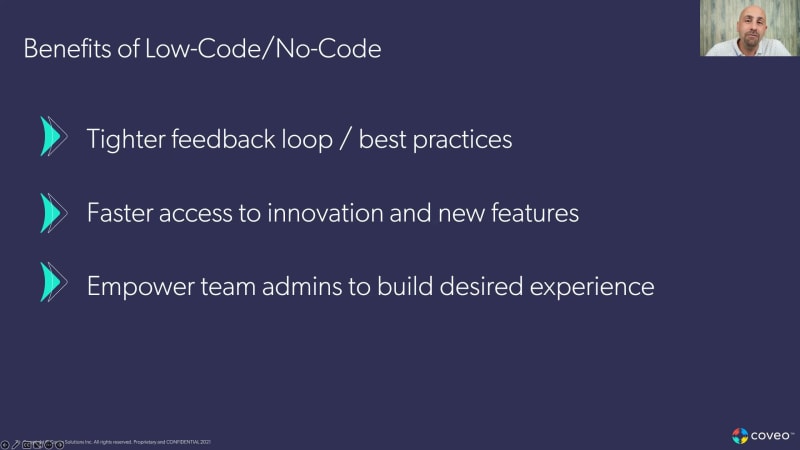
I'll give it a second for people to get into the room. Hello. Good morning. Good afternoon, everyone. Perfect. Thank you for joining our webinar, how low code, no code technologies are revolutionizing the agent experiences and service. My name is Maggie Bliss, and I'm so excited to be joined today with Dan Gingis, the experience maker, and Bonnie Chase, our senior director of marketing here at Coveo. They have a lot of wonderful content for you guys today, so I'm just gonna pass it right off to them. One of a few housekeeping things, this is being recorded, so I will send you a recording afterwards. And then if you have any questions, throw them in the q and a chat box. Thank you so much. Awesome. Thank you, Maggie. Hello, everyone. It's great to be here today. Very excited to be joined by Dan, the experience maker. If you haven't heard his podcast, definitely definitely listen in. It's a lot of fun talking about customer experience and really how to build those better experiences. So today, you know, we're talking about how low code, no code tech revolutionizes agent experience, a mouthful. But before we jump into the technology, I think it's really important for us to talk a little bit about why this is a topic, and why this is something that we should be thinking about, talking about, and and working toward improving. So, you know, I'll just start with a with a statement, and that's customer service is a differentiator. You know, it's not enough to just provide service. It's not enough to provide good service. This is something that customers, if they're not getting the experience that they prefer, the experience that they expect, they know they can find that experience elsewhere. So they can go to your competitor who's providing that better experience. So we're starting to see that it's not even just it's not even the products that companies are competing over anymore. It's the experience, and the experience makes the difference. So customer customer service on that aspect is a critical piece of that experience because that team, they're the ones working hand in hand with your customers. So, you know, over the years, we've there has been this kind of balancing balancing act between customer experience and employee experience. What we saw since the pandemic is that this this shifted from a balancing act into, okay. We really need to do both. Right? We need to make sure that our customer experience is good. We need to make sure that employee experience is good, and we know that these actually impact each other. And right at the center of that is the agent experience. And, unfortunately, agents are the ones who often get overlooked the most. Now on this slide, Dan, I'm curious from what you're seeing. You know, you you dig into to customer experience a lot. Is this is are you seeing this as well in this balancing act? Is it shifting more toward one or the other now that we're moving a little bit further away from twenty twenty? What are you seeing? Well, Bonnie, I think you hit it on the head when you said that they're related to each other. I look at CX and EX as sort of an infinity symbol. You know, that one that just keeps going, the kind of the eight on its side. And the reason is, is that CX and EX continue to affect one another. So we know that great customer experience is delivered by employees. And so employees have gotta have a pretty good experience in order to do that. We can't ask employees to provide a great experience if they don't know what one looks like or if they hate showing up to work every day. We've all walked into a fast food restaurant before where the person behind the counter, it looks like we're interrupting their otherwise pleasant day by wanting to place an order. We've also walked into a place where a salesperson in a retail store couldn't be friendlier and wants to get to know us and wants to offer us a personalized shopping experience, and that improves the whole customer experience. The happier customers are, the easier it is for employees to do their job. That makes them happier. And when they're happier, they show that to customers and that the cycle continues. Absolutely. And, you know, there there are lots of stats out there that that kind of prove this point. I've pulled in a few here. You know? Having that that good employee experience actually, you know, keeps your employees there longer. So I know on the the agent side, agent turnover is a huge deal. It's always been an issue. But how about we take some more time to to invest in that experience and and make that better? And the stats show that it does actually make you know, it reduces that turnover. And, you know, we definitely wanna keep our customers with us. We wanna keep our employees with us. So taking care of both is really important. Now it it's easier said than done. Right? So we talk about delivering a better agent experience, but what does that look like? And, you know, I think one of the biggest things that that we see is there are a lot of companies who want to invest and want to improve that experience, but it continues to be a challenge. So I wanna talk a little bit about some of the challenges that agents are facing in today's digital environment. You know, I put a few here. I can talk through these. But, Dan, really wanna get your thoughts on, you know, what are some challenges that you see in delivering the agent experience? You know, the first thing I think we all have to understand is being a customer service agent is a hard job. My first job out of college, they took people from the marketing department during the holidays and asked us to fill in in the customer service department, like, sometimes just for a couple of hours. Wow. Was that hard work? You have to know so much about so many different things, especially if you're a company that offers a whole bunch of products and services. You have to be the expert in a lot of things. And, unfortunately, the information that you need is not always at your fingertips. You don't necessarily have a complete knowledge base that answers every question that could possibly be asked about every product. You don't necessarily know where to find things or the systems you're working on so many different systems that it's just too complex. Anybody that's walked into a contact center has seen this before. All you gotta do is look at the workstation of an agent, and usually you see never just one monitor, always more than one monitor. Sometimes it's two, sometimes it's three. My favorite part is you usually see post it notes all over the place because agents have created little shortcuts to help them do their job easier. I have found that agents have a Word document up, and, and and they copy and paste responses into chat sessions because they don't have anywhere else to go grab that response. And so they create these little fixes themselves, but all of that makes their job more complicated. And if we bring this back, Bonnie, to what we were saying about the impact on customer experience, what happens is the customers sort of get that they get that feeling because you're dealing with an agent that's frenzied or frazzled or that doesn't, you know, that has to keep putting me on hold or that has to keep, you know, asking me to wait a moment while they go find something. And what we find is that that bothers both the agent and the customer. It's not a good experience for either one of them. Yeah. That's a great point. I mean, you know, I think we've all dealt with our own bad customer experience or customer service experience, even even situations where you you call in to customer service with a question. If you call back five minutes later and got a different rep, you may get a different response. So I don't know if anyone's worked the system in that way. I don't like this answer. Let me just call back and get somebody else who'll give me an answer that I like. And, you know, I think part of that is the fact that, you know, all of all of these technologies that that they're having to work with, it's all siloed. Right? So the systems aren't talking to each other. So they're really dependent on the people. Right? So other agents to kind of help them. It's that whole swivel chair mindset where I can turn and and ask the person next to me. So there's a lot of shared knowledge happening, both on their, you know, on the docs that they're kind of creating on their side, the conversations that they're having in Slack, things like that. So a lot of information, a lot of technology, and then nothing is nothing is connected. And you made a really good point, which is they're they they don't like delivering that bad experience either. And I think, you know, when you look at the agent turnaround, that's part of part of what leads to that. Right? They they're not getting the support that they need to do their job. They they're dealing with angry customers every day. They are expected they have high expectations on, you know, response times and getting the right answer the first time, and yet they're not equipped to be able to do that. And so it really is, you know, very, very challenging for them. And on the other side of that, you know, they're seen as a cost center. So it's hard to invest in an organization that you see as a cost. Right? And I don't know. You know, one of the things that we're seeing is is that that's kind of turning around where contact centers are are no no longer see being seen as a cost center. But if treated the right way, if used the right way, they can actually lead to profit and lead to more revenue. Curious if you you've heard that as well or if you're seeing companies kind of make that transition. For sure. And, you know, you made a bunch of really good points there. One that I wanna point out is that that agents are often dealing with angry customers. And if you think about it, the only reason somebody calls customer service is because something in the customer experience went wrong. Something wasn't as advertised or or didn't meet the customer's expectations. So that in itself creates a lot of stress for agents. It's one of the reasons, by the way, that I always suggest, that when you do get compliments, and and compliments are more apt to happen in other channels like social media, that you let your agents take those too because it it it will improve their day to talk to somebody who's happy every once in a while. And I think it makes them better at handling the angry customers as well. But, yes, definitely, this idea that the contact center is a cost center. You know, Bonnie, if I still had hair, I would be pulling it out at hearing that because why wouldn't we want to talk to our customers? I mean, without customers, we don't have a business. They are the single biggest asset of our company. Employees, a very close second. But let's face it. We don't need employees if we don't have customers either. So if a customer wants to talk to us, to tell us what we're doing right, to tell us what they wish we could be doing better, to ask us questions, This is something we should be leaning into. We should want to do this. Because not only are we solving problems for a single customer, we're capturing so much data and feedback about how people use our products, about where they get tripped up, where the barriers are, frustration points. And if we're doing it right and we treat the feedback loop as an actual loop, we bring it back into the business to fix the underlying problems. This is which ends up, by the way, reducing cost. So the contact center, it has so much value that to only look at the cost of hiring is kind of like looking at marketing, you know, and only looking at the salaries that we pay marketers without looking at the people that they bring in the door, which is the revenue part. And I think contact centers have not gotten that kind of credit in the past, and they're starting to now. Yeah. Absolutely. I I definitely definitely starting to see that as well. And, you know, as far as as delivering that good experience to those agents, you know, it's it's more than just, okay. There's a call center in this location that we need to improve. Right? I mean, agents are spread across the world. Contact centers are are all over the world. Just one organization can have all of these different, contact centers. And and so trying to deliver technology that meets the needs in every single one of those areas can be a challenge as well. And that can that can impact the experience for, the agents, but also for the customers because that leads to things like longer hold times, you know, being being put on hold so that they can find an answer. You know, that that just leads to increased frustration. So, you know, the the third point that I have here on this slide is, you know, a lot of times when there's technology, you've gotta get IT involved. And so that configuration, that process of having to go through IT to make a change, you know, that can delay the process as well. And and that really leads to, you know, this idea of, you know, using low code, no code technologies in the contact center to help deliver that good experience. Now when I talk about low code, no code, what do I mean by that? I mean, there are solutions out there who deliver these experiences without having to, hire a developer to build them out. I know it's very easy when you have an internal team that likes to develop things and and make those custom solutions. But in the long term, what ends up happening is, you know, there's extra time to to maintain it, you know, the time it takes to fix issues. And then, of course, if you wanna make a change and wanna make an improvement, you have to go through, all the red tape that's a part of that. Is this something that that you're seeing as well as far as, you know, the role that I see plays in in creating these solutions, but it can also kind of hinder the the progress of creating that experience. I could tell you from my own experience in corporate America where I spent more than twenty years, IT is often the biggest barrier to bringing in a new vendor. In fact, there were oftentimes where, as a product manager, I just wanted to find some other way to do it because I knew that I'd have to get into a long queue of IT projects. I knew it would take a long time to implement, and I needed a solution now, like, not a year from now or eighteen months from now. And so I do think that's a very under realized barrier. And so when you can have a no code solution where you or plug and play or however you wanna call it where you don't have to use the IT team and you don't need separate coders and all that, I think that is a huge advantage. And it is definitely, you know, I talked to more than my share of vendors when I was in corporate America. And often, the ones that we had to kinda send away were just ones we knew we were never gonna get prioritized with IT or that even if we could, it was gonna take too long. So I do think that's a really important aspect. Yeah. And, you know, it's it helps to remember that IT is responsible for the entire company. Right? It's it's not always, you know, by department. So, there's a lot of things for them to consider and, you know, especially if you're seen as a cost to the company, you may not be a high priority on that list. So in in talking, you know, more about, more about the benefits and things to, low code, no code technology, you know, there are a few things in here. You know, one piece is really that that tight feedback loop, for agents providing that better experience. I mean, you talked about this a lot already, which is they're the ones who are interacting with the customers. They're the ones hearing the voice of customer. So they're able to bring that, conversation back quickly and start enabling those best practices. You know, faster innovation, faster access to innovation and new features. You know, we talked about if you're wanting to make improvements, having to go through IT to make those changes, to make those improvements, it may take a while. But if you have a low code, no code solution where you actually can make those changes, you'll be able to take advantage of that faster. And then, you know, my last point was really about empowering those teams to build their desired experiences. And I'll show a few examples of this, here in a in a little bit, but it's really about enabling them to, like, own their experience. Right? So they're the ones dealing with the customers every day. They're the ones having to, find the information and sift through all the different areas. So put it in their hands to enable them to to modify that experience, make it personalized to the agents, as well as the customers. You know, I'm curious to see what your your thoughts are, here on this, Dan. Yeah. I wanna talk about a couple of these. The first is feedback. And we think about a feedback loop. There's a lot of people that are involved in that loop. So if customer x has an issue, the first thing we wanna do is solve the problem for customer x. The second thing is we wanna figure out what caused that problem, and that might involve our product development team or our website team or some other team that's gotta go fix the underlying problem. We also wanna make other agents aware of the problem so they know what the right answer is so that, you know, if if the agent had to research a solution, now the next agent shouldn't have to research the same solution. It should it should be part of the collective knowledge. And I think the last piece is going back to customers because at least when I was in corporate America, one of the sort of unwritten stats was that every time somebody called in with a problem, there were a hundred customers that had the same problem that didn't call in, or there were customers that had called in previously for the same problem. And so getting back to everyone to say, hey. We just finally you know, we fixed the underlying problem. You shouldn't have this issue anymore. Makes customers feel heard and understood. I also really like your point about the faster access to innovation. And as you were talking about it, it made me think of, you know, my cell phone or even an electric car that gets automatic updates. Right? Things get fixed, things get improved, and you just you you just turn on your phone one day and the software has been updated, and now you've got new features. And, I'm not saying that it works exactly that way, but it's similar to having to okay. Now we gotta call the IT department and, and have them recode this, or we're gonna have to take it offline for a while. This is a much simpler process than that. And I think what's great about it is that employees, and agents are used to that in their real lives because because, you know, with those examples I just shared, we're kind of used to being able to have this continuous improvement just happen without us really having to do anything. Yeah. That's a really great point. And, you know, and even thinking about what you just said about that faster access to innovation, I mean, we get it every day in our lives. If we're let's say we're looking for an employer. Right? And which employer are you gonna pick? The one with the latest, greatest software that makes it easy for you to do your job or the employer who's ten years behind the time that, you know, it has a sticky workflow that makes it difficult to do your job. So from an employment perspective, if you're looking to, you know, build a team, grow a team, keep a team, You need to make sure that that they've they have that experience that, you know, they're used to every everywhere else in their life. And, you know, it's funny because sometimes it's the small things that make the biggest impact on employee experience. I I remember the day that one of the companies I worked for went to Friday jeans days, and it's like you would have thought they were handing out hundred dollar bills. I'm so excited. Right? Or, I've worked at companies that, you know, many of the types of companies I worked for were on PCs. Right? But you go to a company that hands out, you know, Mac computers, and everybody's so excited that this is the greatest place to work ever. And so it is sometimes it feels like small stuff, but it can make a really big impact. And for sure, for an agent, making their day easier and more seamless and just, taking away barriers is going to greatly enhance their ability to be better agents and to provide the better customer experience that we're all looking for. Absolutely. So let's talk a little bit about what that looks like. So, you know, in creating that agent experience that, you know, helps them answer questions quickly, provide that better experience. You know, it's really, you know, five different things that we're really looking at. So a process to capture and reuse knowledge, unified access to that knowledge. So we talked about all of those different silos, so needing to be able to bring all of that content together. Metrics, being able to see the metrics that you know, what are people, what are people looking at before they submit a case? What have they already searched for? What have they already viewed? You know, embracing AI to drive relevance and personalization. Personalization isn't just for customers. It's for agents as well. And you can actually deliver a personalized experience right within their workspace. And then the fifth piece is really, you know, learning from behavior of the crowd to continually improve. So you mentioned, you know, having a customer call in and, you know, you you've been able to answer this person. Maybe there are a hundred others who have the same question. We can learn from that and start using that data to improve that experience. Now these are all very large concepts within within their own, and and, you know, we can go into to each of these. But, really, what I'm going to talk about is okay. So we know that the agent experience is important. We know that there are some challenges in getting through this. So what are some things that we can start in order to deliver that better experience? Now, obviously, at Coveo, we we do just this, which is, you know, being sure that you're able to bring all of this content together, deliver it to the agent, personalize that experience. But I think where, you know, where we're headed, where the industry is headed and, you know, we're we're right there with them is being able to deliver that in a low code experience. So not having to go in and code every single piece, and customize every API just to pull it in. Right? So really making it a drag and drop experience so that, you know, let's say you've designated a couple of, couple of support agents to be, you know, the admins who are owning that experience. They can go in and they can decide what they want that workspace to look like. So here, I've just included an example of you know, we have on the right here, which is what we call an insight panel. So it sits right within their workspace. In this clay case, it's Salesforce Service Cloud, And it pulls together all of the answers regardless of where the content is located so that the agent doesn't have to jump around. They can pull up answers from a Word doc that they saved or from, you know, Salesforce knowledge or maybe a video that they watched, even a Slack conversation. They can pull those results in here to help them solve those questions. But the really great piece about this is, again, making it low code, you can actually customize what that experience looks like using a drag and drop builder so that, again, you know, our agents are using this. We're adopting it. They're answering questions. But let's say, you know, there's a different way that they wanna work with the system. They want this to look differently. Maybe they really like the recommendations that AI is providing, and they really wanna level that up. This is all available within that builder. And so all of this to say, you know, when we think about providing the agent experience, I think it's really important to to know that there are options out there where you don't have to customize and build every single little thing. Just keeping in mind that as you're looking at solutions, you know, what is the level of, what is the level of of code that's required to build this out? So for us, you know, we're really proud of the fact that we are a low code solution. But, you know, when thinking about that overall agent experience, it doesn't have to be as hard as we make it out to be. Any any thoughts on that, Dan? Yeah. I mean, I think about from a customer experience perspective, you know, one of the little tips that I always give companies is to look and see what customers are searching for on their website. Many companies have a search bar, but they don't ever look at what it is that people are searching for. Why would you do this? Because if they're searching for something, it means they can't find it. And so that may give you some hints about what you need to bring forward on your website to make it easier to find. Similarly here, we've got the ability to look at what are agents constantly looking for and the AI can help to figure out, hey, maybe this is something that we need to make it a little bit easier to find or we need to put it in as one of these recommended articles or something like that. And I think that that kind of thinking is what ultimately makes these kind of processes easier for everyone. And, again, I don't wanna, you know, I wanna come back to this idea that the longer an agent spends trying to find an answer, the longer the customer is waiting for the answer. They may be on hold, they may not be on hold, but in either way, they're frustrated. And so anything that we can do to speed this up is so welcome for both the agent and the customer. Absolutely. Alright. Now before we wrap, you know, just to give you an example of a customer who has done just this, Xero is a company who engaged with us to really, you know, deliver world class support while they were undergoing hypergrowth. So, really, by leveraging Coveo, they were able to, you know, reduce their cost to serve, increase their NPS, and get improvement in their agent's ability to find knowledge. For them, the agent experience is as important as the customer experience, and they're getting the results because they're looking at it from a holistic lens. So that being said, that is the the presentation for today. You know, at the end of the day, it's really about, you know, thinking about things holistically. If if customer experience is our primary objective, agent experience is part of that. Any last words, Dan, before we get to questions? I think you hit it on the head right there. This is, all related, and we've gotta focus on all of it. There is a great quote in my book, The Experience Maker, that I wish I said, but, unfortunately, I had to attribute it because I wasn't smart enough to say it. And that is that customer service is what happens when customer experience breaks. Think about that. Nobody's ever picked up the phone to call customer service to say, hey. You guys are doing a great job. They call because something's wrong. So if we get back to this conversation about it being a cost center, if you wanna have no cost, then just have a perfect customer experience. Now we know that that's not really attainable. But what I love about the conversation today is that we've talked about elevating the customer experience and the agent experience simultaneously, which gets us ever closer to that goal. Absolutely. Alright. So now we'll go ahead and take some questions from the audience. If you have any questions, feel free to drop it in the q and a portion of your screen. But I'll go ahead and start with the first question, which is, you know, when when deciding between EX and CX, I understand it's important to do both, but how do you even know where to start? Yes. Here, I like to quote, Julie Andrews in The Sound of Music. Let's start at the beginning, a very good place to start. And, unfortunately, in this case, it really is about, about doing both. I think the best place to start in both cases is to listen. Listen to your customers, listen to your employees. If you ask them, you will get the feedback that you're looking for. Now you gotta have thick skin because they're gonna tell you good things and they're gonna tell you bad things. But if you look at all feedback as a gift, then you can take it in the right way, and that will help you to start to to begin to create a strategy around both CX and EX. There is nothing better than listening to the actual voice of a customer or voice of an employee. One of the best ways to do that is to sit in on the contact center. And, actually, they call it wide jacking. It's the the little plug that you plug in so that, you know, Dan, who's not an agent, can hear both sides of the conversation. I'll tell you, every time I did that, I was blown away. Because first of all, you hear the customer and you hear their voice, and now you start to feel their emotions. And you understand how frustrating it is or how emotional they are because they're talking about their health or their finances, and this is really important to them. And then you also can kinda see how the customer emotions then affect the agent's emotions. And the best agents, of course, can stay sort of strong and neutral and let things bounce off them, etcetera. But agents are people too. And so the more we listen, the more ideas we're gonna get in order to create strategies around both CX and EOs. I love that answer, Dan, you know, really listening because oftentimes, it can be easy to to assume that we know what's best and come up with a strategy based on our own thoughts and ideas and experiences. But listening really is the key in delivering what what's needed. And I'll give you an example. We, you know, we were working with a customer, a new new a new customer, and they they kinda had a very similar question. They weren't quite sure whether they were going to to make that investment in their self-service experience or their agent experience. And what it really came down to is where where is the biggest pain. Right? So the idea is we wanna solve for both, but where is the biggest pain? And and that comes from listening. Right? So by listening, you understand where that biggest pain is, and the answer is really there for you. Yeah. I mean, people aren't shy when you ask them for their opinion. So listening can happen in a lot of different ways. You know? Obviously, call listening is one way, but certainly surveying, focus groups. I always appreciate things that are more direct. So a one on one conversation with an agent. Whenever I did YJAC with an agent, between calls, I would always ask them questions. And I learned so much about my own product or my own business line just from talking to the agents because people weren't asking them these questions. And, and so it it was the the more inquisitive we are and curious and willing to listen, the the clearer the answer is gonna become in in what you need to do next. Absolutely. Alright. The next question is about voice of the customer. Agents are getting the agents are getting the information from customers that could be useful internally. How can we better improve that feedback loop from customer to agent to internal teams? That's a great question, and I do think that that process is broken in a lot of companies. You know, I was working I was consulting with a company who I will, keep anonymous for their own sake, and we were looking at the call disposition code. So this is you know, what was this call about? And there were something like a hundred and four codes. And I'm like, how does any agent remember a hundred and four codes? It's impossible. We've gotta make it simpler for them. But, also, we've gotta be able to empower agents to raise their hand or raise the flag or whatever it is when they see something that needs to be fixed because the agent is going to be the first person that hears this. Yeah. I used to joke at one of the companies I worked for. Unfortunately, it wasn't a joke. We often found out that our website was down from Twitter because customers would go to Twitter and tweet about it, and they knew before our IT department knew. Very similarly in many companies, your customer service agents know things that are wrong before you know them because you're sitting in you know, you're in the in the big office, and it hasn't gotten to you yet. So having the ability for agents to to be able to press the panic button or to raise their hand or whatever the process is to say, look. I think there's something that's really broken here, and I've gotten three calls this morning. And normally, I don't get any calls on this. So somebody should look into that. And if you can get them to do that and empower them and make sure that, you know, they're never penalized for doing it, You're gonna be surprised at at what you hear. And then, of course, you have to have the ability to go fix it. And that's the other challenge is that, you know, especially in complex businesses, there's so much going on. And, frankly, there's a lot of things breaking at once, and it feels sometimes like a game of whack a mole. And you have to you have to prioritize what you fix first. But remember that every time we fix one of these problems, we're gonna stop the phone from ringing, or we're gonna make it ring less often. And that is a huge impetus as you're trying to prioritize IT projects and that sort of thing, that the reduction in call volume is a big cost savings. And let's not forget that also makes the agent's job easier because they're not fielding quite as many calls, and that means they can spend more time on the calls that they are fielding. And that's a better experience for both the agent and the customer. And, you know, I love the fact that you said, you know, really empowering them. You know, agents, I think what what we've seen is, you know, they're often seen as, like, the bottom of the totem pole. They're they're stuck in a contact center responding to angry customers when really they they should have more of a voice because they've got so much good knowledge. You know? They know how the product is supposed to work, but they also know how customers are actually doing it. Right? So, you know, great great input, great, great advice. And I think, you know, if we empower our agents, you know, not just with technology, but as people too, it will really help the organization as a whole. You know, Bonnie, so well said. The one thing I would add to it is agents are often the only human being that a customer ever engages with at your company. So they are the company. They are. Yeah. Right? They're not talking to the CEO. They're not talking to the head of marketing. They're talking to a customer service agent. So these people are really critical to how your brand is perceived by the public. Absolutely. And so I think we'll we're gonna wrap with that, which is, you know, take care of your agents. Your agents are a lot more valuable than, you know, we've perceived them to be in the past. So, so let's start making that agent experience better. Alright. Well, thank you all so much for listening. You will be getting a recording of this, within twenty four hours. Dan, thank you so much for joining in this great conversation. Thank you, Bonnie. Thank you, Coveo. It's been a pleasure. Alright. Bye, everyone.

How Low-Code/No-Code Technologies are Revolutionizing Agent Experiences
