
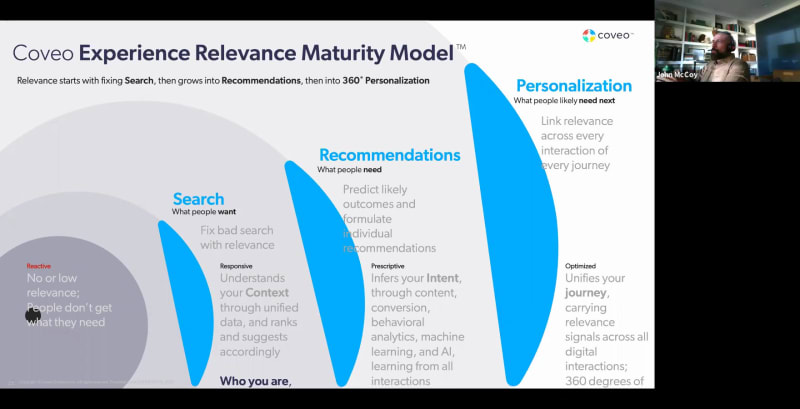
Alright. We'll go ahead and get started here. I just wanted to thank everyone for attending today's lunch and learn with Smith, SAP, and Caveo. It's called Infusing AI Power Search Recommendations and Personalization into Your Commerce Storefront. We look forward to spending the next hour or so with you, but I'd like to cover a few logistics before we get started. We'd like this session to be interactive. So if you're comfortable, feel free to turn on your camera and ask questions when you have them, but I'll also be monitoring the chat if you prefer to ask them there. Here's a quick look at today's agenda. We'll do introductions, and then we'll talk about how search and AI are shaping digital experiences, what customers need next. We'll look at some customer case study examples. And then at the end, we'll have open discussion and time for questions. And now I'll pass it over to our speakers to kick us off. Great. Thanks, everybody, and thanks for spending a little bit of your Wednesday afternoon with us. Brian McGlynn. I'm the general manager of our ecommerce line of business at Coveo, and excited with the opportunity to work with a lot of great customers and a lot of great partners, as well, such we have here today, to talk about commerce, talk about AI, talk about personalization, recommendation. And, yeah, I'd like to introduce our our speakers. So I'll kick it over next to John, John McCoy from SAP. Hello, everyone. And I look very different from my picture. I obviously have shaved my head. I have no hair. I don't know if that was COVID's fault or just actually, we'll blame COVID. It's an easy it's an easy thing to blame. I run digital, or the customer experience advisory in a digital format for SAP. My team's comprised of people that have been p and l accountable. So prior to joining SAP five years ago, I was ultimately accountable and responsible for the overall revenue financial outcomes, the strategic plans, for the organization that I came from, just, again, prior to joining. And my team is filled with people that have that same direct experience of having to figure out digital and commerce and and how to make those particular departments of solid revenue streams for the companies that we stewarded over prior to joining SAP. Great. Thanks, John. Glad to have you. And Ryan. Thanks, Brian. Hi, everyone. I'm, Ryan Kiesenfeld. I'm the CTO of Smith. Smith is a we build ourselves as a full service digital agency, but we're squarely focused on the commerce space. So we have a large amount of business in the the suit you know typical systems integrator work but also do digital strategy, user experience, customer journeys, all sorts of work in that space. We have a long history with, with SAP. We're a we're an SAP gold partner, partner of Coveo as well obviously, but, you know, our team goes back a long ways and, has, got a lot of experience in this space. So definitely looking forward to, trying to share as much as we can today. Great. Thanks for coming aboard and have some interesting dialogue and some customer stories. And, really, I've kinda come back to, really, certainly, John, from your your background looking at managing a p and l and and others certainly appreciate the work of ecommerce. An area we get into time and time again with our customers, really, our our whole reason that where we come into is what can we do to boost the performance? So, clearly, there's a lot of variables that go into making ecommerce work. There's physically being there, getting content, being transactional. A lot of the mechanics and the plumbing, so to speak, that it's out there. One of the big areas where we come in and and continuously work with customers is what do we do to help transform and really add quick hits to to boost commerce? It's actually interesting part. We value it. It's a one year anniversary when when they essentially signed with us and came on and and asked to move forward and and start to put really things in place for a beneficial long term and for a beneficial holiday season. So they had gone through. They've been on a platform for commerce, and just overall, just not performing where they wanted it to be from the revenue conversions or other parts being looked at. And one of the things that they highlighted right away was the fact that search drove over fifty percent of their web traffic. So someone going in, whether it be an AdWord or whatever it may be organically coming in, especially with COVID in the works, they go in. The whole idea would be hitting search, and people were searching on a doorknob, searching on a particular item. These guys are a DIY store, and people are just getting wrong items. And it was just an area that was either diverting sales or people go back to Google search and then land on Amazon or other part from there. So that was the part where they went through and really pushed hard to go in and and fix at this point going in and looking at it. Now in candidly, in some cases, some very large organizations have armies of people going in, typing in, and looking for playing that whack a mole game as we like to say, looking for what people have typed or what sort of, zero results sets their work. In this case, we used AI, and this is really what Coveo does. We're able to take AI, get the intent, get the understanding, and literally within forty five days, give a thirty percent bump on over half of their web traffic with returns to conversion. So a big transformation, by all means, really a testament to looking at the way in which a user interacts and getting them the relevant information to the request to move forward. And certainly for ecommerce, we see this as critical within the customer experience. Another example, we'll go in the b two b side. Long term customer of ours, Acuity Brands, we've gone through and similar case we've seen with Acuity going in, we got involved where they've got thousands and thousands of different products coming from different product catalogs, from different data sources, and really needed to go in and look at a way to, in this case, get customers either product or, in this case, information. It's chewing up a lot of their phone lines for customers going through and driving down customer satisfaction. So they're in a point where they looked at conversions, but for them, conversions in many cases are people clicking and getting the information and items that they wanted. So in this case, they're able to go in with Acuity brands and using Coveo and literally build an experience where we're able to go through and very quickly find the information and drive it in. So what it did was really drive quite a bit on there. So we look at it from many different parts where we go in creating that relevancy. It's engaging visitors. We convert customers to that part. We look at it from overall their lifeline and and, really, at this point, the entire part of an organization and a customer's, entire work within an organization. So from all the different parts, whether it's customer directly, after sales support and service, we're able to go through and provide that. And just quickly who we are, we're a company headquartered in Quebec City with offices around the world, six hundred and fifty employees. We're powering over fifteen hundred different points. So we have quite a bit of whether it be commerce, customer support, or employing and empowering the agents to give them that information if they need to go live and talk with customers. We're really providing that relevant component. And, really, what's why it's doing and why it's going in is really from a perspective that the expectations of customers in our business is doing well. I think of anyone else in the digital commerce economy would say so. But, really, the the driving force behind why we're seeing a lot of customers come to us, helping with relevancy is that search, data, and AI AI are really shaping the experience. And, really, the whole idea is that expectations as customers come in, they expect things to be convenient where you can find them and be able to get to it. They expect to find the information in little to no clicks. They expect the information to be relevant to where customers use it, where it's personalized. If you're going in shopping for golf clubs and you search for tees, you should get golf tees versus t shirts or other items as it may be. So it needs to be relevant and then reliable. This is a big part as well, specifically when you're dealing with large catalogs where there's per user pricing, specifically in b two b where going and finding the information and getting the right information at the right time is really key. Can you trust it? Is the inventory information accurate? All these things go in and provide the overall customer experience. And as we go in, we're looking with workplace shortages. We look at just the expectation of growth and continue to build on on the business. And many ecommerce sites are not profitable. Profitable. And that's where we go through with the p and l aspect and say that we need to focus on the cost of delivering these expectations to meet what the users want. You have to use AI, and that's really what it comes into as well. So you think about it. Knowing with AI, it's not just looking at what the customer is interacting with on a regular basis and really trying to go through and and say, well, I should order more of this or order more of this. A lot of it's making those microsecond level decisions and having it to where you can anticipate what the customer wants to do next, where you can personalize, where you can bring that information, where it rel where the relevance would be in. So we see it certainly in our world, three areas, search, finding it, recommending based on what someone searched on and what they might buy next, and then personalizing it. So where that entire journey, whether you're searching for a particular item, whether you're a buyer or a browser, making certain that it goes in and ultimately driving results. So we're basically boosting, having relevant products where we're driving AOI or AOV rather, content where we can go in and specifically b two b. We had a customer that was talking a couple weeks ago where they were selling car parts, but they had to get all the data sheets. And the big issue where they got clogged up was getting data sheets for customers around the product and being able to get that. And then, okay, determining whether it's time to get someone to buy or lean in and browse and look for more information. These are the whole ideas of being able to drive those particular parts together. And providing the three capabilities, what people want, what they need, and what they'll need next is where we go in. And we do this at scale. Certainly, our organization, we we do it at scale. We've done it for many leading organizations around there. Certainly, we look at Polaris running over, like, sixteen different brands across North America, bringing in items, connecting into SAP systems, whether it be Bunnings or or Phillips. We're unlocking all that content and making it to where it performs better and making very clear numbers around lift and growth of an organization and how they serve a customer. So we look at it for many customers. Let's take example here in in the SAP ecosystem. Certainly, there's three main parts to go in where if you're running a p and l or if you're being tasked to improve performance, there's been enormous amounts of investments in ecommerce platforms that are out there. So there's a whole need to extend the utility. A lot of tape cases, you get a new executive that comes in. Hey. We wanna see performance. Should we go in and look at replatforming and others? A lot of cases, just not necessary. There's a point where you can extend. You can modernize by being able to go in and use that. And then any need for replatforming your other components, you can get the performance out very quickly and be a leading performance by looking at it from a point of what is driving relevance, really what the key components are around relevance. So prime example, a customer of ours, Bunnings. We're Bunnings down in Australia for our North American audience. It's a case they're a leading DIY chain. They're actually fourth largest in the world as far as online presence. And that so for anyone who is down under, there's no need to introduce Bunnings. It's one of the most iconic brands in Australia and New Zealand. And they had gone through a a large replatforming exercise where they had gone in and looked at it some states, some areas, and they brought in SAP because they needed some real serious horsepower to go in and and handle large transaction volume. They went in initially and and set up and built the system. And part of it was where search came in realizing, okay. We really need to get absolutely have to have as as a speech and study of ours pointed out, you've gotta make certain your online experience is at least as good as your in person experience. You go in and you ask an associate for a glue gun, they'll take you to the aisle of these glue guns. But if asking a basic search engine for that, well, this is what their experience was. You don't get glue guns. You get nail guns. You get everything else where there may be glue or may not be glue. With AI, you're not guessing it. You're not programming it. You're understanding what the users are looking at and understanding the products. With Coveo, glue guns come up, nail guns do not along the lines. We see the same thing as well where recommendations, not just a case of going in. We can start to see, alright. Here's a personalized view of one particular user that they've typed, what they've looked at from searches, and what they see is popular. And other parts where we go in, someone looking at cookers. In this case, being able to bring in grills based on what someone's looked at because there's a propensity to buy. And even more importantly, going in when there's a propensity to buy, working to educate a consumer. In this case, we're going in and reaching out content from different areas, YouTube, where it may be in other parts just to augment that experience. We found from our own research, Gartner and Forrester have all pointed out is the instant you take your store and you make it not just transactional, but you make it experiential. You sell more and you build more relationships. Bunnings does tons of amazing videos. And here's an example where we're able to go in and recommend the relevant ones, not based on a static page, but based on what a user's looking at and what they had looked at. So how does it work in our partner? Hey, Brian. Can I can I jump in just real quick on something as well? And and I think, you know, also, just to everybody, if at any time you guys have a question or a point or whatever to make, just just feel free to interrupt. But, you know, I look at some of these use cases and these examples that you have, and I, of course, think about my own direct experiences and and the customers that we're working with, currently. And in in the past, I've seen organizations. So there's there's the efficacy of search, right, which you're highlighting now in the story of Bunnings. Obviously, those were nail guns and staple guns, not glue guns like you had highlighted. And obviously, it's a poor customer experience, user experience, if you're getting glue guns or staple guns instead of glue guns. But from an organizational structure, and I think about things foundationally. Right? In my past, you know, when I was accountable to the ecommerce sites and and that part of the business that I was stewarding over, I would oftentimes have a search me. And I would have somebody that owned search, and it was, like, their job to figure out all of these kinds of, you know, reporting aspects and elements, analytics, what my direct search metrics were versus my behavioral search metrics were. And and that was good in some ways and that I felt like I really had somebody that really understood the systems. But then at the same time, the the challenge was that while they could tell the difference between a staple gun and or a glue gun, in most cases, they certainly wouldn't understand the overall business, drivers and or reasons behind why we might want to push a specific product and or some of the logic behind some of the algorithms in manifesting and showing, you know, this particular let's say it's soft goods instead of hard goods. This particular, you know, shirt or blouse or a pair of socks as an example because we're trying to move through inventory or we're trying to, you know, increase our turn from a merchandising perspective. This is much of a, I think, kind of a I think just a statement as it is a question maybe even for Ryan and Brian just to chime in to get kind of your guys' perspectives on. From a from a structure perspective, organizationally even, what have you guys seen in how organizations have successfully set up search? And maybe, you know, if anybody from the audience feels like they've kind of figured something out, right, and come up with a solid example where they've seen some success, but just to get some perspective of some of the other, you know, people here on the panel. Yeah. No, John. I think it's a it's a good point. You you know, realistically, what you you can kinda whack a mole some of those types of scenarios, and that's often what we've seen in the past. Even if you have a dedicated search SME, they're often doing the top fifty search terms every month and then going through and trying to figure out, hey. What do we need to do here? And, you you know, often what it ends up being is, you know, a fairly convoluted list of synonyms and then some boost fairy rules that you start to layer in. And, really, what you're doing is is being very reactionary, in a lot of ways. And and I think that's where you know, that example with Lenny's obviously, it's one specific example. A lot of people look at it and say, hey. Maybe we should do hand searches instead of horse. But, you know, there's more to it because then you introduce a whole host of problems, then you start to get into product data. And I think, you know, one of the things we find very often is it's a never ending battle of trying to stay one step in front. And, typically, you're doing it, you know, kind of thirty days in a rare from the review of what you're seeing. And, you know, structurally, that's that's very difficult for companies to maintain in the long run, and then take it to the next level, which you said, which is sort of a a semantic meeting behind the search that is is very difficult to drive out when the search starts, you know, truthfully as more of a pure keyword type of search mentality versus a true understanding of the intent behind the search. And, you know, as much as you may have SMEs who try to understand the the intent, if the tool is incapable of interpreting that content or that intent and driving the results, you you really are trying to to work around the problem in the wrong way. Yeah. I mean, altogether, you guys nailed it. That's really you think about one of our customers, the area we come into, we see time and time again the the challenges. It's really around that part of, one, there's a scale component to it, and the other part is really just the relevance component. And in part of where it's actually almost we got this, I wanted to flip over quickly. This is exactly what we see in in a human capacity and and not being able to go through one by one and really one to one personalization. We've gone into some customers. So we have one over in Europe. They had six search analysts that were going through. Six analysts that were looking at zero result queries and other parts around that. And then you couple in, John, what you mentioned is, okay, do you wanna target on margins? There's always that trade off between a margin Yeah. About maybe that's a point where maybe you wanna look at inventory and say, okay. What we wanna go focus on it turns and moving inventory at the same time, keep margin and satisfy the customers, that delicate balance that goes in. And what we've seen is there is a point where you can manually get decent results. They're expensive. In many cases, they missed the mark. And that's where we go into is that where what we've done a lot of is with this is how our platform works. Essentially, we'll take the various components and the signals. We analyze. We bring that in. But the real magic is in the AI models. So we have models for inventory maximization. We have models for profit maximization. We we've gone in. Some of our retail customers are doing thirty percent, revenue margin on in store, fifty percent online, and a lot of it is really going through and understanding that online business and driving into it. And part of it is, as you mentioned, Ryan, it's an area where if we can go in, if the feedback loop is manual, we're looking through it for a monthly basis. It's you're looking in the rear view mirror, and that's what we've seen in a lot of cases is making decisions based on what's happened a month ago versus looking at it in real time, being able to say, okay. There's enough signals to where we can get better. We can close that loop and bring it in. Nothing's perfect, but at least we can get in and get a much closer approximation to where it is. So in many cases where we work with customers, it's an area where we went through recently with, a shoe company. And what they've gotten in is it's an area where there's a whole different set. There's one where we go in for profit maximization. There's another model for inventory turns. And we'll look at it at this point and apply the appropriate model based in the right time to bring that in. And where we come into this, clearly, the metric of let's look at it from a revenue perspective driving it, but also, whether it be returns that are down, whether other items are in there as well. This is where we'll bring in. But it's it's a good point to bring up is that from a customer, those signals of where we get brought in, that's exactly it. Is, is okay. What can we do to do more of this or more of that? And search is just one of the key parts where we really the entry point we see in a lot of these. Yeah. I mean, I I've, I've I've heard it so many times, and it's it's kind of dumb when you think about it in this way, but it's a major driver and a major trigger of, essentially, the the president of of of my division or the CEO sends an email on, you know, Monday or on Saturday or on Sunday. I was looking for this with my spouse or with my friend, and this was the search results that I got. We need to fix this right away. And it's kind of one of those trigger events Yeah. That I hear about from customers and have dealt with myself all the time. It's like, oh, gosh. Here we go. The the division heads going through the site and searching things, and I'm trying to figure out how to take their specific unique, I guess, search use case and now, you know, have to expand upon that problem and deal with trying to resolve. In some ways, it's it's it's valid, of course, but it's just that that driver that oftentimes is frustrating when you're trying to fix this and, you know, things are broken and trying to, you know, almost be super human with your search. And it's nice to know that the technology is starting to catch up. Right? That it's starting to get better and better, so we don't have to have those awkward, you know, Sunday night responses to the CEO on why things aren't working the way that he thinks it should. Absolutely. Yeah. So with, so, Ryan, any thoughts on that from your side? Have you run into trigger points? What have you seen on where where we looked at customization, personalization, customers that, have brought in really bringing you guys in to fix things. No. Absolutely. And, you know, in John's example, you know, it gets home. I think anybody that's been in the space has had those. I can, you know think to a hardware retailer that was fairly upset the fact that when they typed in metal hammers there were no results but you know technically they had no products with the word metal and hammer in them they you know they were thinking just because it says iron or steel hammer that it would show up and you know, those types of tuning exercises are very simple to fix but, again, are very reactive. You know, most of the time where we see the trigger points is when, when customers are looking to get past the very simplistic type of keyword searches. And, you know, if you look at it, eight, ten years ago, we were we were trying to train everybody to cut out all what we call stop words. They're all words that didn't matter to the relevancy. But, you know, if you think about some of those words that we were always cutting out, it actually those are actually hints to the intent of what the user was trying to do. Right? Was the user actually trying to buy a product, or are they trying to get help with the product they already own. And in some of those scenarios where you know for a long time we were we were focused on cutting out those types of noise in the search to try to hone in on a product set was actually throwing away a lot of the the hints at what the user was actually trying to accomplish and you know the trigger points to that are you know users calling in and they're frustrated or you see abandonment or you see you know different reactionary points and it becomes a it becomes a slippery slope of custom very quickly when you try to take an old way of thinking about search and drive intent. And I think that's that's where we often see these moments where we need to take a step back talk to our customers and say you know the time now isn't to double down on the approach that we've been taking the time is to rethink it. And you know, that's where, you know, something like Coveo is built from the ground up for the idea of, you know, what is the user trying to do? Are you trying to drive product results sets? Are you actually trying to drive help content? Are you trying to drive, you know, how to videos and things like that? And that's that's where that that understanding becomes very critical. And, again, it's not it's not typically built on the same thought process or tools that a, you know, a a traditional product search was was geared around. Yeah. I think that's the big thing we look at really going in in in nailed that we had a customer come in recently. The CEO and owner or founder was on a private jet, going through me, couldn't find a red hat. And it was a case where a call goes to the CIO. CIO comes back and looks at it, but it it's it's certainly these are it's kind of that moment where it's either true too late or sometimes embarrassing. The others is real revenue impact on it. So you think about it where there's, within Google and and really for where a lot of traffic is driven in at this point, conversion rates matter. So going in and if you go on-site, user searches for a red hat. I've done this many times myself. You go back to Google and do a search looking for a particular item. I was looking for a house for remodeling, and we wanted to get door frame items. And I couldn't find what I wanted on search sites, so I ended up going back and looking on Google. Well, Amazon bids because their conversion rates are very good. They can bid more. There's a limitation of inventory, not a limitation of actual dollars in many cases on that. So what happens is the bid prices will go up to where you can get a reasonable margin. And if your conversion rates are low, you can't bid as much and you lose traffic. And that's essentially where somebody will go off to another site. We have one customer we went in, they were spending close to a hundred million dollars a year on advertising. So whether it be print, radio, and all that. And eighty seven percent of traffic from any other means when you look at it from any of those particular push means for brand building's gonna end up in a hit to the digital property, whether it's mobile or whether it's on web. So they were running ads for Samsung. In this case, Samsung refrigerators. They were probably getting co op advertising money at this point, the tunes of a hundred million a year. And when you go on the website and you search on Samsung, the first thing that would show up is a pair of hoses for a Samsung washer. Now that was great, but really and if if that's exactly what the user was looking at and that's exactly what the search was, sure. Mission accomplished. It wasn't. And it's it's kind of a bad example, but you look at it. You compare it to a company like Wayfair or others that have twenty two hundred users or twenty two hundred, devs rather that can go in and provide that level of AI and tuning. But to in this case, a company that was a seven hundred million dollar family owned furniture retailer, it really came down to is being able to leverage a platform and go in and start off with that. And that's where I mean, to your point, Ryan, about things, they can go in and try to hardwire, moving out stop words, putting in ends, putting in ors, and all that. The realistic part is consumers are gonna continuously invent new terms and invent new ways to end up with zero results that'll just, in some cases, be be funny. But at the end, so they'll they'll bring up the wrong things and go out the wrong direction in this case. And that's really where that feedback loop as we look at to learn from the content, learn from the catalog, and those parts just just isn't there. I assume, John, you've you've probably seen stuff like that or and I guess really, yeah, what's what's your approach in in really getting people to come aboard when they realize these items, and how do you walk them through improving? Yeah. Well, what what we've done in the past and what I've seen other customers do is it's not that that you know, when when I think they they go to kind of the second phase of search. Right? So you have this out of the box box search capability. And whether it's with SAP or any other competing software, it doesn't matter. Right? There's typically this very basic Barca bones component of search where the the language and the morphology and etymology and all of those things are kind of baked into the engine itself. And for, you know, a certain percentage of the business, is that sufficient that works and that it's good? And so the, sorry. My kids are trying to I guess pizza was delivered at my house. They're trying to bring it over and and and give me some. But the, there comes a moment when that's insufficient or when you get the Red Hat email, right, kind of type conversation and components. And so what I've seen is that that individual who's that search me, is is very valuable, in addressing certainly some of those one off type scenarios. And they're but they're more so value in helping to sell the justification for enhancing search. So when you have someone who's really looking at those analytics and those insights, it can really help you break down where things are broken and then make a use case and build out a specific road map on ultimately what needs to happen to get to that higher tier and more intelligent personalized, you know, like you have here on your chart, types of searches is where those types of resources can really help. It can really, you know, be quite supportive. So we we still actually recommend when we make organizational recommendations to still have somebody who is a SME that really understands whatever tool it is that you're using and really understands the ins and outs of some of the more, higher level consumer behavior components of what's actually happening when people do browse search versus direct search and some of the types of analytics and KPIs that are associated with that and what success looks like to help you then also build out what the future could yield if you were able to make an x type of improvement. Mhmm. So I still very much support, you know, having a SME, but having them get into some of the very, very, very specific components and starting to get into some of the engines is where things can go sideways real quick. And that's where you really need to have some sort of technology to support to process things that can take you beyond what simply you can read in a whether it's a GA type of a search report or whatever type of search report that that engine's kicking out, to really help you make more of those decisions more intelligently. Because I've I've personally gone down that path with the SME, like Ryan had talked about before, to try and fix stuff. And it was like we would fix one thing and break five others, and it it just kind of turned into this horrible vicious cycle of creating more work for ourselves as we try to address the one off scenarios that we encountered. Yeah. And, John, just to remind you, you know, it's yeah. No. I I couldn't agree more. And, you know, one of the things that we've found often I've made this statement many times. I actually, you know, I almost think it would be better for some of the platforms, SAP or or otherwise, to not even have search out of the box because it actually almost creates this this belief that, you know, search is there. I gotta worry about all the other functionality. And you don't pay attention to search often very closely through an implementation because you're almost making excuses that we haven't loaded all the data, or someone's going to tune it later on. And you sort of you pump those problems down the road. And then often, you get live and you're starting to you're starting from a reactionary point already. And I think those types of realities are are are really critical to start up front with a a true realization that search doesn't fix itself. I think it's a good point. Yeah. I know. The joys of of working from home. Right? All good. I've got two myself, and I'm sure they'll probably pipe up as we go through this. But I think, you know, it's a it's a valid point. And, you know, a lot of the decisioning around product and search and what, you know, platforms like SAP are really looking at is there is still a tier of customers out there that are okay, right, with your basic search features and functions. And so it's kind of like a almost like a competitive thing. But to your point, it it's not designed to be best in class. It's not designed to be. And oftentimes, customers make an assumption that if search is in there, that it's going to, for one reason or another, be great, or maybe they were sold and that it's fantastic. But, you know, what we're trying to do, you know, from a overall strategic perspective is to provide a foundation and really focus in on areas that we think are mission critical from an overall commerce landscape perspective and then to partner with organizations to to try and figure out, you know, other solutions for when, you know, those kinds of situations and scenarios are required. A lot of our customers, you know, just kind of are content with sitting around in kind of basic search land. However, for those that start to really seriously get into these sorts of offerings, especially in a b to b environment, very quickly do they grow out of that. Right? And they and they need to start looking at other options and their solutions or then customizations with respect to that setup. So I I I think that, you know, all platforms could certainly do a better job of coming to the table with a very blunt statement around what our search is and what a search isn't, and then alternative options that might provide better results for the customers depending on where they're at in their journey and what their needs ultimately are as a business. Fair statement. Yeah. And the one thing I'll I'll say now that the, the guys won't grab my door is, you know, where I was whereas I I was also going with that is, you know, to build on what you're saying, John, I think often what what I see and what we try to work with our customers to get ahead of is really the guesswork around how they could make their search better because what it often requires is a level of customization with the kind of hypothesis that it that it'll work, and I've often seen that require, backing out in the end. So, you know, for example, I've had customers where we put a significant amount of customization into you know correlating a lot of aggregate values on past purchase history across customers and you know quantifying that up associating it to product information and then using that to boost relevancy and you know with with platforms like solar for example you're very much statically controlling that type of information and, you know, the relative impact that you have to control on your own is a little bit of guesswork while you're going through it and oftentimes it sort of requires a production to play a production with real customers to see its impact and you know that becomes a process in which you've spent a lot of time and money building it into your search in the hopes that it that it makes an impact because it's very tough to prove in a synthetic lower environment. And that's, you know, that's something that we try to work really closely with our customers to make sure that we've got real reasons why we think this will work versus, you know, kind of working hypothesis. That's the thing where I look at a lot of cases with without AI and without really having an ability to to guide someone through it. It's kind of like looking at someone taking driving, getting driving instructions by looking at where they crashed and telling where they took wrong turns. And it's a case where without having that AI and being able to go through, it it really gets into it. That's it. And that's the thing where we see time and time again with customers. Sorry. People ask who who's your biggest competitor? And our our answer is really doing nothing. As the competitor. It's really our our biggest part is one, what's the to to degree that search in relevant information at the right time can impact a transaction or impact a customer interaction. It's huge. But a lot of it is getting that sense of, okay. It's it's relevant, but it's something that shouldn't be it should be done when we're thinking of digital channel. We think about digital transformation. We think about hitting the goals and really going after hitting those particular expectations. It's an important part. And we look at with many organizations. So whether it be where relevance does any ecommerce, it's a case of there's a conversion rate. We wanna look at those or or average order value, but even service in different parts as well. Sometimes we look at b to b ecommerce specifically. A lot of it is, where I've talked to many customers. It is, okay. We wanna go seventy percent digital penetration in two years or digital penetration at fifty percent in three years. So the whole idea is being able to offload a lot of processes, which may have been very manual, but being able to put it into where it's driven by okay. People can find the data sheet. They can find the product. We've got, FleetPride, one of our customers, just did a webinar with them a few weeks ago down in Dallas, and they had gone in, originally with COVID. They were looking at doing an upgrade on their ecom platform, decided to put it aside for a bit, Then they came back to us and said, no. We need to prioritize search because now we've got we were virtual, and now we're a hundred percent, virtual. And we've now gotta really rely on the online channel. So for them, it was less about we wanna boost our conversion. It's more about straight up utility, where they wanted to go through and and and measure the deflections that would have either come into a rep who is still scrambling to get used to working from home or are going in from other parts. And that's really research and to do one, find part numbers, find what's relevant in their catalog and get the right price, have the right stock information, and two, recommendation. Okay. You own this particular product. These are bought together. This is likely what you would go into, or recommendations can come in sometimes in replacement parts. You were looking for this. However, this is a replacement part or a compatible part. For their interest, they have house brands. Another area where we're promoting them a little bit more allows certainly better margin and certainly from their perspective, they can hit those items. What you don't wanna do is be overt about it, but do it in a way that's tasteful to where it preserves the customer interaction. But at the same time, learn from interaction where you go into and present that. And that's that AI in that closed loop. I certainly wanted to expand to that and say that these are are things that are are really key around a digital experience, not just from a pure search perspective, but just that overall relevancy where it happens to manifest itself in, in different parts as well. So you're back, John. So what do you what do you think on that side? Yeah. No. I think that that pizza that was delivered was really yummy. It's making me hungry now too. So it's, you know, if you go off camera for a bit, you'll be enjoying a little bit of it. Yeah. Yeah. Well, I mean, it I think that the a lot of the the challenges with a with the specificity and the breadth of the catalogs that from a b two b perspective just just enhances the overall complexity of all of this. Right? And and I think that trying to find the right balance between, not only the search itself, but what you do after the search, right, and then how you ultimately connect the dots sometimes for the the customer. You know, one thing that we haven't talked a ton about just yet, I guess, is there's the there's the search that's that's in the moment. Right? That's that's certainly based upon what they're looking for, and you can leverage and use a variety of different cues to to to capitalize on past behaviors and things of that nature. But a lot of the times from a b two b perspective, it's very cyclical. Right? And there's very specific, products and goods that they're constantly looking for and constantly asking for, and constantly needing. So there's this kind of connection between, in my view, not just the search itself, but the habitual nature of business and seasonal trends and support as well as even potential of the automation of certain things, you know, as you're then connecting the dots between search and cart and, the needs of the customer. So some of some of the, like, the accounts that we've worked in have been have been this way. So from a manufacturing perspective, let's just say they're manufacturing chairs. Right? An office supply organization and company. And they need raw materials in this scenario upstream from from another organization so that they can put together the steel the different fibers and textiles that are required for that. So this company that's upstream from them, knows that based upon business and historical trends, how often their their you know, those things are typically coming through, take COVID demand aside. And so when people come in and log in to that, customer experience and they go into that site, now them seeing what their past orders were, them seeing, you know, what that what some of those recommendations specifically are based upon their past purchase habits is something that's just generally very simple, sometimes complex and difficult to pull off. But we've seen major gains yielded simply by just having them on login, show, and display what their past order was, what the overall quantity was, the last time that they bought it, and then when they should be able to and and and if they want to just quickly add that to cart, you know, from their past purchase experience. So it's kind of like yes on all of these things that you're highlighting, from how the different, you know, aspects of business can ultimately come together and and where there's, you know, improvements that can be yielded by different pathways into that. But then it's even, you know, where where a lot of organizations, I think, are missing, you know, just simple simple conversion rate increases is just by providing that kind of interface without having to go and and to even do anything and by leveraging some of that data to surface it. I don't know if that even directly answered your question. Amit? Yeah. Though, I think altogether, I mean, it's an interesting part you bring out for think about LMS, the order management system, and a lot going in. We've had a lot of interest in that, and and that's the thing even with our technology. With Koveos technology, we are really it's a search as an application. We go in. There's recommendation. There's just overall relevance that we bring in. And even from from the technical folks on on the the call today and looking at it. These are things where we're seeing a lot of areas that it had just different inputs when we look at from data. We also, at the same time, look at the different outputs where it is, where we can go in, whether it be a a portal. So b to b areas where the customer portal is, a lot of our business has been coming from there where it's okay. I wanna find new information. I wanna find information that we can go into and and and basically increase and decrease different components that are out there and and really understand that part. The other part is really being able to look at it and see that, what we would go in and and find for past orders, find all the different parts, whether it be help or other parts around there. Consolidating all that information into one area is key, and and that's really where the part is using tech relevance area to under really understand, bring in, and and just provide that with a a reduction of friction. So I keep going back to what is that analog world. That analog prime where you have an in person, so going you through and and were finding information, digging through information, bringing it back, and providing it. So in that moment, the user is not searching for different items or that agent's not searching for different items that we're able to surface that and bring those components up there as a key part. Guess, Ryan, I'd ask you on on net new implementations or customers. Are you seeing that that really that multichannel convergence in where we're just going through, and looking at what drives our customer loyalty in different parts around there? No. Absolutely. And and I was I was gonna chime in because, you know, John segued nicely to that. But, you know, one of the things that we're working with our clients more and more on and and we we do pretty heavy amount of b to b as, you know, it's more majority of our work. But, you know, the the idea of, you know, replenishment or reorders have always been one of those capabilities that people take for granted. You know, I order this frequently, go in, reorder that same order, But there's a lot more complexity to that, especially when you've got b to b relationships with a fairly high volume of orders. It's not quite as simple as I need that exact same order every time. It's I need that product that I have ordered. And what it ends up meaning is, you know, we're getting quickly into the requirements of, you know, search within order history or, you know, influencing the site wide search that I don't wanna go into my order history and peel through a few orders to figure out what it was that I've ordered successfully in the past. I wanna just find it in context to to the site experience itself. And so that's something we're starting to see more and more on. And, you know, plain and simple, those are tough from a scalability perspective when you're trying to, look at it from a traditional search experience where you're you're you can't decorate products with the list of every customer that's bought them because you also then get the immediate next use case of don't have it just be that user's purchases maybe the company they're a part of and these problems exacerbate themselves. And so, you know, what we're starting to see more and more is that idea of what I've done from an interaction with the company. Could be orders, it could be call centers. It could be, you know, offline orders. It could be a lot of different scenarios. But those those items influencing the journey in the site not simply be being made available in a my account section. And, again, as I said, those are, when you look at traditional search approaches, there's there's a defined upper limit to how many things you can try to combine because, typically, you're pre combining those. What are all the things I want to expose to the user, preprocess those, index them in that form so that I can be made available for search. Business comes along and says they wanna be able to do it slightly differently. You have to rethink how you're indexing that information to make it available. And that's where, you know, lately, we've seen more and more conversations with our clients take that take it a step back and look at, you know, our our relationship with Coveo to say, let's talk about all the datasets that we wanna use to influence each other separate from how we wanna leverage those with the with the customer experience. That's that's actually it's a huge, you know, point that you just made. And I don't know again if, you know, if the audience has experienced this. Again, I've seen this with a variety of different clients. I experienced this myself. You know, rewind about ten years, I was working at a specific company, and and it was my responsibility to take because they didn't have a digital catalog even. They weren't online. They didn't have anything. Everything was, you know, based upon, you know, handshakes and, you know, handwritten POs, you know, and those kinds of things. It was that kind of environment. And then, you know, they had made the decision that they needed to build out and construct a commerce site. And so I got pulled into that, you know, scenario and, didn't didn't really know what I was getting myself into at the time. But because they didn't have a catalog and everything was built out based upon their ERP systems and and and naming structure, that existed that made sense for their their offerings in warehouse, it did not categorize and or catalog the the same way that you would typically want to portray that from an ecommerce or digital perspective. So we went through this initial push of getting that content live, which was great. We hit our deadline, but at the cost and expense of putting and and and not having standardization within the data structure from not just a categorical perspective, but even from a faceted perspective. So, you know, how you would classify a reel, right, or a gear and being consistent in how you've classified those, what that created is a huge nightmare for us because we had to then go through and then rebuild that entire platform, right, and that entire structure as a result, and literally go through that process two and almost three times in certain categories of the catalog to get that lined up. I don't know if anybody's had to go through that, but it's a pain. It I don't know if either of you guys have experienced a way to if if something like that has happened, if there's any options I'm I'm not aware of any, but if there's any other options to try and fix that from a data perspective because I would assume that pretty much any engine, garbage in, garbage out, but I'm not sure if any of you guys have come across that kind of scenario where, uh-oh, like, this data's a mess. What kind of a process it looks like to go through and clean it up? You know, I go through and and it's a good point you bring up. And, certainly, John, one of the things we've gone into work with customers and first calls. Okay. Here's our target. We wanna improve search. On a net new implementation, there there's so many items where, especially in b two b, when you're dealing with six million SKUs and ten different variants and different components on part of it. And as well you look at b two b where you're going through, there is maybe engineers and other product parts have gone in. So we had a customer of ours, we got on board with. They were in a hurry to get online and go digital. And given that not a perfect solution, but they were they were gonna go down a PIM solution, go in and formally acquire a PIN to store all their data, categorize, tag, and go through the manual labor process of it. The information they had was there. It was in Oracle databases. It was scattered in different components. And it's actually where, even in this diagram, we look at it, and we're at least able to give them some short term gains by indexing. So a lot of it is indexing, bringing it in a different formats, and do transformation on index. So being able to say, alright. At least at this point, try to normalize to some degree. If it's a case where there's a a reasonable nomenclature between different sources, maybe gears are represented this way and this way, we're able to go in, bring it in, transform it at this point and ingest, and then on index time, at least provide a uniform set where we can go in and and then learn from it and start to understand and apply some ML to that point. We we've done AI as well in color normalization. We actually worked with a partner of ours and a customer to go through and and it was believe it or not, they had to bring in about three hundred different catalogs from different sources. Colors. Colors are not just spellings, but the hues and all the different parts and variants. These things can get extremely complicated and and tedious at this point. So what is blue or blue if you're dealing with two different languages or chartreuse or what it may be at this point to understand the different spectrum of what a user is typing in and what they're looking at? And there is magic that AI can do. There's no question about it, but there is work that has to get done on ingest. And these are things where we've applied, almost ETLs with brains to look at it. And we're we're doing some r and d right now in the catalog space. We can go in and start to understand vector differences between where a particular product is and its particular attributes. But a lot of our focus is, are we gonna go in and provide the same level of of what's out there to to make it to where as if a human went in, read, categorized, and done classification? Now we're we're not we're not here to do that and provide an exact copy of something up. What we're able to do is get ninety percent accurate or or increase that probability of someone finding something to where rather than saying we're gonna wait two years on a formal process and a formal PIM solution to go in, categorize, process, we'll at least give the customer a couple years back at this case and allow them in parallel to either clean up the data or at least go in, but at least derive some data out of this. Actually, it was a case where the their ecom platform couldn't handle the actual data going in. So what we're able to do was overlay going in and search in their homemade PIM, which was Oracles and flat files and other parts, bring that in, and provide at least a shopping experience. So the product listing pages, product navigation, and search so they could go through and and and move on. So now they've got a pin, and now they've at least moved forward and and got into it. But from a pure bang for your buck perspective, we were at least able to get the access from a user into their data source without, without having to go in and take a massive project to get there. So it it's definitely something we have seen. Ryan, any thoughts on that from your side? It's fun times. It was just speaking from personal experience, super fun times. No. Absolutely. And I wanna I wanna make sure we have time for the any questions. But no. I I mean, you know, your garbage in, garbage out is is tremendously valid. And, usually, that's one of the things we see often is in an engagement, the customer is is a bit at their infancy but wants to talk about personalization. And, really, you have to have an organization that's set up with the the right approach for personalization, but you simply have to have some of the data to support it as well. And, you know, AI can, bring a lot of fuzziness together, and there's a lot of inference that can be made, and there's a lot of learning that can be done. But, you know, it takes time. I think one of the things that is unique about Coveo two is is its indexing pipelines. You know, that ability to bring in disparate data sources that you might otherwise not want to integrate with your commerce platform for the sole purpose of simply indexing it into search. And that's one of the one of the key limitations we often see when there's a search engine tightly coupled to commerce. Commerce is its indexing feed directly into the to the search engine, which means you're inherently limited by how much data you want to bring into commerce just for that focus and that's one of those opportunities that I definitely see with with companies who are ready to take that next step or have disparate data you know their sources to, you know, to drive an ability to bring those together. Oh, thanks. Hey, Suzanne. Any questions on the chat or anybody popped in with, email or anything else from that side? Don't see any questions at this point, so we can probably wrap up unless somebody wants to come off camera and ask or just pop it in the chat real quick. There was one. It looks like it may have actually come directly to me, Suzanne, but, there was a question just around, SAP, Commerce, SAP, high risk, high risk, depending on how far you go back, integration with Coveo. There's there's actually multiple different ways of doing it. One of the unique things with the SAP to Coveo process is the flexibility that we have with Coveo. So there there's a few different ways, and Coveo has documentation. But, if you're on a very new version, there's the integration APIs that are now available with SAP, which become a very noninvasive way of either pulling data or pushing data. Either one's available from that perspective. You know, typical cron jobs or outbound API calls can be made, but one of the things that we work with our clients on is is to remove the intelligence of that preprocessing from commerce and push the raw data push or pull the raw data into indexing pipelines in Coveo because then we've got a separation of concerns. At that point, commerce can simply be a provider of the data that commerce already has, and then Coveo with its pipelines can be the one that's doing e processing transformations, you know, correlation with other other data sources. So, you know, in a very direct answer, it's it's largely around, for us, our preference with our clients is to use the integration APIs if you're on a newer version. If you're on an older version, then it it often is a, a cron job type of approach. Yeah. That's exactly what we look at because we've got different methodologies. We've designed methodologies. We we work with, like, Bunnings, for example. Pretty massive implementations. There's push, and then there's some areas where it's cron job, and there there's others as well where we're able to go in and crawl different components. So it really comes down to how things are set up and and and the the requirements. How often is inventory changing? Is there particular items around? Are we taking inventory feeds? Are there product entitlements and other parts that we need to go into and understand? And that's the thing. Certainly, as you get to a complex implementation with ecommerce, every every implementation is different, and we certainly find that we need to have the flexibility in order to go in and provide that level to all of our customers and be able to work through it. So by all means, it's, certainly not a one size fits all, but a lot of what we do with our product is we offer the enablement for our partners and and our customers to be able to go in and deal with pretty much any solution in any situation that's out there, whether it's out of the box, whether it's homegrown or heavily modified, whether they've got for us, it's it's really the date the data is less of an issue. It's really what people want and understanding in their their UI and their design that we've seen more than anything else from from where effort gets put forward. So I think on that last question, there's two questions other in there. How has the three of us come together to make this presentation? We all lost a bet. Mhmm. And that's why no. We we we, know our organizations do work together. Right? And so SAP, just speaking from my perspective, and and you two can chime in on this as well. But so we have invested a lot in in, of course, a platform. Right? And that's SAP Hybris, SAP Commerce Cloud, and are continually modernizing that platform. Ryan and team, that organization, Smith, they help implement, right, our platform as well as other technologies. And Coveo has just a fantastic advanced search component that also is part of our partner network. So in addition to the platform, we also, as an organization, focus on companies that can help implement that platform and other companies that can help augment that platform. I just put it kind of think very plainly and and simply. And to answer the question, it's not replacing solar from a strategic roadmap perspective. SAP will continue to to develop, you know, its its own search components. But for the limits that we had spoke about earlier, if you find that you're kind of experiencing, you know, solar fatigue, so to speak, and and the system is not getting you to where you wanted to go, there's other options out there that are part of our partner network where those integrations, you know, API based like Ryan had shared and highlighted before, are there so that, you know, you can go from Solr if you're not satisfied with it to Coveo as an option. I know Ryan or Brian, you wanted to chime in on any of that, but just to quickly answer that as I know we're running short on time. Yep. I think that was good and concise. Yep. Absolutely. It's been any other questions, Suzanne, in the in the chat? No. No. I think that was all. Great. We are just at the end of time. So Yeah. If anybody wants to reach out by all means, so got our we'll have our contact info here and happy to chat. And and I think, Julie, to to thanks for everybody. Thanks, John. Thanks for Ryan. Thanks for your time and and expertise. This was fun and altogether, certainly with all the difference in commerce and a lot of stories we've got, we certainly continue chatting on for a while. But if if things pop up and there's more means, for that, by all means, reach out. And thanks to the audience. Thanks for giving some time to us. Hopefully, you guys had a chance to learn something. And, really, on our side, we're more than happy to engage. If you have a search audit, you'd like just to look at your site and see where we could add value, business valuation to see what there is from what we think we could do to increase as far as conversions or hitting your goals. More than happy to engage, and talk directly with you, and help out, across the lines of any of those items. Thanks, guys. Thank you, everyone. Cheers. Thanks. Bye bye. Bye. Thanks, everyone. Cheers.

Revolutionize Your SAP Commerce Storefront Experience


