
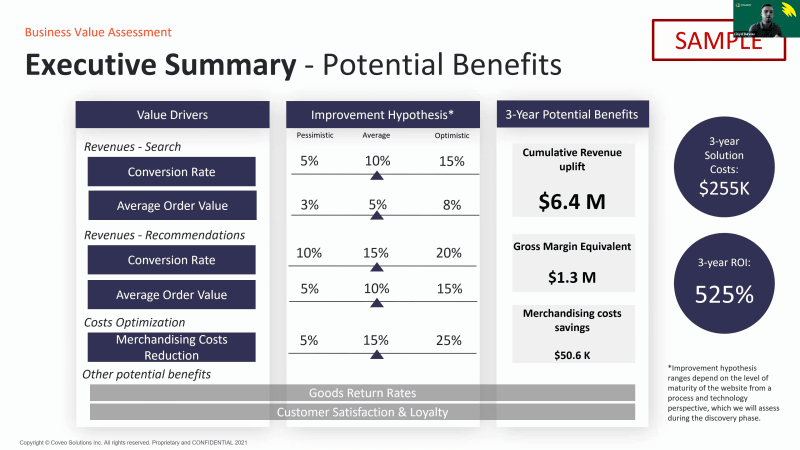
Hi, everyone. Thank you for joining. We'll give just a a few seconds for people to join, and then we'll get started on today our session, projecting the impact of AI on your ecommerce business. Can I'm I'm seeing that maybe my Internet is not quite good. Olivier, Lloyd, can you hear me? Yes. We can. Okay. Perfect. You you were out there for a second, but you're back now. So Okay. Thank you. We'll start again. No worries. Thanks everyone for joining. So today's webinar is called Projecting the Impact of AI on Your Ecommerce Business. My name is Clara Boulanger, and I work in the marketing team here at Koveo. I'm really thrilled to be a part of today's session. I'd also like to present our speakers today. We have Lloyd Bureau and Olivier Teteu. Lloyd is a, business value manager at Coveo, and Olivier is a solution Barca, at Coveo. I have a couple of housekeeping items to cover quickly before we get started. First, everyone is in listen only mode, but we do want to hear from you during Chely's presentation. So please feel free to send your questions along in the Q and A section on your screen. We'll make sure to cover, questions at the end of the webinar. For those of you just, joining us, welcome to our webinar called Projecting the Impact of AI on Your Ecommerce Business. As I was saying, this session is recorded and we'll send the recording within twenty four hours, of the end of the session. Now we're ready to get started after, this, small Internet bug. Lloyd, please take it away. Thank you very much. So, first of all, thank you all for joining us today. Very happy to be here presenting, this webinar on how to build a business case for AI in your ecommerce business. And so it's, in our e increasingly ecommerce driven world, it's becoming a common theme. So how do we compete with the Amazons of the world in the digital space? What are they doing that we're not? And most often, the differentiator is applied AI. Leaders are frequently directing their ecommerce teams to investigate how they can use AI to improve business outcomes. But the task of building a business case for AI can feel both daunting and overwhelming. This is why global relevance leaders such as Coveo have built dedicated teams to help ecommerce managers and companies of all sizes measure, articulate, and project the potential impacts attributable to AI powered digital experiences. And relevance matters for consumers, with those surveyed indicating they will pay more for the ability to easily find supporting content and personalized recommendations. This is not an ecommerce problem. It's a relevance problem. And also, forty three percent of consumers surveyed said they would pay more if they could find what they're looking for in just a few click. This percentage goes up to forty eight percent when we're talking about millennials. Again, this isn't a merchandising problem, it's a relevance problem. And this also rings true in a b two b context. Quality search matters to your b two b customers who are avid users of of search. These users need to find products quickly, but they often report product findability as being a big source of frustration. Quality search is a priority to improve the experience and AI can help you do just that. But how do you get your team on board with investigating the value of these tools? This is what today's session is all about. So we'll cover a few things today. We'll have a a quick overview of, what Coveo for Commerce is. We'll look into some of the main reasons why it makes sense to build a business case for AI and ecommerce. We'll look at how applied AI can impact your commerce KPIs. We'll also discuss the opportunity costs related to search and recommendations that are not optimized, as well as look into how Coveo's analytics identifies the value that's attributable to AI, and then we'll discuss a couple next steps on how you can get started on this journey. So let's have a look at, what Coveo for Commerce is in a nutshell. So what are the elements that define a relevant experience in ecommerce? Well, it's a combination combination of search, recommendations, and personalization, all underpinned by applied AI, And it's the best way to provide consistently relevant experiences to all visitors navigating your site. This is really the relevance equation. And so Coveo works by using a variety of machine learning models, the applied AI that we're talking about, to generate relevant shopping experiences that are continuously optimized based on user attributes and interactions, whether they're authenticated users or not. The journey starts by adding your products and your content and designing your interface. Then turning on the different machine learning models to start showing relevant content. And really you can customize any combination of these different machine learning models that we'll go through, in a later time in this presentation. And finally, you can use our powerful analytics tools to track and optimize the experience on an ongoing fashion. So why build a business case for AI and e commerce if the value can seem pretty obvious, providing better relevance should have a good impact, right? But it's important to put these in context of your business. And really often more often than not, these AI powered search tools are an added layer on top of existing systems. And the need to invest in these tools is a fairly new phenomenon in order to compete with e commerce relevance leaders, such as Amazon, Walmart, Wayfair, and many more who keep raising the bar and creating very high expectations for consumers. But before we can measure success, we need to define what success looks like. This involves assessing your current state so we have a starting point upon which we can measure the impact of AI moving forward. And to be able to measure this impact on your business, it's important to take a good picture of your current state. This effectively traces a line in the sand between the value your ecommerce store is generating now versus the incremental value that can be realized when you power your ecommerce experience with AI. Of course, purchasing an AI solution comes at a cost and a business case can really help you understand the measurable benefits associated with this investment. By building this business case, you'll be best equipped to convince your organization to invest in AI, which will put you in a driver's seat to creating tangible impacts for your organization. This will help you build a success plan for what a successful AI powered ecommerce implementation can look like. It allows you to align your desired business outcomes with the value drivers that are supported by your operational data. It also allows you to better understand the potential ROI that AI can provide to your ecommerce operations really adapted to your context and your cost rates, your products. And then, finally, this becomes a way to gain buy in and alignment from decision makers at all levels so that you can get started much faster. Now I'll turn it back to Olivier, who's gonna discuss how, this solution can help impact the different commerce KPIs. Hi. Thanks, Lloyd. So hi, everyone. So let's let's get started by looking at different business outcomes and KPIs. Sorry. That can be, impacted by a party app. So here, you know, I create two buckets. Just know that this is not an exhaustive list, of course, but there are potential KPIs that can be impacted, by applied AI on on commerce experiences. So in one bucket, you have, you know, APIs that, look to increase revenue. Right? We think of average order value, conversion rate, you know, average, units per order and everything. And on the other hand, we have, the reduced cost KPIs, such as, you know, reducing your marketing and merchandising costs, sorry, or, you know, increasing your call deflection. So let's have a look at different, actually, buckets, which I have created for this presentation to sort of segment, you know, the applied AI models, and have a look at how each of these buckets can impact these KPIs. So first of all, you know, the most important one of all of them all, I think, is ranking. Right? So we think of dynamic ordering, and, you know, this can definitely impact a lot of commerce KPIs. Afterwards, you have recommendation where we're initial essentially servicing products based on user context or, you know, product context on your site. We then have some models for discovery, such as, you know, discovery tags or query suggestion where by type ahead, we're pointing the user towards a more relevant query. And we also have models for personalization, which, you know, take the user's immediate intent and actually personalize the journey as the user goes on. So now let's have a look at the ranking and how these can impact different KPIs. Do you know that the KPIs at the bottom, the ones that are in the same color as the top are the ones that could be impacted with this? Right? So we can think of, you know, increasing the average order value because we're servicing the relevant products to the top. We can think of increasing the conversion rate as well because customers are more likely to buy if we show them, you know, what they're actually looking for right away. And we're also reducing the merchandising cost because merchandisers don't have to manually set up these rules and, you know, to log these products into place. And, also, you know, doing a bunch of call deflection because when the users find what they're looking for immediately, they have less tendency to call to request for more information. For instance, here, we have hearts on fire, one of our customers, who actually increased their conversion rate with search by five hundred and eighty seven percent. Now that's a real KPI, you know, for result ranking. Afterwards, let's have a look at recommendations. So recommendations can impact different metrics, of course, but they're still increasing revenue and reducing costs in their own way. So we can think of increasing the average order value with something like a cart recommender, where we're actually trying to increase the number of items in a cart by suggesting complimentary items or increasing the conversion rate on a product detail pages by showing complimentary or sub or substitute products, which, you know, the user might not have converted before, but by showing a different product, then now they're converted. And for instance here, we have a customer, who actually increased their average order value by four forty five percent, sorry, when users interacted with product recommendations. Now let's have a look at discovery. Right? In the discovery section, we we can think of increasing revenue by increasing, you know, the average order value and conversion rate as well since, you know, by showing the relevant content that's, you know, attached to the product, such as a blog article or some, you know, support content. The user might be more inclined to purchase that product by having all the relevant information surface towards them. We're also reducing the call the merchandising costs here because, you know, by discovering more content and everything, taking that job out of the merchandiser's hands and giving it to AI so that the users can see relevant products more often. And here, you know, another example that we have is, you know, increasing the customer satisfaction. So the CSAT score by twenty five percent at a very large computer manage manufacturer. Sorry, guys. Alright. And then last but not least, we'll look at personalization. So this is the most interesting one in my opinion. And this by personalization, what we mean is actually modifying the user journey as it goes on. So to take immediate signals and to translate them into actionable recommendations and applying these signals to all the AI models to actually modulate the user journey as it goes on in real time. And here, you know, this is really the most important one of them all. This really reduces merchandising costs. We have an example of a customer that now spends three hundred hours less per month, you know, merchandising because applied AI actually takes into account these signals and does most of the merchandising for them. And, you know, here I just dropped this extra slide so that you can have a look at a few key KPIs that happen at some of our customers. This is more of a takeaway slide, though. So, you know, feel free to rewatch this recording, or, you know, reach out to us, and we'll be able supply you with that information. So back to you, Lloyd. Thank you, Odi j. So now let's look at the opportunity cost related to search and recommendations that aren't optimized by relevance. Well, the opportunity cost is the value that you're leaving on the table by not improving your ecommerce experience. A search without a relevant result is a missed opportunity, and customers will give up quickly on a site with poor search and irrelevant recommendations. Every day you spend without optimizing your search and recommendation experience, you're missing out on the full potential of your ecommerce store. But how do you calculate the value that AI powered ecommerce can bring to your company? Well, the objective is to start, with the business outcomes that you want to have an impact on. And, really, it's about identifying these, these, these different, metrics that can impact these business outcomes. But it's a challenge because it can it these business outcomes are the result of many different variables, that are hard to map and hard to predict. So the solution is to use value drivers. As you've seen earlier, all of those different KPIs can be interpreted as value drivers that can be, that can be used in your in your business case to illustrate the impact of improving those KPIs on your business outcomes. So let's have a look at, what an executive summary of a business case could look like, for, for combining all of those value drivers. So while business building a business case, Coveo's business value team uses your baseline KPIs to project the potential improvements based on past Coveo results and industry benchmarks while projecting the proportion of your transactions that would be attributable to search and recommendations. It's all about understanding the impact of AI in your context. The final plan includes a breakdown of the value drivers in scope that lead to success, the improvement hypothesis on each value driver, and the potential benefits attributable to the Corio platform. The improvement hypothesis ranges depend on the level of maturity of the website from a process of technology perspective, which we will assess during the discovery phase. So here in this example, you'll see, we have a variety of value drivers, conversion rate from search and from recommendation, as well as average order value from sessions with search and sessions with recommendations. And finally, cost optimizations of merchandising cost reduction. Again, as as Aditi mentioned earlier, spending less time on manual rules and more time on on more value added work. Other potential benefits can include, you know softer benefits such as goods return rates, as well as customer satisfaction and loyalty, all things that are not as easy to attribute to the, to the Coveo platform, but can be observed. If can be observed over time once these solutions are implemented. And in e commerce, we look at value in a few different ways. We'll look at the cumulative revenue uplift that this will lead to, but we always know that an increase in revenue comes with a cost to serve. And so we only calculate the ROI based on the gross margin equivalent that AI is generating for your for your store. Add on to those the merchandising cost savings, and this is how we calculate the ROI on top of the solution costs. Again, this is only an example. This is not a real business case. Just wanted to show you kind of the structure that this could look like when it's all built together. So let's dive a little bit deeper into each value driver to see really individually what the impacts are when we're projecting these improvements. So here you can see the baseline value along with the target value for conversion rate attributable to search and attributable to recommendations. By looking at the percentage of sessions that leverage search versus the the percentage of sessions that leverage recommendations as projected in the business case, you can, see the equivalent in terms of additional orders that this improvement is generating. Again, going from the current to the target, this is what AI is bringing you in terms of additional orders. So when we combine these additional orders with an increase in average order value, it provides you an estimate of the potential value attributable to AI powered search, navigation, and recommendations. You can see the potential benefits over three years as well as the equivalent in sales uplift when compared to your gross margin, which again, that's the value on which the ROI is calculated. So this is a good way to kind of visualize what these improvements will mean when adapted to your context and your costs. Finally, looking at merchandising costs reduction, here you can see the breakdown of the value generated by saving time on merchandising, allowing to spend less time creating manual rules and more time on higher value added tasks like analyzing reports on content gaps and catalog analysis. Always trying to improve, the product offering that you're, that that you're offering to your your customers rather than spending time on deciding which which products to boost and vary. This is all better left to our machine learning models. Now let's see what these results look like at one of our existing clients, a large pet supplies retailer. As you can see, since they've implemented Coveo, they've experienced an increase in conversions and visits with search by ninety nine percent, as well as an increase in card value from recommendations by ninety four percent. You'll notice that these improvements are a lot higher than what was outlined in the business case earlier. But the objective of the business case is to be as conservative as possible. It's very likely that you'll actually exceed the benefits that are outlined in the business case. But the business case allows you to kind of create that conservative scenario that still makes sense to invest. And a few other, a few other KPIs here that were impacted, decrease in bounce rate by ninety nine point five percent, as well as an increase of ninety nine percent in conversions from visits with search, as I mentioned earlier. Considering they went live less than a year ago, these improvements are very impressive. And then increase in card value. So they've also experienced an increase in two hundred percent in revenues from visits with search. Again, another very impressive result from from an existing implementation. But how do we identify the value that's attributable to the platform in practice? Well, I will turn it back to Olivier who's gonna walk you through the concepts of single versus multi touch attribution. Hi. Thanks, Lloyd. And, you know, before talking about single versus multi touch attribution, there's one thing that's very important to mention. Right? It's one thing to be able to prove value, but it's really important to be able to track it and track that progress through time. So, you know, behind the all these machine learning models and everything, the core of it is really our universal tracker. Right? So we actually track the customer journey from point a to point b, you know, from a to z, sorry, you know, all the way from when they land on the on the site all the way till they, you know, make a purchase or exit. So, you know, once we have that tracking in place, right, we have to decide on an attribution strategy to be able to attribute revenue to one of the components or to the overall experience. So, you know, let's go over how a single versus multi touch attribution works. Right? So I'll give you a real world example. Let's say you win an Oscar. Right? And you have an an Oscar acceptance speech to make. So with single touch attribution, it would look something like this. You would give a hundred percent of the credit to your director because he's the last one on your journey who actually influence you. Right? So you would say, hey. Thanks to my director. Thanks, everyone. Bye. Now, however, with multitouch, you would do do more something like this. Right? So the director would skip still give most of the attribution in terms of, you know, the success. However, you know, you're still gonna give some credit to the fellow actors who helped you, your agent who landed you that gig, to your teachers who tell you how to act, and finally, you know, a a five percent to your parents who actually raised you and educated. So this is a little bit like what we do at Coveo here to attribute, to do attribution actually for for success in ecommerce. So if you go to the next slide, here, you know, we can see a typical customer session. Right? So this the customer lands on the site, searches for a pair of shoes, clicks on a pair of shoes, and adds them to the cart. Afterwards, they head over to a category listing to browse. It's like a product, but they don't add anything to the cart. However, at the bottom of the product page, you have a recommendation component. And, you know, the customer clicks on that recommendation component and adds one of the recommend recommended contents to his cart and then converts. In this case, here as you can see, if the both products were, you know, priced the same, we would get fifty percent attribution to the first product that came from search and fifty percent to the recommended product that was added to the cart. Now, you know, Coveo does this at scale actually when when, you know, you we have a commerce customer. So if you head over to the next slide, this is an example of our commerce dashboards. And as you can see, we're servicing a bunch of metrics because of that universal tracker, you know, that we're able to track all customers on a site. However, we're going even further by actually segmenting, you know, all that revenue, all those sessions, and all those success, you know, to attribute them to different components. So if you look on the top left here, you can see that, you know, yes, we have the two hundred and twenty five thousand in revenue. However, we're able to segment that, you know, with Coveo's help and without. And, you know, through Coveo, we're also able to segment it for different components. So you can see here we have your revenue for search, for category listings, and for recommendations. And if you head over to the next slide, we can even drill deeper into those metrics and look at how Coveo impacts, you know, user behavior and, and success on your site by by location, by component, and by type of visitor as well. So, you know, this is just a small overview of how Coveo does attribution in in analytics. So, back to you, Lloyd. Thank you, Olivier. Very insightful. Love the, the Oster acceptance, example. It's a really great way to to visualize multi touch versus single touch attribution. And this is really what differentiates Coveo's analytics, the ability to really track in a granular fashion what's being impacted and aligning that to your business case. So, you know, I hope this session was interesting, insightful to all of you. The next steps to learn more about how you can have some of these impacts in your organization is to get a free assessment of your ecommerce site search by getting a a site assessment done by our Coveo professionals. They'll produce, an assessment of your current search, personalization, and and recommendation capabilities. This includes, query suggestions, typo tolerance, synonym management, intent detection, recommendations, dynamic faceting, results, relevance, and your unified index, everything that's included in the search, experience. And once this assessment is complete, you'll receive an email copy of the report, and a Coveo sales rep will be in touch with you for the next steps so that you can get started on on this journey. Thank thank you all for tuning in and listening, and, I'll turn it back to Clara. Thanks, Lloyd. Thanks, Aditi, for a great presentation. And now we're ready to take questions. So you still have time to, type your questions in the Q and A section, so please feel free to add them here. We had a bit of time, and while you do that I'll start with the questions that we do have. So Lloyd and Olivier, I'll just ask the question, and, one of you two can, reply whoever feels, most comfortable replying. So the first question that we have is how will we be able to measure the impact of AI for a specific campaign? I can take that one if you want, Lloyd. And it really depends, right, with or without Kaveo. Through Kaveo, the way we do this is actually by tagging the different components. And we even have some AB test features within the platform, actually, which we can leverage to actually tag a specific campaign. And then when the user lands on the site, we already know that they landed through that campaign, and that would get automatically segmented through our analytics. I did speak about our analytics earlier, but we also have a Snowflake reader access, actually, that comes, you know, with the commerce license here at Coveo. And that's another way that our customers actually use to, you know, really segment those analytics and do granular, reporting. So they can access their, all their usage analytics data actually through their Snowflake, reader access directly. And, pull that in, you know, any, BI reporting software such as Power BI or Tableau and run any analytics they'd like, you know, through the data that we collect. Thanks, Aditi. That was a good good answer, clear answer. As a reminder, there's still time to ask your questions, so please, submit them, and, we'll continue with the next one. So how can AI influence my profit margin? Who wants to take that one? I can take a stab at that one. And, yeah, please please add some more context and if if you would like. But, there's also, you know, not Coveo creates, creates rules automatically with with machine learning algorithms. Right? But there's also the ability to kind of influence this, this, this process by creating manual rules to boost or bury products based on the margins that, that they're bringing into your company. A good example is, a lot of brand a lot of the ecommerce stores, they have their house home brands. So they're they're brands that are owned by the parent company. And those generally have a lot better profit margins because you're you're, cutting out a lot of, a lot of suppliers in in supply chain. And so these are obviously products that you're gonna wanna promote, throughout the the shopping experience. And so by leveraging, manual rules on top of the machine learning, rules that are being created constantly and optimized, you're able to boost, these, these these products that are higher margin in the results. And so that has an impact overall on on improving your your gross margin and improving profitability for the same amount of dollars that are coming in. Olivier, anything else you would like to add? Yeah. Maybe a bit more color, on the, you know, machine learning specifically. Right? So we do have ways to train models on different subsets of data. Right? So, we could definitely train models as well on, specifically some high profit mark high margin items, that could actually, you know, be the only ones that would be recommended. That would be another way also to increase your profit margin, through Apply dot AI with Kaleo. You're on mute. Yeah. You're on mute, Tyler. Classic mute on mute issues. Another question that we have, thank you both for answering that one. Can AI models be AB tested? Of course, they can. Yeah. I can take that one if you want, Lloyd. So, you know, we actually have an AB test feature built right into our platform. So it's it's it's literally as simple as creating, creating a subset, if you will, of rules in our platform. And then you can actually compare them to another subset of rules. And both of these, will be, well, the traffic will automatically be redirected, to your liking. Actually, so it can be fifty fifty, seventy thirty, up to you, between those two subsets of rules. And you can also attach AI models or variations of different AI models to those subsets of rules, to launch AB tests. So it's a really good way, actually, to launch new AI models, because it gives you a real world impact on your site actually and a real view of what, how the AI impacts your experience overall. Thanks, Adi. Lloyd, anything to add? Yeah. Sure. Well, you know, on the point on the point of AB testing, the process of building the business case is is kind of a similar approach. Right? We're we're taking a a solid snapshot of your operations starting with with AI and then projecting what it would it would look like with AI. And so when we have those, this projection, we can compare it over time, to, to the results that are generated. And really, that's that's kind of the same same idea is is isolating, two different worlds, one with AI and one without, and, in kind of projecting the results. The difference between those two those two results, that's the value that's being generated. And so there's there's a lot of of value in creating the business case early on to to kind of mimic this this this effort. But even continuously moving forward when you're developing or implementing new machine learning models, you don't have to use all of them at once. Right? But if you want to start testing new things, you don't have to roll it out to your whole customer base right away. You can go ahead and test it in isolated environments. And, that can really help you, really, you know, segment the impact that, that better search and recommendations and navigation, can bring to your your e commerce store. Good point. Thanks for adding that. It looks like, this is the time that we had. If you have any questions that we haven't answered, please feel free to to contact us or we'll follow-up with you right after this and make sure we answer your questions. Also I want to remind everyone that this session has been recorded and we'll send you the recording as soon, as possible after this session. And, I want to take the time to thank you everyone thank everyone for joining us today, spending time with us, And on behalf of Lloyd and and the rest of the team, I'd like to, wish you a good rest of day. So thank you everyone, and we'll follow-up with you if you've asked some questions. Bye. Thank you.

Finding Value With AI for Ecommerce

