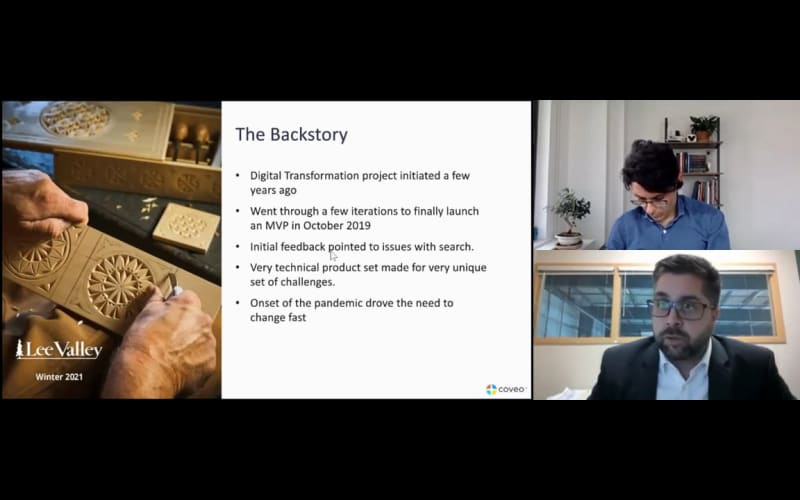
Okay. Welcome to our next session. We're gonna be talking about how Lee Valley is transforming their online experience with AI. I have with me today Steve Cristo Ferro, the director of digital and ecommerce marketing with Lee Valley tools, and Chiro Greco, the director of AI with Coveo. Welcome. Thank you very much. Thanks so much for being here. Chiro, I'll turn it over to you to, get started. Yes, sir. Here you go. If you can all see my screen, I'll go. So thanks again for for for having us. My name is Chiro, and I'm the director of AI at Coveo. And today, I'm here to introduce you to Google for commerce and hear it from from one of our great clients, Lee Valley Tools. And Steve's gonna be here with me, and we'll walk you through your experience with Coveo and give it a more detailed tour of the journey we've been on together so Barca. And, of course, we're gonna talk about the future as well. Before diving deeper into the actual use cases, I just wanna lay down the ground a bit and tell you, something about what we think in general, around AI and the adoption of AI. If there is one thing that I want you to bring home from today is this, that, the best user experience is achieved through technology. There's no question about it. And I think, like, the digital era somewhat made that clear for everybody. But the recipe for a good usage of an artificial intelligence solution in your business is basically a function of two things, knowledge of your business problems and a good innovative solution in terms of technology. The first without the second risks to be, kind of helpless, and the second without the first might end up being useless. So the digital digital companies all over the world needs to need to adopt AI, but I understand that it's often hard to navigate the landscape since many of these companies are not tech companies in their in their DNA. And I am personally a big fan of starting with a business problem and then kind of walk backward to the solution to the technology because that kind of puts everything in the right perspective and simplifies drastically the decision making process around the adoption of AI. The first thing that, to consider in our opinion is that is what is a good problem for AI? Because at the end of the day, like, AI in the industry right now is basically a sophisticated form of automation. And so there are problems that are great for AI to solve, and others, they're just like the wrong problems. Problems that are very good for AI to solve are repetitive, and they have a real time component because machines are faster than humans. They are multifactor. For instance, our problem that require, to take into consideration several data sources at once to come out with one optimal solution, and, of course, they are data driven. And this is the reason why things like recommendations are a great problem to use AI for because it basically checks all the boxes. Optimizing the results of a search engine is, also a very good example because, again, it checks all the boxes. It's repetitive, it's fast, it's multifactor, and it's data driven. Now at the same time, we also know that certain cases, you know, it would still there still would be a benefit in having some human, intervention in the loop. There are cases like, for instance, merchandisers, where we might wanna have some recommendation feeds to be built under the supervision of merchandisers for special occasions or for special type of products. And it becomes then important to choose an AI solution that can balance these two somewhat contrasting needs. The optimal solution in this case is the one that gives the repetitive real time multi factoring one iterative component to the machine and leaves, room for humans to take care of that part that requires quintessentially human capabilities like complex reasoning, common sense, and, you know, domain expertise in the line of business. So in this way, you can get basically the both the best of of both worlds and you have, you know, solid technology on the one hand and expertise in the domains in the specific domain of your business on the other. Right? So I believe that this is basically, the most important thing to address when you find yourself in a in a situation where you have to choose between build or buy. And once this problem is is somewhat being addressed, then you can move to other, important, questions, that that you know, like, if you wanna build or you wanna make an AI solution to yourself, you can then take into consideration the usual the usual problems. Do you have the right talent to build it, or if not, can you attract it? Data scientists are they're expensive. They're not many of them. Honestly, they will need guidance from the product people because otherwise, like, getting the best out of them is gonna probably be tough. Time and ROI are super important factors. How strategic is the application? How much time do you have? Steve will tell you more about how the digital transformation roadmap of Lee Valley tools has been put in hyperdrive by, the, you know, the pandemic in twenty twenty. And if you wanna buy, it's very crucial to understand what are you looking for. Is a generic solution a technology or a very specific provider? That is the most important thing to me. And if your business does not make money, from search bar, for instance, well, you might be okay with a technology that fixes the problem and you don't really have to take care of it and the search engine is okay. It's more of an IT decision. But if the search engine is a crucial component of your business and you make money out of it because people use it to find products then they buy, well, then you might wanna consider a solution that is built by people that not only understands AI, but understand AI with respect to the specific problem of product search that has its own quirks and and and and idiosyncrasies. I will leave the floor to Steve, now so he can tell you more about how these factors play together in the decision making process at Lee Valley tools and how the specific capabilities of Coveo for commerce addressed the needs of Livadi tools in, such crucial moment as twenty twenty and for the specific needs of the business line. Thank you very much. Steve, I'll I'll give it over to you for the second part of the presentation. Thank you. Thank you, Chiro. Let me, just start sharing my screen on my end, and, thank you for the opportunity. It'll take just a second here. And I need get back again. And here we go. Okay. Now I'm back. Thank you everyone, for the opportunity of sharing a bit of Lee Valley's story today. My name is Steve. As, you introduced, I've been, at Lee Valley for a couple of months, acting as the director of digital and ecommerce marketing. And before we go into the the Deep Cloud project, I think it's a good idea to kind of just give you a sense of who Lee Valley is and, what has been our journey through, our digital transformation just to give you a sense of how we could we benefited from, you know, expert products such as Coveo. Lee Valley is a family owned company founded in nineteen seventy seven. Provide quality tools and learning tools out there. And and, basically, what Lee Valley is about throughout the year, and if you've received the catalog, if you are a woodworker or a gardener, you you will understand really quickly that we we are here to inspire creators of all kinds. And that's what what the brand is about. We evolved from, you know, being a catalog business, that started in nineteen seventy seven to opening three physical stores across Canada, distributing worldwide, and we've been growing our online presence, in the last few years. And our aim in this interaction with our customers is to become the trusted advisers. We are the person you go to if you're not sure which tool to use for your job. We are the, the the the friend that is there to help you out with a specific job you have in mind and to give you the expert advice on how to get that done the most efficiently and the most, you know, enjoyably possible possible. The road to, our, you know, our backstory of our digital transformation is that it started a few years ago, much much like, you know, a lot of the digital transformation stories out there. And it launched as an MVP at a new website, running on-site core, in October two thousand nineteen. The initial feedback we got, from the, from the customers, it showed that we had a few points that need to be addressed. And the the one of the major one was search. Search was identified. The the initial implementation we have was a bit weak, and it would return, poor results once you got into two or three words queries. So, you know, one word query, that's easy to handle. But once you go to two or three word queries, understanding the intent, the old search engine, and very rarely much limitations would return you hundreds of results for very specific queries. We have a unique, position because our we have we sell very technical products, and that makes us a very, very unique set of challenges. The angle on wood planes, the types of screws we sell, the the level of detail which we do hardware, you know, maybe decorative hardware or, you know, just hardware for your projects. It necessitates really an expert an expert, level of detail, and it it transitions it it infuses how we do search. And on top of all these challenges and identifying the road map, the the onset of the pandemic in last March really drove the need for the business to act fast on these challenges to make sure that we could answer our customers in the best way possible online. So we did want to, have better search, as I've mentioned. And we, did a proof of concept last summer, and then we took, with Coveo. And then we took the opportunity to, pretrain our machine learning model during that period. So that was a lot that allowed us to see in real world conditions with our data, with our structure, without any additional work, how did Coveo compare to our our our current search engines? How would the results compare? And it allowed us to quickly train from real world interactions the machine learning model that that sits inside Coveo. We simplify the rollout by going into phases, and and we wanted to use search as a launchpad to building a better customer experience. So when I say that, what I wanna what I mean exactly is that, to us, entering the world of lead value through search is very important. We see that more than twenty five percent of our users, you know, in in on their first visit, they're gonna they're gonna be using, the search bar. We want to make sure that they don't just interact with product cards, but that they get, you know, they go to get deeper in the Lee Valley, universe just through interacting with our church. Need to account for bilingual market. You know, we deal in in Canada, so we have English and French. And we have also, websites that serve international customers and US customers. So that, complexified a bit the delivery of our search. We're able to deploy from, from project start to deployment, live deployment in forty five days. Not only that is that we got to go live five days before Black Friday week. We were so confident in the results we're getting from Coveo that we decided, you know, that's better than what we have. It's gonna be better for our Black Friday week for our Cyber Monday sales, and we need to go ahead and release that. Just to give you a quick quick view of our setup. So as I mentioned before, you know, we're running this on-site core. And the way this works is we're leveraging our existing product feed, which we use for, you know, advertisement or any other uses coming from our PIM, and we're feeding Coveo that data. So the data model resides on our product feed, and then start to to cycle Barca Coveo. So we're really leveraging the data model, inside of our PIM to inform all the search, activities that that Coveo gets to do. And all those data fields are exposed, so that they can become a variable into, us controlling our search experience or letting the machine learning understand which data points are important into, for our customers and how to ponderate the the search results for us. Just to give you a sort of where we were before our AI or before, Coveo, you see a quick results for drill, very disorganized list of filters, lots of results for a simple keyword, and, and really, just no kind of ordering to our search. And if you go, we're able to do after, switching to Coveo, We see that we're able to, you know, do search inter intercepts where we can, you know, have banners appear in our search. The filters the filter list was cleaned up by using the components in Coveo. And we also were able to merchandise our top search result pages a bit better to showcase the the products and their, in a unified way. Results are important. The impact of, getting Coveo on our website was in within the first two months, we saw a thirty percent lift in search conversion. So any users that were hitting our search engine were converting thirty thirty percent better, in within the first two months. And that trend has continued on afterwards, and we decreased the bounce rate from our search pages by ninety five percent. So people were engaging with our content a lot more, and they were actually finding, a lot more, a lot more, content. Just as a as a as a testament to the, to the progress we've made with, with our searches, when we started, the, before we implemented the Coveo, our unsuccessful search results were about five to ten percent. Basically, of our searches were getting us zero result. Basically, we're dead end for the customer. We've been we've been able to reduce that to under two percent of searches within a for a a a quick few months by applying, the machine learning model that's in Coveo. And that's been very successful for us because that's what's grown most of these metrics. Lessons learned. For us, it was very important during this project to and it came it dawned on us, in the later parts of the project that we need to clearly identify, all the user types using the the the website. The reason behind that is that we realized that we had a lot of internal searches that were polluting the, the the, the learning of the model. So, we were generating a lot of false results because internal users were searching for specific part numbers or older products because they were servicing customers. And that realization allowed us to quickly exclude the these from our from our from our results and get a model and a behavior from the from the from from the, from the search engine that was much more natural for customers. The other, learning is and that we were happy to have the tools to do that within the toolset of Coveo was that sometimes we need to, leverage quality over, automation. When you're being very technical your products with your products, when does the the search becomes very refined, you you have to kind of let go of some of the automated automated, associations and really leverage the the internalology I like Shiro mentioned in the beginning to kind of, like, take over and make some true, quality, experiences for your for your customers. Looking ahead, you know, this is us scratching the surface. What is ahead for the valley and, its search for, its search for a better customer experience? Well, we want to use search and the tools we have in, our Coveo toolset, along the other website tools we have to bring to life the trusted advisor role online. You know, when you go into a store and you ask for a hammer, you're gonna get asked Barca, what type of hammer? What type of job? What do you need to do with that hammer? We need to bring that to a website in some way, shape, or form to kind of get that second interaction, that that question, that discussion going with our customers, not by just creating search results for Hammers, but really by injecting a lot of, of insight into what what wraps around your search. Right? How you categorize the filtering, the questions you're asking your customers. We're also, going to deploy, product ordering driven by the machine learning model. So we're gonna take our product feed and our product page and really layer in what Coveo has learned about our website and our customers' behavior on all of our product listing pages. We're gonna send some content. So one of the things that we do that, you know, might not be apparent from from what you've seen so far is that we, we go, really deep into content and videos. And we do a lot of those, at Levalley, and we want to expose them through search so that just so that search doesn't become only transactional experience, but also a brand experience where you get to understand which content working out there. We've implemented the new endless front end for, for Coveo to help with our SEO. So we're we've been looking at the, the freshest releases of Coveo, and there's a there's a way to implement that's gonna actually help us with, with serving, optimizing our website for for for search engines. And, finally, and the last step that we're searching for phase two is leveraging how Sitecore and Coveo, can bring our website personalization, to another level. You know, leveraging their search power with the personalization power, I think we can really build some great experiences for our customers. And that's it. Thank you for listening to us today. Great. Well, thank you so much, Tiro. Thank you, Steve, for a great presentation. For anyone who has questions for Steve or Tiro, you can, enter them through the chat function and they'll be around to answer those. And now we're going to, head over to our next sessions. We have a panel on, creating urgency for today's browsing at home shopper, and we also have the women in retail sessions. So enjoy and, head over to those sessions. Thanks.
How Lee Valley is transforming their online experience with AI