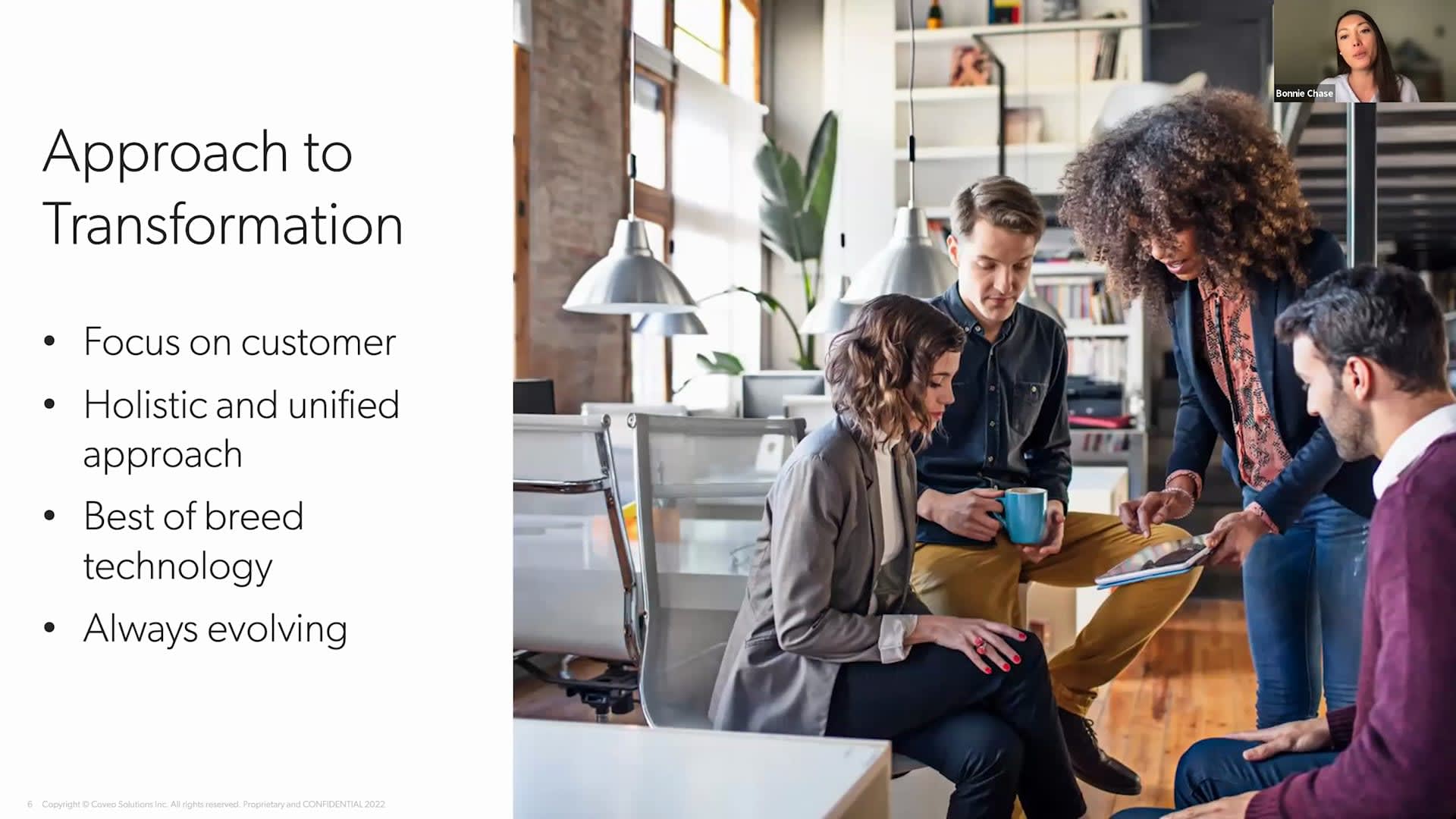
Hello, everyone. Thanks so much for joining us today. My name is Bonnie Chase, and I'm on the marketing team here at Koveo. And today, I'll be joined by Jamie Batten, who is the digital experience director at Ellucian. And today, we'll be talking about how Ellucian is thinking about the future of support. And, you know, as companies are undergoing digital transformation, we thought this would be a great story to share, and, hopefully, you'll get some key takeaways, and best practices to apply in your own transformation journey. Now when we think about support, you know, one of the things that that really comes up is how support teams have been undergoing digital transformation for years. So there was a big push to self-service, more channels keep appearing, you know, chatbots and and communities and and knowledge bases and all of these different options. And so we continue to evolve that support experience. But there really isn't a destination to digital transformation. You know, transformation is a journey. It's one that should continue to evolve. And as we saw with twenty twenty, there will continue to be big shifts in the market, that require us to adapt and make changes. And just looking at, you know, the experience, you know, getting getting a digital, getting a digital experience alone isn't enough. That experience needs to be a good one. And just looking at some stats, you know, thirty eight percent of consumers are more likely to recommend to others based on a good experience. So if you're giving them that experience, you know, that really helps that that improves the NPS and the CSAT. You know, people want to share when they're having a good experience. But on the other hand, eighty percent of consumers would rather do business with a competitor if you have one bad experience. So, you know, these good experiences all add up into, you know, bringing bringing along friends and recommending others to to join join, do business with your company. But then if they have that bad experience, that really pushes them away and pushes them toward competitors. So when we think about the type of experience, consumers want, it's really you know, they expect personalization, seventy six percent expect that as part of their, support experience, and then seventy five percent desire consistent experience everywhere. So whether you have, you know, that community, that chatbot, that that self-service experience, that should be consistent in every touch point. Now, Jamie, can you share a little bit about Ellucian and your role there and then talk a little bit about how you view an exceptional digital experience. Thanks, Bonnie. It's it's really, good to be with you, and I'm excited to share the Ellucian story and the Ellucian vision for, digital transformation. So Ellucian is a software and solutions solutions provider in the higher education market space. We serve colleges and universities around the world, and we have ERP solutions that help universities with their administrative processing, everything from admissions and registration, the financials for the university, alumni, payroll, HR, all of the auxiliary apps along with data warehouses and all the things that you think might be employed in order to run the university, Ellucian, delivers and supports those, around the world. And, you know, our digital transformation and our vision for digital transformation, I think, exactly aligns to to what you were just talking about a few minutes ago. It is a journey. It never ends. We've done two significant, I'll say, upgrades or reimplementations or redesigns of our digital support experience, most recently here in June of twenty two and prior to that in, twenty fifteen and twenty sixteen. So as new technologies are unfolded and as new practices are developed and as consumers' expectations change, our changes and our solutions are updated in order to meet those ever growing demands from a highly sophisticated customer base. But when you think about digital transformation, I mean, what are the what are certain things that, you know, sort of must be there in in any digital experience? Obviously, you know, you also mentioned self-service, and we are a really big proponent of, you know, making sure that, customers and consumers can get at the information and find the resources that they are looking for quickly and easily in a consistent experience in a way that is intuitive. And, you know, accomplishing that is, you know, easier said than done when you think about all of the various solutions that various organizations around the world, you know, employ to deliver those to to deliver those functions no matter what the industry or the marketplace that that particular company, you know, may be involved in. Getting something that's going to be, tailored and offer that unique experience for your customers, can be that ever growing challenge in order to deliver that digital experience that is pleasing and is welcomed by your customers. Absolutely. I mean and and that it's a lot of work. Right? It's not something that happens overnight. Yeah. And as you mentioned, you you kind of did did two transformations or or two upgrades. Let's take a look back at that initial change that you did back in twenty sixteen. What were some of those, initial challenges? You know, I've I've put a few here, but why don't you talk through what those what that experience was like before that initial transformation that you led? Absolutely. And and as I mentioned, we're a a global provider of software and services for the higher ed market space. And as such, we have a very diverse need for our customers in in terms of delivering support. In that, we have cases, and we have knowledge and communities, and we we deploy and and deliver and and allow customers to download software, and we offer documentation and, training. So there's a whole variety of services and solutions that our customers, receive as part of their relationship with Ellucian, and they expect, you know, very sophisticated, elegant, best of breed solutions to deliver all of those solutions. And it's very difficult to find in fact, there isn't one application out there that is going to meet the needs for Ellucian to deliver that experience to customers. So we employ, you know, a number of we have a couple we had a couple of CRM solutions. We had training. We have documentation. We have all of separate applications, and customers sort of had to have a sense of where a piece of content resided in order to go find it. And so that is that fractured experience where I'm in one solution for documentation and another solution for cases, and, you you know, it's just very, very disjointed. And then, you know, trying to find where is the the case or where is this documentation or where was this article that I read, you know, sort of going down rabbit holes or there was a there was a piece of communication from some some place, somewhere, from somebody. I don't I don't remember where. You know, that rabbit hole idea where customers have to know where something resides in order to find it was one of the key drivers in us being able to, you know, wanting to bring together all of the content. Because at its very core, you know, someone could come to a support site in a digital world and say, you know, I'm looking for x, and we should be able to serve everything related to x to that customer irrespective of the system, solution, or environment in which that piece of content resides. Absolutely. And I feel like that's a common thing that I that I've seen in in support organizations where, you know, okay. Well, there's this type of information on the community and there's this type of information in the knowledge base. You can't find it. Well, you're looking in the wrong spot. Exactly. It's like, they shouldn't have to think about that. So, yeah. I mean, absolutely, you know, that that requires that requires a change. So you did make a change there. So let's talk a little bit about what, what that transformation was like. How did you approach that, and what was key in that initial transformation? So we felt and and based on feedback and regular conversations with our customers and our, you know, internal stakeholders who are talking to customers, you know, we had a pretty good sense of where we needed to go, you know, at a high level. But there's nothing like continuous regular feedback, validating assumptions, getting feedback on requirements, making sure that we really are, you know, hitting the mark with any, you know, potential changes. And when we're talking about changes of this magnitude, you know, you wanna get it right. So Ellucian is a you know, we are committed to our customers, and we really value the the customer feedback and the customer, the customer cycles where they they are involved giving us feedback on requirements, helping us with design, giving us feedback during testing, and then completing the cycle and then starting over. So customer feedback on, you know, what are the key things, that are utilized? For example, you know, you mentioned community, and when we're talking about a support site, you know, much of our business has to do with, you know, support tickets and cases and things of that sort. You know, we have documentation and we have training. We have all these other sites. But, you know, some of our research found that, you know, the majority of our customers, the two biggest environments that they're using or, functions that they are taking advantage of are around cases and community. And so we, you know, we kept that in mind as we looked to the development of, all of our transformation activities to make sure that we are keeping our focus on the two most important things that customers are using. Not to say the other ones aren't important. They are all part of the suite of services that we offer. But knowing, you know, which ones are critical and we really gotta spend some maybe some extra time on to make sure that we get those functions, spot on, working exactly as a customer would expect certainly helped shape and frame the the nature of the project. And and, you know, we wanted to have a consistent experience. And even though Mhmm. We may be talking about different solutions, we really worked to make sure with our, marketing team that we had similar branding and iconography and the color palette and all of those things that may sound so basic. But when you're looking at, an entire solution of stitched together applications, you wanna make sure that you have some of that consistency so the user knows that they really are in an Ellucian environment, and it's all part of this. You know, it may have a little nuance here and there, but by and large, you know, it has that unified approach. And and we do offer sort of a best of breed solution for what for what we deliver, whether it's in the area of documentation or how they access software, or community or cases. And so that's really important that we bring those things together in a in a logical, meaningful, consistent way. But at the same time, you know, to the last point, we are always changing. It is that ever never ending journey to always improve, to always make it better, to always get feedback, and to always incorporate that into changes. And some of those changes can be very small, but yet it has a big impact on the customer experience, and those are just as important as the, you know, the the big the big rollouts, if you will. Yeah. Absolutely. And I would say, you know, your your first the first thing you mentioned was really around the customer, and and I think that that goes to show why you're you're a leader in your space because, you know, it's very customer first. Right? So you have that outside in approach, which I think is really important. And and even though we always you know, everyone talks about the customer, we don't always actually put customers first. And so, you know, in thinking about this transformation, I like that you really got them involved from the beginning and kept them involved all the way through that experience, getting that feedback from them because you don't wanna go and and spend a a ton of time, you know, implementing things that in the end, the customer wouldn't actually care about. Exactly. Exactly. And, you know, there there's a, an anecdote I always like to share from another customer, AARP, where they actually, they have customers or or clients, members who actually prefer handwriting in their letters. So, you know, they have a department that that supports that. Right? So it's all about being customer focused. So on your end, your customers, they they wanna go online. They wanna find the information that they need, and they don't wanna jump around to a bunch of different places. So it makes sense that you really focus your efforts on that community, bringing everything into where they where they prefer to access that information. Now when you're implementing these technologies, are you you know, you mentioned all of these, you know, the these best of breed technologies that you're using. You didn't have to, like, rip and replace and kind of put one you you weren't trying to force everything into one system. Right? You were kind of tapping into what you had with Coveo. Right? Exactly. I mean, we have these solutions that deliver the the specific functions that a customer needs in order to, you know, execute their, you know, business objectives. But, you know, over top of all of this is where Coveo comes in and really where we can bring all of this great material that we have and the valuable resources that we offer to customers and all of that, goodness of content that customers are looking for, bringing that together through a single search experience whereby it can return information that, is relevant from community or from cases or documentation or training or some other site. You know, if I'm if I'm looking for, something related to, you know, transcript printing or alumni donor information or how to process financial aid, whatever it might be, There may be answers to those questions, whatever the specifics are. The answers to those could come in a variety of ways. It could come from previous cases. It could come from a conversation that's happening in community. It could come through training or documentation. And being able to bring all of that together and present that to, to a customer in a relevant way that makes sense and would help them resolve their issue quickly regardless of where the content is. That was one of the key differentiators for us in that work that we did in twenty sixteen. That was our, that was our bringing all of the content together in one place activity. And, you know, it's been it's been something that that has been tremendous, and, customers find it extremely helpful. It's part of our our strategy. It's embedded in our ecosystem. And, you know, it's a it's a great partnership that we have with Coveo to be able to continue to deliver and improve and add more content because, again, that journey is just never done. You have and and so you mentioned, you know, you also did another, another kind of revamp in twenty two, so this year. So can you tell us a little bit about, you know, that that you know, how it's evolved since twenty sixteen and what you've done in twenty twenty two? Yeah. No. Great, great question. And, you know, I'll I'll I'll reference again the fact that the journey, is never ending. And in twenty fifteen, sixteen, the reality was we had two CRM solutions within Ellucian. We had one CRM solution for our on prem customers, and we had another solution that was utilized for our, SaaS or cloud customers. And as more of our customers are moving into the SaaS world, we began to quickly realize and customers express frustration that, you know, having two CRM solutions to deliver a ticketing experience is not a tenable solution. And so we began to quickly realize that the the case experience from the two were different. The workflows were different. The UIs were different. There was no consolidation of views. There was no consolidation of reports. And so that was a significant project that we needed to execute, deliver, and improve the customer experience, and that was all of the project that was launched in twenty two. And with that, we decided that we were going to try to leverage as much of one of our CRM solutions that that we could in order to deliver that consistent experience, have that integration of data, have that similar UI. And so we were able to migrate to a new portal. We were able to migrate into a single support case. We were able to have within that CRM solution tracking for our defects enhancements and releases our knowledge base, and our community, and all of those things. And all of that in a single CRM was made even much more streamlined by putting Coveo, you know, on on top of that, if you will, and having a single source of index of all of that content built out and offered through, through Caveo. We also redesigned our UI because, you know, five years or seven years is a long time for for systems and solutions to be in place. And so we did a UI refresh. We redesigned our search experience. We streamlined it. We made it cleaner, more personalized. And and the and the portal itself is much more customized to the individual user who's logged in. And, you know, every time we talk to customers, you know, personalization is top of the list. And, you know, that's our guiding one of our guiding principles is, you know, only show me content that is relevant to me. Amazing. Yeah. And that that really kind of shows, like, those initial stats that I brought up in the beginning. You know, cost customers want personalization, and they want consistency. And that's really what you the experience that you're building with your support experience. Absolutely. Oh, that's great. So, you know, you've undergone undergone a couple of transformations over the past six years, and you've got some good best practices to share. So let's go ahead and and chat a little bit about some of these best practices. I've I've added three here that we've discussed before. So why don't you, maybe dig into these a little bit and and share any more that you may have? Sure. So, you know, we we've we've touched on this, but, you know, I'll talk a little bit about maybe some of the specifics about how we executed our customer feedback. We have through our even in the solutions that we deliver to the marketplace, we have what we refer to as customer advisory boards. They are made up of our, customers around the globe who wants to, you know, work with us in all the various life cycle activities of a project. And we and that's no different for for our, support experience. We have customers who are highly engaged. They they have very very specific and clear ideas about some of the challenges, that we face, and they they wanna help. They wanna give us ideas. They wanna give us recommendations. They wanna be involved. And so, you know, reaching out to those customers is is, is key for us. And and we actually reach out to some customers who may be what some might call our biggest detractors. Those folks who may be not the most positive voice in the room. We reach out to those folks and say, you know, help us. We wanna make it better for you. So, you know, we we understand in certain areas, maybe we need to improve, so work with us, and let's make it better together. And so including those customers, in that process, I think, is critical. And having them test and being engaged with them, getting their feedback, you know, we can't always include everything that a customer may put on a on their wish list for any given release. And I'm always upfront to say, you know, we will we will take the feedback. We will take action where we can. We can't make any promises that we'll do everything. We'll tell you what we can do. We'll tell you what we can't. We'll be fully transparent. And all of that goes a long way in establishing, you know, an excellent rapport, you know, back and forth between, the company and, and customers. And and and it's what's really fantastic is when those customers are involved in the process, then as conversations and things are happening in community, those customers can then, you know, provide their feedback and provide their input. You know, I was part of the testing team that did x, y, and z, and we made this decision because of a, b, and c. And that gives a whole another level of credibility and and validity to why potentially certain decisions were made or why things, you know, may have gotten shifted or what you know, whatever the situation might be. Having customers being able to answer other customers' questions always is a different level of support than Ellucian answering the question. You know, and in the feedback loop, we have a a very robust community. We have a very active customer base, and we have forums, and we have areas of conversation for our solutions, but we also have areas of conversation for our support experience. And so, you know, they may have questions about our registration product or our finance product, but they can also ask questions and give us feedback in our feedback channel that we have in in our community. And that's, again, a lot of engaged customers giving lots of good feedback, a lot of dialogue back and forth. And so that's a regular channel that's open all the time that we're constantly getting, you know, new ideas, new suggestions, ways to improve the solution. So that that's just one, you know, just one more way. And then, you know, communication. All of this loops back to whether it's communicating through the the the community forums and the the locations that we have within our support side about what isn't, you know, what is something that we can take action on or what is something that's further down the line or something that may be, you know, a longer term, you know, product enhancement. All of that transparency, you know, is critical throughout the life cycle of the project, but really critical when you're doing a huge upgrade like we did in June. And for that, we started, in January with our communication out to customers. We had multiple mailings. We had communications through our existing portal channels. We had communications through our communities. We had a microsite off of our dot com site that had video snippets and talked about the project and why we were doing it, and we had FAQs, and, you know, we had terminology changes. We we had a whole variety of information and resources available to customers, throughout the the project. And, of course, as it got closer, you know, the the communications were more frequent. But, you know, by the time June came, for the release, we felt pretty confident that we had hit, a number of communication channels that we utilize because you can't just rely on one. You have to you have to go where the customer is. And sometimes they're in email, and sometimes they're in community, and sometimes they're on the website. And some you know, it just depends on on where they are, and we try to, you know, we try to go where they are in order to make sure that they that they didn't miss the message. Absolutely. And and I love these best practices because, once again, I mean, it's very customer focused. It's all about the people. You know, the great tip about pulling in detractors because they'll they'll be honest about what's not working for them. And then transparency. I mean, that you know, transparency is key in in in saying whether it's something you can or can't do, really. And then that communication. Right? Like, you don't wanna just send one email a month before it happens. You're you're having regular communications in multiple ways, even building out, you know, FAQs and and, you know, that's a lot of content that can be useful to helping them understand not just what's happening, but why. So great best practices. You know, and it's been really great to see this journey that you've been on and the experience that you're delivering to your customers. Any last last, tips before we wrap? No no last tips, but, you know, getting back to the journey is is never it never ends. We are working on we have a number of months of enhancements, of features, some really specific, some really great suggestions from from customers about things that they would like to see or improvements. We have more content that we're going to be bringing into our Coveo index as we add more systems and solutions to our support, environment and our ecosystem, things like, projects that our professional services teams use to engage with our customers. We'll be bringing that project content into our search experience. Again, bringing all of that together so that the all of the content that a customer is interested in and is meaningful for them is available quickly and easily at their fingertips through a simple search interface. Absolutely. Well, thank you, Jamie, so much for sharing your experience. Really excited to see what the future holds for you and your customers. Appreciate the time that you took today. So, you know, I just wanna say thank you to everyone who, who joined us today. And, if you are curious to learn more about Coveo, we have some additional resources available for you. Jamie, once again, thank you for joining us, and have a great day, everyone. Thank you, Bonnie.
How Ellucian is thinking about the future of service and suppor