
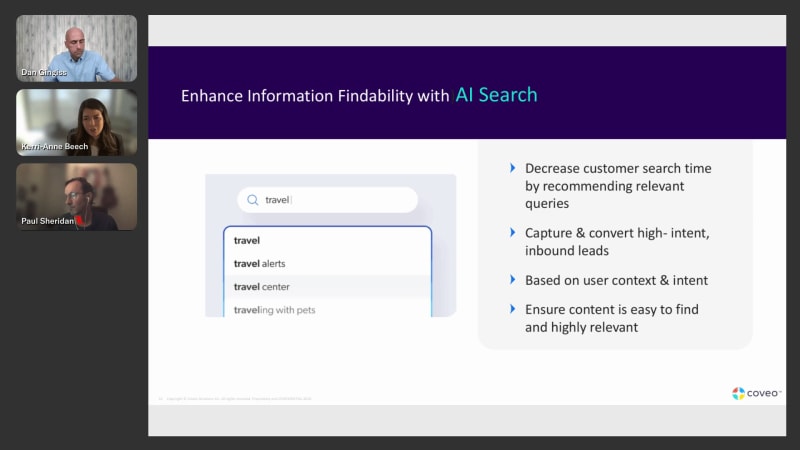
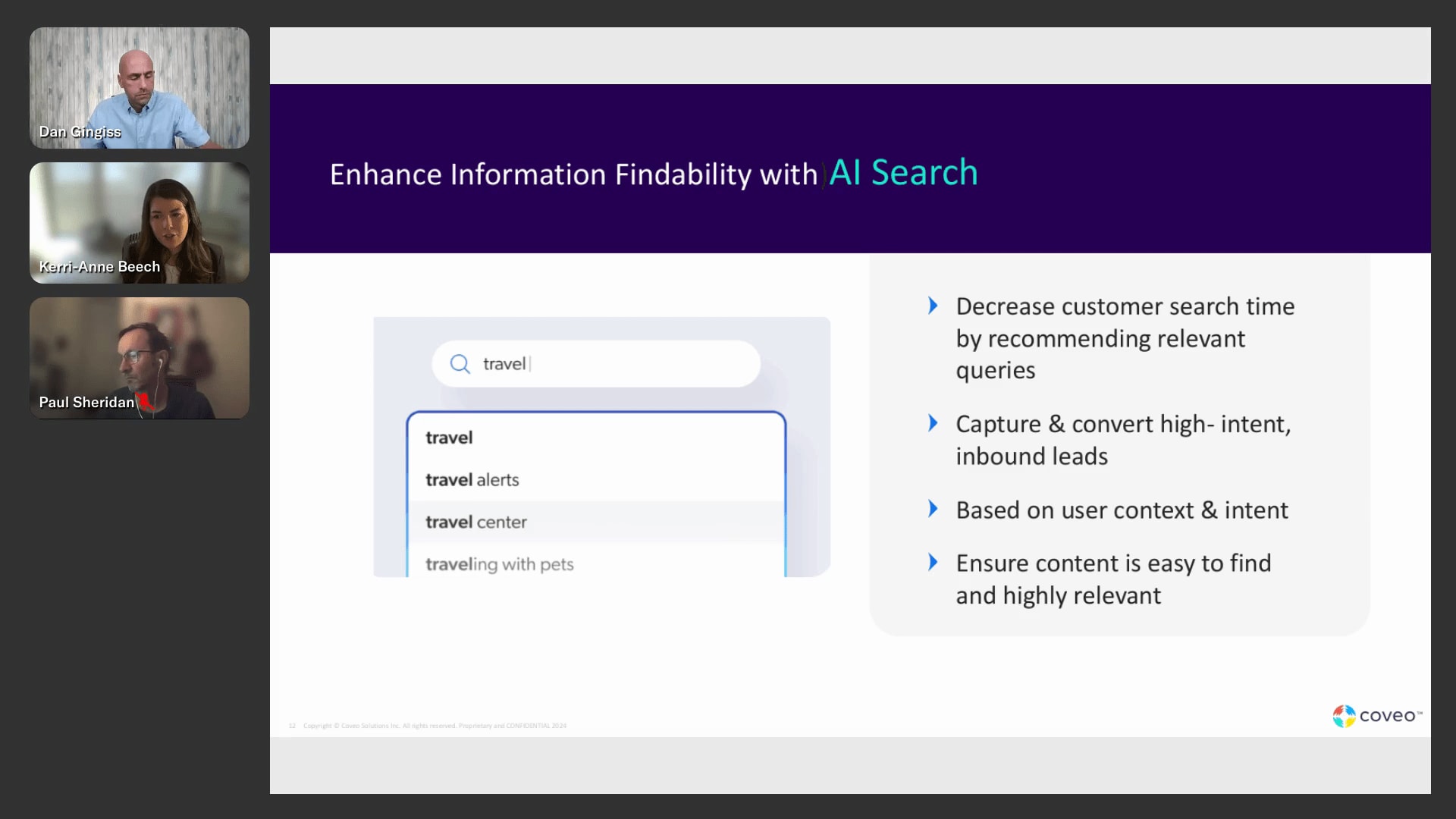
Alright. Hello, everyone, and welcome to another CMS wire webinar. My name is Michael Trapjack, and I'm here today to help answer any general or technical questions that you might have. But before we get started, I'd like to welcome you to today's webinar, AI and the customer experience. Here's today's timing breakdown. These numbers are just rough, so don't hold us to these. At any point during today's webinar, if you have a question, please don't hesitate to submit that in the q and a tab on the right side of your screen. You You can also chat with your fellow attendees by clicking the public chat that is also on the right side of your screen. We also have a few resources made available to you on the docs tab. Here's a little bit about us here at CMS Wire. We were founded in two thousand three and cover the primary topics that you see here on the slide. You can read our great content and register for upcoming conferences all by visiting w w w dot c m s wire dot com. I wanna thank today's sponsor, Coveo, for making today's webinar possible. Coveo is the world's world's leading cloud based relevance platform that acts as an intelligence layer, injecting relevance into the digital workplace with AI powered solutions spanning from intelligent search, through to knowledge recommendations for Internet search, employee self, service, and departmental knowledge needs. You can learn more at w w w dot Coveo dot com slash solutions slash workplace. Alright. And then, Carrie Anne, I'm gonna hand it over to you. Thank you so much. So really excited to be here. Welcome, everyone. So my name is Carrie Anne Beach. I am a senior product marketing manager at Coveo, and I'm really excited to be joined here today, by Dan Gingis, who is very knowledgeable in all things customer experience. So, Dan, could you wanna introduce yourself? Sure. Hey, Carrie Anne. Hey, everyone. Thanks so much for having me here today. My name is Dan Gingiss. I am a customer experience, speaker, author, podcaster, all of the things. I live and breathe customer experience, each and every day. And I came at it from corporate America. So I spent twenty plus years at some companies you might have heard of, McDonald's, Discover Card, Humana, and a couple others you maybe haven't heard of. And that's where I really, learned customer experience in the wild. And so now I work with companies, to help them identify opportunities to improve it. And, of course, AI is all the rage. So very excited to talk today about how AI is going to impact the experience. Amazing. So really excited to get into this discussion. As you may have guessed, we will be discussing the impact of AI on the customer experience. And definitely be sure to stick around until the end because my wonderful colleague, Paul Sheridan, will be providing a demo. So you'll see AI search, recommendations, generative answering across your sites. Paul, do you wanna introduce yourself as well? Sure. Glad to. Thanks, Carrie Anne. Thanks, Dan. Paul Sheridan. I'm a solution engineer with Coveo. Open with the company. About nine and a half years now. Based in Toronto, and love to have these kind of webinars and learning more from, folks like Pam. So let's jump right in. So just a kinda quick recap for those who aren't familiar with Coveo. We are an AI search platform with over a decade of experience in AI. Our machine learning models power AI search, recommendations, generative answering, and unified personalization across use cases. That includes websites, commerce, service, and workplace. So diving right in, let's talk customer experience. For many companies, you know, digital experience and customer experience has really become one and the same. I wanna share this stat with you. Eighty nine percent of companies now compete primarily on the basis of the customer experience. And that's especially true in, you know, highly competitive industries where product differentiation can be kind of difficult. Customer experience truly is that competitive front line. Yeah. I mean, I every time I see this statistic, and this is a popular one, I actually doubt it a little bit, and here's why. There's no question competing on price is a losing game. Don't do it. It's not you are not going to win doing it unless you're a company like Walmart. Right? There's very, very few companies that succeed by competing on price. Usually, it's a race to the bottom. Competing on product or service is also really, really challenging because almost every industry has become commoditized. And to that, I look at an industry that actually was quite revolutionary at one point, which would be the ride sharing industry. And today, you get into a car at the airport, you don't even know which company you're riding with, and chances are you're riding with both because the the drivers work for both companies. So something that completely revolutionized an industry is now also pretty commoditized. So we can't compete on price. We can't compete on product. The only thing left is experience. Now I look at that as a positive because experience is something that you can differentiate on. It's delivered by your humans and your technology, and nobody else has those same humans especially. But the reason I doubt this statistic is that I still think if we look around as consumers, there are way too many companies that are still trying to compete on either price or product. And so I think this statistic should say eighty nine percent of companies should compete primarily on the basis of customer experience. I'm just not positive that they actually do. That's fair. And I think we're gonna see that in some statistics that we'll unpack a little bit later. The digital is definitely still lacking a little bit, but there's definitely no doubt that it it is your competitive front line. And, actually, to your point on product, product enhancements around the customer experience are what can help you with both of those things as well. So I think the two are definitely intertwined. So, Dan, can you tell us a little bit about what's top of mind in customer experience today? Well, you've got it here on the screen. Certainly. So Spoiler alert. Exactly. Obviously, AI is taking over almost every industry and it has, is is playing a growing role. And I think I would say to people, and this is as a guy who is generally not a shiny object chaser and not a first adopter. I was I was telling somebody the other day, I think my first iPhone was like the iPhone six. Okay? So I'm not usually the first person out there. And yet with AI, I think I very and especially generative AI, I very quickly saw this is a game changer that we can't ignore. And I wanna remind people, if you're in the US, you'll appreciate the baseball reference. If not, just bear with me. A baseball game is usually nine innings. We are probably in, at most, the second inning of the technology. Right? So that means this is going to continue to grow. It's gonna continue to get better. And so getting in now and understanding it and figuring out where it best fits within your organization is absolutely critical. And I'm super excited about all the opportunities for it. I'm seeing it in my own business, places where it can save a ton of time, places where it can help to make client or customer experience better. Don't look at it as something that is meant to completely get rid of your customer service department, for example. That's a bad way to look at it, but do look at it as a way that helps your customer service department do their jobs better. And then self-service, I think, is also really critical as, as especially as the generations start to flip over and as we start to get, you know, Gen z now is entering the workplace. I think millennials, were probably the first generation, to really appreciate self-service and want it. And I think Gen z is following with that. And then Gen x just like me are like, yeah. Self-service is cool. And so there is a higher demand for self-service. The way I look at this is, I mean, I worked in a credit card company and a health insurance company. And I told my teams very honestly, no one wakes up in the morning wanting to talk to their credit card company or their health insurance company. There it doesn't exist. Right? And so if we have to talk to them, we want it to be quick, easy, and painless. And that's why self-service is something that we really want because we just wanna go figure it out ourselves and go on about our day. We don't wanna wait on hold. We don't have to wanna go through an IVR. We don't wanna be transferred. All of that stuff that's just miserable. So people definitely want to self serve. And that's why I put these as the top two CX trends. For sure. Yeah. That's very fair. And, actually, I wanna dive into that a little bit more. We actually recently did a, CX industry report, and we found some interesting insights that really do kind of, like, showcase a lot of what you're talking about. And the first one is actually, around information findability, which is search, is still having the biggest impact on brand perception. And I want us to think about that for a little bit. Right? When a user comes to your site, this is actually an in like, an exercise in trust. They're coming to you expecting for you to be able to help them find what it is that they need, probably, you know, self-service on their own, as you mentioned, in the easiest and fastest way. So you need to prove to these users that you understand them, and a way that you can do that is by helping them find the information that they need. And if you're not able to do so, so either you can't help them find information or you give them information that's not relevant to them, you've kind of broken this trust and they will go elsewhere. And while we've seen that customers are expecting online interactions to be as good or better than in person, everyone needs to compete in, but not everyone's really figured out how to truly leverage that that customer experience to their advantage. Yeah. I mean, look. This is not here just because Coveo is really good at search. Okay? So this is here because this is an important facet of the experience. I wanna tell you a really quick story about how I got into customer experience and it's related to this. When I was at Discover Card, I was actually a marketer for most of my career, and I got recruited into the, digital area to a role called head of digital customer experience. And the chief digital officer recruited me himself. And I went up to him and I was like, man, thanks. I'm I'm really honored and flattered, but I have no idea why you picked me for this role. I'm a marketer. What like, I don't even know what customer experience is. And he said something that changed my career path. He said, Dan, I've been watching you in business meetings, and you are always the person that's wearing the customer hat. You are always looking at problems through the lens of the customer, and we're gonna need to do that in the digital space. This was two thousand twelve, by the way, so he was quite a visionary. And so when you build a website and you are only thinking through the business lens and not through the customer lens, then you tell people what you want them to hear. When you think about it from a customer perspective and you are wearing the customer hat, you're building a website, then you tell them what they have told you they want to know. And so that's a very different way of approaching how you put content on your site. And findability and search become a big piece of that. I always tell people, if you have a search bar on your site, you should be reviewing each and every month what people are actually searching for because they are telling you what's important to them and they're telling you perhaps that they can't find what's important to them. That's why they're searching. Right? Now we have gotten to the point where almost all of us just search by default, but sometimes we'll scan a screen and we'll look for something. And if we can't find it, then we'll go to the search bar and we'll look. So looking at and analyzing what people are searching for is unbelievable information that can help you put the right information in front of the right customer at the right time. So I do think that is, is super critical. And one of the things I love about Coveo is I think this is a very underrated part of the experience that not enough companies are thinking about. It's true. Search, you know, really is so much more, I think, than it can be taken at face value. To your point, it's the voice of the customer. It is really the first experience someone's having on your site. It's the front door to your content, to your organization. And if you're not able to deliver on that promise, you know, that you've made that you're able to help understand your customers and give them what they want, right away, you're not gonna go further. So it's definitely imperative. It's it's it's very it should be very top of mind. The other statistic here is that three quarters, of respondents think Jennie I will blur the line between in person and digital experience. So, again, you're just talking about Jennie I a little bit, and it is, you know, truly the next step. I think it's allowing people to interact with your sites in more natural ways. It's also kind of changing the way that users are interacting with the sites. They're asking longer questions. They're talking in more not natural language. You need to be able to adapt to answer responses, in in the ways that they're searching. And to your point, this is especially, important with multigenerational kind of workforce or really just anyone who's on your sites. They're searching in different ways. You need to be able to help them no matter how it is that they're searching. Yeah. For sure. I have three really brief points on this. The first is I still think we're in a period of time where we need to tell people when they are interacting with a a robot. So don't try to trick customers. Right? It's okay. Be upfront that this is a a chatbot. I think people appreciate that. Secondly, is we've got to train our chatbots and any generative AI to be able to grab a human when it's necessary. To under I mean, these the technology is smart enough to know when it doesn't know the answer. And so rather than trying to go in circles or worse, making stuff up, there's got to be a trigger that says, okay. This is now beyond my scope. I'm gonna bring you a human being. The third thing is I'm gonna say right here, right now, you can write it down. I think we are at least ten years away from customers being willing to engage one hundred percent with AI. So we are still a a community. We are still a people that, were affected by COVID. We're affected by not being able to engage with humans, and we still crave human interaction. And so Gen AI and AI broadly has gotta be a piece of the puzzle, but it doesn't become the entire puzzle. And I think it's really important for us to figure out when it's time to bring a human in. And maybe we'll get to a point in ten years where customers say, you know what? I don't need to talk to humans anymore. I'm cool talk just talking to the robots, but we are not there yet. No. For sure. Actually, Paul, I see you nodding here. I know this is kind of one that is you're pretty passionate about usually. I don't know if you wanna add some context. It's true. When Dan was talking about transparency, that's, that's, absolutely a passion of mine. The ability to well, the the need to be transparent to to a user, to tell them why you're personalizing their results in a certain way, why you're generating an answer and an ability to, either speak to a human. Went through this just yesterday. My girlfriend was buying a new phone. There's absolutely she was able to find what she needed on the site at the end, but it's super useful going through somewhat complex, phone contracts. And so on, there are times where you do need to speak to a person. Yeah. Absolutely. I couldn't couldn't agree more, Dan. Thank you. You know, I do a I do a lot of blogging, and, I even disclose every time when, let's say, I used AI, I used DALL E to generate an image. Right? I will disclose that it's an AI generated image. When when, ChatGPT first came out, I put a couple of blogs up on my site very intentionally that were written by ChatGPT. Now most blogs are not. Most blogs are written by me. But when I did, I literally put the author's name as ChatGPT, and I put a disclaimer that it was written by ChatGPT. I'm not trying to confuse anyone. I'm not trying to be dishonest with anyone. I thought it was really interesting. This first blog happened to me. I asked ChatGPT, how can you help with customer experience? And it was really interesting to see what ChatGPT said about itself to help customer experience, but I didn't want anybody to think that this was something I wrote. So when people ask, when can I use it? You can use it anytime you want, but being transparent, I think, is really, really important. And potentially also providing links, citations, you know, where did this information come from? You as a customer or user, you want to go and and validate. Maybe not even wanting to talk to a person, but validate. Where did this where did this full information come from? I need the the nuance, the context about it. Absolutely. Definitely. That's definitely a really important part. So implementing Genia, I definitely wanna have a holistic strategy, and we'll we'll show a little bit of a demo on that, at the end of this webinar. So another point that I wanted to bring up, is that there is, of course, still room for people. Right? It's not self-service all the way. Dan, you're just kinda saying this. We saw that consumers did still wanna interact with humans, especially for complex or sensitive issues. So this also highlights just that need to have a seamless experience from self-service into support so they're not having to explain all the places that they've been, you know, the how they got to this area. You want the agent to just have all the insights of what was just happening and be able to help provide them with an answer. The last point, which we've also kind of covered briefly here is around data. Right? So consumers are willing to share data if it will enhance relevance. So if you're going to be collecting data in this way, then you definitely there is, an expectation involved that the results that they're getting back is going to be personalized. So, again, being sure that you are looking at your data, you're looking at the customer journey, and you're also personalizing those interactions and and using it to better experience. The last point I wanted to bring up too is that sixty percent of respondents said that they rarely complain. And the reason that this is scary is because it can put you at at churn risk without you even knowing, and that especially highlights the importance of looking at the journey, of looking at the data, understanding where those friction points are, and where people might be falling off of the journey. Yeah. On the data part, I always recommend, look, if you're gonna collect the data, then use it. And if you're not gonna use it, then don't collect it. I did an experiment a couple of years ago where I opened up thirty apps on my phone on my birthday. And these were all companies that I was one hundred percent sure knew my birthday because I had either put it on a form or I had given them my ID or whatever it was. And I just wanted to know how many of people were gonna use that data point to wish me a happy birthday. And out of thirty apps, it was only two. So answer me this. Why do twenty eight companies need my birthday if they're not gonna do anything with it? Right? And and then multiply that out by the number of data pieces that we have, and it's just unbelievable. So I do think if you're gonna have if you're gonna collect the data, use it. The complaint thing is really fascinating. And I have this theory, that I outlined in my book. There's also a blog about it called the leaky bucket. And I believe this is true of almost every company that we have leaky buckets. And what that is is it is customers that are leaving you and they're not telling you why. If you could use a different reference, you might call them a silent but deadly, which of course is usually referred to something else. But that they are so much more dangerous than customers that are complaining. Because customers that are complaining are usually doing so because they care, and they actually want you to solve their problems so they can keep doing business with you. But the silent ones, they're off waiting for the next promotion. They're off looking at your competition. They are silently seething and fed up, and they're gonna leave as soon as they can. And by that time, it's too late. So we've gotta be careful about our leaky bucket, and I believe that customer experience is the way to plug that leaky bucket. That if you continue to treat your customers well, as an old boss of mine used to say, loyalty goes both ways and you show them that you appreciate them being a customer and you are there to help them and support them, then they don't become part of that leaky bucket. And they're not tempted by a, you know, a new customer promotion from somebody else, because they know that they've already made a good choice. For sure. And, also, you know, going back and looking at the journey and identifying areas that maybe the user journey is breaking and and they're having to go elsewhere or else, you know, these things could be happening and you're just not paying attention. So I I like that analogy. So before we get, a little bit deeper into AI, how it could help drive these seamless customer experiences, I just wanna take a moment to talk about what makes an end to end digital customer experience. You know, how do we get to the scenario where customers are jumping through hoops to try to find the right information? And I think a big part of this is the way that we look at customer experience in general. Right? A lot of people can think of it just in relation to the service experience and, well, customers. It's in the name. Makes sense. But in reality, it represents the entire user journey. Right? And this includes your prospects who are looking for information. They're doing research before they're purchasing or interacting with you and becoming a customer. And it even goes into the employee experience because employees are customers too. And it's important to really look at it holistically from end to end because it truly is the entire user journey. It's every site that customers or users or prospects are interacting with you on from your website, your dot com, your, commerce site, support portals, even your internal portals. So I wanna raise a question to you, Dan. And it's a bit of a trick question. But who do you think owns customer experience? It's a great question. And and first, I wanna just say that, somebody way smarter than I once said that customer service is what happens when customer experience breaks. And if you think about it, nobody calls customer service to give a compliment. Right? They always call because something's wrong, and that means that something else in the experience isn't working up to their expectations. And so it is a subset of of customer experience. But the answer is twofold. Number one, I do believe that companies need to have a dedicated customer experience team. The reason for that is that somebody has to have that thirty thousand foot view where you can actually see the whole journey. Most companies become siloed as they get bigger, and so you have lots of teams that are responsible for one little portion of the experience. So you need somebody that's responsible to look at the entire thing. And that should be led by a senior leader, with the title of a chief experience officer or chief customer officer. However, the other answer to your question is that everybody owns customer experience. And I really do believe that customer experience is every employee's job no matter what their title, no matter what their job description, from the CEO down to the custodian. Everybody plays a role. Even if you never talk to customers or engage with customers, you make decisions every day that impact customers. So if you work in the finance department and you are making decisions about ways that people can pay you or the terms that they can pay you, or you're sending out invoices or etcetera, these are all customer experience aspects. And if we're not thinking through them, from a customer viewpoint, we we can make bad decisions. Real quick example of this that I think really highlights it is I always imagine this is a fictionalized, dramatized example. However, it was it is based on fact. So in two thousand and, I believe it was two, something happened in the airline industry. And I imagine that there was a young whippersnapper in the finance department that went to his or her boss and said, boss, I've got a great way for us to make billions of extra dollars in revenue. The boss is like, really? Lay it on me. I wanna hear this. And the young whippersnapper says, we should start charging customers to check their bags. And the boss says, wait a minute. They've been doing that for free for fifty years. Why would we start charging them now? And the young whippersnapper says, Exactly. And so began the airlines charging us money to do something that was free literally for fifty years. Now did customers get any extra value out of that? Not at all. And you wonder when you look at the industry listings almost every year why the airlines are one of the one of the industries that people love to hate the most. Because a decision like that is a purely business oriented decision that doesn't even consider the customer. But when we consider the customer in our business decisions, we make better business decisions. And that's why every person in your organization has to be in the customer experience business. That makes sense. I I do like that. I like that it's it's everyone who should think of themselves as owning a portion of the customer experience, and you definitely always need to keep it in view. And what it makes me think of as well when you say that is, like, if everyone owns something, then also kind of no one does. Right? And that's kind of how we do get into this fragmented experience. As you mentioned, different teams own different parts of the customer experience. They're looking at it from their own lens. They have their own goals. But most importantly, they have their own technology. And this leads to knowledge that's being created and stored in these siloed repositories. And this siloed back end is what shows up on the front end as a fragmented customer experience where users are needing to bounce around from sites to find the information that they need. And, you know, if, something like search was implemented in silos as well, they could actually be having entirely different experiences depending on the sites that they're on. So they're not even understanding this as your full brand. It could just look like different companies. So it is it is very important, to kind of clean up the back of the house. Yeah. And this is why I said that it's both. Right? This is why you need that that dedicated unit within your company that has the thirty thousand foot view. We're looking at the thirty thousand foot view right here. And in fact, one thing that I would say I would add to this view is all of these pieces are our own, but we've also got third party pieces. Right? So some of the data on websites, you might go search on Google and you might find results that aren't your website that are still impacting how people think about your company. They're get they're educating it, etcetera. And so when you think about even adding third party data into this, it gets really confusing. So, absolutely, yeah, we need something to unify. Speaking of that, this is actually my answer to all of this. For you? Is is that a good summary? That was pretty solid. Knocked it out of the park. I don't know sports. So, yeah. So the way that we solve for this, the way that you're able to support so many different user journeys and ensure that seamless and personalized experience throughout is getting your house in order. It's it's really having that unified access to knowledge across the enterprise that's going to allow you to drive a holistic search experience so that your knowledge isn't going to be stuck in the silos that they were created in. So you definitely wanna think about connectivity and bringing in, data and content and knowledge and product information from all of the different enterprise, applications that are going to power your organization. And then beyond that as well, when it comes to applying AI, you wanna be sure that you are applying it across your organization as well, right, rather than being constricted to certain ecosystems. That can also create inconsistency in experiences. So if you're going to be applying AI models, AI search recommendations, generative answering, you wanna look at it throughout your entire experience and have that be seamless and cohesive. Yeah. And don't underestimate the part of this graphic that talks about employee experience. I mean, when we are siloed, that can be really frustrating as an employee is that we only know one area of the business, but we need to depend on somebody else to provide us with information. And if now we have the ability to search a centralized knowledge base that that has the entire knowledge of the company all in one place, man, that's really powerful and a time saver, and it helps us do our jobs better as well. Definitely. Lots of productivity gains for sure. So with that, I think it's a good time for us to jump in, and just kind of unpack the AI opportunity a little bit more. I know for marketers, we often think of AI as helping us, like, create content, but equally important, as you may have understood from, you know, the conversation we've been having, is how you're able to find the content, discover the content, and how relevant the content is in relation to the person's journey. So, of course, we're gonna start with search. And all of these components, I'm gonna have Paul a little bit later show us in the demo. So we know that the need for content is exploding. Marketers are creating more and more content to drive those personalized interactions. But as we talked about a little bit, what good is that information if it can't be found or if it's being shown to the wrong person? So AI search really is that first part of the customer experience journey where you can help customers find what they need. What's really interesting is this is also a really great opportunity for you to capture high intent inbound leads. Because, again, when someone's coming to your site, they're coming to you for a reason. They're looking for something. This is a great opportunity for you to, you know, show them the information that they want. And like we said before, build that trust. They're telling you exactly what it is that they want. It's really the voice of the customer. And it's not just about how quickly you can deliver the results, but also how relevant is it to their intent. So it's also something that you definitely wanna consider in the search. Yeah. And I what I love here is, you know, Coveo has been talking about relevance for a lot of years, and I think it is still an underutilized word and concept. I don't know if you play, any of the New York Times games on your phone, but there's a there's one called connections where, you have to, put groups of four words together into different categories. And, usually, there's a trick in there. So there'll be words that look like they go together, but they don't because there's only one solution to the puzzle. And they just announced last week that they have introduced an AI bot that will analyze your choices, the correct ones and the and the incorrect ones. And what's really fascinating is it looks at the incorrect ones and it tries to guess what were you thinking? Like, what? How did you think these four things went together? And so that brings me to this, which is intent is different by customer. And so one person might be searching travel to look for pets and another one might be looking to, you know, look at luggage requirements. Right? And so understanding the intent and having AI help us quickly identify that intent can help us to personalize the experience and not only to get the answer quicker, but also to make customers feel like, wow, this company really gets me. And I think when we feel that about companies, it drives this sense in us of loyalty and affinity for the brand because we wanna do business with companies that know us and appreciate us. A hundred percent. And, you know, being able to leverage that user behavior is so important to understand where it is that they've been to get a better idea of their intent. And that actually brings me to my next slide, which is ultimately the goal is to go beyond search. Right? Search is the beginning. You like to start and scale, but then you actually want to layer on, you know, a suite of other AI models that are going to be learning from user interactions and creating that feedback loop that allows you to drive the one to one personalization at scale. And the more that you have, the more beneficial it's going to be. They're all working in tandem to improve the overall system continuously. And this is really how we're able to power those countless user journeys. And I wanna bring up financial services because, I think it's a really great example that can leverage this, when you think about all the things they need to consider. So the different types of users. You have customers. You have prospects. You have financial advisers. So they all have their own journeys. They all have countless moment in time needs that you need to be able to account for. You know, where are they in their financial journey? Where are they in their relationship with you? You can't possibly do that manually. Or Or you could, but it would take a lot of time and a lot of resources. Yeah. And in fact, I have a story for you about that when I was at Discover card because when I was there, it was really pre AI or, you know, pre generative AI for sure. And, and and one of the ways that my team played a huge role in Discover winning the JD Power award for customer satisfaction for the very first time, beating out a pretty good credit card company called Amex that had won seven years in a row. One of the ways that we did that is we looked at issues on our website because the website was such a big part of the experience digital. You said earlier, digital experience has become customer experience. And at the time, I was getting a daily report of all of the comments that had come in from the website. So every page on the Discover website, there's a little comment box at the bottom where you tap you, you know, you touch on the on the plus sign and you can leave us a comment. And hundreds of people did this every day. So I get this long report every day of comments. Some of them compliment, some of them complaints. And what I found was there's no way my human brain can analyze this unless something's on fire. Like, if there's a page that's down, sure. I'm gonna look at the daily comments, and I'm gonna see thousands of them. But, normally, that wasn't the case. And so I was frustrated because we're getting tons and tons of comments, but it was very hard for me to put all this together. Now I eventually asked the dev team to add one more question at the bottom. So when you clicked, besides from being able to fill in a comment, we just asked a simple question, which was how easy was it to do business with us today? Now after about sixty days, I asked for a different report. I said, stop giving this to me every day. I just wanna see the pages where people rated it as very difficult to do business with us because that probably something's going on on those pages. And so show me only those like, give me the the worst ten pages and give me the comments just for those ten pages. And I'm telling you, Carrie Anne, as soon as I saw the data in that way, it became crystal clear what I had to do on each one of those ten pages, and most of those fixes were tiny. One of them I remember, the very worst page, there was a button that was not showing up with a a single browser version. And once we figured that out and fixed it, all the complaints went away. And so I did that for a hundred more pages, and our customer satisfaction scores went through the roof because we got rid of all of these little death by a thousand paper cuts things that were annoying people, and we won the JD Power award. Now you fast forward to today in twenty twenty four, I wouldn't have had to do any of that work if I had AI because AI could have been able to do all of that for me, and it could have taken every one of these daily reports and crunched it up and analyzed it and spit out what's really going on. Brilliant. I wish I had it. And so today, that that's you can see me getting animated here. Like, this gets me excited about what's possible as long as we are asking the right questions, and we are leveraging this unbelievably powerful technology, to be able to give us stuff. I was looking at an example just yesterday on Claude where, somebody was comparing Claude and ChatGPT, and one of the things they did was upload PDFs of, like, massive texts like war and peace. And then they would say things like, tell me tell me how many times the word cloud appeared in this text. And the the thing scans, you know, whatever, however big this this book is, nine hundred pages, and counts the number of times that the word cloud shows up. That that's amazing. Right? And so if you think about how you can now apply that to customer experience and, to look at, you know, whether it's search or or really any other feedback that customers are giving us, it's remarkable. And so that's what really gets me excited about how how we can use this. For sure. It definitely helps you scale. Right? That's that's just in essence, doing more with less. It's something that now more than ever is so important. There's a lot of great applications for sure. The next one I wanna talk about, of course, is generative answering. Right? So this is around helping, increase self-service success. So we talked a little bit earlier about how Jenny and I can be blurring the lines between digital and in person interactions, and that it's also changing the ways that customers are interacting with your sites. Right? We're seeing longer queries and more natural language. You need that flexibility to be able to provide answers in the same way. With our, Coveo's relative generative answering, relevance generative answering, you can provide, accurate and secure answers to complex questions that sound like a human. Right? You can even format it in different ways depending on your needs. So Paul will show you that in a demo pretty soon, which is really important as well when you think about the brand consistency. Right? You wanna be sounding similar across different sites. Another part that I think is really interesting, it's not thought of as much as it's not only for the customer, it's also for your internal teams to be able to scale their creative output. And the way that you could do that is by extracting relevant content across various different documents to provide the press answers without manual intervention. So truly being able to serve more people depending on their moment in time needs, of course. Obviously, Jenny, I guess brought up a lot in the service industry as well, right, where it could be used to uplevel self-service to take on tier two issues. But it can also help agents in more complex scenarios. So it can help the customers do more on their own, but then it can also help the agents for those more complex or sensitive issues, and it can help them provide better answers faster. So really, really exciting time here. Oh, man. And what gets me excited about this is if we remember back, you know, not too long ago to some of the earliest chatbots, they basically took the IVR system from the phone, which no customer loves. Right? Press one for this. Press two for this. And they just turned it into text form. And if your problem didn't fit into any one of the four choices, what did you do? Right? And now we've completely done away with that, and we've created a more flexible environment in which people can just talk. And they could just use the words however they want to ask the question in whatever format they want to and get help. And I think that is so powerful, and it does connect back to what we were saying before, which is most people want to try to self serve first or at least at least a bunch of younger generations do. That's their goal is to just solve it fast. And I think this does wonders to helping us get there. For sure. And then finally, I wanna talk a little bit about usage analytics, which is something that we talked about at the beginning. Right? And this is really interesting because search can also be seen as a listening tool. Right? We're listening to what customers are telling us, and it's important to continuously be looking back on that. It's really not a set and forget type of technology. In order to utilize it properly, you need to constantly be monitoring what your customers are telling you. And one of the areas of opportunity that I find the biggest is around content gaps, which is meaning when someone is searching and they're not finding information because this can kind of, allow you to stay ahead of trends. Right? Especially for industries where you need to constantly be adapting different, you know, trends that are happening in the market and be able to come out with, responses to help customers who are probably looking, looking at these different things at a current time. You need to be able to very quickly understand that this is a trend that's coming up. Okay. We don't have any content for that. We're gonna go create some content. We're gonna plug that gap before it turns into a larger issue. So, of course, it can flag what's top of mind, what's being searched most. It can provide more context to some other data results that you're getting, seeing exactly where people are clicking. But this content gap is, is a really interesting one because how else are you going to realize that you, you know, have that blind spot? You know, we talk a lot about voice of the customer or VOC, and it's a very important part, customer feedback. It's very important to enhancing our experience. One of the things that gets less discussion, and I say this with apologies to the US representative from New York, is what I call AOC. And AOC are actions of the customer. And so actions of the customer are more concrete. They are more quantitative. We can we can calculate clicks and and events and things that happen, and we can start to look at why did it take four clicks for this customer to get to where they were going, and how do we reduce that to three clicks, two clicks, one click, or even zero clicks. And when we combine actions of the customer with voice of the customer, because the voice of the customer is what they're telling us, but the actions is what's actually happening. When you combine those two things, you have a full picture of the customer experience, and that's how you start to figure out where your gaps really are. For sure. And then that actually leads me into, our last topic before we get into the demo, which is how do you measure customer experience? There's so many different ways that we can do that. So in your perspective, Dan, what are ways that people what are things that people should be looking at? Yeah. So I, sorta like the order of this particular map because in customer experience, we tend to default early on to CSAT and NPS, and that's a customer satisfaction score or net promoter score. Now these are scores that tell you how you're doing at a moment in time. They're not predictive, and they don't answer the question of why. And so I have seen this over and over and over again when I work with clients that when the NPS score goes up, everybody's high fiving patting themselves on the back. We're so great. Yippee. Go us. And then when the NPS score goes down, it's, oh, well, it was the pandemic or it's, climate change or it's blame something else. Right? Very rarely do we have any idea why these numbers go up and down, and so that's why they're limiting. They're a good data point, but you can't stop there. Customer effort score gets a little bit farther along because it's at least how having customers tell you. It's basically the answer to that question that I asked at Discover, how easy is it to do business with us. When we start to get into customer lifetime value, retention, and churn rate, I would add call deflection. Now you are talking about metrics that have a direct impact on the bottom line. They either affect revenue or they affect sales. Why excuse me. They either affect revenue or they affect cost. Why is this important? Because that's what executives care about. So when we are talking to the CFO or we're talking to the CEO, they don't really care about the CSAT score because they can't do anything about that. But they care about how we're saving them money or bringing in more revenue. And so these metrics, I think, are the most important. We have to understand what the value of a customer is because we need to know the cost of acquiring one and we know need to know the cost of losing one. And that's get back into the leaky bucket theory. Retention churn rate, same thing. Right? Is that every time we are able to save a customer, there's a dollar value attached to that. And if we can take our if we can connect our CX initiatives to retaining more customers, now we are driving revenue for the company. If we can deflect calls by figuring out ways to allow customers to self-service or by fixing underlying, you know, core issues that are causing the phone call, we are saving the company tons of money. That's how we start to get executive attention on this stuff, and that's where we get the investment that we need to continue to evolve. Definitely. And I like that it's you wanna look at different metrics depending on who it is that you're you're speaking to. Right? Because they're gonna be interested in different things. So it is important to look at all of it holistically. I would also add product metrics into this as well. Right? Like, search time, engagement. This is all going to tell you how seamless your customer experience is, which, Paul, do you wanna add a little bit onto that, and then take us right into our demo? Sure. Happy to do so. Absolutely agreed. You know, met measuring the right things and tying them back to user actions. I love actions of the customer. That's great. You know, what, does a generated answer still lead to somebody creating a support case? Does it lead to somebody adding a product to their cart? You know? How do you tie these action these outcomes to the the user's initial action? It's a matter of measuring the right things. And if you're measuring things, making sure that the data that you're, that you're storing, the birthday example is a great one, the data you're storing actually ties back to that in some way. You know, do do I need to measure the people whose birthdays are in September, let's say, are purchasing this product more frequently? Probably not. But does it matter to me that people from a particular locale, let's say, Canada versus United States or more specifically? Is that context useful, in personalizing results, and is this something that I do need to track? So understanding what to what to measure, understanding how to look at it, of course, and report on it and and and derive outcomes, absolutely important there. Happy to hand back to you guys for a little bit of a summary, or we can go into into our demo right, right now. I'm just gonna try and address a few of the, the subjects that have come up with, you know, live examples, I suppose, if that makes sense. Yes. Yeah. Let's go. Let's let's go right into the demo without further ado. Let me just share my screen here. Make sure I can do this correctly. And what we're gonna do here is, we're actually taking a a demo environment that's powered by Coveo and a variety of other technologies on the back end, but try to, dig into, a fictitious company called Barca. They're, in the boating industry. They sell accessories. They sell, in and they sell accessories like GPS systems, for example, solar panels for sailboats and some quite fancy, but that they are fictitious, but we tend to like to use them for for demo environments. We do have a variety of parts of that customer experience journey that you guys were talking about, very effectively. I thought from sort of discovery. Hey. I'm looking for a GPS system for my fancy sailboat. You can see here. I don't actually have a sailboat. Right through to the you know, when I become a customer, I've got questions about how do I use this thing that I've that I've purchased or I've got a problem with it. So to show some examples of that, how AI kinda fits into the experience, I'll show a couple different sort of story lines, if you will. Now I'm I'm by no means, Gen zed or anything like that, but, yeah, I go to that search box right away. And the design of the website is such that, hey. Got search front and center. We know we understand that Barkha knows and understands that people tend to go to that search box to to express themselves. Sure. They've got, you know, nice little, tabs here to navigate through the site. Maybe I'll go to the FAQ first of all, or maybe I'll browse through the lovely content that's been created. But the search box is front and center. And what we can start to see if I if I start to type in a a question along these lines, we're getting predictive type ahead query suggestion, and this is actually driven by a machine learning model, which is learning from successful user outcomes on this site. What have people searched for previously and gotten a good outcome? Certainly, they've received they've gotten results. They've gotten results they clicked on. It might even be results, search results that, have led them to a successful outcome like conversion. I I know in the case of Baraka perhaps, I've downloaded a catalog or I've, asked for a salesperson to contact me because I'm buying something expensive from them. You can see here even if I, even if I don't know how to spell, how to use maybe I maybe I've left left open or left a space out here, how to open. We can still get better suggestions. It's the user experience that Google has trained us all on, of course, but it's happening on, in this case, Barka's content. Barka's users, experiences on this site. But for example, perhaps I am, investigating and maybe I do need a GPS system for my sailboat so I don't get lost, on Lake Ontario here. And I found a good question. I hope somebody searched for this. They've gotten good results. Great. I've got a clue. Well, firstly, I've got a clue as to what content is there on Barca's site, but Barca has a clue as to what my intention, is as well. So it's a nice symbiotic kind of a relationship. I can go and perform this this query about how to use a GPS. And of course, we're gonna search across a wide variety of sources of information. I think you mentioned, I know you mentioned earlier that users don't really care where the content resides. It might be from knowledge base articles. It might be from blogs. It might be from documentation. It could be from anywhere. Of course, having that unified ability to search across all this content and to filter and navigate common experiences here on a search page, very, very useful to do. But in addition to now providing, oh, here's a list of good content. Let's also try and generate an answer for them. And what you're able to do here, thanks to modern generative AI techniques, is to say, I'm applying, what we call relevance generative answering and returning those most relevant results related to my semantic search that I performed. And I'm gathering from those key embeddings, key concepts, and sending that to a generative large language model to try and answer the question. Not just provide a list of results, which is useful, and people know how to do this sort of thing. We've been searching for content on the web for quite a few years now. But also try and answer the question here. Gather whatever context you have about the user. They're brand new on the site. Maybe this is the first time they've done this query. That's that can be interesting information. Maybe that informs, the generated answer. I also do wanna provide the user with citations and disclaimers. We were talking about this a little bit earlier. Where do I find the original version of this information? It's it's pretty good. It gives me a good, summary in a sense of, the key concepts from, from these potentially multiple articles. But maybe I wanna go and validate in detail what does Barca really say in their carefully created, knowledge article about how to use a GPS. Personally, again, I think that level of transparency, very important when you're dealing with these generative solutions. This response is grounded entirely on Barka's articles, on the correct source of truth and such, but it's really important to be transparent to the user that this is generated content. It may contain errors. I mean, human created content could create a container risk too. But, I think that's an important aspect here when you're when you're using this in a customer experience, that transparency to your potential customers and your existing customers as well. I also like to show a couple of other things. Checking our time here. We do have some time left. And that's going beyond search and, and, Carrie Anne, you talked about this a little bit towards potentially recommendations. And it's another aspect of machine learning and AI that can be applied to user experience. I've gone and I've started reading this this article. Yeah. The answer the generic answer was pretty good, but I want to read this article. And it's a good article too. But what else might I be interested in? Here we see example of automated recommendations. So machine learning model that, again, is learning from user behavior on the site, perhaps based on the context of the user. I'm I'm in Canada. I it's my first time on the site. I don't have a whole lot of history here. These recommendations are being made based on what other people like me have also read. So in this case here, we're in kind of discovery mode that early, I'm a prospect at Barckeye, might be interested in their product. Here's other stuff that we've learned, is relevant to people like me based on my context, who I am, the little bit they know about me at this point. These are good things to start to automatically propose to this person to increase their engagement and hopefully lead them to that successful outcome, downloading a catalog, purchasing a product, whatever that might be. By the way, I should pause for a second. Anne and Dan, you're more than welcome to chime in here as well if you have any thoughts, but, I can just chat around for a while about this too. You're doing great. Appreciate it. Now as, you know, let's say I'm I'm moving through my customer journey. I've actually bought that GPS. I talked to a a salesperson. It's working pretty well for me. Now, perhaps I'm in a in a later stage of that customer experience. I'm I'm logged into their support site right now. Now, again, you know, you are, our customers have multiple sites, but the importance again of having that unified content, I can still find the marketing information that's on the corporate website. I can also find your knowledge base article and more detailed information. Whether you decide to make all of that available everywhere across all of the Barca sites, decision that you might want to make. I think in some ways it's nice to be able to narrow the scope perhaps of what's being presented in one environment versus another. And certainly, if I'm logged into a support experience, I'm a Barca customer, I've been, I owned this GPS for a few years now. There's probably information that's secured that I, I should have access to that perhaps other people would not, any support cases I've created with Barca perhaps. And my questions are gonna be kinda different as well. So, you know, let's say, how can I open a support case with Barca? I'm having a problem with that GPS system. And we can start to look at, potentially different ways to answer that question based on, let's say, knowledge articles from from Barca's site. Here's here's the that information that I require. Here's a citation that tells me how to do how to do this. Here's a little bit of a disclaimer. I have different ways. Carrie Anne did mention different ways. Let me rephrase that. I have answered and give a step by step. Here's how you do this. You you here's the steps to open that support case if you're having a problem. But of course, backing up a step perhaps. Most people as as we were discussing are more interested in serving themselves if possible. So, you know, I've I'm getting a particular error message on my, on my skipper system. It's the name of the GPS that I bought. Error twenty two, I don't know what it means. Error twenty two is a little bit of take to me. You know, what what can we what can we start to do about answering that question? Well, here's a nice generated answer coming from, support cases that I have access to, of course, respecting my permissions and and security, but also common knowledge articles. It's great to be able to provide links to these, discussion board messages and such that talk about that error. But let's reduce that friction for me, getting to an answer here as well. One thing I should also mention, you know, all of this, all of these machine learning AI models, a lot of them anyway, learn from, user interaction, user behavior. What are people searching for? What are they clicking on? Do they still go on create a support case? Unsuccessful outcome. Do they give a nice thumbs up, and give them a bit of feedback here to this generated answer? All that information is being used by the the Kavao Analytics platform, both for reporting purposes and also to feedback into these machine learning models, as well. One interesting tidbit about the feedback on generated answers, our customers, I was speaking to one of our customers, a very major airline, who've been using Coveo Generative Answering on their site to answer questions very much like this, but of course, with their business. And they're seeing much, much more interaction, generally speaking positive, with generated answers. People feel it appears, that providing this feedback is helpful. It's also, you know, blurring that line. I think you were describing a little bit between finding self-service and talking to a person. And so they're they're more inclined to get feedback. You know, Paul, real quick. I I one of the things that often gets missed, and and both you and Carrie Anne have mentioned this, is this difference between AI and machine learning. And I think for people that don't understand, sometimes people just say those together like they're all one thing. But the machine learning part is what helps the AI get smarter. And I love that you're taking not just the feedback from you're doing the VOC and the AOC, exactly what I was talking about before. Right? It's like Yep. What does the customer do? Do they handle do they put a thumbs up or did they not? But also what happens next? What what action did they take? And as we feed that back into the AI, it gets smarter. It gives a better answer next time, and that's really where I think the the possibilities become endless. And and when I said back, we were in the second inning of this nine inning baseball game. That's what I mean is that, you know, this stuff as it continues to get smarter is only gonna get better, better, and you just did with. Yep. Yep. Exactly. Exactly. And and to highlight that here is this top search result, which contributes to the generated answer. Certainly, the the most relevant stuff from my search result is what's being fed into the, strictly speaking, AI, generative AI model to produce an answer. This article is actually flagged here as being recommended, and it's being recommended by a machine learning model. So that's where we're learning from user interactions. People search for something like this. They clicked on this document. They did not open a support case. Successful outcome. Let's start to boost that higher in the result list, and hence, let's feed that into the, into the generative model too. Because this is a good answer. This is proven to be a good answer. Let's let's use that when we're generating a more human looking answer. With that, I see that we're about one minute left. I do have a couple other things to show, but, I'll let let you folks wrap wrap up. Alright. Alright. Well, thanks for your presentation, and that's all the time we have. I wanna thank Carrie Anne and Dan and Paul for being here today and Coveo for sponsoring today's webinar. And last but not least, thanks to you all in the audience for your time and attention today. Today's webinar will be recorded, and we'll be receiving that recording all of the email. Keep an eye on your eye for that. For the meantime, thank you all once more, and we'll see you on the next one. Thanks. Thank you so much.
Dan Gingiss: AI and the Customer Experience
Rendez chaque expérience plus pertinente avec Coveo