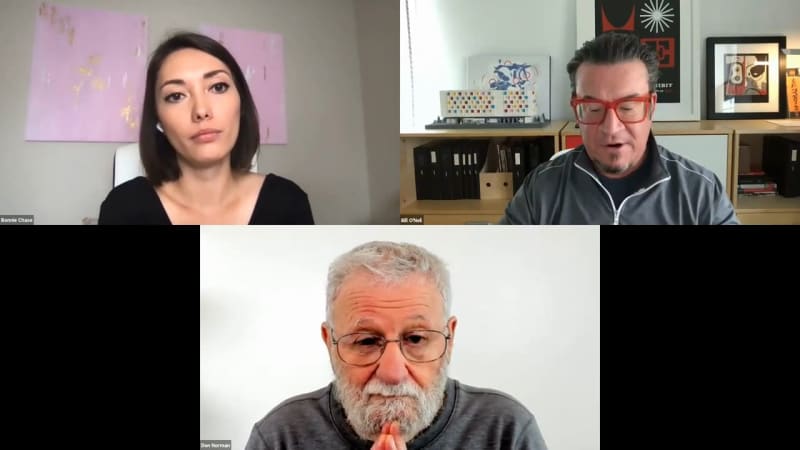
We're gonna give everyone a couple of more minutes before we get started. Hello, everyone. Thank you for joining our webinar today, the emotion of design. My name is Bonnie Chase, and I'm on the product marketing team here at Cloveo, and I'll be your host today. So I'm so excited, to be joined by today's guest. So, first, I want to welcome Dawn Norman. Dawn is a leader in the application of human centered design and the author of several books, including Design of Everyday Things and Emotional Design. So, Dawn, thank you for joining us today. Also joining us to facilitate this conversation is Bill O'Neil. And as strategist and design leader, Bill has helped shape hundreds of digital experiences, including websites, communities, and apps. Just to go over, the agenda for today, we're going to start out. I'll I'll be, kind of framing up the conversation and giving some context for for our discussion today. Then Bill will lead the the q and a with Don, and and then at the end, we'll take some audience questions. I will be monitoring the chat throughout the session. So if you have any questions that that come up during the discussion, feel free to enter them into the chat. I will either, bring them up into the conversation as relevant, or, you know, we can take the rest of the questions at the end of the call. Alright. So let's get started. The topic for today, is emotion and design. And, you know, I wanted to take a step back by looking at what has transpired over the last year and how that has impacted the way that, businesses have interacted with customers. You know, with COVID and, you know, people working from home, what businesses have found is that there is this need to, have a rapid digital transformation. So we've been seeing that, you know, for the past few years, companies have been wanting to provide their their services online, giving more engagement options for their customers. But, you know, with COVID, it was it was forced to really be, very rapid. And so when when undergoing a rapid transformation like that, it can be very easy for for companies to start thinking about how technology can help solve those problems. But today, we really wanted to take a step back and look at the human element that is often overlooked and which is emotion. Now what we've seen, you know, when when we look at the data, you know, there's a stat that forty one percent of companies make investments in digital transformation without the guidance of thorough customer research. And this isn't a surprise to me because what, you know, what I see, and and what Bill what Bill sees, you know, in in the work that he's doing is that these companies are are struggling now. So they they roll out all of these different technologies. You know, maybe there are multiple digital touch points that a customer will have to jump through to engage with that customer. And because that experience and that the emotions behind that weren't thought through, the the experience isn't that successful. So companies are struggling with adoption, customer engagement, and really that overall experience that, you know, that that's what should bring the customer coming back. We also see that consumers who have an emotional connection with a brand have a three hundred and six percent higher lifetime value. And this is really what that experience is about. Right? It's not just about being able to complete the task at hand, but it's in the way that we're completing it, you know, with ease, with delight. That's what keeps customers coming back for more. And so, really, you know, I'll I'll close my opening by with a quote by Don. You know, emotion is a necessary part of life affecting how you feel, how you behave, and how you think. And this is really why we we thought this conversation was important today. You know, as as we're we're undergoing this this change and and heading into the new normal, it's really important to make sure that we're taking this into consideration. So I'm going to stop sharing now. And, and, Bill, I'll hand over to you to go ahead and begin the discussion. Great. Thanks, Bonnie. And and, Don, it's just a pleasure to be with you today. I I interview a lot of designers, and, maybe it's no surprise that a lot of them bring up that your books or perhaps a speech you gave, was the the pivotal point in them in in in focusing on a design career. And it's really impressive. So I'm I'm thrilled to be talking with deal with you today. Okay. What I've always loved about your approach is how you kinda distill things down for us, helping us think about taking problems down and drilling down to the root cause or understanding why, everyday things is distilling down what the essence is that we prefer one thing versus another. So I and I'm I'm guessing that a lot of on the call are familiar with your work around human centric design, but I was wondering if you could explain for everyone what the emotion of design is. People often think that emotion is, you know, in the modern society, we're very logical and sensible and rational. We don't deal with emotion. Emotion is sort of a relic, they think, a relic of our, you know, genetic history. That's wrong. There are two different components of how we behave. One of them is emotion and the other is cognition. And, cognition is where we, we think it through. We have rational reasons. We etcetera, etcetera. Emotion is mostly subconscious, but cognition is sort of explaining, whereas emotion is judging. Emotion determines whether what you're doing is safe or dangerous, good or bad, and the two work hand in hand. And moreover, emotion usually trumps cognition. Emotion, first of all, there are multiple kinds of emotions, and we may get to that later on. I I for simplification for designers, I classify it as three levels. But and the but the first two levels are faster than the cognitive level. So your emotional state is narrow almost immediately. And, you decide whether you like something or not. And then quite often what the cognitive state does is makes up a rationalization for why you're liking what you like. How many times have you decided what it is you would like to buy? You've done a lot of research on, I don't know, refrigerator or an automobile or a new couch for your for your living room. And then you go into the store and you look around and you end up buying something completely different. Well, that's the emotional state. Quite often, you fall in love with something. You fall in love with the physical form or the the appearance or maybe, even how it works. You might sit on the couch and wow. Hey. This is really comfortable. Or you might try to use signal. You might drive the automobile. It drives so nicely, but in automobiles, actually, the outside appearance really, really matters a lot. It's amazing because it's really not important in many ways functionally. Cognitively, you can dismiss that. No. I'm I don't I hardly ever see the outside. I see the inside, but you fall in love with it. Fall in love. That's an emotion. So they're really important to consider. And when you're talking about customer experience, you're keeping a customer going. So let me give you an example, and then I'll turn it back to Bill. I I had this experience recently. We we my wife and I moved into a new home, and we were the first occupant to the home. And we we really loved it. We loved where we are. I'm sitting in it right now. But I woke up, and we spent the evening, and then I woke up in the morning to take my shower, and there was no hot water. And so I called up the, the, basically, the contractor who had worked on the home, and I said, there's no hot and I was really upset. But what happened afterwards was that the the the results were remarkable. Suddenly, about four people appeared on my door and, tried to fix the hot water. We have a new kind of hot water heater I've never heard of, and it's a heat pump, hot water. Heat pumps are often used for air conditioning and heating, but I've never heard of it for hot water. So it's a heat pump plus an electrical heater in case you need it. And it so it's fairly complex. And so they couldn't figure out the problem, and they kept working on it and working on it. And they they they offered me other homes I could go and use their shower if I wanted to. And they just and they kept calling. And all the time, they kept apologizing. And then at night, but I still didn't have hot water. At ten PM, their electrician showed up, and he was apologetic even though he didn't even work for the country. He was just called in. And he went in and did all sorts of measurements and, and said everything's right. Everything's correct. We don't understand it. And so what happened was the next day, they decided the only way to fix it was to replace it, and it would take a long time to get a replacement one. So they found another home that wasn't occupied, and they took the hot water either out of that home and put it into my home and installed it. Well, the point is this. The fact that I had a problem should have made me really annoyed, but the way in which they responded to it made me like them more than I could possibly imagine. And there is a marketing belief. It's not completely well backed up by data, but I believe it. If a customer buys you a product and it works perfectly and they're really happy, that's customer a. Customer b buys your product and it doesn't work, and they're unhappy. So they complain to you, the the either the store or the manufacturer, and you go out of your way to make them to compensate for the problem and to fix it for them. That's customer b. You test them later on. Customer b likes the product and likes the company better than customer a. So think about that. Is that rational? No. You should be like person who had no trouble should like it better. But that's what the power of emotion. Yeah. And we often see, you know, especially in, in support cases. So if if, if customers are submitting issues and tickets and engaging with support, they're they're more likely to, renew than a customer who's not engaging at all. So that's interesting. Well, let me talk about that. Already companies think of support as a cost center, and, therefore, they're doing their best to reduce the amount of time that the supporting staff spends with the customer. And oftentimes, they try to find the cheapest supporting staff. You go off to India or Indonesia or China or someplace where they can speak, well, English or in your case, Portuguese, and use often badly. And they have scripts that they follow, and they don't really know what's going on. But they're saying the company is saving money. No. The company is not saving money. First of all, quite often, the customer leaves not only unhappy, but without the problem resolved, so they call back again and again and again and again. And in fact, you could think of this as a positive opportunity to engage the customer, to make them happy. And while you're at it, you might even upsell. You might be able to get them to buy other stuff. And, if you take if you reverse it, you can change the entire, emotional interaction and their view of the company. And in fact, in the end, if you do the accounting properly, the service line is no longer a cost sync. It's a it's an income generator. The only problem is that the income might come a few months later, but it will lead to increased sales and increased satisfaction. I think that's a great point. We we've seen similar things with some of our clients is that, some of them may see it as a cost. There was one client that, we evaluated some of the folks on their support community and found out that the people that were registered only represented a small segment of their customers. They were scared that they were giving information away to competitors or whatever. And as we dug a little bit deeper, we found that their prospects were out there. The leads that they were already talking to were out there. Their partners were out there. And so the bulk of the people that were their their entire ecosystem, it wasn't just a support channel. It was everyone trying to get access to information, presales information, things like that. Just trying to learn about the brand before they made some decisions, and even in a an an empowerment tool for partners. So it's interesting to think beyond just it just doesn't serve one use case. It sort of serves a broad set of use cases. One of my important design principles is that everything is a system. And if you simply work on the one thing you've been assigned to, you're not gonna do a great job. To do a great job, you have to recognize all the other things that are impacted. Yeah. That's a great point. You know, one of the things I was thinking about before today was, you know, how much digital is all. You know, we've been you've been talking about the motion of design for a while. And and as I as I think about the early days of the web, you know, we were focused on things like visits. We were lucky to get hey. We got another visit on our website today, another hundred visits. And today, the complexity has really changed. You know, now we're focused more on engagement. People spend a big bulk of their day in some kind of digital experience, whether that's a branded community or a mobile app or a business web enabled business application. And I was wondering if if you thought about how this emotion of design changed, you know, with our more pervasive experience that we're having on the digital digital experience, is it is your thinking about the emotion of design changed at all? My thinking has not changed at all, but, the way it's being done today, is mostly wrong. And for example, you count how many hits or how many visits your website has. That's completely irrelevant. You wanna know how many people buy your stuff or or take advantage of whatever you're offering. That's what matters. And so, actually, you know, I was just I'm writing a new book, to talk about the way things have changed and the way I believe that we need to change ourselves. But one of them is has to do with measurement. There's this belief that if you can't measure it, you can't improve it. Well, that's that's probably true. But what do we measure? We almost never measure what really matters. We measure what's easy to measure instead of the real thing. So what's easy to measure is how many times how much clicks did people make or how many times did people visit. But what we really need to measure is, as you said, Bill, engagement. How happy were they? How satisfied were they? Are they going to come back? And more important, depending upon the nature of your business, are they going to purchase your services or your or your goods? And that last one is those first of all, engagement is hard to to measure. You can measure time, but that doesn't tell you. I might spend a half hour because I'm being frustrated, and I'm really annoyed because I can't find what I'm looking for. So how much time I've spent is not a good measure. But how do you get a good measure when you're a distance from a person? Look. I'm talking to, it says here, sixty eight people, and, actually, sixty five. It just double count the three of us, four of us. But how do I know what if they like what I'm saying? I get no feedback. I have no idea whether what I'm saying is the right thing for them. I might be saying wonderful things, but if it's not relevant to the audience, who cares? And I don't have any feedback on that. But so how do we measure what really matters? That's what's important. So what I believe in, I don't like questionnaires. I don't like surveys. I don't like focus groups because focus groups well, probably all of you know how biased they are. And the way I like to point out surveys and questionnaires is, how many times have you been happy with a questionnaire or survey you were sent? Do you trust your own answers? No. I don't trust my own answers because you asked me a question, and then none of the answers that you gave me as a choice were the ones that I believe in. So I couldn't I couldn't answer what I really thought. On top of that, what I think is not necessarily what I how I behave. Because what I think, I behave rationally and sensibly, etcetera. But, no, that's not actually how I behave. We've already mentioned that. So, what I believe in is is observation. And so that's why design researchers are trained in going in to watch real customers doing their everyday jobs. You might wanna spend a day with them because the first hour is doesn't count. Because the first hour, they're so sensitive that you're there watching and observing that they're not gonna behave normally. So you have to spend some time with them, and you don't ask them what they're doing. Just watch. Now what you can do is break periodically and then go back and ask them what they were thinking and what they were doing in that you observed. But if you ask them while they're doing it, they'll change what they're doing. So you have to watch and then come back. This is a way it's very qualitative. You're getting opinions. You're getting but you're getting trained investigators who are trying to record what happened, and it really helped if they video it the permission to video it so that the designers and the, actually, executives in the company can see the videos, sample videos, of what is really taking place. And it's amazing what you learn from that. It it's really interesting. I was I was thinking too a comment that Bonnie had earlier about customer support communities and and people coming into an inherently negative experience that they've got, a problem they've been trying to solve, a frustration that they have, and then they come in with this emotionally charged negativity into maybe a support question that are looking for support. How should we think about maybe approaching the the emotional design of something that already kinda starts off on a negative foot? Well, first of all, the designers, the engineers, executives ought to be required to spend considerable time listening to those support lines, observing and watching and listening. Understand what your customers are complaining about. It's amazing how many people don't do that. They let it to the service lines, and the service lines maybe writes a report. That's not the same as spending time listening to people. So when I worked at Apple, I did that. I went and I listened to the customers coming in over the support lines. And I went back and tried to tell the engineers what the issues were, and it was amazing that they didn't wanna go listen to the support lines and or their or their managers didn't wanna give them the time to spend a few hours every week to listen to support lines. And I it took me a big fight to convince people. And I was a vice president, but I still didn't have any power over the other divisions. It took a lot of a lot of time to get people to actually say that that's an important source of information. And, the the because there's another problem is that people tend to think that, oh, the people complaining are are there's something to matter with them. How come they can't use our product, or why are they having trouble? Well, it doesn't matter if there's something that matter with them. They're your customer. And and on top of that, most of the time, it isn't something that matter with them. It's something that matter with your product. So you you you have to in other words, to get this to work, not only do does the design community have to really get in touch with those customers and watch and observe, but so do the engineers and so do the executives and so do the salespeople and so do the marketing people. It it's it's funny. One of the the things sometimes I see with communities is they're designed really well. They they seem, very usable and, you know, intuitive and emotive experiences, but they're still have challenges that that you can tell that they they focus on designing the look and feel of things, but not the experience. An example I might give is you you come to a support community and you can see that there's a very frustrated or disgruntled, post front of the community because they're trying to show you some relevant content, what's what's latest from the buzz from the community, but there's no response to that. So that person's frustrated about their, product or support experience. You can see based on the post date that maybe it hasn't been, responded to in a day or maybe longer. And it reminds me of, you know, kind of your emotive stages that I get reflective. Is this the right place for me to be if this person's not getting a response? Is this the right brand for me if if they're letting somebody just kinda linger like this? And I think I've seen some other scenarios where there maybe is a post that says, sorry to hear you're having a problem. Please call me. My name is John. Here's my email or my phone. And that might make me feel a little bit better that that person got some resolution possibly, but it it's kind of a neutral state. And I think kinda to your point about the hot water heater, when I see a response where there's a thoughtful thread from, another peer in the community or customer support person that says, here's a couple different options for you to think through it. You know, really a longer dissertation on that and the invitation to contact them. You do more to provide confidence to other people that might see that post. It becomes content for the next customer that might have the same problem. It's it's more input for search engines that are looking for content like this, and this content could be relevant for, customer support representatives that need to have that kind of content too. So to think about the design is really thinking about the whole experience, not just the the look and feel and the usability of it, but what's the experience like for somebody visiting the site and the content they can they can find and discover? So there's nothing nothing I really can add to what you said because you said it perfectly. But I'll add but I will add one thing. What's really important is now that the that the people in the support line, first of all, show empathy and concern and go overboard to try to help everything you said. But now afterwards, they should make sure that whatever they discovered, it goes back into the company so the company can try to call try to fix the root cause so it doesn't happen again. It doesn't do much good if the same problem happens over and over and over again, and you have sympathetic, empathetic people trying to tell them what to do. No. No. That's also you should also then post saying, we have gone back to a whatever kind of company you have, you know, the manufacturers, the designers, the engineers, the support people. Who knows? And say, Ed, we've changed it, so this should never happen again. But if it does, please call me. Here's my direct contact. Outstanding. Yes. This makes me think too one of the the challenges sometimes we see is is in such a a fragmented customer service experience that you might have, phone service and online chat in the support community and forums and social media. It it's it's hard sometimes to think about the emotion of design across that cross channel experience. Have you seen any successful tactics and think about that holistic experience or ways to to help us as designers think about how we're integrating with some of those other channels? It's rare. It's rare. No. I don't think I I don't believe I've ever seen a response where it's clear they have consulted with other components of the company. But I will say that one of the companies that has pleased me the most is, believe it or not, Amazon. Now Amazon I have lots of friends who have worked for Amazon at many different levels, from high level executive to middle level people. They're not necessarily happy with Amazon as as an employee, but Amazon has always put the customer first. And I've had a number of of incredible experiences with them where, well, I had bought a Kindle, for example, for reading. And it was, I think, ten years old or something, and it wasn't working anymore. And it was way past its expiration date and then its, you know, warranty date, etcetera. But I just I just wrote them and told them what my problem was, wondering whether there was an easy way to fix it so it could keep working. And what they did was they just mailed me a new Kindle. What? I wasn't expecting that. I I I was fully expecting them to say, you know, it's ten years old. It's past its life cycle. And what's the problem that you mentioned is not one that's easily fixed. That's what I expected. I would have been happy with that response. But, no, they said, here's they just mailed me a new Kindle. And I've had other cases where Amazon just goes out of its way, and it doesn't matter if it costs them more money to do all of that. In fact, quite often, when I if if they send me something and I'm I don't remember what it was. We recently bought something, and it was a wrong thing. It was our fault. We shouldn't have ordered that one. We should have bought it a slightly different one. And we I went and sold them that, and they said, okay. We'll send you the right one. And then they said, don't bother to send the old one Barca. Because actually, they figured out that it cost them more money for me to send it back than it would be just for me to keep it or do whatever I want. Now that's dangerous because if people learn that Amazon always gives fixed consumption and gives you, you know, what it is you ask for, they're gonna play the system and people who who maybe never even bought the item will ask for it, etcetera, etcetera. But, nonetheless, for them, customer satisfaction with Amazon is very, very high. They're really quite good at that at keeping the customer happy. Now if only they can learn to keep their employees just as happy. I I like what you touched on with the idea of surprise and delight in the customer support experience and helping somebody resolve a problem to either oversolve it or provide something additional that was unexpected as a way to create that positive emotive experience that's memorable and create some brand preference for them. Some other things that I've seen is that, brands are trying to recognize you a little more cross channel. So when you call, they know it's me. It's Bill. Yes. It is. So I don't have to do some of that. So it feels like there's, a recognition across the different touch points. There's a bit of each channel has a specific task that, you know, online, I'm doing a certain thing, but maybe, on the phone support, it's it's for a different kind of use case so that there's that bit of channel specificity in there. But I I really like what you had to say about surprise and delight. It's one of the things I think is it sets a lot of brands apart, with their support experience. Surprise, delight, and personal contact that, so it's really good. When I deal with a company, I don't recognize the fact that a company has many different divisions. I assume that if I've talked to some, I talk to the company. I don't talk to a division. And so when I give the problem and so on, it's really annoying when they say, oh, I'm sorry, but I'm the wrong person to talk to. I'm gonna transfer you over to somebody else, and that somebody else has no idea why I'm there, and I have to start all over again. So but now today, our our lot of our digital systems make it possible for the entire interaction to be sent over to the person. And, by what happens in medicine too, I see is I see a physician who recommended me to a specialist, who gave me to another specialist, and each one starts over again. But for today, more and more of the electronic medical records make it possible so that even if I go to a completely different hospital, completely different hospital system, that specialist has, oh, my entire history. Well, that's what we need in in in the world of business as well. But you have to be careful. If, I've had this happen, and I go to Brazil as an arbitrary example. And I come Barca, and suddenly, I noticed my the advertisements whenever I go to a website to read the news, say, are all about things happening in Brazil and things I should buy or in my next trip or where I should stay. And wait a minute. Why are you invading my privacy? What you know, why are you doing that? So you have to be careful. You want relevant information. But when when suddenly it means that my presence was advertised to the world so everybody can come and attack me or ambush me, no. That isn't pleasant. I wanted to kind of add to to what you said. You know, you're you're talking about Amazon as an example and, and, you know, interacting with one brand. And, it just it just made me think, you know, when I when I'm shopping on Amazon or I'm interacting, interacting, I don't think about their departments. Amazon is Amazon. That's all it is. And then when you when you interact with them online, you know, whether you're on the website or the app, it feels like the same company. It's that same experience. And I think that's one of the things that that, that Bill, maybe you were you were kind of, alluding to, with your last question, which is, you know, we have these small moments. We have, you know, I'm designing the website or I'm designing the app. But then really thinking about what does that whole experience look like as a as a person transitions from one to the other and just keeping that, you know, the same brand, the same company, and and how important that is for that for that user, for that customer. In fact, Amazon's a good example because on their website, they they have this drop down menu and various things that let you choose which department you want to be in. How do I know? I wanna buy a new light for my video so that I'm in this I'm in in light, not in this not in the shade. Where do I look? Electronics, lights, living room? I don't know where I look. And but and most companies, if you don't choose the right division, you're screwed. You're not gonna find what you want even though the company has the perfect thing. With Amazon, it doesn't matter what where you said you you wanted to go or where you want to look. If you type in what you're looking for, they'll find it for you. And, I don't I'm not even sure what I put in those divisions because I don't need to use them. I it could say I'm looking for laundry products and but I really want a book. So I type in the name of the book and it there it is. So, Don, I was thinking about that a lot of the folks on the call today are are designers. And, I I'm sure that they they are probably excited to champion the the emotion of design in their work. But one of the pinch points that, you know, we all have is, you know, having enough time to think about design much less than the emotional facets of it. I I was curious. Do you have any ideas about how designers can articulate the business value of exploring the emotion of design in their work, to help kinda sell some of these more time through for for them. Well, what a coincidence. I just happened to look at the question and answer, and there it says, what suggestion would you have to convince the benefits of experience design and and to implement it holistically to a company who doesn't understand what I do? They're timely. And here's what I usually say when I'm asked that question. So how do you try to convince the people you work for about the value of what you do? And usually, what designers say, well, I tell them the kind of work I do, the kind of problems that customers are having, or the kind of issues that I see in the company and how I'm solving them. Or and I try to tell them the prizes we've won, and I try to tell them that wonderful letters of of, you know, congratulations or thanks that we get. And I respond by saying, well, that's interesting. That's nice. Who is your customer? And they'll tell me about the person in the store or the person who's using the stuff and so on. And I'll say, no. That's not your customer. The customer is your boss or, actually, the boss of your boss. So that's who you're doing your design for. Yeah. Yes. You want the person who who eventually ends up with the product or the service to be happy and etcetera. But your real customer is the person you're working for. And if you're working in a consultancy, well, it's your client. So your job is to get your client or your boss promoted. In other words, you need to understand the language of business. So what matters in your business? Well, let me tell you. I worked at Apple back in the years when we had the best computer system of anybody, and nobody was buying it. Everybody bought Windows. And it doesn't matter how good your product, how many prizes, how wonderful if no one is buying it. So why wasn't anybody buying it? Well, that's a long story and not for today, but it had to do with, well, different day unless Bill insists on following up. The, the in business, you're rewarded for being successful. If you're not making a profit, then it doesn't matter how good your company is because you're going out of business. And so you have to understand profitability. You have to understand balance sheets. You have to understand what it means to have what what does the word margin mean? You have to understand the economics of finance that, a dollar that you were you know, a dollar that you were in five years from now is not as valuable as about what you were in today. It's called present value of money. Basic finance. Very simple, but you have to learn it, and you have to appreciate it. You have to recognize what does it take to get your boss's boss promoted. That boss's boss has to show increased sales and increased profitability of the division. Or if it's a support division, which is in, as I said earlier, Barca cost sync, for that matter, so is design a cost sync. For that matter, so is engineering because none of these people are selling things. They're they're making it possible to sell. So they have to all justify what they're doing because they're helping the company succeed, and that's what you have to do. You have to learn to talk the language of your company. And where do you learn that? It's interesting. You don't learn it in design school, although you ought to. So you have to learn it by yourself. And the easiest way to learn it is make friends, let's say with your marketing friends. Because most marketing people get MBAs often, and the MBA is a degree that teaches you all of this. So have them tutor you. It isn't that hard. It's surprisingly it just it's a different mindset. That's all. But unless you understand where you are in the company, what your real role is in the company, you're not gonna convince anybody. Now one more thing. Quite often, designers have a have an idea to change the product, or they realize people are are complaining about the product. If and I here's what happens. If I've I've been an executive in a large company. When somebody comes to me and says, let me explain the wonderful things we're doing and the prizes we're doing, I say, yes. That's very nice. Yeah. I'm really pleased that you get all that. But, that's why we hired you, of course. But now thank you very much, but I have to get back to work. So second, if they come to me with a problem saying, well, here's a problem that we're hearing from all of our customers and our people using our stuff. I'm gonna say, I don't wanna hear about the problems. It's not because I'm not interested in them. It's not that I'm trying to close my eyes to the problems we have. What I want to hear is the solution. So don't come to your executives with the with the problems that you see out there. Come to them with what you can do to solve them. And one last thing. If you have a new idea for a product or even you have a possible solution to the problems you've seen, it's good to show them your examples, and it's good to show them pretty renderings and pictures and diagrams and whatever. But that's not what convinces them. What convinces them is a spreadsheet. You have to show an Excel or Google Sheet, anything, a spreadsheet that shows them, see, increased sales, see, decreased cost, see, increased profitability. And most designers say, oh, well, gee. How do I know what those numbers are? How do I know what the increased sales would be? And I say, well, let's talk about making a physical product. It's easier for this example, but it applies to everything. We know that lots of times Barca insists that you add this new feature to this product. And you'd say, no. No. No. That makes it harder to use, and marketing always wins. And why is it? Because marketing shows the spreadsheet to their bosses. They say, here's the increased sales and increased profits. And by the way, look. Here's what the competition is doing. Why don't you do that? Where does marketing get those numbers from? Well, they lie. They make it up. So can't you lie? Can't you make it up just as good as they can? And if you can't do it as good as they can, make friends with the marketing people. They'll help you. Because you're in theory, you're both on the same side. Marketing cares about sales. You care about satisfying the customers and what they need. Those are two different things, but they're both essential to the company. So you wanna be on the same side. So what it takes is to sell something is different. Sometimes you actually have to downplay some of the virtues of this product to make it more sellable, but accept that. It's important. So the point being, when marketing makes up these numbers, the executives, they know they're made up because they used to make them up too if they were being promoted. So but what they look at, they look and they say that there's no choice but to make them up. There's no way of getting evidence about what a new thing will do in sales. So they ask themselves, does this make sense? Do the assumptions that are being made here, are those reasonable? Do I do I believe that this is a reasonable guess about what might happen? So that's how you have to convince your audience. It's it's a very different way of thinking, but you have to take away your hat as a designer or an experienced, architect, whatever you are. Because, yes, that's what you were hired for. But what you have to do is demonstrate that what you're doing is gonna aid the entire company. And I like how you're calling in the the collaboration, Don, because you really can't do it alone. Right? And so one of as as you were talking, one of the things that I thought of, you know, as far as, you know, trying to see what's successful with customers in in a different context is, you know, one of the things that I do in marketing is is I'm talking to customers. I'm talking to prospects. And if you can, collaborate with with that person on your team who's doing that, we can we can ask those questions too. We can help, get some of that information because, you know, I'm I'm asking things like, well, what content did you see across your journey that was helpful to you? I mean, we can ask things about, you know, how did this impact, you know, your your buying decision and, you know, I think I think that's very possible. And so working working, you know, with another team member in the organization, I think, is a great way to to add to that. It's not only a great way. It's an essential way. Mhmm. You know, I blame the schools. We train people in all fields, by the way. The university is about the only place in the world where you have to do your work all by yourself. We train people to do their own thing, their own product design, their own essay, their own whatever, and then we test them on it. That's not how the world works. In fact, I I argue that if I'm asked to write a paper in a class and I don't know understand the topic, I should ask my friends if they can provide some material for me, and I should copy from the work they've done. And I should go find books and other stuff and copy. Look. If I'm working in a company and my boss says, what is this new kind of satisfaction index? I don't understand it. Would you write a short paper for me to explain it? And I have no idea what the person is talking about. Well, I'm not allowed to say, no. I can't write it. I have to go talk to my friends, and I copy. I take this. Oh, you wrote that description. That's wonderful. Can I have it? And this, that, and I put it all together. Now in the university, that's called cheating. But it's not cheating. It's not cheating if you give credit. But because it's not allowed to take from somebody else, we lie about it. We make believe we wrote it ourselves. No. I say, if you borrow somebody else's work, you should say, so and so wrote the following. You give them credit. And maybe if you get a high grade, they should get part of the high grade as well. Because because the real skill you have is not that I, in my own head, did this wonderful work. I found all these other people who were doing the wonderful work, and my skill was putting it together in a way that made sense and taught you something. Now in the company, it's the same thing. You are not you yourself are not the only person working on the problem. You usually have a team. But the problem is the team is almost always people from your own division, whereas the issues go across the company. So you must bring in and take advantage of all of the other experts and make it a multidisciplinary team. And when you do that, it's gonna be really hard because you're all gonna each each discipline thinks it's the top discipline, and the others should listen to it because everybody thinks whatever they do is the most important thing in the world or in the company, which is a good way to think because, otherwise, why would you be doing it if you didn't think it was so important? But you have to recognize there are different points of view, and you all have things to add and of value. So learning to work collaboratively and take advantage, just as Bonnie was saying, is critically important. Don, I realize our our our time is starting to run on. I I have, so many questions I'd I'd love to cover with you, but maybe a last one before we kinda open it up to some other audience questions. You know, COVID is on everybody's mind. Bonnie kinda talked about this in the beginning. There's been a big transition as as folks realize they need to be more digitally enabled to engage their stakeholders, their customers, their employees because we're all remote. What are some ways to emotion's playing a bigger role obviously today, in in all of our lives. It it it feels like the stakes are higher, I guess, when it comes to some of this stuff. What's your thoughts about how emotion design fits in today versus maybe in our recent past? And is there any considerations for navigating this? It's very interesting because we were all forced to go online, and it turned out that some things are better. We've learned how to do some things better. Look at this. You could get me to give a talk, and I didn't have to travel a great distance. And on top of that, for the, now fifty nine people listening, it's a more personal experience, I suspect, because they're they're seeing me straight ahead, you know, a big face. I'm is is if I'm talking directly to you, and I actually try to do that. I try I don't look at my face or or your face. I look right there at the camera. So it means I'm looking at you, and I'm speaking to you in the audience. So it's a more personal interaction. And, the kind of discussion we're having really wouldn't have been possible otherwise. And the fact that we have several people asking me questions, but, again, I assume your face pops up on the screen, and they they see it's personal. And when they ask a question, I'll be responding directly to them. And depending upon how you do it, I may even see them specifically ask me the question. So, that's one big thing. Second is that we've also learned to do better customer support and other things because of the use of digital techniques. Now some of the things we do are not nearly as good. You can't do networking. You can't go, you know, out to drink afterwards and become friendly and get to know a different side of the person, which causes an improvement in interaction. So it isn't that everything is better. Some things are worse. But I have a feeling that after this is all over, man, we're gonna maintain some of these new things. Wouldn't it be nice if the support line was like this? That when I called the support line, instead of a a an automatic system on the I'm not even allowed to talk to a person. I have to talk to a bot, and and it's really hard to get back to a person because the bot only has certain abilities and doesn't have them all. But and when I talk to the person, I don't see the person. But why can't we bring in a little bit of video like this where I'm actually talking to a real human being and it really feels like it? And the emotional state. Look. We have thirty seven, a whole bunch of muscles in the face, a lot of which its major purpose is to show my emotional state to you so you know how to react to me. And we miss that if we don't see the face. It's funny. The the video thing that you mentioned, Bank of America is doing the same thing in their lobby. So rather than having the staff there, you can go to a kiosk and have a video conversation like this. So I agree with you. There's some things that are going on today that might become a persistent part of of the future for us. And by the way, and nowadays, you won't even have to go to the bank because if they can do it in their kiosks, they could do it at your home. Right. Right. One of the things that's been persistent for me is kinda thinking about designing for better mental. Part of our mission is going to help people create, compete, and innovate in in new ways. And I just think today, in the current times that we're in, it's never been more essential to kinda think about that and how we're helping people move forward and become more fulfilled in their lives. Yep. Well, Bonnie, I'll turn it over to you. Do we have any, audience questions? Let's see here. I do have a question, for you, Don. So, you know, you mentioned that that you're you're you're writing a new book and and you're thinking about some of these other external things that we should be considering as designers. I I'd like to to know if you could share just a a what a few of those things are that we should be, that we need to start thinking of, especially today. Thinking about for what? What purpose? Just things beyond, like, external things, you know, sustainability, maybe ethics, you know, race and design. You know, what what do you think are some of those top things that we should be thinking about now? Yes. The list you gave is actually a very important list, a very difficult list. Each one of which is gonna, even an hour conversation, wouldn't be enough. I am very concerned about sustainability. And, one of the problems we're facing is, the world is not doesn't have infinite resources, and we're reaching a limit on some of the resources. And I have been in India, for example, where the city of Ahmedabad, there's a big trash pile that's burning continually. It's discarded electronics, and it it it just it wouldn't it the fire is spontaneous with the degrading of the components, and it emits poisonous fumes, and it's horrible. And it isn't just in Ahmedabad. This is this is true in many, many countries of the world. And why is that so? Why do we make things that can't be recycled, can't be reused? And one of the reasons is, well, gee, if I take a look at this phone, for example, this happens to be a a Google and, Pixel, but they're all very similar. You can't really tell them apart when you look at them. Look how thin it is. Isn't that nice? Well, yeah. But making it thin means you had to reduce the size of the components. You had to to squeeze everything in, and so we took the cover off the battery to make it thinner. And you can't open it up. It's really hard to open. It requires special tools to open it up. So if your battery goes bad, you have to buy a new one, a new phone. It's very expensive and difficult to replace the battery. And moreover, the battery life is limited. It barely lasts a day, if because it's so thin. If you made it as a little bit thicker, a few millimeters thicker, the battery life would be much extended. Battery life goes up as a square of the distance. And, second, it's got combination of materials. And when you take a material, let's just take something pleasant that's, you know, a nice piece of wood, but it has a nice piece of leather over it so it feels good. Well, leather could be recycled, wood could be recycled, but not the fusion of the two. You can't separate the two, and so that has to be thrown away. So so much of our material there's a cup, paper cup I've been raking coffee out of. I can't recycle it because it's plasticized. It has to be plasticized so this coffee doesn't sink in, but the plastic means that the paper can't be recycled. Why do we make so many things that are so difficult like that? Are we we are destroying the environment as a result? So that's one thing. And designers, as I said earlier oh, I didn't say to this audience. I said to you privately. People have blamed designers for that, but it's not the designer's fault because designers can only do what the company tells them they must do. So the designers have a responsibility, though, to educate, not only educate the company, but also to provide alternatives to what they are doing. Sustainability is real, and we are not doing a good job of taking care of it ourselves. The way we treat people is real. Racial imbalance. Race is an artificial concept. It doesn't really exist in the world. And quite often, skin color is used as a surrogate for race, but skin color isn't isn't doesn't change the person inside. But we use skin color, but it's easy to see. We can distinguish men from women so we can discriminate against men or men or against women or treat them differently. And now that that's also crazy. And this is a this is a really large social problem across the world that has to be changed. Indigenous people, you know, Columbus sailed the ocean from Spain to, oh, America, and a new uninhabited land that we can take over. It wasn't uninhabited. They had lots and lots of indigenous people living there with good, powerful societies. And but, they were called savages, and so savages aren't real people, so we can kill them or move them away or whatever. Or we can enter into agreements with them, but we didn't understand their culture. So in the United States, we reached agreements with the people who were inhabiting the land. Now Columbus thought he had discovered India, so that's why we called them Indians even though he didn't go even anywhere near India. But the Indians didn't didn't understand that people owned land. They thought people had hunting rights. So when they signed an agreement with the new settlers, the settlers thought you owned in the land, and nobody else could use it if you said it was yours. And the Indians thought they had the hunting rights, so nobody else could hunt there. But other people could use the land for other things. But what you got there, and this is typical, a complete lack of understanding. They each thought they were they were in legitimate, sensible negotiation, but they were talking about different things. That's another problem across the world is we lack a deep understanding of the cultures. So, yes, there are major issues that we really must address. By the way, back to customer satisfaction. That last issue is really critical. You need to understand the culture of your customers that even in a single country, you will have multiple cultures. And you one thing that's worse is when you're an international company and you think that what the way you design it from one set of cultures in your home country now applies all else. No. It doesn't. Now one of my takeaways from today, especially in the conversation that we have in advance of this, is just the changing role of designers to not focus so much on design, but become broader in understanding business and sustainability and ethics and being a facilitator of the design experience, not a black box of design to really bring other people into this to this process to create a better future for everyone. It's a system, and we're all in this together. And it doesn't work well unless we're all a team. Correct? Absolutely. I think we can take one more question. What do you think the major considerations are for emotional design as it pertains to AI and the intersection with human interaction? Well, as a former researcher in AI and what is today called good old fashioned AI, but not only that, but, in my office and next door to me in my laboratory, we invented the neural network, which is one of the really themes of today. And, one of my, one of my postdoctoral fellows not only helped him get the neural net, but he then went on later on to invent what's called deep learning. Actually, he didn't invent deep learning. I asked him. I said, so what is the real breakthrough that allowed deep learning? And he said nothing, except that today, computers are immensely somebody told me a trillion. I don't believe it. But a thousand to a million times more powerful than they were earlier. And that's what it said. But the problem is that AI is soulless. Doesn't know anything about emotions. Doesn't know anything about people. It simply knows it's basically pattern recognition. Machine learning is pattern recognition. And, it's soulless and emotionless and it makes errors because it's subject to the same biases as humans are except because it's done by a machine. We don't recognize any biases. So, we need to bring in the human side of the use of this technology. I don't wanna blame the technologists. They're doing a good job. But, I do blame the people who apply the technology and who overstate its power because it is powerful. It is wonderful. A good example is machine translation, which has become really quite good. It often misses the the point, doesn't fully understand, but it's remarkably good. And just a few years ago, it was remarkably bad. But it has to be just another tool that we engage as we put together our interactions, say, with our customers. And AI can be valuable, but that doesn't mean that you should always follow it or trust it. And it it's not that it's untrustworthy. It's that it's incomplete. It doesn't have a full it doesn't have any understanding. No understanding. It's pattern recognition. It recognizes its pattern and here's what I think. But that isn't understanding. So we have to recognize the longer story that goes along with this, but that's the major point. And then they're actually a big movement. A lot of people now do recognize the problems and the ailments and the evil, if you will, that AI is causing when it's used inappropriately. And so lots of people in the AI community itself, they're talking about humane AI and AI for the good and so on. Well, Certainly, we're seeing some of that in some of the platforms that we work with is they're becoming smarter platforms. And and some of the designs considerations that we're thinking about is making sure that we're con continuing to start with the user, not taking the technology feature and saying where can we apply this, but starting with the the users and what they're trying to accomplish and then seeing where maybe technology can lend a hand. It's important to know what to automate. We don't need to we can't take users out of feeling in control or involved in the experience by automating too many different things. I think we have to differentiate what's intelligent content and explain how machines think. Amazon does a little bit of that today by saying, here's some recommendations on how we provided these to you. That kind of transparency is really important if you're thinking about embedding that in your own solutions and provide the ability to give feedback. To Don's point, you know, this is this is machines are learning. And if we don't give them a chance to get some some feedback on that, they they can improve about it in the recommendations that they're providing. So those are some of the things that we've been thinking about as we're trying to bring solutions to life too. Yes. So, actually, giving rep giving recommendations, which a number of systems now do, is really excellent because it doesn't force yourself upon me. But it says you watch this movie. Well, here's one that people who like the kind of movies you like also like, and I can look at it and or or ignore it. Right. It doesn't thrust itself in my face. But here's another example that happened to me. I discovered it because I moved, so I'm putting up all my books. I discover I don't have a copy of my first major textbook, human information processing. And so I went and I searched, and I found a used bookstore that had a copy. Until I ordered it. Well, then lo and behold, I'm now getting all these letters from them saying, would you like to know more books by the author Donald Norman? Well, no. Thank you very much. I said I know them all. But that's that's what happens when you use artificial intelligence. It seems like a sensible thing. If I bought a book by by an author, and I've never bought one from that author before, then I must have really wanna see other books by that same author. But my name was on the on the order slip. They could have sort of checked. Yep. No. That's that's these are good examples, and I I love the discussion that that we had today. So thank you, Bill and Don. We are out of time, but really appreciate you taking the time to join us in this conversation. We'll follow-up with any remaining questions. And so thank you all for joining us, and have a good rest of your day. And thank you, everybody Everyone take your time. Staying with it. And thank you, Bill and Bonnie. Take care. Bye. Bye.
Emotion of Design: Designing an Experience People Will Love