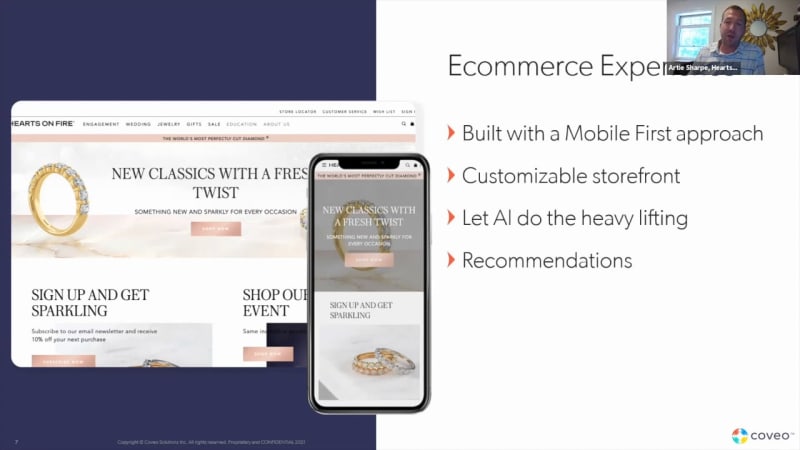
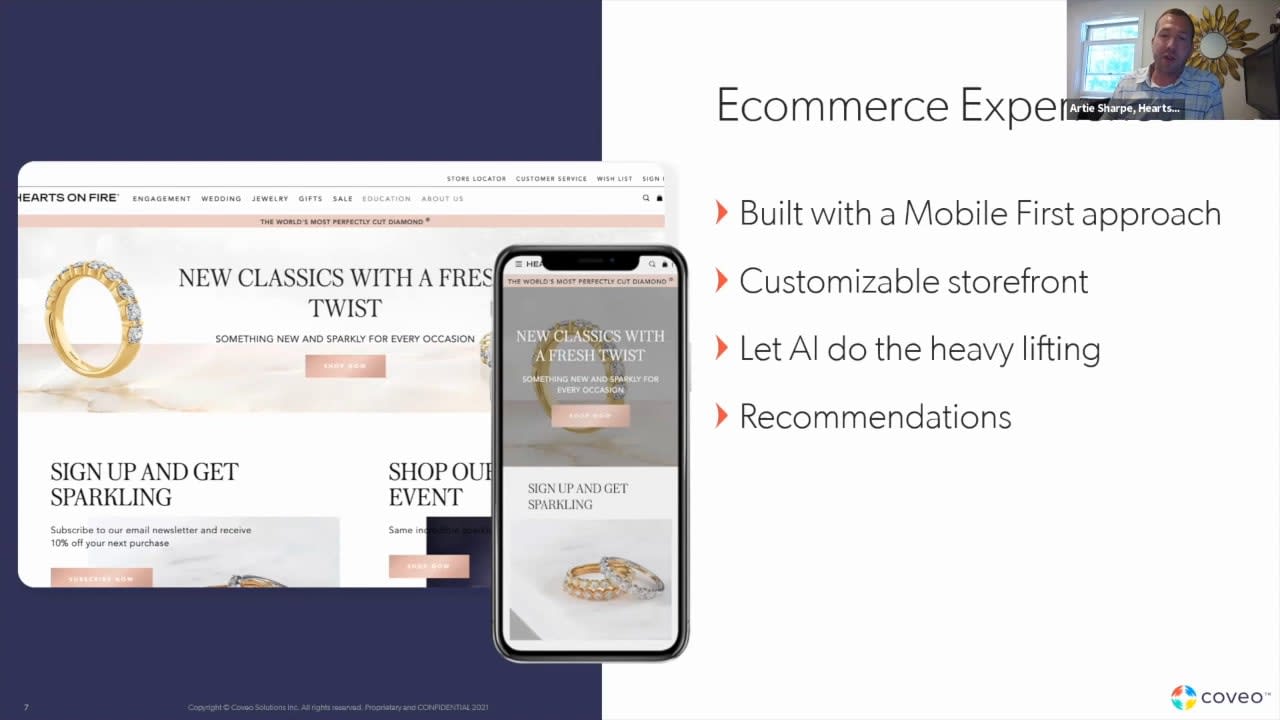
Hi, everyone. Thank you for joining us today on our webinar, creating engaging experiences that convert with hearts on fire. My name is Clara Boulanger, and I work in the marketing team here at Coveo. And I'm really excited to be a part of today's session. I want to introduce our speakers first. So we have Artie Sharp, who is the senior director of innovation and experience design at Hearts on Fire. We also have Shereen Reed, who is, director of product marketing here at Coveo. I have just a couple of housekeeping items to cover quickly before we get started. First, everyone is in the listen only mode. However, we do want to hear from you during, today's presentation. So please feel free to send your questions along using the q and a section on your screen. We also, get, asked if the webinar will be recorded. Yes. It will, and we'll make sure to send it to, everyone, as soon as it's available, probably within the the the next twenty four hours after the conclusion of the webinar. For those of you just joining us, welcome to our webinar, creating engaging experiences that convert with hearts on fire. I will now pass it over to Shareen. Shareen, thank you for being here today. Happy to be here with one of my favorite customers, Artie from Hearts on Fire. Don't tell the others I said that. So just to set the scene for Artie, I thought it would be interesting to highlight a single data point from a recent, Coveo research study that we conducted. We invited about two thousand people to share their thoughts about their online shopping experiences. And incredibly, or some of you may not be surprised, but what we found is that ninety percent said that they expect their online shopping experience experience. So if we take a moment to reflect on that, it's it's quite a high bar. And the reality is that, although some companies are able to meet those expectations, there are many others out there that are still struggling to catch up. So, many others out there that are still struggling to catch up. And Hearts on Fire, though, I believe, has done a great job in developing a compelling online experience, and it's very attuned to the way people want to discover and buy their products. So let's get into it with Arty, and tell us a little bit about Hearts on Fire because it's a great name, and I am always pleased to introduce you. It is a great name. I always joke that when I when I first started working here, people thought I was working for a dating service originally. But Hearts on Fire, Our claim to fame is that we are the world's most perfectly cut diamond, and that is, a trademark true statement. Every single one of our diamonds is cut to exact specifications, angles, and polished to a hundred times magnification. So they are just beautiful diamonds. They look bigger. They sparkle brighter. We always talk about our tables our our our our diamonds being ten table diamonds because when you're sitting at a restaurant, from ten tables away, you see that, that diamond sparkling. So I've been with the the organization for about fifteen years. And a few years ago, we were purchased by Cha Tai Fook, which is a Hong Kong based jeweler. They're actually the world's largest vertically integrated jeweler. So we are now a mine diamond mine to getting it on your finger operation. We have about two thousand points of sale around the world. Our b to b, b to c platforms are are are leading edge, and it's a global, network, that we're operating. Excellent. Thank you for that intro. I love that mind to finger. That's a good catchphrase. So nobody has a crystal ball already, but it seems like all you almost did. Because you you were actually ready to launch a new site when COVID hit last year. So what really triggered that investment for for you? Like, what made you think of doing this? Yeah. So we we saw a a universe of shoppers, a younger universe of shoppers that were starting to get an expectation of of online shopping and an experienced expectation. And, honestly, we were not meeting that expectation with our old site. The jewelry industry, can be a little bit behind sometimes when it comes to some of these technology initiatives. So we knew that we wanted to, build a brand new site from the ground up, very experiential focused. And, really, it's funny to try to mimic, that in store experience in a digital way. So we became laser focused on, product information, how people were gonna view that product, and how we could really get that bespoke experience, while they're basically sitting at home. So we we sat down. We met with customers. We talked to consumers. We went through a whole user experience project, and really focused on the strengths of our old site and what we needed to, to bring to the new site so that we could meet those expectations. And, really, it was focused around search, product information, and a tailored, personalized experience. Okay. Great. And you ended up actually launching was it last summer? Last summer. Yeah. The the new site experience. Okay. Great. So I think a lot of times, we also look to technology, right, as, kind of the the holy grail and what's going to solve all of our problems, but it's really important to have the right people too, right, with the right mandate aligned in the right way so that projects are successful. So it's not just about technology. And I know you at Hearts on Fire did some important shifts in the way your team were structured, and that really helps you, in progressing to where you are today, I'd I'd say. So can you quickly share just with the audience, how you realigned people? Yeah. This this is a great story because this is really part of the foundation of, of our company now and how we were operating. So we were structured like a lot of other companies. We had an IT department. We had a marketing department. I used to be the director of technology in the IT department and had responsibilities for email servers and ERP systems and phones. But we knew that if we weren't focused on that external customer experience, and this was for our end consumer and even our retail partners, that we weren't gonna be successful. So we formed a new team. Internally, we call it the IXD team, and this is the innovation and experience design team. And this is a a multidiscipline group that is totally focused on the external experience. So we don't have to worry about ERP upgrades or, sales orders, purchase orders. We are making sure that we are delivering a shopping experience, the information people we need, and also the latest technologies in place. So there's three main pillars to that team. We have our internal development side so that we can respond quickly to the business's needs when it comes to those external, projects. We have content management in there now because as our internal team is building things, we want them used properly, and we want our content team to make sure that they can leverage those components that are being built and those personalization scenarios that we're putting out there. And that it's not just something that a technology group is handing off to a marketing group and saying, good luck. Call us in a few weeks. Throw it over the fence. Pretty much throw it over the fence. It is a deeply, integrated, group. And then to keep all the trains on the track and keep things moving forward, we have project management in there, to make sure that everything is running because we're a fully integrated business. That means everything from the front end all the way down to the back end is gotta be automated. So, obviously, there's a lot of moving parts there. There's a lot of departments that have to be coordinated, different technology groups within the company now that now we're the external facing one. We wanna make sure the internal IT team is is part of what we're doing. So we had to have that in place to keep everything on on track. So we're this small kind of agile team. We often joke that we're like the seal team out ahead of the aircraft carrier, so that we can move quickly, we can adjust fast, and we can be very flexible. So this was something that we we formed and has been very successful. It's become an integrated part of our business. We're so closely part of the business now that, you know, we're meeting with customers all day long and and talking to them and figuring out what needs to happen next, and the developers are part of that. And everybody is kind of part of this the seamless, flow that we have. Great. And your priorities are on the customer, so that doesn't change. Very much on the customer. And there's an interesting bullet here too around, you know, we have digital merchandising because that's that's that's something that, you know, is part of that experience, products and how they're showcased. You know? We don't have a store window or a, a jewelry case, that we can merchandise. And we kind of started off with the idea of, like, okay. We need somebody who's gonna help us kind of align the products that we need to have there. But over time, we really leverage the power of AI and machine learning and the models to enhance that experience because we can do the basics. We can we can define, you know, here are the here are the the the rules around that. So so some margin goods that we might wanna put out, some sale goods or different collections. But the second somebody goes and performs a search or clicks a button, they kinda blow that all out of the water because they're bringing up the products related to that search. So we wanted to make sure that we are bringing the most relevant information to do that. And using AI and machine learning, that's how we're doing that. We're looking at behavior and conversion, and that is now helping us digitally merchandise. And that is a that is a key piece of creating that that digital intimacy, that that trust when people are shopping because no one's getting lost. They're bringing the information is being brought to them. Okay. Great. And I have a just a a quick screenshot here of the product detail page before and after and how you really streamline the experience and made it more, beautiful and intuitive. Yeah. I I call that one on the the left there, the refrigerator door, because it just feels like things were just stuck to it. And, it was a lot of information for SEO back in the day and just not a not a clean experience. So and then our new one, we came highly focused on imagery, product information, and just ease of use when it came to figuring out exactly what you wanted. Great. Okay. So tell us a little bit about your digital storefront today, and what are some of the important elements that you wanna call out here? Yeah. I mean, the bit the first bullet is a big one for us. So we started with a mobile first approach. Eighty percent of our traffic, comes or starts on a mobile device, so it's huge for us. So making sure that our products, both was easy to find through the navigation elements and the the buttons, but also looked beautiful. You know, this is this is a smaller device, that we wanna feature these beautiful high end, products on there. So we started from the the phone, and and we've worked out. And we're always kind of watching the behavior and seeing what people are doing to see what we need to, to to tweak. We do a lot of AB testing, and personalization scenarios to make sure that that experience is a is a great experience on the phone as much as it is on the, the desktop. Also, it's gotta be very customizable. We have very different shoppers. You know, we have people that are coming in for that engagement ring. We have people that are coming back for anniversaries. We have gift shoppers, fashion shoppers, you know, certain collections that, or or designers that they look for. So it makes no sense if you keep coming back to our site, for us to keep showing you something that you're not looking for. Like, if you're not an engagement shopper, we're not gonna feature engagement rings on your on your home page. Or as you move through the site and we figure out that you're really looking for a gift, we wanna make sure that we are bringing content to you that is gift centric, making sure you're aware that you can gift with confidence when it comes to warranties and returns. So the site is constantly morphing and changing, to support those those different areas. So we wanted to make sure as we built that that everything that we do and everything that we build, we keep that in the back of our mind that this is something that we might wanna personalize or customize or deliver somewhere else on on the site. So there's a lot of that happening. And then AI. AI is a big part of what we're doing. We're really letting that do all of the the heavy lifting for us. Search, obviously, is a massive part of that website, but we don't want it to feel like your standard ecommerce search. We want you to have an experience. We want it to be beautiful, and we want you to find what you're looking for in an easy way. And that is just not humanly possible at scale unless you bring in machine learning and the models that we have and the, the interactions that we're building around that. We're also using that for recommendations across the site. You know, this this is such a, the jewelry jewelry is such a a personal, purchase. You know? Everybody has different tastes and, and and different thoughts around products. See, it's funny. We don't have reviews on our site because people don't wanna review their jewelry. They love it. They they they they don't wanna hear anything bad about other people's jewelry. So, and the same thing kinda comes with the recommendations. It's very hard for us to tailor recommendations, because of people's taste taste and what they might be looking for. But if we start to see people looking at the same things and look alike shoppers, we can use the AI to bring recommendations of those people together, and then we get that very tailored experience. So people are seeing the pendant that will look beautiful with those earrings, alongside of it and being rec recommended for them. So we're not doing that manually. It would be almost impossible with our small agile team, but with AI and machine learning where it's a lot easier to accomplish that. So, interestingly, I I don't think you even have any digital merchandisers. Right? We have today, we don't have any digital merchandisers anymore. We have content people that are, you know, helping put that together, but no one is moving product around on the site anymore. You know, the the content goes in, the products go in with certain information, the rules have already been set up, and then that product is surfaced either based on behavior, or scenarios that we've set up along the way. But there's no back in the day, I think things were just moved to the top of the stack or boosted. That's that's not happening anymore. That's all just the machine learning doing that for us. And we're seeing incredible results from that. I mean, people, talk about our product being a lot easier to find nowadays. Our our customers and our stores that are reselling to end consumers think the experience is so much better because people are walking in able to have shown them things that they found online easily, and they can easily get to it. And it was not as intuitive, in the past. So we're we're we're seeing really, really great stuff with that. Yeah. Because you would think jewelry is one of those experiences where when you go into the store, it's very customized to you because the salesperson's dedicated to you, and they're gonna take you on that journey in the store depending on what, you know, what you're saying you're looking for, what answers to certain questions. So you kind of have to almost mimic that intuitive salesperson online, which is very difficult. Right. Yeah. It it really comes back. You know, in the past, people went to their local jeweler, and you sat down at a desk. They had a bright bright light over you, and there was a tray. And you went back and forth on that tray and looked at different product. And the knowledge of that jeweler may bring other pieces from the store in. And our role as as digital, merchandisers is to to to mimic that and to try to recreate that experience, you know, and using technology. So, yeah, it's it's it's very much a, a personal experience with a digital connection. There you go. Okay. And, also, of course, search is at center of this search and navigation. It plays a big part. So you wanna touch on a couple of things here? Yeah. So this kinda goes into what I was talking about with with people sitting down at the store. You know, we talked to a lot of customers and consumers on their experiences, and we wanted to make sure that we could we could mimic that, if not improve upon it. So, you know, people walk in with kind of a mindset of what they're looking for. Some people walk in with a magazine picture or, you know, their girlfriend picks something out and they've got some ideas. And there's some very early questions that are asked. You know? Are you looking for an engagement ring? Are you looking for a band? What metal types are you looking for? What's the the the shape of the diamond that you're looking for? And we were able to do, this using the search facets that we have down the side of our product pages. Yep. And the beautiful part about this is that as you interact with them on our site, they're dynamic. So they're constantly changing and and morphing and narrowing down to help you serve that product, back up for you. And you can always pull back out using the filters at the top and then the breadcrumbs. But that really creates what, that never a zero results scenario that we're we're looking for. They're never getting into a dead end because they're picking from the options that are, presented to them. So we, like so we really modeled that on that in person experience, you know, thinking of that jeweler across from the table that you could kind of tailor down exactly what you're looking for. We've enhanced it now so that as you're choosing your metal types, the photography is changing to reflect that. We're tracking that now in the background so that we know that you're a yellow gold shopper so we can deliver experiences around yellow gold. But really, our the the biggest thing for us is to build trust. You're about to spend a significant amount of money here on a a purchase. This is not a car because you're gonna keep this for the rest of your life most likely. You're gonna pass this possibly on to your children. This is a significant purchase. So we want to build trust around this, and we want you to feel very comfortable doing that. So by presenting you with rich photography, easy search options, make you never feel like you're lost, and also not overwhelmed. If we threw a thousand products on the screen at you, you're gonna run screaming. So by delivering, you know, a very narrow set and then being able to morph around within that set, you're gonna have a better experience, and you're most likely to convert at that point and become, a a hearts on fire advocate. Absolutely. I'm one of those shoppers that get overwhelmed when you throw too much at me. Yes. Absolutely. Alright. Love this slide. Yeah. So exciting climax to the story is, of course, that what results are you seeing, what's the data telling you, and what, you know, what what have you been, seeing with all of this? Yeah. So, I mean, I think the results speak for themselves. This is a year over year comparison, of our of our site traffic, and, you know, everything is up here. We saw increased conversion rate, increased transaction, increased revenue, our average order value up, unique purchases up. And then the things that we wanted to go down went down. So our bounce rate went down. And that really speaks to the thoughtfulness of our UX and our design that people weren't hitting the home page and leaving, or they weren't hitting a product listing page from a search and leaving. They were going deeper into the site, and and finding things that they needed to. And that was really kinda goes back to that experience that I talk about about, you know, as you can tailor down, find what you're looking for, you will check out, and you're not gonna leave the site immediately. I think the average time on page is interesting. It went up a little bit, and I I like this metric because, this shows us that we're probably putting the right amount of information on the on the page for you. You know, it's there there's we show beautiful imagery, but some people wanna know measurements. They wanna know the width of the band. They wanna know, the exact count of the diamonds around all of that. And we're delivering that, to the pages that we have that feature these products because although we wanna be high end, beautiful, a beautiful brand online, we also wanna make sure you know exactly what you're getting. So walking that balance means that you might spend just slightly more time on the page, but since you're so you're still converting, that's that's a great thing, for us. We've also seen more people spending more time on the site. You know, as they're going deeper, they're enjoying their experience. They're moving around between our education areas and back into the search and really kind of finding their their path, through the site. And we've also seen a reduction in, in our call center. You know, we have, we call them perfection stylists that are available by chat. And in our old website, they had to answer a lot of questions. A lot of the stuff that I just talked about, number of diamonds, quality of the metal, what's in it, that is now, been very reduced because that all exists on the page. And even when it's starting to, still happen, we're actually serving up a lot of that using AI now too in the chat and answering a lot of those those questions. So we're making our perfection stylists very efficient. So when that sale comes in that really does need the assistance that they need to help close, they're available, and they're able to do that. So great results all around. Since we last ran these with the they it continues to grow, which is great. And we have a lot of, projects planned and exciting new things coming down that I think will only I don't know if we'll top this year over year, but it'll continue to to continue growing. Yeah. It'll continue to optimize. Right? That's what it's about looking at the data that is there. Great. I know we're running short of time, so I'm just gonna ask you that you had some takeaways prepared. So pick two and and tell us you know, give us some advice on, given all of your project experience that you've had now. Yeah. So we talked a lot about AI, and, obviously, that's very important, but a big piece of that is data. Right? So kind of looking at your data holistically and making sure that you have the information that people are looking for, and you're delivering it to them. I can't tell you how much data probably sits in ERP systems that never makes it out to the end consumer. That is valuable. So you wanna make sure that you have that holistic picture of everything that you can, deliver to the customer, and then you might also be able to personalize around. I mentioned, you know, we look at things like yellow gold. That's a piece of data that we can personalize on. So having that holistic picture is, is very important. Team of experts, you gotta have them. You know, there are people that are doing smart, doing search that are much smarter than we are. That's why we have our partners at Coveo to help us, with that. You know, we have our internal development team, and we've got external development partners that help us continue to grow and evolve, this this platform. And then the future is all about personalization. You know, that that is really the expectation now is that you are delivering a personalized experience, whether that is personalized content or personalized search results. If you're looking at everybody with the same slate, you're not going anywhere. So making sure that you have a strategy and then also a way to execute on that is is key to any digital success now. Thanks so much, Ardi. This was such a great story, in just twenty minutes. Unfortunately, this was all the time that we had. We did get some questions, and we'll make sure to follow-up with every, everyone and answer your questions. As a reminder, this webinar was recorded, and we'll be, sending it over via email within, twenty four hours. I want to thank everyone for being here today. Thank you, Artie and Shareen as well for such a great presentation, and, I'll wish everyone just a great rest of day. Thank you.