
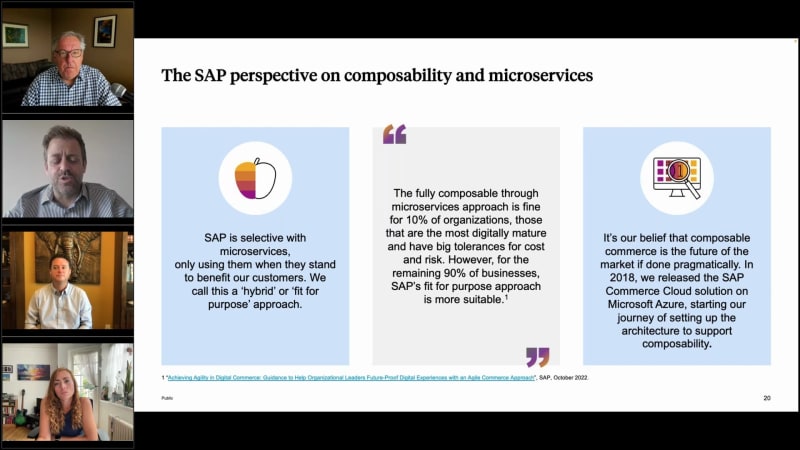
morning. Good afternoon. Thank you for joining us today. To discuss how the SAP commerce to send extension can work for your business. I'm joined today with, tremendous a group of panelists, and and we'll dive in here shortly. But really what I wanted to start with was to to talk about how we will leverage that in, in today's conversation. So before we jump into straight into the extension and how that's leveraged, to amplify and speed up a composable landscape within your ecosystem. We wanted to set a foundation, across all of the parties that have been brought together by this So we'll we'll dive in and start a little bit first on how AI powered search and personalization, can impact your your digital ecosystem and transition into what a headless CMS can do for omnichannel enablement to discuss that composable landscape and the perspective there. And then we'll wrap up really diving into the extension itself and and how that been architected, to scale with your organization. Just a few logistical items before we get started, Today's session is being recorded, so there will be follow on. And at any point in time, there is a question, section within GoTowebinar here. Please feel free to drop your questions. At the end, we will have a q and a time with all of our panelists to kind of help drive anything that you have immediately that we can help, resolve on today's call. My name is Liz Dougan. I'm the EVP of Strategic Consulting here at Smith. As I said, I'm thrilled to have you all here today. I'm joined by a tremendous group, with Lisa Coveo, Jim, a contentful riyadh SAP, and then, our very own Ryan here at Smith as well. So what I'd like to do foundationally, is just to talk about why we wanted to bring this together and and how this really got teed up. I think within the ecosystem and landscape, there's a lot of confusion that's occurring, across, organizations and how do you even start to broach, composable landscape, not ignoring the existing tech investments that you have today, and those lines keep getting more and more blurred, making it harder for business stakeholders like yourself to figure out the right solution at the right time and the right need. So, here at Smith, one of the ways we've been doing that is through kind of our our three philosophies. Incremental is key. So as we look at this and how we start to drive things forward, how do we do that? Over time, setting you up for long term success focused around business value. The next is focusing in on the features, not the enabling technologies. What is it that we need to solve as we go through that road map? And then allow the rest to enable through, the pieces and parts based off of what's gonna drive the most value soonerest for your business so that it becomes almost a self funding mechanism either through operational gains or even just increased conversion. And with these blurred lines, it's very important that you make sure you're picking the right tools within the right intent system as you go through that. And I think this is a good frame up before we start diving in and talking about the solutions, within the landscape. And really how we wanna start to to drive that moving forward. So with that, I'm pleased to, turn things over and get started here with, Lisa kicking things off from Coveo. Excellent. Thank you very much, Liz. Hi, everyone. My name is Lisa Greyston. I handle product strategy for SAP with Incoville. Thank you for having me. It's a pleasure to be here. Let's get started. COvero, you might have heard of us, hopefully. We are a publicly traded enterprise software as a service company. We're focused on, but also very passionate about applied AI simply put. We are a single AI platform that can power both external customer facing, as well as internal sales and customer support experiences. We have over six hundred software as a service subscription customers around the world. We work with more than one hundred fifty strategic partners and integrations and We have been consistently recognized that leaders, in Gartner's Magic Quadrant forrester Wave, where, cognitive surgeon, even infotech customer survey. On top of that, we also have the amazing pleasure to be an SAP endorsed partner. So looking at the typical commerce challenges that we're seeing, we're talking about customers commerce customers, interesting enough across both B2D as well as B2C companies, businesses, We consistently see and address challenges such as businesses struggling with complex and large catalogs and product information We see bit to b to b businesses in particular struggling with specific customer pricing as well as the need for restriction within those, those pricings. And we surprisingly still see a lack of, well, proper one to one personalization capabilities We see trends such as heavy reliance on rules, manual rules, in particular, which prevent businesses from being truly agile truly adaptable, especially in conditions and market conditions, and competition conditions that we see nowadays. Search trends, search tends to be quite hard to use still. It's cumbersome to set up even with the very lengthy implementation processes on on legacy and and adjustments on legacy solutions, we still see that the vast majority of our customers struggle with high maintenance from business users going, running ongoing. And in return, that obviously makes it hard for buyers to actually easily and accurately find the desired products. Therefore visibility into long tail, or profitable products is very limited, and even transparency over local inventory poses huge challenges to companies, obviously impacting the entire overall business. So people discover products in different ways, but Initially, they can generally be largely split into two main groups of shoppers. There's the part of, there's a segment of shoppers that are browsing. They need guidance. They need, recommendations tailored to them individually. They also need help with inspiring discovery. And then there's at the opposite spectrum. You have the shoppers or the buyers that know exactly what they want. They just want to get there fast, and they want to get there accurately. They don't want any not delays in the middle. Now our AI platform is able to support indicator for across the entire spectrum, support all types of shoppers, delivering best in class search and complete product discovery experience, including our catalog index optimized for e commerce search, with functionalities such as ML powered content and product recommendations and dynamic navigation powered by machine learning to suggest, boost, and reorder filters automatically, and in real time. In session, all are built to handle both B2C as well as B2B complexity at scale. We therefore make products easier to discover which is, I'm sure you'll appreciate the number one reason why customers actually leave a site. We also inspire and guide shoppers to purchase the recommendations, with recommendations, and the right personization. Therefore, we solve the choice and the bounce issues. And we also are my merchandisers with so much needed intuitive tools and customer and products insights so that they can adjust their business needs, and they can respond quickly and tailor it for their specific requirements. Therefore, connecting search to all this navigation and to and recommendation from machine learning actually improves the relevance of the customer's experience across the board. Looking at one of our customers, at a customer success story, I'm sure that most of us are familiar with Ansel. They're one of the top leaders in synthetic lubricant technology, also an SAP Commerce Cloud customer. Now Amsoil chose our platform to improve search relevance and boost conversions. Those were their two main targets. They faced typical challenges that we see in the market today for a lot of businesses such as pressure to cut costs to increase efficiency. They also struggled quite a bit with the legacy solutions they had and the lack of machine learning to aid customers through their discovery journey on the right products. We help them replace their search technology and leverage machine learning and process to provide superior customer experiences which resulted in an increase in conversion rate of fifty percent, and two point seven increase percent in average order value and that drove two million revenue, in in in monthly revenue, sorry, increase in monthly revenue. So then how do we actually do this? Well, surprisingly, unsurprisingly enough. We have a few tricks, but to stay relevant on the today's topic, We are all about relevance with Covayo. You'll find that. There is a winning formula. So that formula is our platform is flexible. Is secure, has a very strong focus on composable API first and microservices approach, We handle multi region, hosting. We handle, data res residency multi region data residency as well. We are highly scalable, high availability, and also elastic to the month. We have our own Kuvo headless. Headless library. And, this is used for developing COVID UI components, and it works as a middle layer for applications. Opening a line of communication in between the UI elements and all the other all the all the convo solutions that we provide. We also use atomic library, which is a collection of pre built UI components, which is used to create versatile search interfaces, tailored to every single need of our customer. And to sum up, our cloud cloud platform is built in such a way that it enables customers and businesses to be able to achieve the right solution, the right formula they need for their business, not the best in the best in breed, the solution they can find out there, but the actual best solution that they can they need. To address their industry and market needs at the same time while also future proofing their businesses in the long term. That was it from my side. Thank you very much for listening, and Jim, over to you. Okay. Great. Thank you, very much, Lisa. Hi, everyone. Thanks for joining us today. I'm Jim Amber, a solutions strategist at Contenfell based in Palo Alto, California. I'll give you a short overview of how we can help you as an SAP Commerce Cloud customer. And Let's see if I can advance these slides and go to webinar. Okay. There we go. Alright. Okay. So let me tell you how a contentful got started. Okay? It's, two thousand thirteen, our founders, Rimberlin, and they were building native mobile apps. And they were trying to tie a content management system to power the content to these mobile apps. But There was a basic problem. And that is that every single content management system ten years ago was built for a single purpose. To build HTML pages that get rendered in a web browser. And the problem is that that didn't work for native mobile apps And for the same reason, it would not work for, extended reality or virtual reality devices or digital kiosk and store fronts. Or the conversational interfaces that Amazon was building at the time. So they did something new. They created a new type of CMS where the content is stored and managed separately from this presentation. And today, we call this a headless CMS. So by decoupling the the back end content management from the front end presentation, we created have a new category of, CMS's. And the thing is that by doing this, What this allowed is not only could we power, native mobile apps, but basically any type of device, any type of channel. So the idea is that you would create content once and that content could be used, anywhere. And by doing that, you know, in terms of this this new kind of approach, since the front end presentation layer is not tightly coupled with the CMS, This gives your developers a lot of freedom. K? They can choose any technology, any framework, any programming language for building the user interface, and that results in rapid development. So there's really kind of three key things to remember about contentful. You know, one is that we want to be the a single content creation hub for all of your content within your enterprise. And when you create content and you publish it, that content can be published to any type of device, any type of channel, not just, a, a page in a in a web browser. But through there's one challenge here, okay, for all of our customers, you know, beyond just kinda creating content, wanna translate that content into multiple languages. They wanna, perhaps, use some kind of digital asset management system. As Lisa just mentioned, they wanna do personalization, analytics, AB testing, and on. The thing is that, you know, no single, vendor can possibly do this. You know, the average enterprise today is powering their website with over one hundred Martech and AdTech apps. So how can a single vendor do this well if they can't? So that's why we created something that we call the app framework. And with the app framework, it's open source. What we've developed is we've we've made it now very easy to extend the contentful web app. So you can do translation to different languages. You can access a jam. You can do personalization. You can do AB testing by integrating with other API based services. And we had we now have a marketplace of over eighty prebuilt integrations with those kinds of SaaS services such that it's, you know, a two minute install. You find a kind of application you wanna integrate with, You click install, plug in a API API access token, and in two minutes you're up and running. And the latest addition to our app marketplace, is the SAP con connector for, SAP Commerce Cloud for contentful, meaning that you can browse and search for your products and your SAP Commerce Cloud product catalog, and then insert references to them, you know, inside of contentful. Now, how does this apply to e commerce? Okay. Contentful has a ton of e commerce customers. And when they come to us, they're all really kinda saying the same thing. You know, one is that it's no longer, okay to have a e commerce site that simply rows and columns of thumbnails of images. You've got to seamlessly integrate editorial content with your commerce content. You know, secondly, you just heard about this from Caveo. You know, Netflix discovered a few years ago that they have about twenty seconds to grab someone's attention, to find a show that they wanna see, before they move off the site. Okay. Twenty seconds. And what they did is they invested tens of millions dollars in a recommendation engine, which they claim is saving them over a billion dollars of churn. Per year by people finding, at this point, eighty percent of the content that they view is coming from the recommendation engine. So with e commerce, I think you have less than twenty seconds to grab someone's attention. It's no longer a nice to have. You have to have a personalized, experience for your your users. In terms of performance, you lose seven ten percent conversion with every additional second of page load time. Okay. It's huge. So you have to have it blazingly fast site, if you're an e commerce site. Now many of our customers are using, static site generators, you know, these kinds of new job script frameworks, where they can statically build every page of their site, automatically push it out to a CDN. There's other kinds of optimizations, and you can't possibly have a faster site than that kind of approach. Now that also gives you, like, really good scalability. Right? If you're pre building all of your pages and they're on a CDN, well, you don't have to worry about, you know, use spikes and traffic. Now with contentful, there it you're not dealing with, servers, okay, with traditional content management systems. Even if they're in the cloud, typically, you're dealing with load balancers, web servers, database servers. And if you have a spike of, say, twenty x in traffic on Black Friday, you need twenty x amount of hardware to support that. We're auto scaling. Okay? Or infrastructure is it's cloud native. We can absorb any kind of degree of, you know, spike in traffic without any kind of need to, provision new hardware. The majority of internet consumption today is being done on mobile devices. No longer be done on laptops and browsers and so on. So you've got to basically have a really great kind of mobile service optimization One way that we help out doing that at Contenfell is with our images API. You can upload a a single high resolution image, say a PNG And contentful will automatically convert that image if the person's browser supports it to modern image formats like, webp and AVIF. And that will reduce your, image sizes by two to three x, directly improving the performance of your site. Now, you know, beyond just mobile first delivery, we have customers like IKEA that are delivering, making available to their customers augmented reality applications so people can see what IKEA furniture looks like inside their home, you know, with their, with their smartphone. We have customers like Bang and Olsen that are extending the online shopping experience with the in store shopping experience. Where they're pairing digital kiosk and stores where the content's coming from contentful. So omnichannel delivery is essential today. It's it's way beyond the browser on a PC. And then finally, by doing all this, you know, the name of the game here is enabling your merchandisers to spin up, like, new personalized landing pages not in two weeks. But an hour or two. And by doing that and by doing that, where where they don't require developer resources, that frees up your developers to kind of focus on creating better experiences for your users. So let me, wrap this up, talk about just kinda two, showcase commerce customers we have first is Pankton Olson. Okay. When they first came to us, they actually had two separate sites. They had a a site for, editorial content a marketing site, and then they had a e commerce site. This was the polar opposite of a seamless blend of, editorial content in commerce. They're actually two separate sites. So when they, moved on to contentful, instead of talking about it, I'd say just go there. Just go, you know, bang dash olsen dot com. It's a fantastic site. Okay. It's inspirational in terms. You don't feel like you're on a e commerce site. It's fantastic. And it it has been inspirational. It's a very high end luxury electronics brand. They're selling sound bars for seven thousand dollars a piece. It better be a pretty inspirational experience when you're on their website. And, you know, next one of my favorite customers is actually ruggable. Let's see. Do we have a chat here? Any of you have pets? You've probably heard of ruggable. Probably many of you probably own a ruggable rut. Okay? They make machine washable ruts. K. When ruggable came to us, they had a lot, a lot of issues. K. They were just on a single e commerce platform. They weren't using any kind of content management system to kinda hit the wall in terms of kinda crediting how to guides, editorial content, you know, things like that. And what was worse was, you know, over Black Friday, over the Black Black Friday weekend, they would have to have their engineers actually push out changes to their production site to do things like change promotions and change content on Black Friday. You know, what could possibly go wrong? So they moved to Contenfell. And, last Black Friday was the first time that their, merchandisers were able to schedule content changes over the course of that three day weekend. Contentful, you know, push those changes automatically, and no no developers needed. And then on top of that, they always had issues with scalability with performance things like that in Black Friday. This was, like, their first glitch free, Black Friday. And beyond that, they're now doing a high degree of kind of personalization. So go ahead and just, you bring up a web browser after this and search for pet friendly rugs, machine washable rugs. You're probably gonna see a ruggable ad at the top. And if you click on that, this could be actually a personalized landing page. And then you also see that they're also in the top two or three of organic search results because by creating these highly personalized landing pages, You get great SEO as well. And what that resulted in is a twenty five percent increase in their conversion rate, a seven x increase in their click through rates, you know, for their content. So to kind of wrap this up, you might be concerned if you, you know, working with us if you think that contentful isn't an early stage startup. Well, we're we're not. You know, we're not early stage, and I would actually say we're not a startup at this point. We're a scale company. Okay. We we're we're reaching into one third of the Fortune five hundred. We have, thirty seven thousand live websites globally. Have a network of three hundred and fifty partners. We have enough funding to kinda continue this high growth. And the good news is this, with contentful, with what you're about to hear from Ryan and so on, you get all the benefits of what I'm talking about in terms of this headless CMS, this omnichannel delivery and so on. Without the need to rip and replace your platform. You can do this incrementally, very, a number of very safe small steps. So, you know, take a page of editorial content and go ahead and, you know, move that to contentful and eventually move your homepage to contentful and so on. There's no need to kind of rip and replace, your existing platform. You can incrementally in a very safe way, start getting all these advantages with, contentful. So thank you very much. And, if you wanna find out more, go to contentful dot com. Click on, contact us, and, we'll be happy to talk to you. And next, I'm gonna hand this over to a re add from SAP. Thanks, Jim. And, thank you. Thanks to both of you, you, you and Lisa, actually, for this, great presentation. I mean, we're really, really excited to be partnering with, it's really best of breed. Don't use it against me at least I'm using a best of breed, but, vendors, And I'll talk a little bit more about, you know, our partnership, you know, with the likes of Koveo Kitevall and and others. And and thanks to the Smith team for, giving us the opportunity here to do this altogether. This is really, really great stuff. So, in terms of what I'm gonna be covering today, let me really start with introducing myself. So, Riyajal, I run, a solution management and strategy for SAP commerce. And so I'm gonna, touch a little bit on composability, the topic of composability, arguably the hottest topic in digital commerce today. Maybe try to dispel it a bit, you know, some myths, on composability on whether it's, you know, a all or nothing proposition. And then talk a little bit about, SAP's point of view as it relates to composability. I mean, you know, as the vendor, SAP has been in the commerce space for for quite some time. So I'm sure a lot of you on the call today are you know, at a minimum, curious, maybe even considering moving from, you know, potentially some of you are still on prem, right, and are evaluating a move to the cloud. And so what does that mean, you know, for you and so on and so forth. So I'll try and make it as, as real and tangible as possible. And then, of course, hand it over to Ryan who'll, who'll walk us through the specifics of what, what Smith is is offering in this space. So with that, let me try and move to the first slide if it cooperates. Okay. So, as I said, I think, know, the topic of composability and microservices, has been gathering a lot of, you know, a lot of, team, the last, the last couple of years. And very often we get asked by customers, you know, what is SAP's point of view here? You know, is the SAP solution composable? If I'm a customer who's, you know, on prem or in the cloud, using and all in one solution, you know, what is the path for me to get into composability? And so, let me try by by hopefully addressing all of those questions. So, you know, let's start with maybe the benefits that we see and that our customers ultimately are telling us they see when they moved to, somewhat of a, let's say, more composable, architecture. I think chief amongst them is agility. And, you know, the ability to, frankly, better support the business. It is a very much an IT topic, but it's an IT topic that's ultimately an enabler to better support the business. The business is now running you know, at a at a very, very fast speed, and they expect their IT counterparts to be able to help. And, you know, to be able to to meet their needs, And so what composability brings to the table is the ability for, businesses to be able to bring new features to market faster experiments faster, as well as, you know, be able depending on where they are, where they are in their digital transformation journey. To potentially, you know, remove, pieces of functionality and replace replace them with other pieces of functionality. You know, depending on on, on their current needs. And I think this is the first key takeaway here as it relates to SAP's, you know, perspective on composability. Is that from our perspective, composability is not a all or nothing approach. You know, what I mean by that is that the the the the the narrative, you know, the nineties and the early two thousands of best of breed versus best of sweet. I mean, frankly, it's quite antiquated. And so know, the way we look at it is rather what's the best for me, the best for my needs as a business, as Lisa was saying, And, ultimately, that answer is gonna vary depending on the industry you're in on, you know, what's your digital maturity looks like. On the size of your company, even in some instances on the region that you're operating in. And so, you know, for us, we're not trying to you know, force feed is certain one size fits all type of architecture for every single customer out there. So I think that's that's that's point number one. You know, point point number two is that, you know, this the topic of composability is very often completed with the topic of microservices. And, you know, they're sometimes even used interchangeably, and I think, you know, we, as as marketer, as maybe on cloud leaders in the in the digital commerce space, probably bear a lot of that blame, but ultimately, you know, from our perspective, these are somewhat separate topics even though, obviously, they can tie into each other. And, you know, when it comes to microservices, you know, again, I think from an architectural pattern perspective, it's not a one size fits all. And so what we typically recommend our customers do is really identify those areas where microservices can actually drive business outcomes for them, and then, you know, use that pattern in those specific instances. And just, you know, just they would with just like they would with the composable architecture. So as an example, if, you know, you're a b to c retailer, in fashion. I mean, obviously, you know, discovery, is gonna be really, really huge for you. And so, you know, you could think of wanting really an AI based, you know, search capabilities, search and discovery capability, and that's where Caveo could could come into play. But maybe, you know, if you're an industrial manufacturer where your buyers don't really engage via search, that might not be or discover via search. That might not be, you know, the best investment for you at least at this at this juncture. And so I think that's where the you know, best for me, approach really, really comes, comes to life. So with that, you know, very often when we say, people people will ask me or ask us, okay, what does SAP offer? And how is SAP supposed to composability? Different from some of the other vendors in the market. And so as I just mentioned, it's very much we start with the business outcomes first. And then, you know, from there, basically, work with, you know, the technology and the partners to drive the right architecture for our customers. And so what that means concretely, is that we allow our, customers to compose at their own pace depending on, you know, where there are in their digital transformation journey. So we have announced our composable offering earlier this year, ShopTalk in March. It is now you know, fully available and in market. And, you know, it allows it gives the flexibility for our customers depending on their needs, to decide what level of granularity they wanna compose at. It's also important to note that, you know, SAP commerce cloud today is a very, very far cry from, let's say, the hybrid product of, you know, twenty thirteen when SAP acquired that product or even, prior to that. And so, you know, if you haven't familiarized yourselves with, SAP commerce cloud, as well as all of the benefits that a cloud native, solution, including with capabilities such as the ones discussed by a gym and Lisa around, you know, elastic scaling on demand, as an example, then I would urge you to do so. And then, of course, you know, in the current, digital commerce world, we can't talk about cloud native and cloud native extensibility without talking about event driven, modern extensibility, patterns, to augment the solution. And that's what SAB commerce cloud with its composable, offering also also provides. At the beginning of this year, we announced our new, we as an SCB announced our new, CX strategy, which is very much industry led. And what that means is that even though we build, you know, foundationally horizontal products and solutions, we then tailor them, you know, via specific product investments to individual industries. And you know, SAP goes to market along twenty six industries. And within CX, we have eight priority industries across both B2B and B2C, in which we are doubling down from an investment from a product investment perspective. And, you know, more than happy to discuss what those are in a in a follow-up as as required. And then finally, last but not least, you know, you've opened ecosystems. So we've had a, open ecosystem approach for many years now. I think what has changed with this announcement in these partnerships is that, while the e open ecosystem ethos remains, we have identified key select partners, you know, that are really the stars in their respective categories. With whom we wanna basically go above and beyond, not just in terms of go to market, but also in terms of, you know, product roadmap and strategy alignment. And that's what being an endorsed partner like, Contestful and Koveo amongst others is all about. So it's really you know, not just stopping and saying, oh, you have APIs, you know, you guys go figure it out and build it on your own. It's really building those integrations. Building tight integrations, making sure, you know, they they're, they're scalable, that they're comprehensive, and that SCP and the partner actually stands behind them. And so, you were very, very excited by, you know, where we're taking, SEP commerce cloud and our composable offering. And if you'd like to learn more, feel free to visit, s a b dot com slash CRM and, click on digital commerce from there. With that, I'll turn it over to you, Ryan. Fantastic. Thanks for your help. So hi everyone. I'm Ryan Houstonfeld. I'm the CTO Smith ahead of our technology and our delivery here. I'm gonna jump into a little bit of what we announced, recently with our send our send product. Which for us is the, the SAP Commerce cloud composable extension. Alright. Before I jump into it too quickly, I wanted to at least set, just a really high level stage because At times, there is confusion as Riyadh said, sometimes we use terms interchangeably. And I think a lot of us grew up understand the world of monolith. And in this case, here, you know, it served us well, but it was really that that philosophy of everything all in one, right, which was the presentation, plus the data management, plus the services, capabilities, all in one big package. Over the last few years, we've moved into a lot of headless. And in some cases, more recently, we've also seen headless and composable. Be used interchangeably. Often composable implies headless, but the vice, the reverse isn't, necessarily true. The key there, and as everybody here has already touched on, Composibility brings that idea of your solution being the combination of multiple different pieces. That best of breed or some cases, that best of need concept of what do I need the from a different pieces in parts? What are the most important ones? To me, How does that come together? And then ultimately, how do I present that, to my to my customers? So, again, we don't wanna use those interchangeably. But composability really is about moving us in the direction of that combination of solutions. So with that, so ascend, we created ascend really to help drive the direction of the market with our SAP customers, you know, send the concept of that. It is really to rise to a higher position, and that's that's a perfect fit here. Because for us, extend, ascend was built as an expedited go to market solution for composability, specifically with SAP, Commerce Cloud. Now, what does that actually mean? So There's one there's one thing that's really important for us to to talk about here, and ascend was built as the concept of extensions. Right? And anybody who's familiar with SAP Commerce Cloud knows that it's always had a very, really at the core of a composable mindset where extensions all plugged in together to build, and augment your existing solution. And that was very much at the heart of what we built here for SAP Commerce Cloud. It's not a take it or leave it. It's not an all or nothing. It's not an accelerant that you start with. It's really a large set of capabilities across, our Coveo and contentful partners, specifically, that are able to be used individually or pieces of it, and then extend on top of there. Right? Which is a very critical point for us. You know, as we've talked about a lot, there's a there's a need to be incremental in this space. It's not a it's not a, go in and swap out everything. Right? It's a come in and maybe change a piece here and there, maybe augment a piece here and there and build up over time. That kind of compose as you go mentality as as Jared and my team mentioned to me recently. And so for us, a Send comes together really in four kind of key capabilities that augment SAP commerce cloud. So the first is integrations. So, obviously, we've built or we've pre built the integrations, to our partners. And these are both service side and client side integrations. We've augmented that with data models. So these data models are specific. Either to those vendors and integrations, or augment the existing SAP commerce cloud. Right? There's a lot of time that it takes to plug things in seamlessly versus that, you know, the idea of kinda hacking it apart. And with us building these as extensions, they're designed to seamlessly plug into the existing data bottles and take over that functionality. The third is extension point. So nothing we could ever build is gonna work for everybody. And so the extensions have been built to the extendable themselves. Right? Form a foundation of a solution. So what we've built for contentful, what we've built for Coveo can be used as is, but can also be further augmented for client specific needs, for industry specific use cases or just simply out of preference. And then finally it's UI components. So ultimately these have to lend themselves to some sort of customer experience. We have this, again, built flexibly. So work with both SAP's composable storefront, formerly known as Particus, as well as anybody who's on a traditional web based, the old NVC, accelerator. And so ultimately, there's a lot of flexibility here in how these plug into the services and how they're rendered, up to customers that allow us to, again, bring bits and pieces to customers in a way that allows us to augment a solution and and drive some incremental value as we go. So I wanna double click down, on each of these just a little bit here. And these are current, capabilities that we've launched. We do have a team that's constantly working on it and building new features every week here in this solution set. So what we have here is just a a current representation, not where we actually expect to end up here as we continue to build these out. By starting the contentful side, there's a lot of value. And I think, you know, Jim mentioned it in his talk track, but of the biggest values in bringing a headless CMS in is you could bring it in for one single piece or your entire site. Right? There's an ability to have it. You could you can test it out. Or you can take a pain point like landing pages or even just, you know, certain marketing content in an area and augment your site. Decide how it works for you, decide how you can get your feet under you as a business, and then expand the usage from there. Right? It doesn't require that whole rip and replace of the front end or the which is critically important. So for contentful, the main capabilities we've delivered in a send, is full page and individual entity integration. So really what that means is the ability to, retrieve and render full content pages. So, for example, things like product how to or project guides or just help text, you know, help articles or blog articles. So full page, or individual entities. So concepts like, replacing banner support or you know, different blurbs on category pages or different pieces of content can be done at an individual, level or at an entire page level. Pretty flexibly. Everything that we've built for the components is fully responsive and plugged in. So these are preload components, again, could be the starting point of, further augmentation or can be used as is. Another one is PDP related content, which we think a pretty cool capability. So we have a number of customers who are trying to extend their storytelling, that idea of driving more immersive content as Jim said. But driving it in a way that's also, relevant to a customer on how maybe to use a product, how, a product fits with a broader just an overview of what, you know, how to maintain your products things like that. And so what we built are a set of capabilities that allow us to synchronize content within contentful to products either at a product ID level, at a product characteristic, or a characteristic, at a category level and display the relevant content on a PDP. So it allows you to go to a PDP and see what sort content is available that's related, irrelevant to that product set. So pretty powerful use case. And then the last one is a very similar concept up for category. So the idea of as your, browsing categories, you have the ability to see content that may be relevant. And this can end up driving a couple of different use cases, but specifically that idea where a user may not be looking for just a big listing of products on a category might be looking for help in understanding what that category of products is, how to use them, or how to, select a product within that category or understand the differences. Between them. And the benefit we have with all of this is all of the work from a marketer or from a content author can be done exclusively and contentful. And at runtime, that all marries up within Commerce Cloud. So it doesn't require a user to build content and then swivel chair into Commerce to link things up or to add these entries or to put a representation of it in, you know, in smart edit or something like that. It all happens automatically based on the the linking of the the content and the runtime queries, some pretty powerful use cases. On the Coveo side, we've been a Coveo partner for quite a while, and they they kinda speak for themselves in the value they bring. The benefit here is, for customers who are already on SAP Commerce Cloud, Solar does a great job at keyword search, but it does miss that one to one contextual relevancy that ability to really scale your search without scaling your team. And understand, what the user's, intending to do without having a hard link in data. And so you know, as much as we try, most customers don't have the the world's most perfect product data, and something like Coveo does a terrific job at augmenting maybe some of the missing data pieces or that manual intervention, as Lisa mentioned, around, manual rule based into things that can be automated but also can be, relevant at a one to one level with customers. And so what we have with ascend, for the Covayo side of the house, is that ability for the full search experience to be replaced with Cobail. So that removes the the existing solar integration both from a keyword search. As well as on the product listing pages, and then some pretty advanced, fastening capabilities that all happened, happened automatically. So no more, you know, no more rules, management, no more, incentive management, no more, individual boost and vary. That can all be handed off coveo and then seamlessly integrated, with SAP commerce cloud up to the component level. Right? So that's both, integration on the back end. From the, run searches as well as the product indexing as well. And then the other piece there that, comes with with the solution are the product recommendation carousels. So given Cobeo's, ability to do that one to one personalization, it's a natural fit to drive product carousel recommendations so that can be, related, our ancillary products on a PDP, it can be cross sell, products within a a cart page or just a homepage around, you know, maybe what products are trending or what products right now may be relevant to the user, from an order history perspective. So all those come together as capabilities that we've pre built. And again, are really form the basis of what can be built on further, as we work with our customers. So to wrap it up, I wanted to kinda close out with kinda three main themes. So Liz kicked us off really with how we think about composability, but, as it as it stands today, I wanted to kinda wrap up with with a few thoughts and you know, one of those is composability enables flexibility. And, you know, at a lot of times, we see, composability being a bit of that all or nothing, re odd set, and it really isn't meant to be an all or nothing. It's meant to be where do I need something that's better than what I have today? And then let's swap it out. And it doesn't even have to swap out the whole Right? So we can leave, some of the content management alone, but swap out those that are really causing the business friction. And the idea isn't that we're constantly placing vendors. Right? There is some talk track around, composability being, you know, hey, I wanna switch my content provider. Companies aren't switching content providers every week. The idea though is you can you can have flexibility in what capabilities are driven by your content provider. You can have flexibility and how you work with your business, without having them tied to, you know, maybe the limitations of the platform that they already have. For us, it's why we built a Send. And again, it's it was built as extensions. So it's it'll certainly work with customers who are adopting SAP commerce, net new, but it's also works well for customers who are on SAP already. Right? They're we've got a a very large client base that is happily on SAP, but have some needs to to augment. Right? So they could use a, a more mature search, or they could use a content management that scales with their business or allows them to drive into the more of that storytelling. And so we are built we built to send really be that flexible adaptation, not the, you must use it this way, type of approach. And then finally, as Liz kicked us off and talked about, you know, really, we have to focus this on business value. It is a it does tend to be a a technical conversation, but the technology is there to enable the business, not the other way around. And in this case here, it's, it's very easy to, get a big plan in place that starts small. Right? It it it these projects done correctly. If you look at something like Amsoil, can be self funding. They can have their own proof points in, bring in, bring in a capability, swap out a, you know, existing business limitation, show the value, and then build from there. And so that's That's really key for us if you do need to plan plan bigger where you wanna get at the end, but you don't have to execute on that. You can execute it on incrementally in drive. A significant amount of value. So with that, I wanted to leave time for questions. Liz. I think we've got some questions coming in, but I'll hand it back to you here. Thanks, Ryan. Thank you everyone for for that time. Just to kind of piggyback off of where you were at, Ryan, on on some of that. In the name of incremental, how do you start to do that in a non invasive way? Right? I think a lot of our clients and folks on the phone, it's technical debt and big solutions that have built up over a long time. So how do you even get started and try and break apart those incremental approaches to start to realize those gains sooner. Yeah. No. That's a terrific question. And I these two solutions that we talked about today with content phone, Coveo actually lend themselves really well to that. You know, if you take something like a contentful, we can swap out one piece of content manager you know, what that allows you to do, take that piece that's updated every two days, right, that we're constantly changing, or take that piece at the business struggles to manage, get that, get that solution in place. Maybe it's a landing page for marketers. Maybe it's, the homepage banner that they wanna swap out the called action every other day. Get that piece in place, prove out the value, get the business comfortable with using it, how it works, and then find that next piece. And pretty soon, what you'll end up with is, you know, there's a concept of the strangler pattern and set up a very nice analogy. It's that idea just slowly working your way to the end result. You don't have to come in and swap out to the entire system. Right? Same with search and same with others. Right? Search could come in. And just do keyword. Could come in and just be your your product carousels while you're understanding what it can drive from a relevancy. You prove out the relevancy of what it can drive on PDP carousels, and then you justify that next step of of, you know, taking over the full search product listing pages, etcetera. So ultimately, a lot of these capabilities lend themselves to incremental value, and that's really it allows you to drive that business justification very quickly. And I I think if I take the incremental value and and pivot it back here to, Jim, you are on the contentful side. I I love the ruggable, case study as far as you started with, you know, Black Friday pages and and where that that started, but how often are you seeing that testing approach from a content perspective? Cause content king. It's always the the long pole in the tent for a lot of the clients that we work with. But how are you seeing that as the start small with clients as they start working with contentful and then rolling that out further across their landscape? Yeah. I think that that's quite the norm now. So, you know, contentful, we offer a free trial. So you can try us for free. You don't need to, you know, make a initially a purchase, and you can do a trial. You can do a POC. And start with just, you know, like, a hero banner or something. Okay. Power that with contentful. And then as, you know, Ryan mentioned, then you move to some, like, how to page or something. And then eventually start moving your editorial pages, your content pages to contentful, where eventually maybe only your PDP pages and your product listing pages are being power powered by your commerce platform. So you can do you can start very, very small. Do it very safely in a large number of small steps. And and that's exactly what Ruggable did. You know, they, initially, their entire site was, you know, power up other commerce platform, but they started doing how to pages with a contentful. And then eventually their entire home page is now powered by contentful, but their PDP pages are primarily, you know, being driven by their commerce platform. So that's, it's enormous. It's a very, very safe way to kind of, experiment and, you know, prove out the value, without, a large upfront investment. Speaking of of the value, Lisa, I I wanna kind of pivot. We we focus in as Ryan mentioned, a lot of when we look at a Coveo solution driven by conversions and the revenue gains that you can have for for incremental improvement from a search experience, but think with the power of the AI, can you talk a little bit of maybe the operational Ryan touched on it a bit, but I think for that driving that personalization and elevating that experience, can you talk a little of how Koveo dives in in the, not revenue generation, but even just the cost saving side, I think, in this economic climate of of how you can start to really scale with the power of the AI and tooling. Sure. We actually do at Cabo. We do work with our customers and with prospects. To look at the business value that we can actually provide them with. So even for in the spirit of what, Ryan and Riyadh were mentioning that it doesn't need to be a huge it. It doesn't need to be a huge initiative that lasts too much. You can start with small bits and pieces. And what we do is, initially, we work with customers to understand first of all their business to look at what sort of catalogs they have, what product they have, we have customers, for example, that have five million products and twelve million queries per day. These are large customers with very specific bespoke means. Understanding that layer of complexity and then trying to break it down a little bit. Trying to understand where we can actually look at increasing the revenue if we can get the uplift on conversion rate from search and listings. What, what areas do we need to work with with customer and what are the best practices and what we can actually implement to get to to raise the average average order value online, for sessions. For example, with recommendations, if you apply that, does that suit the customer, etcetera? We look at, all the, the, the possibilities of reducing the friction through the search through the additional things and additional layer of functionality that we add on top of that, like query suggestions, the intent of where product rankings, started vectorizing the session where recommendations that we put in place. All these have a specific driver's specific value, which obviously is relevant to that, business themselves to individually. And we look at reducing the manual search management, for example. That is that the outcome we've seen is that it's a tactical search management cost reduction and sometimes we look at fifty to eighty percent reduction in costs for customers. So even even that simple example can drive and remove some of the massive cost that customers at the moment have no option but to reduce, and to address. There's we're we're also looking at the moment in, into the profitability and trying to understand a bit more what is table rather than what is the most popular product, for example. So we're doing a lot of work, and, we're trying to view as relevant as possible and pass that value on to customers. I hope that answers your question. No. I I I think that tremendous. I think a lot of the the folks on the phone would attest to the the tuning and the ongoing maintenance, and how do they continuously have to focus on search being better and just even starting to see those types of gains over and over from a, workload perspective and while driving the incremental revenue, I think, it's it's one of the biggest benefits as you start to look at at driving that scale long term, because in this day and age, we have to do more with less as we continue on. So one last question, Rhian, you mentioned a little bit of the announcement and the composable offering that you guys had made, that earlier this year, other than obviously strategic alignment with a lot of the folks on this call and and other partners. What does that mean from an SAP per perspective or how do people need to start thinking about that a little bit differently, for what they know, historically? Yeah. I mean, I think there's and it's a great question, by the way. So I think there's two, you know, two lenses through which to look at it. There's the, you know, more of the the technical stasher picture lens that's really more of a continuation, basically, the investment that started back, you know, five years ago. Right? So where we started by beefing up all the APIs, you know, moving into a, into into an API first type of, types of the type of the paradigm, decoupling the front end, with our composable storefront, as well as, you know, moving into away from large, heavy annual upgrades that our customers have to do and to truly more of a cloud native continuous innovation framework. So that that part, I would say, was just the you know, the tipping point of that technology investment that have been happening for five years, part of our modernization journey, and that will continue to happen, by the way. So this is in no means a destination, on that point. The other lens or aspect, to consider is, really the the commercial aspect. And so up until that point, I mean, the way we basically commercialized our our, our cloud service, our cloud solution was functionally, you pretty much got everything. And, even though we have separate additions, you know, think of it as, you know, good, better, best, type of addition for, you know, depending on where you were in the market. If you're an enterprise or mid market customer and so on and so forth, at the end of the day, functionally, you know, most of the functions, were in all of three editions. And so now, I think the difference is you basically have the flexibility to only procure and buy and pay for what you need. Of course, you know, we recognize that some customers still want more of a, you know, a best of suite type approach. So that's also available. But we also have the flexibility of allowing customers to pick and choose, you know, if they do need the PIM or maybe they wanna start with our PIM PIM partners. If they do need you know, the search that comes with, you know, the solar search that comes to commerce cloud, or maybe they wanna start right off the bat with with Kaveo. So that's the level of of granularity. From a, commercial, composability perspective. Awesome. Well, thank you so much everyone for joining us today. I know we're at time. If you want to see, these extensions in action, please feel free to reach out and we can give you a live demo. Or if there's any other questions tied to this, feel free to reach out. We appreciate the time and attention. No. Everyone's very busy, here, at the end of June. But thank you so much, and have a great day.

Meet the Composable Experts What Smith's Ascend Extension Can do for you

