
Customer expectations continue to rise, putting pressure on retailers and consumer goods companies to deliver more dynamic, personalized experiences, us every touch point. More and more, these organizations are turning to artificial intelligence to transform their commerce operations, and help make every customer feel like the most special customer in the world. Hi, everyone. I'm Robel Regan, global content director for CIO marketing services at foundry. Welcome to our webcast brought to you by Salesforce. I'm joined by a panel of experts who will discuss practical approaches to AI and data for commerce, along with a glimpse of what the future of retail may look like with generative AI. Let's meet our speakers. First is Simon Longevin, VP of product at Coveo. Welcome Simon. Please tell us a bit about Coveo and your role there. Sure. Thank you, Rob. So Simon on the VP of Product. We are a product discovery platform, based in Canada. So we do mostly product and content discovery for both, commerce and knowledge, I am the product person. So I've been there for the last ten years. Driving our, commerce initiative mostly. Great. Thank you, Simon. Next up is Rob Smith, AVP of Technology at OSF Digital. Rob, what can you tell us about OSF and your role there? Oh, everybody. OSF Digital is a digital transformation company, and we help companies maximize their investment and results, using the Salesforce platform. My role is to help our customers understand technology and what's next and at the moment, that includes a lot of talk about AI as you would imagine. Great. Definitely can imagine that. Thanks, Rob. Our our third speaker is Andy Peebler, VP of Product GTM for Commerce at Salesforce. Hello, Andy. Please tell us a bit about what you do at Salesforce. Hey, Rob. Thank you. And thanks for having me. Yeah, my name is Andy Piebler, and I lead strategy for Commerce Cloud here at Salesforce. I love my job. I get to lead our strategy and go to market for, what has been, you know, thankfully re rated the top ecommerce platform for a good number of years running. In practice, what that means is I spend about half my time looking after our priorities and priorities what we prioritize to put into our product. And then about the other half of my time, just helping consult with our largest customers, on their programs, their roadmaps, how to take, advantage of latest trends, what kinds of considerations to put in place for change management, etcetera. And so, I'm excited about this conversation today. Great. Thanks all. I'm really looking forward to the discussion as well. Andy, can you kick us off by giving your view on the current state of commerce? What's changing? What new opportunities and challenges are companies facing? Well, I, you know, I I I'd say kind of universally and on point for the theme of this conversation. AI is a big topic at ecommerce companies today. And I would say that that's a, you know, for a variety of reasons, but let me just kind of start here. First and foremost, commerce companies, especially leading commerce brands, have been taking advantage of, a flavor of AI for a good number of years, predictive AI, think, you know, product recommendations and the kinds of experiences we all get as consumers. If you're looking for something and it's not available, e commerce apps of all types can make a recommendation on something you might like otherwise. That's a great example of predictive AI. And we've been pioneers of it here at Salesforce, you know, Coveo and and OSF. Our partners have also pioneered predictive AI in many, most of our customers take great advantage of that, and it yields a lot of results relevant recommendations in the flight of a shopping experience as a proven tactic. There's tons of data across, a multitude of sources that has kind of proven that out. And we also know that not only is predictive and more personalized experiences more beneficial. We also kind of know from history that the more platform companies can kind of automate the use of it. Meaning, you know, not require a bunch of data scientists to create, you know, some tools that business users can just take advantage of right away is one of the keys to actually getting results. So I think AI is a huge topic in in in commerce companies now mainly because there's been so much success in history in predictive AI. Now that we're in the world of LLM and, GPT, companies are naturally looking at at where to kind of place those investments. The second thing though that I would call out, and I think it's important is that we're still living in a, overall e commerce environment that's in somewhat a transition post the pandemic during the pandemic period. Boy retailers and consumer brand companies and B2B companies, you know, really didn't hold back from spending on e commerce. Everybody was putting, you know, investments to making digital self serve transactions, commerce growth. You know, easier during the pandemic periods. That's being rationalized now as companies are returning to more of a normal traditional kind of growth, cycle. And so companies are being a little bit choosy in terms of where they put these investments around next gen AI. And I'd say the two things that are kind of leading the pack, the two big areas that we're keeping an eye on and, and, and, you know, excited about are, one, AI experiences that help merchants, people do more faster, launch more products, just do their jobs more effectively. And then, of course, there's generative experiences that are customer facing. Answering customer questions in different ways helping drive kind of what is that next gen search experience? And we think the future's bright on, all funds. Great. Rob, how does that align with, with what you're seeing in the market? Yeah. I think I think that's, really accurate, Randy there. I think a couple of things I might my add on, is companies are still at time struggling with their data. So the the ability to bring together their data from different areas, different silos is still something that challenges companies today. We've got some leaders in the space. But there are still a fair number. In general, your average e commerce company is still having some challenges getting that single customer view. They will unlock a lot of things to do with personalization. And I suppose the second trend we're seeing is that, in in tune with what Andy was saying really post pandemic. Obviously, the the spending rains were off in the pandemic technology kind of ran amok in some ways. For better or worse, you know, not all investments were good. But now we're seeing a lot more kind of CFO oversight, finance oversight onto technology investments, which means that each of them is gotta be a really quite smart investment that's gonna produce solid business results, and I think they're being judged much more strongly than before. Great. Thank you. Simon, what would you add to to what Andy and Rob have teed up here? Yeah, especially with what Rob said about the data challenge. We're seeing, especially the bigger player, trying to become with the next Amazon by opening up to marketplaces. So we've saw it with with Walmart, more recently, but starting to see even local players more and more regional players search starting to open up. And this process, obviously, its own data challenge with, you know, a lot more provider bringing products to your marketplace and and this opens the door for AI, not only, to guide the shopper, but what Andy said to help the merchant, and help the retailer trying to make sense of all of that data and still offer a compelling experience without being completely messy. And I'm also seeing, a bit the the Amazon trend of extremely aggressive retail media strategy where they started to push a lot of their paid brands on top, which try, which is as kind of driven the the the shopper to in a situation where they're not entirely sure if they can trust Amazon or or trust even the retailers overall. And now with NAI, you know, that it kind of surfaced a little bit that issue of trust where, you know, can we really trust chat GP keygen AI, will it become just, you know, a tool, for retail media, such as what we've seen with Amazon? So it brought that kind of interesting challenge of all of these new AI tools, will it be used for good or, you know, for profit? And with the current economic landscape that Rob just mentioned, you know, where our company, or or how far companies are willing to go with with AI to push profit over their shopper satisfaction and all in, and how we can control AI to make sure that we stay, transparent to a user while still, you know, being smart with our investment. Those are the challenges I see. Great. That that's that's really good context guys for what we're gonna be talking about today. We know that AI is disrupting and transforming businesses of all sizes across every industry. Retail and consumer goods are certainly no exception to that. What are some of the emerging use cases in the commerce space where AI is already having an impact? Andy, build a little bit more on what you talked about earlier in terms of what you're seeing. Yeah. Absolutely. Thanks Rob. So a couple of things, because we've been, as kind of leaders in AI, Salesforce has been plunged in this world for some time, as you might imagine. And we have, you know, broad based, relationships with all of the leading large language, model providers. We have a good number of investments and deep deep r and d in in terms of just the models themselves and how they come to life. But, I think one of the things that we've been really leading with are kind of ethics and building, some level of human interaction in in kind of development of these products to ensure safety and testing. And from the testing that we've done so far, on on kind of both vectors that I mentioned earlier that how do we help merchants and teams do more with less? And, how can we drive more powerful consumer customer interactions on the two sides? What I can report is this. We've seen really great success in our labs and testing and have already launched a product. Helping merchants generate automatically the product content, that powers digital buying experience Simon mentioned this a bit ago, with the marketplace use case. All kinds of retailers want to sell more products. Often that's collaborative products they receive from third parties. They don't have as much experience merchandising them, the data associated with those products. Can be terrible. So what that's done is create a kind of a barrier companies that wanna sell more products and get these large catalogs online to benefit from merchandise, they have to hire a bunch of people to clean it. We've seen great results from auto generated, product descriptions, even auto generated translations, even one to one level product descriptions that take a voice and tone of a customer. So really great, results from that. We're seeing good results with our pilots. Where customers are hands on there today. And then, on the other side of kind of the customer site experience is we have this new commerce concierge, that we've been in in beta testing. And that is like a bot experience or WhatsApp experience where You can just ask natural language. I got a trip coming. Here's what I wish should I consider. And if it's a, you know, an apparel retailer or whatever, we can incorporate the weather and customer pass history really in tune kind of recommendations that your best sales associate might do we've seen great results there too. Further a field, though, I, like, there's a lot coming down the pipe. There's a lot of maturity happening on image in AI in terms of being able to make recommendations around things like cosmetic products, etcetera. There's also a lot that we're quite bullish on, around code generation. So actually developing the websites themselves, we're pretty far along in testing that. And I I think that that's gonna be ultimately, that will be a big game changer in in how, operations work, but that's probably about a year Yeah. That's a pretty broad spectrum. Simon, what are you seeing with your customers in terms of some of these emerging use cases? Yeah. I I would say that at a more narrow, in product discovery, really around shopper education, so, obviously, you know, the technology AI overall product discovery is pretty much based on AI. There's no there's no vendor out there or no serious vendor out there that does not include AI or is not completely based on AI for product discovery. And obviously, you know, the core of it all is semantics, natural language understanding, predictive AI, one to one personalization vector search. These are all terms you'll hear. The the gen AI part gives a lot of context to the product discovery. So, you know, the first what we first saw with Chad GPT was pretty much, oh, it's returning or or it's telling me what products I could be interested in based on a long, a long query. But the real, the the real value out of it is mostly explaining why a product is returned. So mostly, you know, we we are suggesting these or paddle boards, for example, and here is why we're suggesting them because they fit, you know, the style what you're looking for, what you're asking for. And I would see what what we're seeing is a potential for reduced returns, which is the thing that was never necessarily you know, top of mind for for product discovery overall. But now with the current economic landscape, you know, with a lot of increase into online purchases, you know, that happened during the pandemic. Now what retailers are starting to see is a lot of returns are coming back, and they're trying to kinda tackle this or re reduce these returns. And if you can inform the user, on why a product is there, why it's important, why this is the right product for them, or what is missing with their purchase. For example, they're buying something, but they might need something complimentary to go with it. You might reduce, you know, that return. You might reduce also the weight that you receive on your support portal as well. So we're seeing you know, Jenny is kind of adding a little bit of context around your shopping experience. This is the first I would say the the first real outcome of of all of that. Kind of genai advent adventure we could say. Great. Thank you, Rob. Anything to add there in terms of kind of what you're seeing with the with the folks that you're working with? Yeah. I think, I think from our perspective, the at at the right at this moment, and I'm sure we'll talk a bit more about it later, but There's a little bit of skepticism, right, around the true ability of AI and what it what it really can bring. Sometimes it looks like magic, and sometimes it looks really steep So we which one is it right now? And so the use cases we're coming across more and the impact, that we can see now and and you know, for the next kind of medium term, I think a lot of people are very excited about efficiency. The the ability to do more with less. So whether that's less human power, or redeploying that human power into higher value activities, or even just raising the game of everyone because the suggested responses in customer service are such higher quality than they used to be. Because that AI can access all of the knowledge, not just what's in that one person's head at that time, or when they when they start to start to feel about retail store stuff, you know, when they're underutilized, can they actually start doing some personal shopping for people, and JNAI can power that kind of conversation? You know, they don't need much prep. I think efficiency and more with us is is a huge thing. And I think that's tied in with the economic climate we have now as well. Right? Not everyone is looking for growth, they're actually also looking for margin, and I think that's a big conversation right now. Sure. That makes a lot of sense. You you mentioned the skepticism. There's also plenty of fear and uncertainty about how AI technologies are or will be using business and customer data. Wanna talk a little bit now about how organizations should be thinking about AI from a governance perspective. What types of guardrails do they need to have in place as they build out these capabilities? Rob, we'll start with you on this one. What are you seeing on the front lines with your customers? Yep. Yeah. Absolutely. I think there's the conversations I'm having with customers at the moment around AI and governance, are where do we start conversations So that, you know, everyone's heard of AI, senior leadership, board level, all excited about AI, but where do I start? And inside that, where do I start questioning is the question of fear and uncertainty. And certainly within some of those companies, you might have in regulated industries compliance in every company you have legal aspects and thinking about bias and all of these things, and they're seeing these new stories pop up, about how it's been trained and all all these kind of different questions. And therefore, there's a lot of overwhelmed potentially. So what what we're talking to our customers about is is starting where you're not deploying AI directly in front of your customers with no filter. So always starting with and it's a very commonly used phrase now, I think, human in the loop, has been a good part of governance. But on top of that, it it's also syncing through how you want to use AI as a business. So I'm just starting to write down a bit of an AI policy. How we'll use AI, how we won't at least for a short period. So give their own guardrails to it in line with their own values because normally it kind of speaks for itself a little bit. So I think that's the that's the first thing that we talk about governance, and then we start to talk about maybe a bit of station upgrades. Great. A lot of this sounds like it could be a pretty big responsibility for the platform provide providers. Simon, what's your take on that? It is, and it should be. That's the thing. It I think I'm I'm kind of happy to see that you know, in my news feed now more and more, I'm seeing these big companies are saying, you know, we're adding, or we're removing any investment in GenI until we have, you know, safety measure in place and all that. You started to see, like, these big players saying no more GNII for our employees until we have guaranteed that it is safe and all that. I think there was kind of that that, you know, early craze at the start of the year where all of a sudden you could put just gen AI everywhere, and you know, it will solve all of your problem. And you kind of forgot that Oh, yes. I have secure document. I have, you know, content that shouldn't be available for certain users or shoppers. I have entitlements and, and I have, you know, local inventory and such. And this was kind of all ignored, and you had every single, you know, startup that would come up with kind of layer on top of CHAGP and say, there you go, you know, give us a few million for this. This would work. And I'm glad to see that, you know, it's coming back a little bit to a more responsible approach now where, you know, players who already could support your entitlement, who already could, support your inventory, who already knew where where your security policies and all that, could, you know, do a good, a good job to, to put GenAI or any other AI technology into your environment. And, for for especially for gen AI, you know, the the key term has been grounding. So so pretty much the entire investment in Atcavell has been around grounding GenAI. So using, you know, the index to augment the the GenI outcome as opposed to the other way around where people saw that GenI could solve, for example, search issues mostly the other way around search and index and product discovery system, will solve, NEI and chat GPU, but mostly gen AI, issues and and three d flaws and and lack of grounding overall. So Yes. It's a big responsibility, and that's why, you need to you need to have a a trustable platform before you move to that. Got it. Got it. Thank you. Yeah, Andy, obviously, Salesforce is heavily invested in in this as well. Can you talk a little bit about how Salesforce is addressing responsible AI? Yeah. Sure. I'd love to. And and, you know, we agree, obviously, with everything Rob and Simon have mentioned here. And We've went to great pains to architect, the nature of how AI works in our core platform. With ethics and governance built in, like, super native. Meaning, it's just there. It's kind of automatic. Anytime you leverage one of our capabilities for Gen AI with any of the Salesforce platform. It's got protections built right in, meaning this. We have a, you know, zero data retention strategy that we've implemented with the external gateway. So, well, we'll leverage your internal data sets and help that make the prompts better, we're not gonna leave traces of your data outside. We're building in the human in the loop aspect to be able to meet or control, turn up and down the degree of human validation that's coming through to check the results, which is really valuable for something like orchestration of say product merchandising processes or the like. But also even for validating customer service, customers support outcomes, making sure that you can, you know, validate that the right recommendations are are coming through. So that testing and ethics is just super, super important. And and and I I would strongly urge every company looking at this to partner with platforms that have that kind of capability and give you the ability to test and learn on side too. Because the data are coming available. They're they're there are good. You know, now that the sort of hype wave is starting to settle just a smidge, There are good data points coming out on this topic and retailers can lean into those areas. So whether it's some of the automation of merchandising tasks that we talked about those are looking really solid and and I think it's worth some investigation. We also shouldn't forget, by the way, that by far, the most tried and true set of AI technologies for commerce, companies are on the customer service and support end. You know, that's another area where the capabilities are pretty advanced and like what Simon was talking about in terms of making product recommendations. A lot of times you know, the power really comes together when we're pointing these models or even discovery, engines like Coveo, at help and support and review content as well as the product information and external. Like that combination tends to be really robust and powerful, as these things come out and you can take tons of time off calls automate support calls, just the same way you can, some of the website set up and merchandising and and and other kind of customer questions. But data. Look at, look at where companies like you are getting really good success, and, and I think you're, you're going to see a decent path emerging out there. I do I do think on the responsible side of things, there is also a responsibility for companies to check out the people they are partnering with. And whether they believe they are doing it the right way because, you know, it's it's easy for us to sit on this call and think everything is happiness and life, but there are and bad actors in the world, but they're also just kind of slightly wrong side of the line actors. Right? They're unnecessarily bad actors, but they're not necessarily embracing the same principles that, that people like Salesforce and conveyor are. I mean, we only need to look to and people might have heard of, stable diffusion, the image generation AI. They open source their AI, not long ago. Right? Now anyone can take the AI and fork it. They already have, and there's already unstable diffusion, and it can generate all sorts of images, on the not so great side of things. So it can be used on both directions. So there there is a real responsibility to do your own due diligence, in the marketplace as well. And the stakes are high. I mean, Rob, you mentioned regulatory earlier. Like goodness gracious consumer products or health related products, any kind of a claim about an outcome is highly regulated. The the impact for companies to get, you know, if they get crossways with those regulatory is just huge. Right? So, these kind of capabilities and, kind of trust, but verify. Notion should really are critical to be a part of it. And I I, fortunately, I haven't seen, you know, evidence of Melphys and Actors, but I think there's a lot of raw technology that you know, much as we see with, you know, really high end, kind of cases where retailers build their own e commerce platforms or unintended consequences can come out if people aren't really prepared for some of those principles. Great. You guys have have done a great job kind of explaining kind of the the the bigger strategic issues that organizations need to be working through here. Once you've settled on kinda that strategic approach, what comes next, Andy, what steps should leadership teams be taking to to get started with AI and and gen AI? Well, I I I think that the great news is this. I I I tend to almost always brace because I I kind of Coveo from a long time implementation background. I spent time as an SI myself. And so I do tend to always bias towards proof points and evidence in in the ecosystem. And, I think I strongly recommend leaning into those subject domain areas where we've got good evidence of both safety and results generation emerging. And and, you know, for avoidance of doubt, I think that those areas are things like customer service and support. Using GenAI to inform agents to answer a question faster, or even automating what an agent would do with a bot experience to avoid a call entirely. Those technologies tend to be fairly well worn. We have got lots of new capabilities that Salesforce has launched there. It's integrated with commerce to be able to even do some, you know, replacements in an order, upsells, and in order those kind of things. So customer service and order support in general, that's an area that I think companies with research will find evidence based ways to adopt, capabilities today. I also think merchandiser effectiveness is a right category, for commerce companies. As I mentioned, things like merchandising, even translations and, automation of certain promotional activities, those are looking pretty good as well. And it's time for companies certainly that are making it a back on commerce and digital to be investigating applications. They're in, of course, the consumer side. Better experiences for customers to find things differently, bots, or other types of experiences there. Those are ready for, investigation and pilot as well. Probably can be a little more choosy. And then the final thing I would say, just in general, I think we wanna remember some of the lessons we learned in the, you know, previous generation of new found web services. Meaning, Lots of things are cool, but having that trust compliance and a meter and ability to understand how much am I even consuming of this compute power, to be able to generate the results. Those are kind of controls that we're building into our system too, because I think it's important for companies to know beside the promise, like, how are they operationalizing the cost, the impact of managing all of these things? Interesting. Simon from a a UX perspective, what's some of the low hanging fruit that companies can start taking advantage, advantage of now to deliver more value to customers? Well, first of all, you don't want to be the next tippy. Right? So you don't want to interrupt people in their shopping experience and and all that. And We were in, you know, in the context where companies retailer mostly were very careful with their money, with their investment and such you know, in the last year or so. And and I don't think it should change because of GENI. I think, you know, GENI is quite an expensive technology if you wanna use it at all time, every time, every time you receive a query or you have someone exploring a product, there's no need to be completely generated content every time using it, you know, for merchandising efficiency, is extremely valuable, obviously, what MD was talking about. Using it for self-service, is extremely valuable as well. So even for knowledge discovery, to inform your user when they are searching for rich content, trying to get them away from Google. So, you know, to to jump ship and then go on Google to search, you know, what's the best bowel board for me? When you are, you know, selling, sport equipment and such. So you should use it in situation where, for example, you know, you're you're detecting a question you should use it in a situation where you're not stopping the discovery experience. So, again, here, test, you know, test your If you have just a typical search or listing experience or just a normal product, product comparison carousel or something like that, try this versus, a generated experience where you have more text, more explanation around it, and see, you know, how people react to it. There's gonna be as much of a challenge of UX as a challenge of technology by implementing GenI, especially if you're working with a provider that already provides, you know, good gen AI. The the the main, I would say the main challenge that you'll have, you and your team will be to put that in place and test it with your current experience is really more a UX work than, than actually technology. And that that's what I think retailers should focus on because data science is expensive, test or cheap. So I would I would do it that way. Yeah. That's, that's great guidance. Rob, any other examples you can share from some of companies that you're working with that are off to a promising start with AI. What what are they doing well? Yeah. Absolutely. Just just before we drop into a couple of these use cases, just few, a few points there. I mean, one of the things I'd say is that people don't have to settle on a final kind of AI strategy before starting to test and learn with these technologies. In fact, I've encouraged them to do the opposite. I'd I'd encourage them to start doing proofs of concepts and and that kind of thing while also talking about their overall strategy because if if you don't do both things at the same time, you're you're gonna get a bit of analysis paralysis up here in the strategic layer, and you're not learning enough to help inform your strategy, these these things need to, come together, So I think a a good thing to think about as well is to set up some kind of AI working group and make sure inside that working group, there aren't just technical people but there are people that you trust with your customer and your brand, and potentially they're not technical people at all because if the use case makes sense for them and they can see the value in it without having to understand any of the technology, and they think it's good for the brand, then you might be onto a win Right? We've got to get all the diverse viewpoints, just like anything else. But a few few customer cases outside, we we had a French company that we've helped use JNAI just to write SEO descriptions, for a lot of their pages on their site, simple job, but again, save them tons of time and efficiency and gets them gets everything to a certain level of quality, which is another thing. You can still then take that upper level for some of the most important areas maybe with with an actual human SEO expert, but that first bit, that was that was particularly good. We did a proof of concept that is not in the public domain, we had a customer that had a popular forum, so an old school forum effectively where people post and people can reply, but it was customers helping customers. And what they thought is that they could use GenAI to provide an immediate response, to posts that never got a response or to post where it might be a bit slower. So the customer can get help quickly. Because they sell products like iPhones and washing machines where some of this content is available to be used And the clever thing we did with them is that we got the AI to grade the question that was being asked to safety because anyone can post on this forum and they could post something the AI shouldn't answer. Right? And and so we've got the AI to grade itself before it answered. And that actually worked surprisingly effectively. It didn't answer quite a few things that you thought might have bias or problems in. And if if it didn't answer, we raised a customer support case so that we could look at it. So as a proof of concept, that was very interesting. Why didn't it go any further? It's exactly what we were talking about earlier. It was the, well, it only takes one hallucination for this to get messy. From our point of view. And so they they found it an interesting exercise there. But most of all, as a use case, I'd I'd actually take ourselves recently because we invested a lot of time into, coding tooling. So we've got our own proprietary coding tooling, that works on the platform. And it generates about twenty three percent more code, for the people using it versus not using it. Their task time completion goes down, digit, double digit percentage as well, and there's less defects in the code. And this is brilliant from boarding. Coding and juniors as well. So I've I think there's just so many use cases to get after. I think the the key is gonna be starting small, doing doing a pilot, identifying what you wanna do first, and having a a test and learn strategy If companies didn't have a testimony strategy before, which they should have, but if they didn't, now is the time to really get going with this because you can't be keep placing, just yes, we'll do this, and we'll keep moving forwards, and we'll never fail. Right? I I've never known a super successful company. That's never filed in a few different volumes. So they really need to get after it now. Leading into areas where we're seeing real results. I think our retailers are and customers are gonna find some straightforward paths. It's not gonna be a big bang. It's not gonna be like, oh my god. All of a sudden, my strategy goes upside down, but it should allow you to do more with fewer resources, which is the point at this point in the market. And and I I'm just encouraged by so much available data that's emerging on these things. It's not a generic bucket of who what's AI do. There's a handful of key areas. That e commerce companies really need to investigate. And, growing evidence that will point them to the right places to implement? Yeah. This has been a a a great discussion, guys. Would love to get some closing thoughts from each of you either some key takeaways for the audience or if you wanna crystal ball it a little bit and talk about the potential of gen AI down the road and and the promise that it holds. Simon, let's start with you. I would say, you know, don't don't lose focus on, you know, what is dangerous at there. Amazon is selling the product as you're selling as well, or Google are sending, you know, shoppers to other sites. Like, these are pretty much the two ones. Right? And If you if you want to compete with Amazon by becoming yourself a marketplace and selling everything, it's really about efficiency. Amazon doesn't provide today, at least, any sorts of shopper GenI experience, such as a shopping assistant or something like that. There's a reason for it they just show you products. They know you'll buy the products, and they'll know you go to their store because they have everything. If you wanna go into that everything, you know, scenario, efficiencies where you want to, you know, you want to focus on. So self-service, creating product description, these are really the tool that will help you. If you wanna be a niche player and avoid Amazon altogether, you have to fight against Google that will, you know, that already has a lot of knowledge. GenAI gives you that ability to produce knowledge and summarize knowledge so that, you know, this you become the adviser for your customers. So if you have customer that trust your brand as being the best brand for golf, equipment or paddleboards or certain type of referrals or anything, that you have now an amazing opportunity to create that knowledge and summarize that knowledge and as you keep people on your side and prevent bounce out of out to Google. So just keep focusing, you know, what brings people to Amazon away from your store what brings people to Google away from your expertise and use AI to help you with both of these scenarios. Great. Thanks. For some reason, I suddenly have a strong urge to buy a paddle board. So, I think I know what I'm doing after this, discussion today. Thank you, Simon. Rob, your closing thoughts, please. Yeah. Sure. Absolutely. I think it's tale of two sides for me. My my advice, one would be that on the leading a company side of things, you've got to consider that GenAI just like a lot of things before it, like Andy mentioned, is a big and powerful tool, but it is a tool in the toolbox. Right? And therefore you still need to think about, your overall kind of company strategy and how that's all fits in with what you're trying to execute. If you're a luxury brand, high end luxury brand, which, you know, there's more and more of them these days due to the kind of emerging kind of plus they can take advantage of their services. We don't want to put a kind of GN AI chatbot in front of these people. That's not the kind of service that they're looking for from these brands, but could it help with efficiency in the background, making even better recommendations, yes, maybe? So it's it's there's no one use case that fits all. So make sure that use cases are are ripe for your brand and your strategy, and therefore deploying this very powerful and exciting tool in the right direction that's going to help your business. And then on the second side, it it's almost the less long term side of that thinking, and it's the start playing around with it. Get everyone top to bottom of your business sign to play around with it. In a safe way. Right? So I don't want them throwing, you know, company data inside chat GPT, but at the same time, get them to explore the tools, you know, at every level because it's not just leadership thinking that gets us there. It's also just innovative little use cases playing around a little group of concepts that get there as well. And more more than ever, this technology, I think, is more democratized than a lot of technology before at the barrier to entry to start using it and innovating with it, I feel it's quite low, and I don't think it's gonna get much higher either. So I think those two things after it's gotta be right for your brand, and it is just a tool. Not the solutions to the world, and you've gotta start with it quite quickly. So I think both those things have to be true. Yeah. Interesting dynamic going on there for sure. Andy, your closing thoughts, please? Yeah. I I I guess in summing it up, I would say get started, to be honest. I I think that that The wave of AI will no doubt transform e commerce generally more profoundly than than even mobility has. At the end of the day. I think it will happen in less time than that took. Like, you know, lots of retailers look today at your data and say, well, tell much on my shop it comes from mobile. It took a lot of years to get to that point. I don't think AI is gonna get that far. It's gonna take that long. Right? The other thing I think is that every bit of data points so far to the coming revolution being at least in part very heavy on all of the back end processes for how you or both customers from a question? How do I get this? Where's my order? How do I do something? And, like, items that are merchandising around you know, how many products you can even sell and how many markets are you in, how many campaigns do you run? So if we think about this next wave of AI being more meaningful than mobility. And I think, to some degree, at least a big time back end resolution, especially as you think of a Coveo generation and all of that, I think every commerce company has to really be leaning in, and and and especially in those areas that are tested, and more proven around merchandising automation support automation reduction. Because at the end of the day, these technologies, are just decreasing the most. They're decreasing the moat around giant companies like Amazon because companies can sell more products now with fewer people. They're decreasing the moat around even giant distribution operations because you can automate a lot of customer service capabilities without hiring as many heads as you would have before. And so I think it's really critical for companies to be ready for that revolution and starting to really incorporate how you can tune your workflow, your back of the house operations behind digital using all of these technologies because that's where, you know, the best companies are gonna be making the biggest changes, in the near term, I think. Yeah. It most certainly is a a revolution. We're seeing some amazing developments with AI. You've all provided some terrific insight about the impact on retailers and consumer goods company. So gentlemen, thanks so much for your time here today. Thank you. And special thanks to you for joining us today. For more information, check out the resources section on this page. For Salesforce and Foundry, I'm Raabo Regan. Be well, everyone.
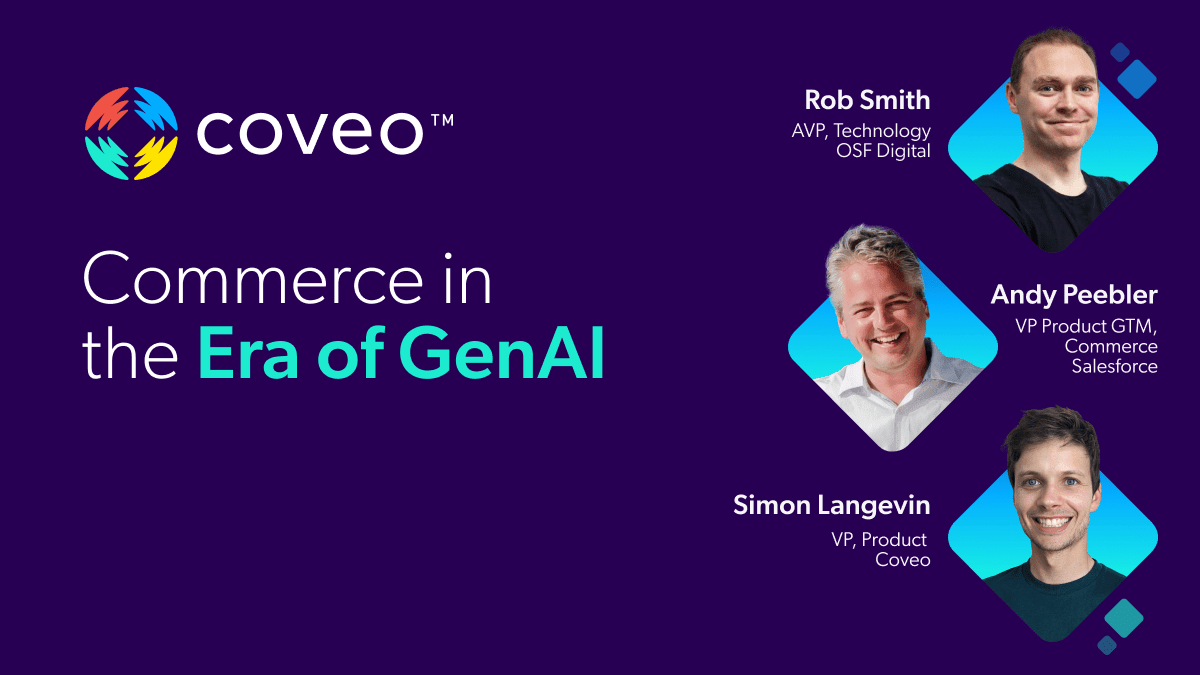
Commerce in the Era of GenAI
In this webinar, you’ll learn how to make every customer feel like the most special customer in the world without hiring an army of data scientists, merchandisers, and copywriters.
