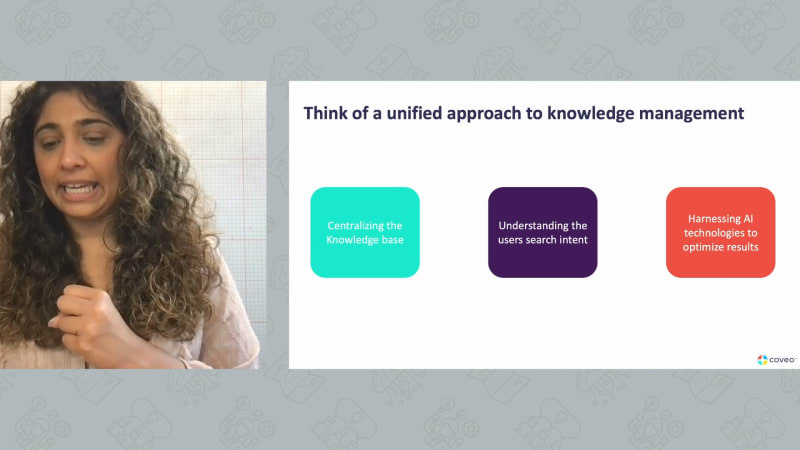
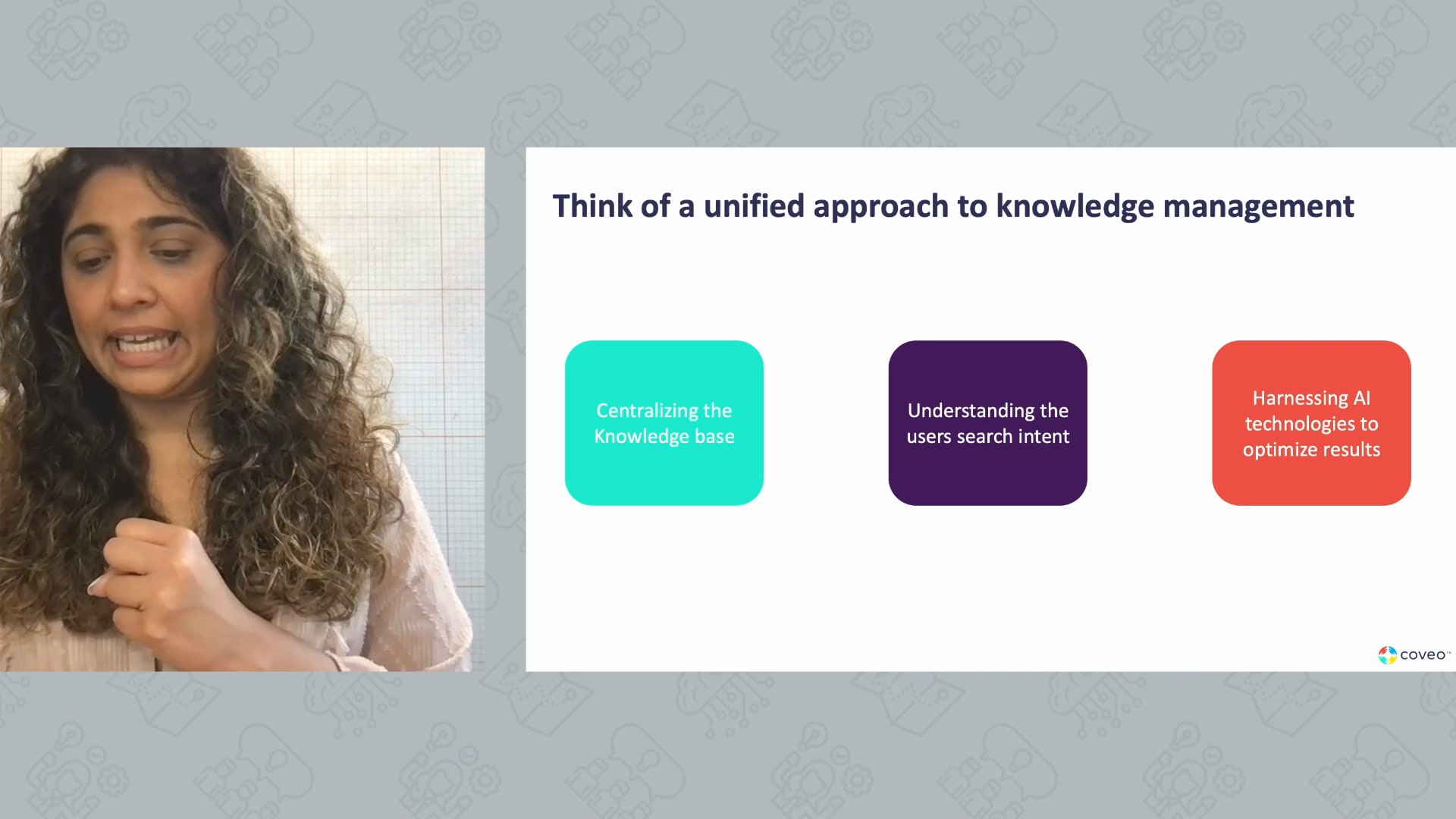
Welcome back. Please join me as we welcome Saher Samnani with Caveo in our next presentation. An efficient workplace begins with discoverable knowledge. Hello, everyone. Welcome to another session for DWX. Hope you've been learning a lot this, the past couple days. Today, I will be talking about an efficient workplace begins with discoverable knowledge. My name is Sarah Samnani, senior product marketing manager at Coveo, and we've done quite a bit of research in this world, in the workplace, Barca, and how employees are struggling to find information and how we can make the workplace more efficient by giving them the knowledge that they need, and this is why I'm here with you today. Just this is just a quick disclaimer, you know, I'll be showing some stats. They are at the point of time current, to this year. Any anything post this year, the data would change, the numbers would change, so it's just a quick disclaimer for you. So let's start. Right? Let's think about the employee experience world right now. The statement is quite bold when we say employee experience crisis. But when we think about it, when we look at the screen and just read the digital overload, the number of average, SaaS application that a user has to go through when onboarding. Think about your Google Drive, your SharePoint, your Confluence pages, you know, internal tools like Asana, maybe you're using Jira. There are so many different applications that a user is going through right now. Limited social interaction, yes, we're coming back. I mean, this, this DWX is also technically remote, it's online, some people are going back into the office, some are not. There's that little, you know, push and pull of, okay, how is the social interaction currently, am I missing out something, am I coming in but then not really getting my work done. There are hiring freezes, which is a fact right now as well, with, you know, the current economical environment, a lot of, companies are putting pauses on hiring, but there are still the the great resignation going on where, you know, people are quitting, people are burnt out. So how do you balance that? Right? As an employee, as I when I put myself in that shoe as well, I'm like, there is a lot going on. And it just, you know, you think it would be changing, but it's not. In a recent report that we published where we did a a research with four thousand employees, we found that three point six hours are wasted every day by an employee to try to find an information. And this is higher if you're newer to the company too. Imagine you're just starting out, you're potentially hybrid, you know, you're trying to figure out what, documents are relevant or not, and you're wasting so much time. We did this report last year in twenty twenty one as well. And what we found out was that, at that time, people were wasting about two hours. So in twenty twenty two, if we're wasting about three point six, which is almost like four hours a day, we're going in a trend which is not in a good way. You think that, you know, when workplace went hybrid, when workplaces went remote, we became better. But I think it's going in the opposite direction for sure. Think about a scenario. If it's three point six hours a day that an employee is wasting, on an average, we work about two hundred and sixty two days a year. Say your company has about five thousand employees. It's over four million hours wasted, just trying to find the information they need to get their work done. Now, how can you be efficient if you're trying to find, documents to just get your work done? Right? It's hard. You think that if we give them more efficiency tools, if we give them more access to different, tools that they prefer, maybe it's gonna be doing good, but it's actually doing more harm than actual good. Some of the stats in our research also showed that fifty percent didn't even know where to start looking. I remember those days in my previous workplaces where I would be like, do I need to go to Google Drive? Or today, is it in the SharePoint? Where do I find this information? Forty three percent attributed their problem, of getting work done to an inefficient search technology or the Internet. They also blamed the excessive search time on having too many knowledge sources. You know, think about your day day to day tasks. How many places are you going? How many different versions of the documents are you looking at? If an employee leaves, where's that document going from their personal drives into, maybe a black hole where someone can't find it? So that's causing a lot of frustration and burnt out between a lot of different employees. And, you know, when you think about it, why is it such a big problem? The information exists. The tools exist. Everything's there for the user. So why does someone have such a big problem trying to just find information to get their work done? And there are a couple of reasons why, right? Like one, the most common, it is scattered across multiple systems, and it's due to the distributed workforce. Think of it, if your company is an m and a company, you're potentially, adding more employees into the system. You're bringing in their own knowledge management systems, combining it with your existing, and then it just keeps on growing and becoming bigger. Internal teams sometimes use different tools. Sometimes Barca and d prefers Jira. Sometimes marketing prefers Asana. So it's just everywhere. Right? That it's not a cohesive place where someone can just go in and find information. Unintuitive UI. It doesn't help if the UI is not very intuitive, if they can't filter based on their needs. Think of your favorite UI. Maybe you're an iOS user, maybe you're an Android user. You have a preference because you like that UI. You you know that the UI is intuitive when you're trying to use it. Then it's also the impersonal experience. Right? A lot of the Intranets and the knowledge bases are created manually. You're tagging it, potentially adding, like, tags of sales, maybe marketing, maybe adding some keyword tags, but they're all manually created. And as we grow, as, times change, the experiences and the expectations of the experiences change as well. Think of your experiences, trying to find information on Netflix, on Google, on Amazon. It's intuitive. It's understanding what your needs are. It's providing you recommendations based on your needs. Right? So that's the other problem. Then, lack of visibility. So, yes, we have a lot of content. Yes. You know, there might be results that are no search results, but you don't have any way to actually gather data or you're not looking at the data or looking at the analysis of that data to really understand where the content gap is. And if you don't know the content gap, how are you supposed to address it? How is how is your HR team supposed to create onboarding materials for someone creating something if you don't have, like, that feedback loop or that analysis that you can use and the rate of the accumulation of new files and documents. We all know that. We all struggle with that. We struggle with the employee turnover. We, struggle with, you know, multiple variations of the documents, the versions. Some of them are irrelevant. Think of how many times you must have if you're from marketing, like myself, a lot of times, you know, in my previous roles, we'd have to, like, reach out to the sales team and be like, hey. Stop using that deck. It's been, like, out of date for years. How do you know? Like, at the rate of what you're building the content, people can't keep up with the use as well. So that's the other problem. But, you know, I know I sounded like a doom gloom day, you know, it came in and started making us feel bad about the fact that, you know, potentially our knowledge management system is causing lack of efficiency, but all is not lost. We can gain efficiency again. We can give our employees the time back, by providing them knowledge that's discoverable. And what is this discoverability of knowledge? Right? Like, how do you approach that discoverability as such? One way to think about it is a unified approach. Think of, bringing everything into one place. Right? Like, imagine there's a centralized knowledge based system where you're pulling in your Google Drive, you're pulling in your SharePoint, you're you're pulling in your Confluence, you're pulling in your, potential, like, cloud drives, any place where you're hosting your internal Internet that you've created, all of that into one searchable page. Then what if you understand the user's intent? And when I mean mean users' intent, I mean, it's not just about, potentially thinking about the keywords. Right? It's not about the tagging. Think about what the user genuinely wants. If I am from marketing, if someone's from sales, someone's from product, if we search for the same keyword, our intent is not exactly the same. It it differs. Right? So understand the user's intent while they try to search, provide them potential filters that they can filter maybe in the type of the document, maybe your the document was created, provide those filtering mechanisms, and then harness AI technologies to optimize the results. Right? You got the search intent. You got the centralized place, but you have to keep improving. And keeping up with it manually is is okay, but it then takes up a lot of time from your team where they could be focusing on optimizing other things. And there are so many different AI technologies right now in the industry that you can potentially use that, set it up, and forget it. And let the AI, the machine learning capabilities to, you know, really understand the user's intent and keep on improving as you go while, you know, you're gathering the data, you're focusing on improving the content, you're focusing on providing the experience and not bogged down by just the manual maintenance of an ongoing knowledge management system. And, you know, that being said, let's remember that shift is happening. Think about it from, a people centric approach, not a product centric approach. Think of the just for me interaction. Make that employee feel special. Think about the coherent journeys. It's not about channel. It's unified. It's everything together. The employee just wants information. Right? It doesn't matter which channel, where it is. Give them the information. Think about the journeys they're in. Are they on the onboarding stage? Have they been here for a couple years? And then prescriptive experience. Right? Really understand the intent, learning from every interaction. And this is where, like, AI technology, machine learning capabilities come into play, that keep on growing and learning and helping them serve the next information that they need. And you know what? That's the Moore's law of experience. Right? If you know, you have to keep growing. You have to keep changing. And that's where Coveo comes in. We are a market leading AI powered relevance platform. We don't think about, information in silos. We don't think about experiences in silos. We think about the platform as a the platform as a whole thinks about an overall experience for your company. It's your workplace, so your employees, potentially your employees that are in the service sector and the support sector, potentially for if you're a ecommerce provider, your ecommerce store, people coming to your store trying to buy, your website experiences, your visitors coming and looking. It's in holistic round. Right? Every everything is connected, essentially. And that's how Coveo looks at an overall unified experience. Just a quick brief history of Coveo as a whole. We started off in two thousand five, and we've been here for over fifteen years. We've been working on our technologies, and we've been growing. We started off as a simple enterprise search technology because we we knew there was a a problem in the market where enterprises were trying to bring information together and provide search capabilities to its users. And then we grew. We have, we have an internal ML team and a AI research team that actually sits down and really understands search behaviors. Our ML models that we've created and we've invested so many so many years into have been created specifically for search, and we've been driving innovation for the past fifteen years. Our company looks at search information in three ways. Right? First one is unifying the content, into one searchable index. And this is what I talked talked talked about, just a couple minutes ago where I was talking about bringing everything together. Right? Bringing it into one index. That way it's searchable. It's findable. We have over fifty out of box connectors. We have native integrations within Salesforce, within Adobe, within SAP, where you would just have to, like, set it up, forget it. Everything will be indexed and auto updated as and when things get updated. And then, we apply a layer into it, which is the AI. The AI layer is our, layer, which is the intelligent layer that adds just takes the indexable, understands the user's, user's intent, and then blends it in and really provides that information. The AI on the back end, what it does is it it's working with set and forget machine learning models. And what does that mean? When I say set and forget machine learning, I I mean, there are the machine learning models don't require frequent tune ups. We you have to just set up the parameters, tell the machine learning what it needs to do. And because these models have been created specifically for search, providing relevant information, all you have to do is set and forget. And if ever needed, you just adjust it based on experience. And then we take all of that information and provide it in different touch points. So it can be your apps. It could be your, Slack channel. It could be your service portals. We bring everything together in various workplace touch points. Don't take my word. Right? We have because we've been in the industry for so long, over fifteen years, we've had time to show that, you know, our technology really works. Dell, we all know Dell increased its employee satisfaction by three times by implementation. Honeywell was able to deflect cases by improving the searchability of a user trying to find information. So IT support tickets decreased, which is always a great thing. Employee engagement at Grand Thornton increased by ninety nine percent. The content gap at UHealth decreased by seventy eight percent. At Comcast as well, there was a seventy eight percent decrease as well. And then at, at Manulife, where the the AI powered guidance, the recommendation increased the monthly searches by over seventy percent. So those are the values that we've provided. Right? And I'm just gonna leave you with this little piece that our clients usually say. They say we need Coveo everywhere. And what does that mean? They use it at the knowledge hub. They use it at the integration level. They use it in conversations, and they use it in their workflow. So this is where Coveo comes in. And if you are currently in a position where you have, your employees complaining about not being able to find information or team saying, you know, there's overload of tools. Maybe come talk to us. Come, you know, tell us your problem. Let us help you find a solution because we're very passionate of helping efficiency come back into the workplace, make the employees feel empowered, and we can do this with you. We can give you free, assessments as well, and it's a no no bars assessment, essentially. You don't have to commit to it. We just want to be able to help you. So if that's the thing, come talk to me, ask me questions. Thank you so much, everyone. Hope you enjoyed the presentation. Hope you went, got some information that you can take back to your teams and some things to get, you know, the thoughts running and really thinking about how do you improve efficiency in your workplace. Thank you. Thank you so much. Up next, Sarah Kimmel, VP and head of research here at Reworked, presents the latest findings of the twenty twenty two State of the Digital Workplace Study. In this seventh annual report, you'll uncover insights from more than twelve hundred digital workplace executives and practitioners like yourselves and discover key insights into the state of hybrid work, AI and machine learning adoption, and digital workplace investment priorities. To join the presentation, simply return to the event hub and click view session.