
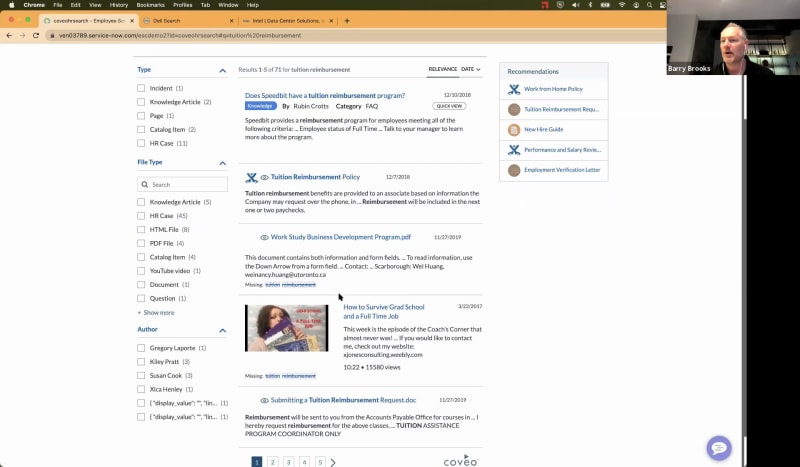
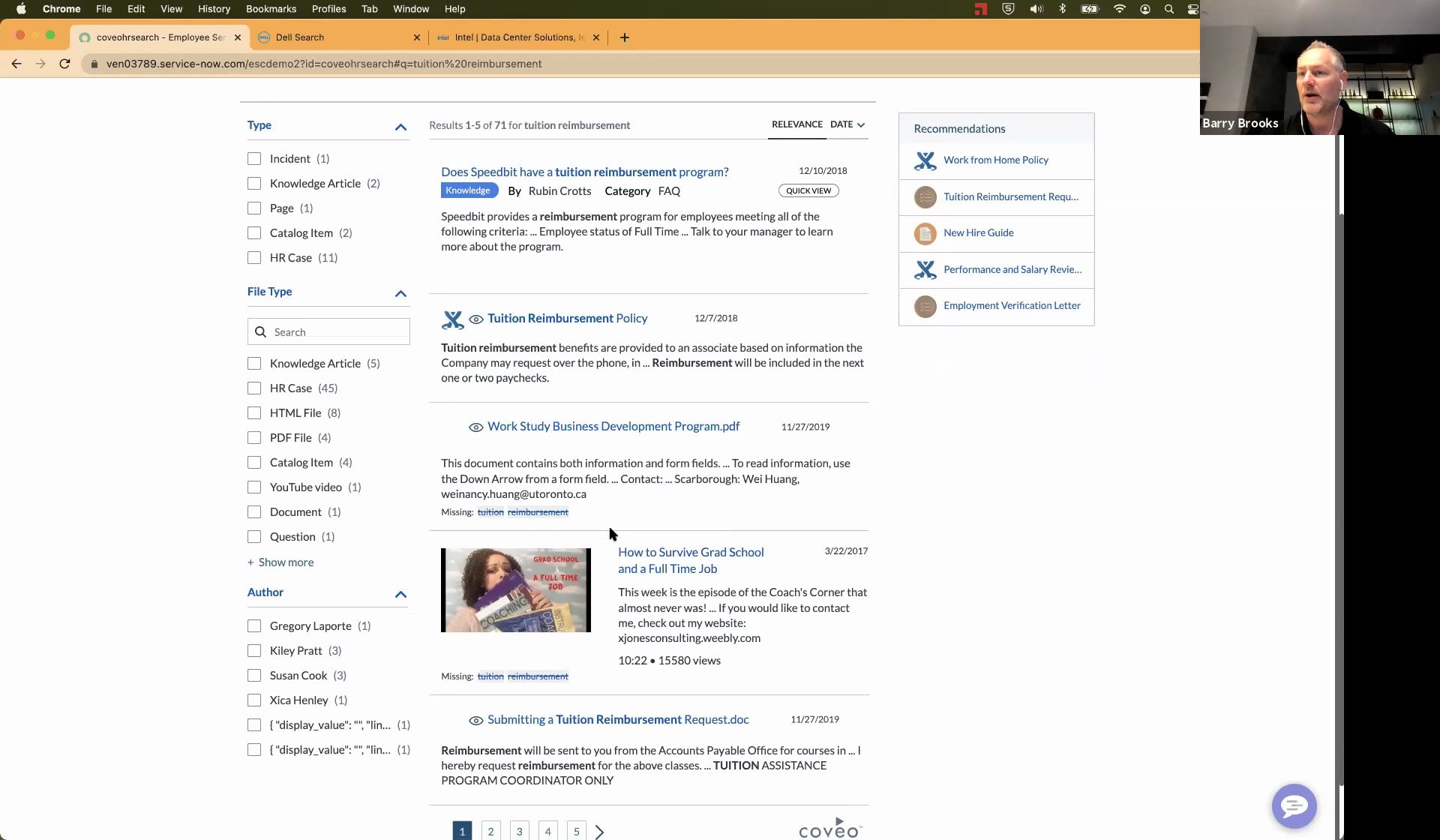
Hello, everyone. We'll give you a few seconds to get in the room. Hope everyone is having a great day so far. I know it's a beautiful day in San Diego. Barry, how about where you're at? I'm in Chicago, and it is not that sunny. So Winter is upon us. The time changes here. Alright. We'll give it just a little bit longer, and then we'll get started. Thanks, everyone, for joining. Alright. Thanks for joining, everyone. This is AI powered search for Workplace and ServiceNow. My name is Maggie Bliss. I will be your moderator today. So if you have any questions, technical difficulties, anything on the back end, please feel free to hit me up in the chat. Today, we are joined by our awesome Barry Brooks. He's our sales engineer here and specializes in workplace. He's a well of knowledge, so please ask your questions. He he has the information. You guys are all webinar pros at this point, but you are in a one way viewing experience. So if you wanna chat with us, make sure you do it in the q and a or the chat portion. And then at this is being recorded, and I will send it out to you later this week. And with that, I'll turn it over to you, Barry. Thanks, Maggie. Appreciate it. So I'm Barry Brooks. I'm part of the sales engineering organization here at Coveo. Spent most of my career really kind of in ITSM and and and and in those flavors, I've been with big companies and small companies, spent a lot of time at ServiceNow. You know, I I just have you for a a few minutes today, but I wanna kinda show you and talk to you about a few things. And so we'll start really with what is relevancy, because, really, search and relevancy is what drives workplace. And I'll show you a couple examples. Yeah, I'll show you a couple live examples in terms of search, and then we'll show you some ServiceNow examples as well. And then we'll just round it out with some q and a. And so when we jump right in, you know, Cabello really has four kind of main business lines and and there's a fair bit of overlap in these guys, but they're really kinda driven, from the experiences. And so when you look at this list, right, you know, the commerce experience on a website is very different than a service experiences. But these are all powered by the same type of index inside of Coveo, and they're powered by different machine learning models, obviously, because you're looking at very different types of experiences. And we're gonna really kinda focus on the the this bottom. So we're gonna look at some websites, and we'll also look at some workplace. But the things we try to drive with with the workplace experience is really about, finding stuff. You know? So you you think about, you know, what is an intranet at work, and it's it's just the digital company. Right? So at Coveo, our intranet is the digital expression of everything. And so when I come into Coveo, depending on where I'm at and what experience I'm having, you know, I may be trying to do something in HR. I may be trying to do something in IT. Most of the time, I'm just trying to find info, whatever that is. And so the things that we're trying to do with Coveo is we're trying to plug people into content faster. We're trying to get rid of this this sort of sprawl of information where I I don't know where things are at, and I'm spending time to reach out to people and say, do you know where this document is? And where is this guy? And where is the other one? And really what we do at the end of the day is we're really tracking what we call a click through, which is the the way to look at the experience to say, you know, when people come into a portal like an intranet, do they find what they want? And how long does it take them to find that? And there's other things that you're looking at as well in terms of content. So you're gonna be able to see things like, you know, do we have the right content? And are we are we pushing the right type of content, in the right type portal? So I'm gonna show you some of that as well. And, you know, why do why do these projects fail? You know, what what is it about some of these older intranets that make us pull our hair out? Well, the the first thing is we we don't want links. Right? I don't want a a portal that just has the the forty five links to to take me to a different place because I I don't know where necessarily the experience I'm looking for is in terms of those links. And I don't want a generic interface. You know, I when I go to things in my personal life, you know, they're very personalized for me, and I want that same experience at work. And so all of these portals need to be based around me. They need they need to be people centric as opposed to as opposed to product or group or organization. And the second thing that the reason why these things fail is that is that there's no connectivity between them. And so, you know, if I'm in Slack or if I'm in ServiceNow, or if I'm in our intranet, I want all three of those portals to know my past experiences. And so I want them to know who I am and the types of things that I do. I wanna start one place, and then if I have to go to another experience, I want it to know that that this is what I was doing in that other portal. And then finally, you know, I wanted to be smart enough to take advantage of new stuff. You know, I I don't I don't want a portal, and nobody wants to maintain a portal, that constantly has to be updated by the marketing or communications team. You know, I wanted to be smart enough to say, you know, these are the types of things that are trending. These are the things the types of things that, questions that people are asking because unique things are happening. You know, we're having some type of financial event, and so I would expect a big portion of that Internet page to now be filled with with information about that. And so how do we how do we get there? And and and what does Coveo do? And I'll build this guy out. You know, there's a lot of companies out there that use the same types of technology, basics that we do. You So you think about shops like Google, Facebook and Amazon, that have built huge businesses. Obviously, they all started with search, just like Coveo did fifteen years ago. And so we're using search to to be able to get pictures of content and how people use content. And we're also using machine learning models to be able to understand that how people are are using that. And what does that mean in terms of, you know, when people ask for a specific type of thing, this is what they're looking for. And and you want those to be constantly learning. So over the course of the years, Coveo has been dropped into thousands of websites, in in in hundreds of of customers across those four different business units. And and all of those things, all of those signals are are constantly going back and not only teaching those machine learning models, but but training new ones. And so you start to see the capabilities to do things like relevancy or things like smart snippets or the capability to have omnichannel across multiple different platforms. And so if you go to the very top of this, what we're seeing is is now the capability to take the things that we've learned from searching and and the the literally millions of different searches that people have done and those interactions and be able to say what types of things would be relevant in terms of the plus one. And so it's one thing to say, hey. We would like to create a a workplace portal that has relevant content for different people and the different experiences, But we also wanna be able to get to that next step, which is this is also, the the the proactive capability. So, you know, when when show when people are new to the organization and they do these five processes, this is the sixth process. That is really what makes a portal personal. You know? So for me, that's the that's the experience where I'm searching for this type of thing in one portal. I switch over to my mobile, and the mobile says, hey. Would you like me to map you to the things that you search? You know, that's that experience that we wanna have. We wanna have it at work. So what do we do? Well, we first connect to all of those different portal sources. And so, you know, everything that you have inside the organization, that's the stuff on the left. You're literally building a connection to that. You're pulling in that content, and you're potentially maybe even augmenting or replacing the search capability inside of those. And so what Coveo is doing is you're having an experience in any one of these portals. It's passing signals back to Coveo that then Coveo can learn from. And so what does this look like? And, again, four different business units. We're gonna be focusing on the things that are in that upper right hand quadrant there in terms of experiences. But start with the left. So let's take just a couple examples. You wanna take your ServiceNow. Let's take your Slack. Take your Google Drive. Let's bring that into Coveo in terms of the index. And then let's power, those search and recommendation experiences. And so we're gonna say what goes on to those portals and we wanna drive search across all of those. And so no matter where you're at, you do a single search. It brings in all of that content together. That all then goes into the behavioral data that says, k. Barry had this type of experience. He searched this. This was the content that was presented to him, and this is ultimately what was successful because we're looking at that entire end to end in terms to to to get a better picture for this is the type of experience Barry is having. And then we start to look at what does Barry look like in terms of is it the role, or is it the type of people that Barry Barry interacts with inside of the organization? And then what looks different? So when I'm searching for templates as opposed to searching for things like policies inside of our Workday system, You know, all of those go back together. They get wrapped around our machine learning models so that way they can get pushed back out again. And so it's continually learning what is a good search, and then also pushing again relevancy. And relevancy is is kind of that secret sauce when we talk about workplace. So successful interactions, what do they look like? You know, inside of, a platform like ServiceNow, it's it's, you know, I'm searching for something. And, I'm I've I've I had a search results from four different, different sources, and I clicked on the third one. And I stayed on it for just a couple of of seconds because I didn't see exactly what I wanted. I backed up, went to something else. You know? But I did click on the fourth one, and I stayed on that for three minutes. I opened it up. I read it, and then I I backed out and went to some other process. So that in Coveo's terms is a success. Right? And everything else also went back to the machine learning models. And so that way, the next time somebody searches that exact same thing, much better chance of that number four starting to get pushed up. And over time, it's learning. You know what? That first one doesn't make sense for this type of query. And all of these things go back in so that they're they're continually learning. They're continuing to get better and better. So let's show you some of these, and let's start with maybe some of these real world examples. This is one of our customers at Dell. Dell uses us, across the board, also internally as well. But in this singular search box, and, again, think about the different types of machine learning models that are running on this, but we're seeing different type of experiential things. And so I could come into this singular search and do a support thing. I could do a commerce side. I could do, I could do a combination of those two, and the system knows or has learned over time how people search and what they're looking for. So when I'm searching for a type of product, let's say, for example, you know, this is the way we search for those. But I may say I'm I'm looking for, you know, a seventeen inch I nine, with a solid state drive, for example. That's obviously a very commerce, product driven type of search. So what I see here is only four or five. This is showing me four of the seventeen different results of the twenty some I think there's twenty eight thousand different laptops inside Dell. So very, very specific. This is machine learning learning, exactly how I type of search and how to then link it to things inside of the database. And if you notice here, this is a, Coveo powered search. It's the Coveo powered search results page. It even highlighted in terms of facets the things on the left, based on exactly what I was looking for. So it only showed me the seventeens, only showed me the I nines, for example. And then you could go away from that and do something that's completely different. So in this case, I may say, you know, how how do I install a driver? Very different type of search. And so now I'll expect to see search results, that come from the support side of the house. And so in Koveos world, this is just one index for us. It's multiple sources, right, because Dell has fifteen or twenty million pieces of content. But you see different type of search results page, but very, very specific as to what I'm doing. So search very important searches where everything starts from, and it's really a nice way to sort of baseline everything else that Coveo does. I've got a couple of different examples, but let's switch over and I wanna show you some service. Now this is what ServiceNow calls their, employees service center portal. It's just a, Internet esque. And again, that's a kind of a broad term, but it's a way for internal folks to really interact with all the different groups, maybe inside of an organization. And so there's lots of things that are happening here on this portal, but this portal is even though they're ServiceNow widgets, it's entirely built or or driven content wise from Coveo. In terms of these are specific widgets, Coveo decides what goes into those widgets. And that's very important to know, right, because we think about rolling this out and how do we maintain it and and who from these multiple organizations is going to Barca conceptually, I think on this portal, we wanna have five or six different types of widgets, and I wanna let the machine learning models to drive what goes into those. And so we start with search. We know that about forty percent of of still portal usage goes here, and you guys will know. If you guys roll this out, you'll know, to a t and you'll know who does what and and from what group and what type of content people are looking for and and how those experiences passed back and forth. The first thing that we see is a query suggestion, and these are not these are not the last ten surges. This isn't these. This is the the last five things that I put on. These are looking at over hundreds and hundreds of signals. This is what are people searching for and what is a good query. Because not only we're trying to figure these things out, but we're also trying to continually teach people how to query types of things. This is the did you mean type of this. And I could come in and drop into one of these, and I could also do this where I'm spelling these completely wrong. So if I'm looking for something, and I don't know how to spell it, the system can always come in and say, I think you meant tuition. And let's see what we have inside of the system. This is the first time that we're seeing, Coveo search results page internally. This is completely configurable by you guys. You know? So what you'll do is you'll wanna decide how this looks, and do you want facets on the left? Do you want things like predictive stuff on the right? How much access do you want people have and and from what different source? And so take a look at the top of the screen. What we're seeing is these are the types of sources, where we found interesting content for things like this. Hey. I'm looking for tuition reimbursement. And so what we see is all of the sources put together in a unified way and all displayed here to me, irregardless of where they come from. So in this case, we've got some knowledge based stuff in here. We've got things from Confluence. This is a flat PDF. Could be probably in Google Drive. Here's a, just a, something from YouTube itself, and they they all play natively. And so, you know, we don't necessarily have to bounce people out to different places. You know, I get really tired of of this link fatigue where I click on something, it takes me somewhere, and I have to find my way back. So view it natively, have the capability to do things like quick views, and they're unique to each of the different content types. So this is just a standard ServiceNow knowledge base. Very simple, very easy. But what if you're a a financial shop where all the documents seem to be five thousand pages long? You know, I want the system to be able to say, you asked about tuition, and tuition is found right here. You may wanna do other things. We have concepts where we call things like quick snippets, you know, where it could take a very large document and then say, I think what you're looking for is just a very easy how to, and here they are in a in a bullet format. So those are very interesting ways to interact with content. You don't have to manage the content. Maybe I don't have to to take it from one system and drop it into another. I don't have to clean it up. Let this let let Coveo and machine learning models figure it out for you, and and you'll find out what's relevant and what's not. And so when I talk to shops, they always say, well, we've got, you know, a bunch of stuff in SharePoint and I've got stuff hidden all over the place. I don't know what people are using. I say bring it in. It doesn't matter. And let's let the system figure it out. Let's let real people who are searching, figure it out, and you'll see it right away. This stuff isn't being used at all, or people are searching for this, but they're not finding it. That's a way a great way to see content gaps. Other things that are on this page on the right hand side, you see recommendations. Now what you don't know is that this user is is a a new hire. And so this person's been on board for less than ninety days. I know that because they have a profile in ServiceNow or they have service catalog items. But the Coveo is is learning about this. And so what you're starting to see is information like, well, this is information that's useful for people that are within their ninety day window. And we know that because I look at everybody that's been in the system, and I look at the types of documents, again, that they use. And so you get this very predictive capability, which is on the right hand side to say, I know you're gonna use this document. So here it is right here, and I don't have to maintain it. I don't have to build that list. They can always add things. And so if I back up out of this guy and we go back to the primary, you know, your marketing, your communications teams, your IT teams, they still wanna push things into these results sets, and you can. So you can always have the this top thing at the top. You can always have these documents to appear in number one or maybe number two slot, but then let machine learning figure the rest of this stuff out. That's how personalization works. Scroll down a little bit further or rather look down. I'll do a scrolling on this portal. Think about conceptually other things you wanna have on an Internet. So here's an example of a of a, a person that has a specific type of role. And so what you wanna see here is, you know, let's look at the role inside of ServiceNow. Let's look at the role inside of Workday. Let's look at the role inside of Slack, and let's use that as we are learning to try to figure out is there a commonality? You know? So people that have this role are looking at these documents right now. They're using these types of things. These are the hot, maybe, items. And so, again, it's personalized, but you're it's very nuanced because you you wanna have as many signals as possible. You know, if you just have one enterprise platform in there, I only understand the uses that comes through that one. Whereas if I expand this out to, again, to my to my instant messaging into my CRM and to my support portals, then I get a much a much broader picture of how that person looks and how they work. Scroll down a little further. So, again, this person is is in their first couple of days. And so it's interesting to have a block in here. Again, on the Internet, on the workplace, it's just based on the fact that that you're brand new. This is the stuff you should be thinking about. And maybe that first one is put in there as hard coded. Right? We always use that. But then the other ones kinda trend in and trend out based on what people are using. Scroll down. How about the things like, location based? And so, you know, it's it's very nice. It's very easy to put into a portal. Let's put a location based recommendation panel and then let the system just go. You know, we have seven or eight different locations. As Maggie said, she's in San Diego. I'm not. I don't want to see San Diego stuff. I I get tired of the in the winter to hear about how fantastic the weather is and all the great things that they're doing outside. So give me stuff that you need to be. And then other things, maybe interest. So intranet portals, personalization, very, very important. You wanna be able to use this content no matter where you're at. So on the right hand side, we have the out of the box virtual agent inside of ServiceNow. So think about using that there as well. Although people interact with those things very, very differently. Right? So you can certainly build out swim lanes inside of ServiceNow, but we could also expand this to everything else inside of the organization, again, without bringing it into the platform itself. And so here, you may do that same type of of example. I think there was a also some other stuff maybe around MBA. Let's go just tuition again. We might expect to see instead of links, we might expect to see a few more videos or a few more snippets. Again, regardless of whether I'm in this portal in the in the virtual agent or I'm in the primary ServiceNow portal or I'm in Slack or some of these other channels. You know, the system is is looking at every single one of these signals. It's building really kind of an an end to end experiential view of of Barca. And, again, the more I know about, this person or this user or the experience that they have, the better I'm able to push that relevancy, downstream from that. I wanna show you a little bit more. Think about also doing things like, case deflection, right, or or anywhere where, you know, I'm trying to to find something. I don't find it. Maybe I need to contact another group. So, you know, I I gave you a little bit of an HR example. Maybe I wanna contact the support team. You know, I still should be able to do it from no matter where I'm at. And and irregardless of of how I get to that thing, I still want this Coveo engine to continually try to to push information to me. And so here is is one of the out of the box, ServiceNow creations date case deflection they call this guy. But you think about this where I'm coming in to say, you know, I'm having an issue, and, you know, maybe it's, I'm brand new. I can't get the VPN, You know, it's it's having some issues. And so what Kaveo can do is it can help build categorization. So it can automate that based on the historical, nature of that, but can also on the right hand side, again, continually give me information. But in this case, I I maybe wanna have it limited. So once I'm putting in a ticket, I wanna have maybe only very, very specific content. So I wanna have maybe ServiceNow or or or maybe just IT content that's built in maybe some other type of knowledge as opposed to the broad community, which had videos and other types of things. Again, more of a specific type of view. But this is content trying to find the user, as opposed to vice versa. And, again, this is still content. It's coming from, multiple different sources. Okay. So I've shown you a couple of different things. We've talked about, a search portal to show you just some of the the basic capability of these guys. We've looked at the employee service center, and we've looked at things like case deflection, virtual agent. I wanna show you a potentially different view of our workplace. And this is, just one of our generic portals. This was not based on ServiceNow. It's just based on a generic portal, in terms of how you would consume it. So think about this like, you know, we have a portal. It's built somewhere. Or I have SharePoint portals. Right? Portals built in wherever. This is the type of view that you may use in those. Again, think about, again, just types of widgets that are more functional. Now we've got some a bit unique things in here. This one is Maria. Maria happens to be that last user's boss, so we tend to see, a little different view. But if you think about this, you know, this could be a place to view tasks. This could be a a dashboard to show you everything in consolidated view. And so I've got tasks that come from Concur and from Work Day, and you can have Jira and ServiceNow tasks all in one place. And they all have the same capability to do things like, hey. Quick view. Open that up. Show that to me. Maybe maybe work in it in some point or select it and and pull up the Jira into that separate window and and work on it functionally right from there. But these are things that are unique completely to me, and I I don't I'm not building these in terms of selecting these. I'm building the concept the the concepts to build a conceptual workplace and then letting the system figure it out. Scroll down further, company news and announcements. We have to have this. These are important. Right? You know exactly what teams are building these types of things. But then what about things that are much more specific to me? What about the documents that the team around me is using? Or maybe a concept of a sphere of influence, which is, you know, even though I'm a an SC in the sales department, technically, you know, I interact with the ServiceNow product guys a ton. The folks that are on this call I interact with. So they're not necessarily people that I'm dotted lines to, but there are people that are in my sphere of influence. What types of stuff are they working on? Right? Is the are these interesting? Are these things maybe even, not even where I've been attached in terms of of of a, hey, Barca. Take a look at this. But just things like, hey. Other folks that are in your sphere are doing these types of things. Same things with relevant files or things you might be interested in. And then other things, maybe experiential stuff. So the system knows that Nick is is one of my, direct reports. Nick, again, is new to the organization. So this is stuff that other managers like me have used when they have new hires. So just, again, just a very well rounded way to build very personal experiences, experiences that are unique to me and cross all of the applications that we have inside of the infrastructure, with very little overhead. Meaning, I can build this. I can I can push it out into the world, and I can let the let Coveo and let the machine learning models figure out what is useful? The last piece of this, and then we'll open this up for some q and a, is really around, the views that you wanna be able to have. And so you you wanna be able to track this content. Now this is the the Coveo Barca end of this guy. You know, this is where you would see, all of the sources and you would see content. This is where the admins would come in to build machine learning models and tweak them and see what's working and what doesn't work. And I I wanna show you just this one overview portal, as a report, and I wanna show you maybe case deflection. That's where we stopped off at. So when you think about what types of KPIs you wanna have in this, I like them based on, the problems that you're trying to solve. So case deflection is always about right shifting left. We wanna get people to resolutions faster. And so the types of KPIs that are on here, tend to be a little bit unique. You know, we see these types of things. Right? How much stuff is out there and what are we doing and the cost? But I like that this is one of the highlighted KPIs, and this is our average click through. Because, again, what do we do at the end of the day? Right? So Coveo started in search. To get to relevancy, you have to be able to provide search results and to learn from them. And so at the end of the day, this is these are the types of things that we track, the average click rank, which is, again, when I'm being presented with content, what con what what's the useful piece of content that was presented to me? Whether it was in search results or whether it was on a recommendation inside of a panel, and where is it at? We like to be in the in the top two. Top three is is is is industry standard. Nobody goes to page two on anything. And so this is how everything else sort of funnels up to the top. And then, of course, from there, you can always see the things like what are people searching and, are there are there any gaps and other gaps, you know, broken down by by, you know, groups or different geographic, areas? You know, it's it's easy to to build knowledge for a specific user group, but then when we push it out, sometimes we don't realize that, you know, this these types of team members look at things differently, or, you know, these types of languages have a unique, recommend need to have a unique requirement that are on them. Okay. Report in structure. I think, we'd like to maybe have some q and a. Maggie, I'll I'll put you on again. Any comments? Any questions came in from us? Not yet. But we'll give them a minute to see if anything comes in. But I have a question. How quickly or how is the deployment process if you wanna deploy Coveo for the Internet? How long does it take to get that guy in? The average implementation is somewhere in the twelve to sort of eighteen week range. Usually, it's completely dependent on the number of sources that you have. That's the the sort of the x in that variable. Like I said, you're not gonna do any data migration. You don't have to clean up the data, but you do wanna set things up, in terms of of, how do they look and feel. So you think about the templates for a knowledge based article or the template for a SharePoint portal. Perfect. Someone asked, is Coveo FedRAMPed, and what is its status? Is Coveo FedRAMPed? Not currently. And so I know that we've talked about in the that in the past. I don't think that's anywhere on the road map for us currently. It's a great question. We'll see if any more come in. This has been great content, Barry. Thank you so much. I mean, I've learned so much about how we implement just pretty much everywhere through across the enterprise. They asked, can Coveo be on prem? Can Coveo be on prem? I don't think we've been on prem for a very, very long time. I think we'd have to have a really, really unique use case or a kind of a a business requirement for that. It it it makes more sense to to obviously have this guy in the cloud, at least for us. Yeah. To the person who's asking the questions, if you want to follow-up with me, we can look into your use case because it seems very unique. So we're happy to dig into it with you. Maggie, is this the same person, the FedRAMP and the on prem? Gotcha. He says on prem means Azure cloud to this person. Gotcha. Gotcha. I'm gonna put my email in the chat so you can follow-up with me. Yeah. I'd love to have a follow-up on that. We can talk about that as well. Yeah. Perfect. Well, it doesn't look like anything else has come in. But, Barry, thank you so much. This has been wonderful. If you guys do think of questions, please reply to the email that I'll send you, or you can email me right at m bliss at coveo dot com. And with that, I'll let you guys all have a great rest of your day. Awesome. Thank you. Bye. Cheers, everyone.
ServiceNow Shows What an AI-Powered Search Really Looks Like
