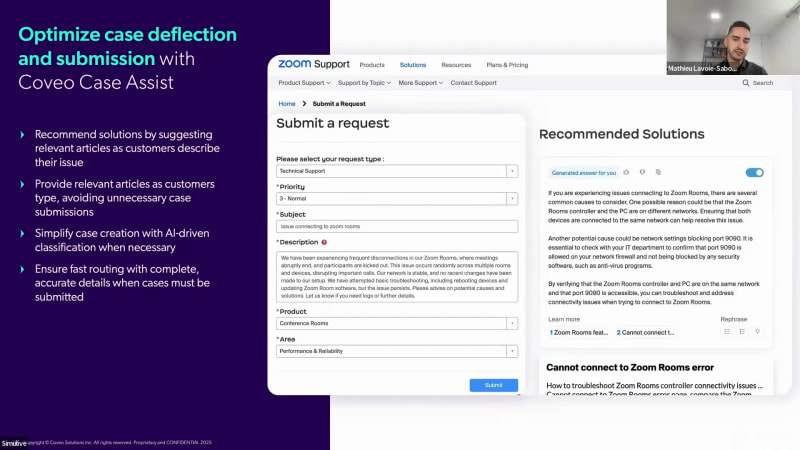
AI, everyone, and welcome to today's webinar, turn your self-service portal into a case deflection and answer engine. Now this is brought to you by Coveo and hosted by VIB. Before we get started, I'd like to go over some housekeeping items. This webinar is being recorded and a link will be sent to you shortly after the event. Q and A will be open throughout the session, so feel free to submit your questions at any time using the Q and A box below. And all related resources will be found in the resources tab, and we'd love to hear from you. So please go ahead and share your thoughts and insights in the chat box below. And with that, I'd like to hand it over to the Coveo team. Hello, and thank you. Matthew and I are really excited to talk to you about how you can turn your portal into a case deflection and answer engine and appreciate the next hour we'll spend together. But today's agenda, what we'll cover are the trends and challenges shaping service, capabilities, and metrics that matter. And then Matthew will cover real customer case studies, which are direct experiences he's had with some of our largest enterprise customers. Diving right in, I wanted to start by looking at things a little bit more holistically. Now we work with countless service organizations, and we try to stay on top of market trends, which typically talk about, you know, challenges and the the latest set of innovations. But it's important to take a step back to really frame what it is that we're really doing as a service or organization. K. And stats like this really highlight the importance the service organization plays. When you see that existing customers, which is essentially what service and support teams support, existing customers account for sixty five percent of an organization's total revenue growth. Now that is a significant number, and I think it's important to highlight that because when we hear about service, we sometimes see that AI thought about as a post sale function, sometimes seen as an after the thought, after the fact thought team, and sometimes not prioritize as much as it should be. When we look when we look at numbers like this, it might change how we look at and prioritize those service investments. So I thought it was important to show really the importance of of of providing the right solutions, not only for end customers, but for the teams that are supporting them. Now I think we're we can agree that we're all here because we know that service plays a big role in the company's growth trajectory. And we know and can be validated when we see statistics also like this. Eighty eight percent of customers say good customer service makes them more likely to purchase again. And this also suggests that your existing customers are also likely to refer your brand to prospective customers as well, again, emphasizing the fact that service and support are in service of this big customer base, which contributes to sixty five percent of your total revenues and are can impact whether you're gonna be referred to new new logos as well. So, again, a very important role to to play and to consider. But we know and it seems that the service organization is under massive transformation, and maybe that's partly because, technology is constantly, you know, coming out. There's new technology coming out all the time. So we wanna take a look at what's happening out there in terms of what's expected from service organizations today versus what where they should be moving towards in the future. So today, we we see that service and support organizations are viewed primarily as cost centers. Leaders are, overseeing people and process, dealing with complex legacy technology. We hear there's low digital maturity and digital savviness. Leaders are focused more on channels and not enough on knowledge management practices, and there's an overwhelm overwhelming focus on operational and process efficiencies. Does any of this look or sound familiar? Now compare this with the future state of where service is expected to go. Service is expected to be viewed as a revenue generator, to be leaders of service delivery excellence, driving digital transformation, being digitally proficient and change management leaders within the organization, taking a channel agnostic and outcome focused approach, leveraging AI to drive those knowledge discovery and knowledge management practices, and, of course, ensuring that customers receive value. They feel that they're being taken care of because, again, they will impact future revenues for an organization. Where we are at today with service is that it's expected to be a seamless ecosystem where teams, systems, and knowledge must unite to enhance the overall customer experience journey. Now what you see here are various touch points that not only your customers are experiencing, but your service and support teams are having to manage through to ensure they're providing great service. And as you can see, there's a lot of different touch points in areas of the business to consider. So this is extra challenging when we consider that those various areas I just showed you are typically managed by different teams. So you're gonna see me show this journey a few times throughout the presentation, and we like to look at this as a buying journey and key steps in that buying journey. For example, you have a prospect that might be going to your website to browse and search and do their discovery. If you have a transactional element on your website, they may be purchasing or buying something there. In the post sale process, this is our traditional view of service where customers are either getting self-service on your portals, reaching out to your contact center. And then we have these other types of roles within your company that are also servicing your customers. Think of teams like sales, your product organization, perhaps even your contracting teams. So these touch point represent all the ways or the areas that customers and prospects are experiencing your brand. The problem is that each of these areas is managed by unique departments. So your websites are typically managed by your marketing and web teams, and they have their own goals. They want to drive conversions. They wanna drive pipeline or impact influence revenue. On the other hand, you have commerce or merchandisers who truly are concerned about average order values and more directly impacting company revenues. Again, when we get into that post sales post sales space, support leaders, right, we care about reducing costs, resolution times, improving CSAT and ESAT. And then, of course, you get into, again, all of the other knowledge workers that it takes to support a customer, and we need to make sure they're armed with the right tools and technology. On top of that, not only do you have, again, these different departments with their own goals, their own budgets, this is resulting in them choosing their own technology to power these various parts of the buying journey. And what ends up happening is that the technology that they buy is very purpose built for just that single area. So I'll build these out, and you can see that there's various technology and ecosystems in each part of these buying journey steps. Now we can see that there's some similarities, some commonality. Like, some platforms can be used across multiple steps, but there really isn't one platform that is going across to really try and connect and unify that total experience. And these are each important platforms. Right? We know there's purpose built, tech for your websites. Of course, you need, you know, niche and specific tools for commerce. We know our service management applications and so forth. But as we said, the buying journey isn't a single step. It's multiple areas that need to be considered holistically. Now I just mentioned some of these challenges, realities, and the impact of silo teams, departments, budgets, and decision making. Regardless of that, service leaders are still expected to close the gap between what customers expect versus what is the reality. So let's look at that a little bit closely. In terms of expectations, customers, sixty one percent, would rather use self-service for simple issues. We've all heard about, you know, people prefer to do their own buying research, and and we see it here with the RealStat. Also, eighty one percent of customers prefer that companies can offer them a personalized experience. Right? These are just some, you know, I would say basic, but, you know, they're they're not basic when you think about implementing them, but they're common expectations that customers have. We then need to look at the reality, though. Where are we today with our teams and our tech? The reality is that only fourteen percent of customer self-service issues are fully resolved in self-service. So only fourteen percent of customers out of from the sixty one to the left, only fourteen percent can actually self-service on their own. And what's very interesting is the most common reason for that ability to self-service, the most common reason for failure was that in forty three percent of those cases, customers simply couldn't find content relevant to their issue. Now there's a lot to unpack. There's a lot to consider. There's a lot that I covered. And the question we have and and you're probably also thinking, you know, well, what can we do? How can service leaders really think about enhancing the overall customer service journey that end to end, both self-service and contact center without having to re platform, without having to, migrate content. And that is really where the Coveo platform or AI relevance platform comes into play. We you can see we're placed in the middle here, and I talked about, you know, your end user experiences with which are those digital journeys at the top. But, of course, there's that back end side, all those systems and technology that you need to make sense of. And what Coveo essentially does is provide that middle layer and those capabilities, things like hybrid search, personalized recommendations, generative answering, and even product and category recommendations and infuses those into your system so that you have that unified experience across your entire buying journey. Just to show it in a little bit of a different lens, since I did cover the buying journey with you, you can see at the top, there's there's our typical, you know, browsing, shopping, servicing, and other knowledge worker experiences. Coveo can be used to our and our capabilities can be used to improve all of those while in the back end working to unify all of those AI, disparate systems and platforms that I mentioned. And, again, it's done in a very lightweight manner, that is easy to deploy, easy to maintain. Our goal, put simply, is to help you achieve operational excellence, whether whether that's optimizing or amplifying your existing tech stacks, bringing you those AI powered capabilities, and unifying that knowledge access throughout the organization. We also, of course, wanna focus on enhancing that entire end to end buying journey experience, helping you work through those silos, which, again, we see that with plenty of our enterprise customers, providing those proactive recommendations, and content and analytics so you understand what's happening and know where to AI. And, of course, get to that future state of what service is expected to be, which is driving revenue retention and growth for the company, going beyond those case deflection metrics, giving your engineers and support teams more time to provide proactive product recommendations. That's really what we're about. And Matthew is gonna go a little bit deeper into how we do this and share those real use cases so that you can see not just part of the possible, but what many of our enterprise customers are doing today. Matthew, over to you. Thank you, AI, and thank you for this this amazing introduction and all this those insights. And, indeed, you know, we're gonna be looking over the next few minutes as to what those experience AI concretely look like. Right? How do we help your enterprise achieve these things, achieve operational outcome, grace customer experience, and move to driving revenue and growth? So we typically see with our clients, you know, a few use case, a few key touch points that, you know, really help drive the most value and move those experiences to the future. And those also the experiences where you can drive and start to deploy generative answering. Right? AI technologies and even agent technologies. So some of the touch points we see where our clients are getting a lot of value. The first one typically is within product. We like to call it in app support, which is typically the first part of the journey where your clients are interacting with you within your product. That's probably where they spend the most time, and this is actually where we want them to spend the most time. So we can keep those users engaged in your SaaS based app while providing secured relevant contextual answers and recommendations. The next step of that journey typically where, you know, we'll see interactions with your users is gonna be within your self-service portal. They could also be your website where they might wanna get more information. Ultimately, they're trying to get a question answered. They like to know more about your product. They'd like to know more about a certain issue that they're having. They AI to get more information about you or about a product or feature. So we can then plug in to power any CMS or experience with proactive AI results and answers for all sites, languages, and content, driving self-service, and we'll get into the metrics shortly as well. The next experience, this one is fairly newer. It has evolved a lot from your more traditional chatbot. You know, we've all seen perhaps in the past some chatbots that were a little bit clunky, a little bit slow, and not so interactive. But in the era of large language models and generative models, we're now seeing those chatbots evolve to become copilots as well as AI agents that can have interactions with their users. But those AI agents ultimately need that platform that we need to present it, the unified relevance layer using the Coveo AI platform to ensure that those AI agents are actually providing a great experience using your enterprise content. So this allows to elevate the quality and relevance of those AI agents, chatbots, or copilots, grounding them in your real enterprise knowledge, essentially expanding the wealth of information and and knowledge they have about you, your enterprise, so that they can provide a better experience to your users. The next step in that journey is ultimately, you know, even if we have the best breed, the best in class, use cases, the best in class deployment for self-service support, in app support, and AI Agentic, ultimately, some users will still go and try to open a request for support, with your enterprise. And it's hard to avoid that with even with the greatest self-service support center, possible. Users will sometimes skip that and to go straight to your case form. And sometimes they really do need issue. They they do have an issue. They do really need to talk to a human, which will drive them to your case form, to submit a case. In that use case, we can also assist customers with proactive recommendations and answers before they submit the case, trying to deflect as much as possible, especially when it's a case for a known issue. The issue is known. We can ensure that an answer is provided and we'll ensure that this user doesn't go on to open the case. If the issue is new or the issue is not documented externally, then, of course, cases will get created And this is where we can start to help your support agents, you know, by providing them assistance to enhance your service apps and giving agents access to all of your enterprise knowledge and answers and user insights without having to migrate content or migrate to different solutions. Now we talk about agent assist here, but this can expand AI Juanita showed to other employees as well. But we like to use the agent assist experience as it's probably one of the most concrete example of where people in your enterprise that have to interact with your customers are able to use the power of AI and AI agents to provide the best experience and to be able to solve more issues faster. So we're going through some of of we'll go into the use case to show kind of put an image on those names. So here we have an example, from our friends AI Zero, who are driving great self-service success with AI powered help experiences. So everyone is talking about Agentic today, but using generative answering within the context of retrieval, of information retrieval within the context of a support center or self-service website or even a marketing website can drive significant value and increase self-service success. So, this is really a great example of deploying a simple yet very efficient way to drive better outcomes and drive significant ROI. We're also able to augment chatbot. Our friends like Zero here, again, have fantastic example where they've actually deployed conversational capabilities using Coveo's retrieval and generation layer in a chatbot that is both on Facebook and on WhatsApp. So they're able with that to augment the answer output with relevant enterprise knowledge, deliver consistent answers across channels, further enhancing self-service success and case deflection. Then from there, there's also those AI agents, right, which can be deployed outwardly for external users on self-service portal, but can also be used internally by your support agents or employees. So for AI agents, Coveo is there to really help accelerate time to value. Right? Typing again into all of your enterprise knowledge, making those AI agents smarter, leveraging our APIs because we're very API agnostic, meaning you can plug into Coveo from any environment, from any use case, or any agent thick framework for for this example to further accelerate resolution and reduce costs using the AI agents or making these AI agents actually work for you. Right? Make them productive and actually bring a lot of value in a significant ROI. They need that intelligence layer to be able to perform just like we expect humans, and employees to perform the best by having access to all the information across your enterprise. And then finally, of course, on this is the AI Agentic. And finally, of course, the case form, we've mentioned this earlier. Case form are a fantastic use case that can drive significant value in ROI for enterprises by allowing to deflect cases before they're created using the power of generative answering and, you know, with Coveo as the underlying retrieval layer and generative layer to make sure we provide a resolution to users before they create a case, essentially transforming those use case from a case creation flow to a case resolution flow. Now, of course, cases will get creative, especially for issues that are new or not documented for clients. So that last experience we were discussing, the agent assist, really involves helping human agents, support agents that are solving those cases, interacting with your customers to have access to all that relevant enterprise wide knowledge, accelerating issue resolution with AI, tapping into all the knowledge and repositories you have, even the one that is not shared externally that can still access internally. Think of Jira. Think of internal tickets, bugs, product information that's proprietary to you, and leveraging those cross channel insights, understanding what the users did before as we see here with the user action on the right hand side. Because we're deployed across their journey, we can actually even help to bridge the gap between those different journeys and help support agents understand what the users did before opening the case and then, of course, further facilitating their ability to resolve those cases faster. And, of course, as we're agnostic, this is an example in the Salesforce service console, but we also deploy in ServiceNow, SAP, Genesys, to name a few, and much, much more. So back to my initial slide. Now that we've seen, you know, whether the main use cases where could AI significant value with AI across, you know, all touch points that your customers may go through while they interact with your company. We now wanna focus on what do we actually wanna track, especially today in the era of generative answering and agentic frameworks where we're suddenly not just providing results that they can consume and click on. We're also providing answers, and we're also even powering conversations. How do you then measure success? How do you measure that you're actually seeing an impact on your enterprise bottom line, reducing case loads and ensuring that you're, you know, regaining efficiency and that you're getting ROI? Right? How do we essentially go beyond the hype of all those new technologies and ensure that we're measuring real concrete success and outcomes for your enterprise? So we'll focus on four core metrics here, that are that are used to track different parts of that journey. And the first metric we'll focus on is gonna be focused on all the self-service experiences. Because in app support, self-service portal, or even AI, as well as AI agents chatbot typically have as a first objective to help users self serve find information on their own. So for that, we wanna look at self-service success, right, which are essentially implicit deflection. And, you know, this has evolved a lot over the last years. Of course, we're looking at visits which were successful at finding an answer. And success today, we still define at least at Coveo, we define still this by being having an interaction. And the simple reason for that is that, you know, even if the user can doesn't continue to the case form, we wanna see that they've actually interacted in one way, shape, or form with the what was provided to them because intents on a support website or self-service portal can really vary. Right? So what we do for this, for example, at Coveo, is even when we do provide a generated answer, which users could just read without clicking, we actually hide the rest of the answer. First and foremost, it actually makes the experience a little more intuitive. It makes the experience it makes the answer take less space because sometimes users actually just wanna use the search results that are provided below. They don't necessarily need the answer. They know what they're looking for or they wanna click on a specific document. So this is just one of the examples of things we track, but ultimately, we track everything. We'll track if they like the answer. We'll track if they click on a document. We'll track if they provide feedback. We'll track if they consume some of the citations that were used to generate the answer. And these will help us to confirm that we had a self-service success, that and the addition of the users not going on and continuing to the case form. And we specifically here say that they're not going to the case form, not not submitting a case. We don't want them to go to the case form at all, period. Because that should be the goal of those self-service portal, is avoiding them having to even start creating a case and allowing them to find the answer they need and to self serve and self solve on their own without needing to go to the case form where then the likelihood of them submitting a case, like, you know, significantly increases. Now the second metric we wanna track is the cases where they do show that intent to print a case, where they do go to that case phone or start to actually create a case in an AI agent. So the AI agents, as you can see here, overlap the two use cases. An AI agent can be used to help users to self serve, answer question, but we've seen deployments also where the AI agent is used as a mean to help the user open a support ticket. So both of these use case can then be used to track our second key metric here, which is explicit deflection. Now with this one, we're tracking things a little bit different because we have here what we would refer to as a confirmed intent. So any visits to the case form or any visits that have shown the intent to start up in a case, whether there was an interaction with an AI agent or someone visited a case form, we would consider that an explicit deflection. Right? It can be assumed based on the confirmation that intent to open a case, and that is, made apparent when the user will fill in that form. No user go to the case form and fill a form if they don't actually have the intent to open a case. This is our rationale. If they go to the case form and abandon, of course, we'll consider that an abandoned. The user hasn't really shown they maybe got there by accident. But if the user actually took the time to write and describe their issue at length, no one just wants to waste time doing that for no reason. We can safely confirm that there is an intent to pin the case. And as such, if the answer provided is good enough and the user leaves, we'll consider that a deflection. Of course, your traditional click will still be valuable here. So if a user clicks on a citation like we see on screen here or on a search result, we'll still consider that confirm confirmation of that deflection. But that confirmation in that use case, we don't consider it to be necessary to confirm a deflection since that intent is crystal clear. They wanna open the case. So we've looked at self-service success, which we define as being an interaction without continuing to the case form. Because the intents and self-service are unclear, users could be searching for many different reasons. We wanna have that intent confirmation. We wanna have that interaction to confirm a self-service success. Whereas when we have a confirmed intent that the user's in the process of opening a case, then just seeing that user leave and consume the answer, we'll we'll consider that to be enough. And then there's another metric we wanna measure here, which will help us get a global picture of this. Because even if we wanna get an interaction, we still ultimately will see users that will just read an answer and leave. And this is the new reality of this paradigm of generative answering not becoming a common part of support experiences. Users could just read the answer and go. They might interact with an agent, read the answer, and kinda go on with the day and have this moment and find what they were looking for. As such, we see measuring the outcome of case submission globally being a key way to measure the overall impact over time of generative technologies across the different touch points that we just looked at from in app support, self-service, as all the way down to your case form. So the way we do this is and we consider this today to be really the best way to look at the overall picture in the era of AI and AIHs because it allows to track for the impact for all client facing support use cases as whole. The way we'll typically do this is really measure the number of cases being submitted for each one hundred visits very simply. AI? So in this example that we see here and this was, redacted from one of our clients, but it shows a very nice example, I think, of what we can expect from AI over time. And as we see here, a number of total visits in Blue was remaining relatively stable with some spikes and occasional seasonality. And we could see that a number of known total number of cases submitted was kind of following a similar trend, but slowly dropping as well. And it's really when we start to look at the cases per one hundred visits, which is that last AI, that the orange yellow line there, then we see that there's a significant drop over time. What we're essentially seeing here, if you look at things properly, is that for every one hundred visit, that client was getting eighty plus cases submitted cases, unique cases submitted for each one hundred visit, which is significant. Over time, deploying Agentic across use cases, both in the self-service search as well as the case form in app or even through AI AI, we've seen that there was a reduction, a reduction in the number of cases per visit, which means that the visits are being more efficient. Users are able more easily to find the answer they're looking for, and they're therefore becoming less and less likely to go on to submit a case. And this is the real value. Right? This is really where you start to see significant reduction in cost to serve across your support organization. Another example here from another client, which was also redacted, is where we're seeing a nice trend with this client using the COBUI platform for many years of the number of cases submitted per visit also going down. And this client was operating at a much lower number. They're seeing significant volume going through their self-service portal. So we're looking at smaller ratios that actually failed and went on to open the case. And what we could see is although they were constantly going down in trend, when we deployed Gen AI, we saw an acceleration of that ratio dropping and less and less cases being submitted for each one hundred visits to the self-service portal. AI. So this is really the impact we expect from Rollogen AI, and this is a safe proof way to measure this. Even if we don't get a click, even if users might just see the answer and leave, looking at the overall picture, you know, is really what we're seeing as the best way for organizations to really measure, the ROI of AI and Edge and technologies over time. And then AI, last one, of course, some cases do get submitted. It's inevitable. We would love to live in a world with no support cases being submitted, and everyone just self serves on their own. But the reality is is that, support cases still do get submitted, and support agents then are are required to help solving those. So when you look at the Agentic assistance, we're still AI looking at the same traditional metrics that we're familiar with. Ultimately, time to resolve is still at the essence the core thing that support leaders are are looking to reduce. And it can be defined differently, however, between companies. Some companies look at open to close. Some company look at open to status as resolved. And because there's different statuses that can be applied to cases, the measurement of time to resolve can vary from one company to another. But it really typically boils down to the time spent by support agents working on a case very simply. And for our clients who are doing a synchronous, that's for our clients who are doing a synchronous support, but for our clients who are doing synchronous support, where they're answering clients directly on a live chat or answering the phone and helping clients, this will typically be measured in handle time. So to show a bit of an example here, we see, like, different statuses where a case is open, a case is assigned. That doesn't actually count as some clients might count it as resolution, however. But in my example here, we're not counting that as resolution. We would count the moment it was assigned to the moment where a solution was suggested, and then the delay between that solution being suggested and the customer answering is not being counted, neither is a delay until closure. So really focusing on the resolution time in this example, but not every company does it the same. Right? That's one example we have. Some companies might consider the first and the last box. Some companies might consider assigned to solution accepted. It can vary. Whichever way that you decide to solve to measure time to resolve, it's typically nonetheless the way to measure the the impact of different technologies, helping your agents be more efficient at doing that. So to do a bit of a recap before we start to look at what our clients have actually achieved, with our technology across those use cases, We have, again, self-service, self-service success, which you also like to refer to implicit deflection, users that are self serving on their own, and that it's implicit. They certainly are resolving cases, and it shows a reduction in case being submitted. But there we really want to measure nonetheless the interactions. I want to measure them having success interacting with the different tools and technologies that you provide to them. For case deflection when it's explicit, just having that confirmation to fill the form is enough for for us to measure that it's a deflection as long as they did not complete the case submission. Number three is probably the best way to wrap one, two, and three altogether, which is look at the global case submission. If we take one and two together, we combine them, we look at all visits, all cases submitted. How is that trend going? And are we really seeing the impact with the delivery of generative answering? And this is what we focus on in ensuring that our clients are seeing that impact and are seeing this value. And then AI, number four, for cases that do get created, looking at time to resolution is still the way that we're seeing clients measuring success in the era of AI, auditioning those technologies and ensuring that those technologies are truly helping impact the time to resolve and the efficiency of support agents in large support organizations. So let's now go into the most, exciting part of the presentation, I'd say, which is looking at, well, how have our clients actually been able to achieve value using our technology across those use cases with those metrics in particular? So we have here a fantastic story from our friends at SAP Concur, who over time deploying Coveo on their support portal have seen a thirty percent reduction in cases per a thousand search sessions. So they're not measuring in a hundred visits, like I mentioned earlier, looking at a thousand based on a thousand, but the principle remains the same. And that thirty percent reduction for them represented an eight million euros reduction cost to serve. And euros are a bit expensive nowadays, so that's a lot of money. AI, obviously, of course, we're really happy to be able to help them achieve such high performance and cost savings on their end. We've also seen our friends at Zoom, deploying generative answering in their self-service portal as well as in their case form, see a nineteen percent reduction in case submission rate, as well as a twenty percent increase in self-service success measured by users actually interacting with results presented to them as well as search results. So it seems to be making not only cases less likely to be solved, but we're also seeing that users are actually more likely to interact with the content that we're bringing to them with AI being able to consolidate content from multiple sources and presenting it as one concise answer, which overall just increase trust and increases interaction. So fantastic results here that we've seen with our friends at Zoom. Our friends AI Zero were one of the first a few years ago, two years ago, I believe now, to deploy GenAI on a public facing support portal. We were one of the first with them, probably in industry, actually, to power such use cases as we essentially move the power of our infrastructure and the AI relevance platform and our security connectivity, everything that interest that makes our infrastructure work for large enterprises to power generative experiences on public support side, which at that time with GPT still being Chad GPT still being fairly new was almost unheard of. So not only did it have a great impact on their bottom line, but we achieved tremendous success with them in under four six weeks. So in six weeks, they saw forty percent reduction in average search AI, meaning they were seeing their clients get to the answer and get to the outcome and the resolution they wanted faster. Now over the last two years, Xero has then moved to powering more conversational experience or AI agents or more modern chatbot that can actually have a more natural conversation with you. And in doing so, we saw another tremendous improvement with Xero deploying an AI agent within Facebook and WhatsApp, where they saw thirty percent reduction in issues requiring a specialist support, eighty percent decrease in time monitoring the Facebook Messenger channel for those social media teams, and they saw seventy five percent of messages handled by the customers, customer support social media team completely eliminated. Essentially being handled automatically by an AI agent, allowing those teams to spend time in more productive places where they can really deliver value for for Xero. So these are just a few of the success stories that we saw over the years. You know, we have today more than seven hundred enterprises who trust our Coveo AI platform to power various use cases across our company. So this AI is really what, you know, what's our goal at Coveo. Right? It's to achieve the same outcomes for you and help your AI see achieve the significant cost savings that some of our clients have seen improvements in self-service success, improvements in case deflection, decreases in searches per visit, ultimately helping you drive real significant ROI from Gen AI and AI agents. Matthew, what great results. Thank you for that. I just wanted to share the, one of my favorite things about this slide and the numbers that you showed, but also what we're seeing here is that they really vary. You know, for some organizations who are more mature, mature, they can, you know, truly track, you know, reduce costs or their impact to revenue as an example. For others, it might be slightly different. It might be, it might be, you know, just reducing the search time or improving improving employee productivity. So it's it's very different for every organization based off of where they are are where they are on their digital maturity spectrum. Indeed. And as we showed earlier, when I was looking at the case submission rate, I was looking at a eighty percent submission rate and then a three percent submission rate. So it also very much varies by the type of intent that clients have when accessing your different portals. We have clients where a hundred percent of their clients go to their support portal to open a case, and that's the only intent they have. Whereas we have other clients where their support portal is an area where they can find more information about their product, to buy more of their product, to fill out requests to have, not just support, reach out to them, maybe a sales ramp or a CSM, for example. They can fill a form to request more information about something. So there's a lot of positive outcomes, and then there's information retrieval. And then there's opening a case kind of as a secondary use case for the support portal, which, of course, will then lead to much lower submission rate overall. So it varies a ton from one business to another, but, ultimately, we're here to help you achieve outcomes and results whatever your current situation is. Absolutely. And we have an entire business value team dedicated to working with our customers. Awesome. Well, we are getting close to the end of our time with you today. If you liked what you heard, if you wanna be part of some of these amazing stats and ROI numbers that Matthew showed, we have three ways for you to, continue learning more to get in touch with us. The first is you can just book a personalized demo with us today. We'll share the link here so you can contact us. But if you feel ready, you you you know what you wanna do or you have a specific use case in mind, don't hesitate to reach out to us to to get started. Secondly, if you wanna learn a little bit more, read a little bit more into our point of view or where we've helped other organizations. Number two here is an ebook, six proven techniques to achieve customer self-service success. Lots of great knowledge in there, and we typically are writing these with experience from our enterprise customers. So AI of pulling those best practices and and putting it in a in a nice ebook for you to digest. And lastly, if you wanna learn a little bit more on you're a little more mature, you wanna go down the AI agent journey and path. We do have an upcoming webinar on September seventeenth, building AI agents without the the development complexities. We're doing this in partnership with Isaac Sikolic, who is a former CIO and CTO. He has amazing tips. He has his own books. He's a best seller. But he has a lot of great tools and tips, especially for you on the if you're more technically inclined, this is a session you don't wanna miss. With that, we hope you've we've given you a few tips, techniques, a new way to think about the service organization, and how you can use AI, search, recommendations, generative answering to provide those great experiences. Matthew and I wanna wanna thank you for your time today. And if we didn't get to any of the questions that you may have submitted here, we will be sure to follow-up after. Thank you. Thank you, Arun.
Transformez votre portail de libre-service en un moteur de déflexion de cas et de réponse
Le service client est au cœur de la transformation de l'IA. Pourtant, malgré le battage médiatique, seuls 11 % des responsables de services affirment que leurs investissements dans la GenAI ont permis d'atteindre leurs principaux objectifs. Le problème ? Des technologies fragmentées, des silos et un fossé grandissant entre le libre-service numérique et le centre de contact.
Alors que les capacités d'IA avancées (flux de travail agentiques, GenAI, etc.) remodèlent rapidement le centre de contact, les responsables du support numérique sont souvent exclus de la boucle de l'innovation. En effet, les portails d'assistance, les bases de connaissances et les communautés fonctionnent généralement sur des plates-formes entièrement différentes de celles des systèmes des centres de contact, ce qui crée une expérience fragmentée pour les clients comme pour les agents.
Le résultat ? Augmentation du nombre de dossiers. Une augmentation des coûts. Dans ce webinaire, découvrez comment les grandes entreprises résolvent ce problème - avec une recherche IA unifiée et une couche de réponse générative qui fournit une valeur rapide, pertinente et mesurable à travers l'ensemble du parcours de service.
Vous apprendrez :
- Les tendances et les défis clés qui façonnent l'avenir du service à la clientèle.
- Comment connecter les stratégies de self-service et de centre de contact - sans replatformer
- Quelles sont les mesures importantes : Taux de déviation, succès du libre-service, etc.
- Ce que les entreprises du monde réel font aujourd'hui pour réduire les coûts, dévier plus de cas et élever le CX avec l'IA - à l'échelle.
Découvrez comment vous pouvez faire travailler la GenAI pour vous, partout où vos clients demandent de l'aide.


Rendez chaque expérience plus pertinente avec Coveo