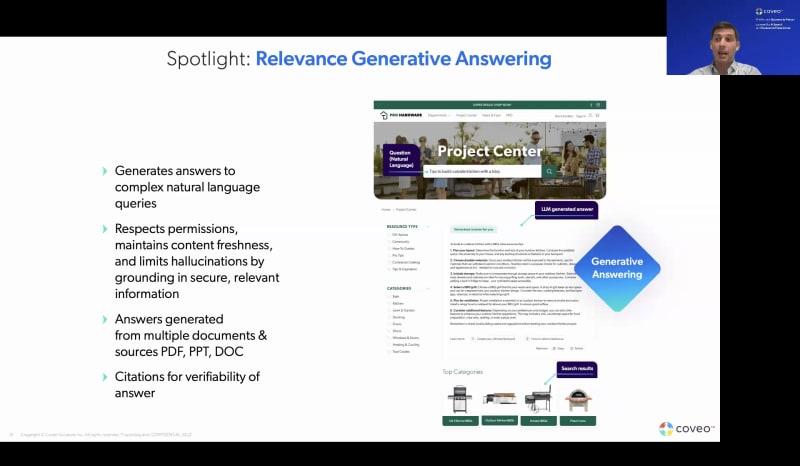
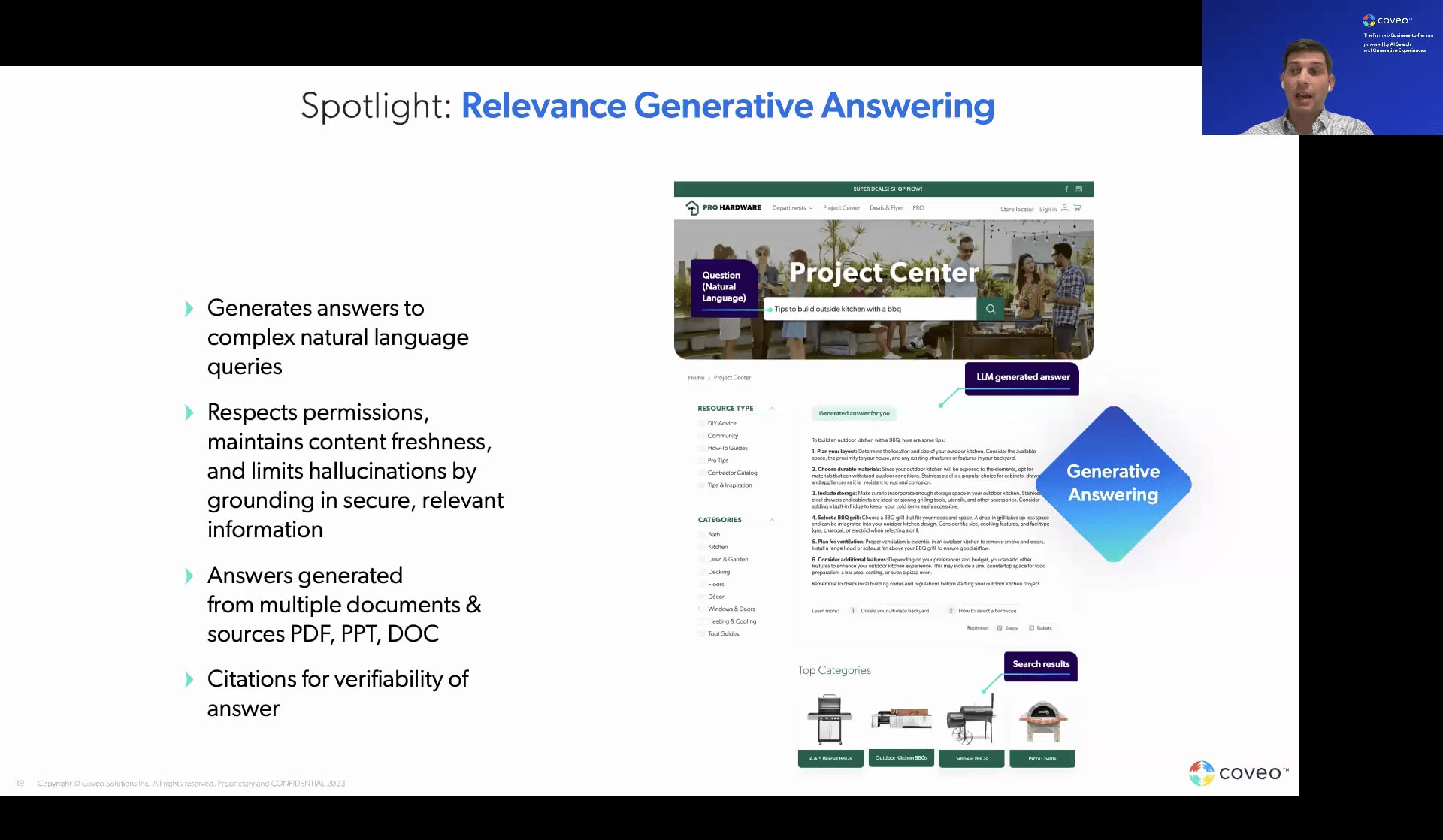
Hello, everyone. Thanks for joining today's partner exclusive webinar on the competitive landscape, Coveo differentiators and value drivers. My name is Mike Raley. I'm based in New York, and I'm the SVP of marketing for Coveo. And I'm super excited to, welcome you to, to join our discussion today and to introduce to you our speaker, Andrea Polonioli. Andrea is a senior product marketing manager at Coveo based in Europe. He joined Coveo about four years ago, when Coveo acquired a company he worked at called TUSO, and he's since become one of our internal resident experts on the the market overall, for commerce and commerce search in particular. Today, he's got a great presentation, prepared for you, to share context to equip you with the knowledge on why and when Coveo wins and give you the tools to articulate Coveo's differentiation to your clients. If you'd like to dig deeper on any of the topics that we're covering today or have further questions, we'll have a little bit of time at the end of the discussion today to talk live and are always happy to set up extra time to do a side conversation. So let Andrea or me know if you'd ever like to follow-up. In this session, we will plan to discuss elements of Coveo's product road map and will be making some forward looking statements. Coveo is a publicly traded company, and this slide reminds you to only make purchase decisions based upon currently available technology. If you'd like a copy of this slide in French, please reach out to us. We would, happily make that available to you. Also, we are sharing this information to make you, our Coveo partners, more successful. Please bear in mind this content is being shared under the confidentiality kind of confidentiality agreements that we have with all our partners today. So with all of that, logistics out of the way, I'm excited to introduce you to Andrea who will take it away. Andrea? Well, thank you, Mike, and, hi, everyone. Welcome to today's, webinar. So I generally believe it's useful to start with an agenda, to set some clear expectations about what we'll, be talking about. So, fundamentally, we'll be talking about three main questions and topics. So first, you'll learn about Coveo. We'll discover, Coveo. Some of you may be very familiar with Coveo. Others may be less. So so we'll start with a recap of what Coveo does really both as a platform and specifically for search and product discovery. And what makes Cobell so special and different, and what's the ideal customer fit. Second, we're going to talk about what we see in the market. So these are really exciting times with so much happening around search and for discovery and, of course, around AI and GenAI. So we want to take some time to review what we are seeing in the market and how we are reacting to to it. So, third point is why Coveo wins. So, Coveo is obviously not alone in this market. There are several vendors, actually. It's a crowded market, and I think it will be useful to clearly recap why and where customers tend to just Coveo over other well known, solutions. And so let's start, by talking of, learning more about Coveo. So, today, we will be focusing on the commerce side of business of our business at Cobello or better on the search and product discovery side of things. But I think it's generally useful to start with a brief introduction of Coveo as a platform because we do more than just ecommerce. We do more than search and product discovery. So the Coveo platform is a composable AI service recommendations and generative experiences platform, and it can be applied across multiple touch points and use cases. And it offers relevant product and content search, tailored recommendations, and one to one personalization, And it delivers what we call the AI experience advantage, which means that with Coveo, you can really provide superior customer and employee experiences at scale without breaking the bank. And we are not new to this, so we've been around for almost two decades, leveraging AI for over ten years. And, I think that it it's it's also important to to say that at Cabell, we really leverage our spinal AI, our robust suite of AI and Gen AI models to deliver relevant experiences across website, commerce, service, and workplace use cases. So to compete, organizations must deliver experiences that are always relevant, experiences that really understand the particular needs of customers and users, experiences that are cohesive and connected as people move across various touch points, experiences that pick up exactly where you left off and constantly learn from each and every interaction, while Coveo is really the AI platform that, can deliver all of that. And, far from being a digression to today's topic, which is our competitive landscape and differentiators within search and price Coveo, I wanted to call out, three specific reason why this is actually a very relevant topic today. So why does it matter that we are a platform? Like, Coveo, is this platform laser focused on relevance? Well, first of all, it's important to focus on solving customers' problems. And so you may be working on digital transformation projects about b two b that, aren't just about improving the experience from product for product sales, but they are broader than that. And for example, they can involve their ability to help buyers to only research, but also to help b two b sales reps, when it when or if buyers actually reach out to them with some specific questions about products. So Coveo as a platform is ideally positioned to help with those broader digital transformation project. Second, from a capabilities and technology standpoint, the fact that we do more than commerce is nontrivial because ecommerce customers can actually benefit hugely from that. Not only because it means that we have capabilities from content search and, content recommendation that we've mastered due to our expertise in other use cases, such as website or service. But just think about GenAI. While our competitors in search and product discovery were struggling to figure out, you know, how to deploy Gen AI for search and product discovery, we had a huge advantage there. Meaning, we could go live in very few weeks just leveraging all the expertise, the experience with frameworks from retrieval augmented generation and Gen AI that we had mastered, for example, in our service line of business, where customers like Siro saw a tremendous amount of value in a really, really short period of time. And third, because a message today is also that there is room to expand, to grow their account by selling products other than commerce. Even if we start, you know, with our offering for search and for discovery, there's more to sell, you know, to increase the value of this account. So it's actually very common for Cobell to start, let's say, with commerce and then add the service. But, of course, today, we will be focusing on what Coveo offers with its, you know, product for commerce use cases, and we'll be focusing on search and product discovery as a category. And, and there are a couple of important points about this category. So the first being that search isn't just one touchpoint. So it comes, for example, with query suggestions and relevant facets for query refinement. And the second one being that product discovery is broader than search. So it it's really not just about queries either. It's about goals. It's about helping customers find the products they need through a number of touch points and capability. So as you can see here from this example, you may have a journey that starts with customers landing on a home page and then going to some category pages, expecting them to be order relevant, and helpful. But maybe then you have customers, you know, looking for query suggestions to formulate a helpful search that returns results or facets and filters to narrow down the result sets. Or maybe they will hope to be able to get answers to their questions about products through GenAI or to receive some smart recommendations based on their intent and behavior. So this is just to say search and product discovery is much more than just a search box. And in order, to win, you need a holistic approach. You really need rich complete functionality. So if you just focus on, you know, say, a result set, but don't really deliver solid recommendations, query suggestions, or facets, So then your approach is overly focused and not aligned with the fact that customers expect you to deliver compelling, relevant experiences across all of these touchpoints. And, and so the category has evolved and has become regional in terms of expected functionality, ensuring that functionality ensuring that functionality is reached excellent through and through was recently acknowledged by leading analysts. And more precisely, as you can see from this slide, Garner has a magic quadrant for this category, and they just published their inaugural report. And we are really pleased to have been named leaders and to be positioned highest on the ability to execute exit, which really means that, you know, our product is perceived to be excellent through and through, and our customers, receive great experiences. So we really received a special mentions for our AI vision, large enterprise focus, and precisely as we we were discussing, our reach functionality. And, you know, we've been talking about Garner's recent assessments, and so it's worth noting that Garner has also published its critical capabilities report, which is complementary to the magic quadrant. And we also received some impressive scores for our merchandising capabilities as well. We were ranked as the second best solution for merchandising merchandising capabilities with four point seven out of five. So the reason I want to mention this is that Gardner's recognition also serves as a great testament to all the investments we've made in merchandising over the past few years. So Coveo has always focused on providing plenty of capabilities to tailor experiences to business priorities, supporting merchandising needs. As you can see from these slides, Circobal is, you know, of course, committed to delivering experiences that are relevant and aligned with shopper intent, but also aligned with business outcomes and supported by powerful merchandising tools. So, clearly, merchandising has been a key area of focus for us at Coveo, and I wanted to touch briefly on our short term road map for merchandising. As you may have heard in the past that Coveo is more tailored to more technical users, nonmerchandisers. But this couldn't be further from the truth today because, it's true. We've always had a a powerful merchandising core and backbone. But more recently, we focused on making the experience even better for nontechnical users. So these, can still apply sophisticated configurations for retrieval and re ranking, but we've also made experience increasingly intuitive for merchandises. And so we've got plenty of features that are either available in early access or just about to be sold, and that are really adding a layer of control and visibility for merchandisers. Again, this is not new in terms of output, in terms of experience for the shopper, But, really, the experience for the merchandise has changed. If you attended if you attended some of our latest new in Cobell webinars where we showcase our latest and greatest, you probably heard about how business users can now really easily influence the ranking of products by boosting, bearing, thinning, or blocking specific results. But now there's much more than can be done. Not and and, I mean, it's not only, with the easy management of synonyms, but also with controls available, not only for search and listing pages, but also for recommendations. Plus now business users and merchandisers in particular, can easily schedule rules, adding a date range for hiding or promoting a product, and they can apply rules at a global or local level. This is very important, and at Coveo, we recognize the complexities and challenges of managing multiregion commerce sites. Plus merchandise have now plenty of visibility into how, and why an item is returned or recommended. So what I wanted to say is that this recognition from Gartner is both timely and greatly appreciated. It validates all the work we've been doing on merchandising. And, overall, the key message is that if you've heard in the past that we're not merchandiser friendly, that's quite old news, that really doesn't match the reality of things today. And, but going back to the, three key strengths, identified by, Garner in the m q, AI vision, large enterprise focus, and rich functionality. I think that Garner actually did a a really nice job at capturing some of the key differentiating capabilities and value drivers at Coveo. But I'd like to elaborate a bit more on this. So Connor has praised our AI vision, and indeed AI at at Coveo is front and center. We've been using AI for over ten years, and we know that many vendors claim AI capabilities, but often only trigger by recent excitement around technologies such as GPT. And, actually, they started the AI journeys only a few years ago. At Convergent, the situation is different. We offer multiple time testing models, that enterprises can truly trust, and we've been pioneers in deploying Gen AI with customers recently. But I also think it's crucial to highlight our underlying technology Because unlike most search engines, which rely on Lucene and use Solr or Elasticsearch for managing keyword searches and results. Cobell operates on a proprietary indexing Coveo, and this proprietary inverted index outperforms other popular variants in the field, providing a significant advantage to our b two c and b two b customers by not being constrained by third party solutions. So Ghana also highlighted the focus, on large enterprises for Coveo. And, indeed, I would say that a second differentiating factor is our enterprise focus. So Coveo has the necessary capabilities to meet the complex and demanding requirements of enterprise level customers. So this includes scalabilities across large and deep catalogs. Support for complex use cases such as real time inventory availability and buy online pickup in store scenarios and the unparalleled ability to meet the highest standards when it comes to security and compliance. That's pretty unique. Additionally, we provide customer success services to help large enterprises while actually succeed. At Goveo, our customer success is a priority. We offer immediate support to help fully leverage the platform and and and meet their KPIs. So we know that we know that some competitors either outsource support and success, which often leads to delayed responses and times on challenges, or do not include it in licenses, which means that, you know, that there are significant increases in the overall contact value from the original quote. Well, Covell's focus on enterprise is clearly reflecting not only in the product, but also in the pricing and the packaging as well. But I would add as well as a third differentiating factor that Coveo is uniquely positioned to provide a connected, unified, and blended experience. So we are the single brain covering and empowering really intelligent experiences across complex long journeys and the multitude of touch points. So we handle search, but also recommendations, but also general keep answering and more. We support both product and nonproduct content, and we address the complete customer life cycle from discovery to service and support. Again, that's quite rare. And as we'll see, it's it matters quite a lot to our customers. And, and I think that it's important to talk about our, ICP as well, our ideal customer feed. So it should come as no surprise based on what we've been discussing. That if customers don't really see the value of AI and want to curate manually all the experiences, if they don't really have a complex or deep catalog, probably Coveo wouldn't be the best fit. So we really try to choose, Coveo, and we we really try to choose carefully who we sell to because we want to make sure that we can drive value and have customers that can stay with us for a long time. And that's also why we have, such a high retention, you know, around ninety nine percent over the past three quarters. So when you have companies that really need to solve, challenges around complexities, buy online, pick up in store scenarios, or dealing with multiple geographies and languages. Or if you've got organizations that don't just need to service relevant products, but also technical documentations or blogs or how to guides. We are definitely a good fit. Similarly, if you have prospect of course, Converse is the go to solution. Of course, Compare is the go to solution. But, of course, you know, we we covered our very distinctive identity focus and positioning in the market. And it's worth discussing what what we see in the market in terms of trends, noting that we keep seeing interesting trends in the market. And and we don't just look at them, but we also try to react to them. So, so I think that, first, we are seeing composability gaining, momentum not only in b two c, but also in b two b with an increasing number of brands versus retailers and manufacturers shifting towards modular, composable services, and opting for an approach all about pluggability and best of breed. And that, of course, means that vendors as well as, the the vendors as well are investing in this direction because they're trying to meet customers' expectation. And second, pretty much every vendor has been talking about Gen AI in one way or another over the past year and a half, but now we are beginning to see real use cases in search and product discovery. Now these are emerging, and the brainstorming testing stage is Coveo, and vendors that can truly deliver on the promise of GenAI are starting to distinguish themselves from the pack. And third, we see that companies are actively looking for ways to to measure and understand the real impact of AI before making investments. So, specifically, the risk in tech investments has become increasingly important for organization and will continue to trend or think throughout the remainder of the year. Brands, retailers, manufacturers, and distributors are all looking for ways to assess the potential impact of AI, and they're trying to use less invasive approach than traditional proofs of concept. So these are trends we observe, but we also are very active and proactive players in this market. So I take the opportunity to share some updates about these trends as well. So first of all, composability is a key trend. We said it, but since every vendor is talking about it, we wanted to ensure that our prospects and partners could be reassured that we truly embrace composability. So we got actually MACH certified where MACH not only offers offers a very precise definition of the business notion of composability, focusing on microservices, API first, cloud native, and headless technologies for the architecture, but also offers a rigorous process to get certified and stand out from the pack. So we were actually told that our assessment was one of the very best. We're actually quite proud of it. But second, in terms of Gen AI, we went live on a customer site with a Gen AI use case that is around customer projects and tests or experiments with Gen AI. It's really live Gen AI at enterprise scale for knowledge and product discovery. So it's pretty big news. And I really wanted to spend some time to clarify what I mean by customer education because in traditional in store interactions, we all know it, customers can naturally ask product related questions. But replicating that experience in an online environment has become has been a challenge. But what you also see in digital commerce is that companies often have vast amounts of buying guides, inspirational how tos, and other rich content that is used to inform and inspire and that can be used to offer conversational answers to shoppers that in turn will guide them to purchase the product best suited for their needs. This use case is relevant to most segments in b two c and b two b. However, it's easiest to margin the impact that using Gen AI will have on specific verticals such as home improvement, grocery, life sciences, b two b manufacturing, distribution. For example, imagine at a home improvement site, you a buyer might ask for tips to build that now inside kitchen with a barbecue. Coveo can augment the shopper experience with GenAI so that Coveo and relevance relevance generative answering functionality can select the best documents within the index based on relevancy and then generates a conversational answer that offers tips and various steps that need to be considered. And and, importantly, as you can see, rather than just doubling down on chatbot interfaces, we believe that there exists actually a better, more effective way to embrace conversational and generative AI re while retaining all the strengths of traditional search interface. So Kombeo's approach is really focused on integrating conversational AI and generative AI within the search framework to address complex queries and enhance customer education. So we could, of course, power chatbots, as well, but we believe that doing so is often not necessary and also risks disrupting users or customers' experience due to an unfamiliar interface and, actually, additional friction. And third, we noted that customers are seeking for are looking for ways to derisk investment and, and really to witness the impact of AI quickly and easily. So in response at Coveo, we launched an AI experience pilot. So this pilot really involves a lightweight, proof of concept, which is using a tracking beacon. So prospects simply need to add a beacon to their website and provide us with a product feed that allows us to demonstrate Kavelo's impact really easily and effectively. So, importantly, all the key capabilities that we've mentioned or alluded to, including one to one real time personalization and Gen AI for customer education can be part of the pilot. So this setup really makes it possible to showcase all our AI models for ecommerce, from GenAI to predictive query suggestions and content suggestions. And, as we move to the last segment of this webinar, I want to examine our competitors and recap why and and where Coveo wins. And, of course, in a one way of looking at the competitive landscape is by looking at the way in which solutions are packaged and the types of investment that prospects may consider. So investing in search capabilities can take three main paths. So first, you can choose a dedicated stand alone, full stack. Solution which is separate from other products that vendor sell and support. We're talking about the Algolia's, the Bloom Ridge, the Constructor, and, of course, we are part of this category as well. But, of course, there are many other vendors as well. Then you have a native search option bundle, into an ecommerce platform. You have here SAP sales for HCM, and, of course, you have other options as well. And third, companies can build their own solution, typically using the, using open source components or in the case of Elasticsearch, originally released as open source, but we see solar more often in ecommerce. And I I want to touch briefly on this, do yourself category I just mentioned because we encounter Solr more frequently than open search or elastic search. My intention is not to critique an entire category. Indeed, numerous successful ecommerce websites use open source or formally open source tools to power their search, and they perform quite alright. The main point is that Coveo really offers an enterprise grade, fully productized solution that provides your customers with, with everything they need to succeed both today and in the future. So alongside the package relevance, the foundation provided by our proprietary index, multilingual, typos tolerance search, analytics, and much more, We also incorporate forward looking capabilities based on deep learning, generative AI. So, essentially, choosing Coveo means subscribing to innovation. It maximizes your return on investment. It mitigates project risks and ensures immediate success without the gamble of, potentially succeeding after years of of significant investments in resources and staffing. And precisely, I believe that the argument for choosing a commercial solution like Coveo has only strengthened with, the advancement in search technology and information retrieval, particularly with the rise of generative AI. So after decades of time tested paradigms, we are now seeing innovative approaches like retrieval augmented generation and other AI driven innovations, paradigms that Coveo has already mastered. So, really, at a time when, the industry is changing so rapidly to confident I mean, too rapidly to confidently go it alone, the best the safest bet is fundamentally to capitalize on Covero's currently available technology and expertise. And if we take a focused look at the competitive landscape in, in in the SaaS, side of things, Cobell caters to large enterprises addressing their, you know, complex needs. Then, of course, there are vendors like Constructa, which while serving some large enterprises as well, also target midsize and smaller companies. Some of their clients have only a few hundred SKUs. So we think it's very important to focus because if you don't do it, you end up spreading spreading your product to thin, ending up serving for everything which isn't just so valuable. Then Algolia, with its seventeen thousand customers, does include some enterprises, but primarily supports smaller or midsize businesses. It's really built for those with, small teams and simple catalogs who are functioning quite well out of the box for such cases. We also see solutions like, Lucidworks, Factfinders, you know, in replacement projects, and they appear to be in decline, then there are, industry or vertical focus vendors. For for example, Hooksers primarily serves the b two b sector and does really engage with the b two c market. Conversely, Google focuses almost exclusively on b to c. Additionally, there are vendors that offer search and discovery that don't but don't really prioritize it. It's kind of sold as a secondary offering. For example, Bloomreach, especially after acquiring Exponia, has shifted focus toward the CMS, CDP, and omnichannel marketing capabilities. So and and, similarly, Skycor, despite offering search and price coverage capabilities through the acquisition of Reflection continues to focus primarily on its CMS first business. Lastly, there are there are vendors like Zuvo and Insight who specialize in specific aspects on search and product discovery. Zuvo, in particular, excels in product finders and quizzes, but falls short in other areas like, well, search. And the site is also popular option for visual search, but its other search related functionalities are actually reportedly underwhelming. But, of course, there are just so many spectrums criteria that you could use, to organize and discuss competitors' position in the market. For example, if you focus on the most popular vendors we see, Algolia is a is a developer friendly platform with solid documentation, appearing to a technical audience. There's no doubt about that. On the other hand, you get BlueMerch with a user friendly solution with with rich functionality appealing to an audience of merchandise. And so the user base is really their core focus. And Coveo often sells into quite complex scenarios, so it support, developer documentation. And while, traditionally, merchandisers haven't been our primary focus at Coveo, as we've seen, that has starting to change quite significantly. But second, you can, you can have rule based on AI based approaches. So, of course, Algolia has been adding some AI tools and capabilities, but remains fundamentally role based with manual approaches needed, for example, for a facet reordering. And that's also the reason why it's actually not a great fit for enterprise. So Coveo is definitely stronger on that. We offer twelve machine learning models for end to end relevance from query suggestions to filters, from retrieval to re ranking and beyond. And, of course, we are laser focused on enterprise. And as we say, Angola among, their seventeen thousand customers have a large majority of smaller businesses. And then, of course, you got BloomRidge, but that would also apply to constructor, which are focused on commerce and and retail in particular. Whereas we do commerce, meaning both b two c and b two b, but also website, but also service and workplace. That's why we say relevance three sixty here. We are laser focused on relevance across use cases, and the Cobell platform delivers relevant experiences to use of customers and and employees across a wide range of touch points. So Algolia does mostly commerce, but they also do website search, of course. It's worth, noting, however, that Algolia is more focused on commerce and probably better suited for that. They have some strict size limitation for records that make them not so good a solution for many b two p project, for website and beyond that. And, after the breakdown and overview, I'd like to share a a few more details about why we win and when we win, against our competitors. So briefly, many of our many of you actually, probably have experience with Algolia. Some may have implemented it many times. And, again, we really think it's a solid choice in some context. So if you have a small brand in apparel or fashion, simple catalogs, no real need for AI, any AI cut I mean, a catalog that is really simple, so simple that there's no real room for personalization. Well, I would say that probably, Algolia would be a great fit. Again, we're very careful when it comes to choosing who we sell to because if we cannot deliver value, then there's really no point in in in trying to sell to it. In instead, we see that customers tend to just compare over Algolia. When, for example, there's a a project that is broader than product search, We know that Algolia will say they do more than product search, but the reality is that their support for internal search use cases in like workplace or service oriented external search use cases is minimal. I mean, years ago, they announced Algolia answers for service, but then they withdrew it from the market. So for example, the fact that, that the the fact that Kubernetes is a platform serving multiple use cases or one of the key reasons why LG Electronics chose Cobay or considered complexity. So we most recently won at Thalia in Germany, and that was a race with Algolia. It was giant giant catalog, millions of SKUs, and they wanted to do personalization and that massive scale. We did a win based on Slideware. We actually did what we mentioned at the beginning, an AI experienced pilot. Algolia did the version of it, and, Fort Belia, it was a no brainer. Of course, when we talk about complexity, b two b often epitomizing epitomizes complexity, which means not only many product, but also many pro many attributes, custom catalogs, and pricing, products and content. A huge amount of factors that need to be taken into account. And one of the customer that chose us over Algoliz, for example, Southern Glazers, and they were impressed by how Cover's proprietary index, could help them with their challenges handling content and products seamlessly and the complexity of their catalogs. And or consider the importance of EI and innovation. Philips giant enterprise that needed to ensure automation rather than manual merchandising and tweaking, which is just not sustainable at this scale. Comair was chosen over Algolia, and our AI was clearly identified as a strong differentiator. So just consider that Algolia doesn't use AI to reorder a facet automatically, which is, of course, needed when you're dealing with complex catalysts and products. So you can compare that against that offer offers twelve machine learning models from free suggestions to retrieve, but from reranking to recommendations and beyond. And, and some of you might be familiar with, with Bloomreach, which used to be a fairly popular, solution for some big c use cases in the past. However, they kind of deprioritized search and product discovery to focus more on other areas of the business, like their CDP, CMS, and omnichannel marketing. So we win when customers choose us and and and customers choose us when search is really understood as a priority. So at Coveo, search and relevance are not secondary. They're front and center. In contrast, Plumridge is now focusing on other areas. Our focus, however, is not diluted. That's why, for example, we recently placed them at Puig in Europe. And it's not just that they are not investing in search anymore. There are also some inherent fundamental limitation in the search capabilities rooted in the fact that their search core is not proprietary, but based on solar, which imposes nontrivial constraints. For example, at Kimball Midwest in B2B, one of the main reason for choosing gas at Coveo over Bloomage was precisely a proprietary index of Cover, which allowed them to handle complex very seamlessly. And AI innovation is a huge priority. At Covell, we invest heavily in it. As we said before, that's also why companies chose us over over Bloomage. The Bloomish might seem, usable and intuitive for merchandise, but the reality is that their AI capabilities are somewhat limited. A case in point is personalization. We build proprietary deep learning technology to personalize experiences not only for known repeat customers, but also for anonymous guest, leveraging in session behavior and all the click stream data and signals that customers have made. And, again, of course, our platform strategy, and story is one of the key reasons customers choose us. That's why Chamberlain, for example, chooses chose us over, Bloom Ridge, to deliver relevance, not just for product discovery, but also for enhancing service and agent experience. And, of course, there were other vendors as well. So briefly, we can review some other vendors. Constructor is a vendor we are starting to see more often with, you know, they've tried to grow really fast. They announced some, new funding last week, so we expect this trend to continue. And they've been enriching the product offering, the product suite. So but it's still a product, most suited for more, for some specific industries and verticals. For example, we don't really see them frequently in b two b. They have serious gaps, for example, around content search, which is, not so good. Typically, customers choose us when they are looking for advanced AI models and sophisticated personalization even for anonymous users. For example, that was the case that you need, select the Canadian b two c portal and marketplace for for the automotive industry. And a comment I have is that, with Constructor, definitely, you get a vendor that, tries to rerank products in session in real time, but that's not real personalization because it's mostly chaotic reranking that overreacts to their last products viewed by a pro by a shopper. I'm also going to briefly mention, Lucidworks. So, I'm I'm sure you're all quite familiar with their offering. It evolved from open source projects. In a way, it's similar to Coveo because it focusing on relevance across a number of use cases from service to commerce and beyond. So we see them in commerce, but also service and workplace. So, typically, we see that customers, that value innovation driven by AI over the need to rely on manual rules choose Coveo over Bloomish. For example, we replaced Lucidworks at Menards, and, the deployment had been tuned with manual rules over several years by the merchandising teams to add patches. And we actually did an AB test, and and managed to prove the business value of upgrading to Coveo. So I'm going to briefly, just, move to the, very final slide. I want you to say there are resources available. We have a wealth of resources available to you from white papers and guides, to our own RFP template for search and price recovery. We will make sure that, you know, some great success stories that extend beyond our commerce use cases such as the case study with Siro I'll also share with you. And, of course, I'd like to if you'd like to explore some topics in more detail, we're always very happy to spend some time delving into them with, you know, with with you with our plat with our partners. So please feel free to get in touch with our partner with your partner manager. That concludes, my presentation. Thank you all from, for your attention. Amazing. Andrea, thank you for such an incredible, and thorough presentation on, Coveo differentiation and and some of the alternatives on the market. I'd like to thank you all for for joining us. We have a moment or two for questions. You know, we wanna maximize the time we all have. So if you do have a question that you'd like covered today by Andre or me, you know, please use the q and a function in the Zoom. We'll take, you know, two or three questions for next few minutes, to to make the most of the time. To kick us off, actually, there's one here right here already. Andrea, could you talk about how Coveo pricing is different to some of the alternatives you're aware of? Yeah. Very good question. So I would say, at Kelle, we treat pricing, packaging with the same principles and commitment between our products and reliability and transparency. And concretely, it means that we really focus on what is most aligned with the value we deliver, to our, customers, which means queries. So we're not based on on traffic. We're based on on searches and queries. So our pricing model is based on consumption and queries per month methodology. So we think that that approach, is very closely aligned with the value delivered to our customers. And, it's also important to to clarify that not all, operationalizations of, searches are the same. So, we we think that in in some cases, it's important to to look at the details. So how do you define searches and queries? The way we define them is, very much aligned with the value we deliver. In other cases, we know that it's a lot it's it's based on, for example, keystrokes, but in our case, it's it's not. So so it's it's always important to, compare apples to apples. So what I would say so, if you have any specific questions about our pricing, feel free to get in touch with us. It's it's a very transparent, approach that, doesn't provide any surprises for you. Excellent. Yeah. No no one likes surprises when it when it comes to pricing. On the on a similar note, how do you recommend we, I guess, from the perspective of a of a consulting partner, guide clients when they're evaluating multiple platforms? Do you have any tips? Yeah. Well, first of all, top of mind, of course, there is just now a third party assessment, the magic port and report, which provides a solid, unbiased assessment of, solutions in the market. So we're proud. We're very happy to be leaders, and I would say that's a good place to start. There is also, say, a critical capabilities report, which is complementary to the magic portal, and that provides more granularity. So I would say, for example, if you are looking for a b two b, use case, the critical capabilities report will tell you specifically what the best solution for a b two b use case is, and it would be, for example, in the case of b two b. So that's that adds some granularity. Or if if composability is really an imperative is is really important to you, looking for some max certified vendors can also be useful. I would also add that we also have an RFP time play that we make available to prospect, and, of course, we can make available to partners, and that can, ease facilitate the selection process. We think it, includes all the relevant questions that you should consider. And we also mentioned during this presentation the experience pilot as a way to prove, an ROI and impact. So, of course, that's also something that that prospects and and newest partners can consider as well. Excellent. Thank you. And I think there's time for just one more question. Let me see. I, I'm curious. How can I ask for my client to get a Coveo business value assessment? I think you talked earlier, Andre, about business value. You know, could you talk a little bit about the, you know, the capabilities Coveo has there? Yeah. No. Absolutely. So, I I think that the easiest way is really to contact your partner manager or, you know, Coveo a, to kick off a business value assessment for, for one of your clients. And I would say just you know, we're really proud to have this, BBA process in place. It's it's an easy process available that really helps us articulate the the value of the, that the Coveo platform can deliver. So, it it provides with it provides customers with a measurable success plan. So it's really something that makes us stand out. So we have a team of experts really dedicated, laser focused on demonstrating how Coveo can help prospects and customers achieve the value. So, so, really, I would encourage you to, to reach out to your panel manager or Coveo. I don't know, Mike, if you have, any comments on it. I, yeah, I I agree. I agree. I think the best the best approach is to, you know, work with your Coveo AE that you're in contact with, you know, either on the specific opportunity you're talking about or or talk with your partner manager. I think those folks can get you in touch with the the Coveo team and help you with any information that we would need, to help you, you know, make that case. So with with that, I I wanna say thank you for, for joining us today with this really, you know, phenomenal session. Andrea, thank you for all the intelligence and insights that you shared with everyone. I think it's gonna be super valuable for folks to have, with them. As a as a reminder, you can contact, Andrea, your partner manager, your Coveo AE, or me if you have any questions or ideas you'd like to discuss, especially if it's something, wasn't covered during the discussion today that you'd like to have as a follow-up. One more point, for those of you who are working with one of our partner managers, Zach Lewis, he asked me to let you know that, he's gonna be leaving Coveo this week, and he, is saying goodbye for now. So if you would like to, please reach out to him and say goodbye. But then if not in the meanwhile, I'll be your your point of contact, and we'll be in touch shortly. So with that, thank you all very much for joining today, and, wish you a good one.
Competitive Landscape: Coveo’s Differentiators and Value Drivers