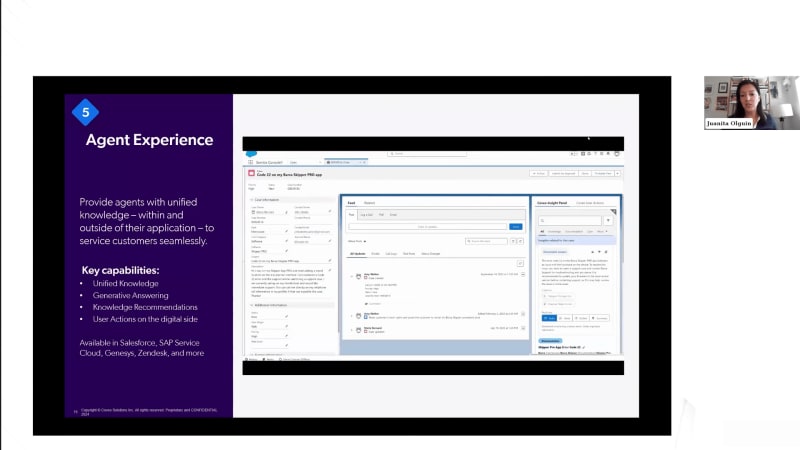
So our next session is brought to you by our partners at Coveo, and is presented by Juanita Alguin, who is, senior director of product marketing at Coveo, and I can see that she's just joined me now. Juanita is on a mission to help enterprises leverage the power of AI, and generative answering to really make the most of and amplify existing systems, while empowering both customers and employees. So she's been in the productivity and digital workspace space for the last fifteen years. So, again, we're in wonderful hands today. Please do remember to use the q and a button. If you've got any questions for Juanita or the chat, I'll be keeping an eye on that. And remember as well that this session is being recorded. Without any more, talk from me, welcome, Juanita. Thank you very much for joining us today. Thank you, Chloe, and hi, everyone. Really looking forward to the presentation today. I believe we started by saying we were going to have five ways that you can use AI and Jenny High to connect and personalize your CX journey, but I found the sixth way and the sixth, use case I would love to cover with you all today. So I'll just jump right in. So I believe we are all here today because we believe and we know that CX is a competitive differentiator. We can see Gartner highlighting the fact that eighty nine percent of companies compete primarily on the basis of customer experience today. But what does this mean? Right? What what do these words mean, and how can we internalize them? What I wanted to do was give you a few personal examples. It's much easier to visualize and understand what being a competitive differentiator means when we consider our own personal and consumer lives. And so there's three examples here I just wanted to speak to you about, including personal banking, buying a car, and shopping for everyday products. Now when we consider each one of these, these are things we we normally naturally do. Right? Each one of these each one of us has an experience transacting. Now when it comes to personal banking, what really sets companies apart, right, when you start to think about the products and offerings that they provide, including loans, savings, CDs? Similarly with buying a car, there are many different options out there, and today's vehicles are mostly competitive when it comes to offering the right digital, experiences or just being really up to date on the latest technology. And from an everyday shopping perspective, you you know, we there are plenty of choices out there, and some stores or online shopping even offer the same products. So why do we choose the brands that we do? Why do we shop at the places that we shop? Why do we choose the banks and financial services that we do? I think we can agree it comes down to, yes, personal preference, but also the brand themselves and the trust that they provide. And part of that trust, though, is does include the digital experiences because we, as consumers, like to be self sufficient. We like to, self serve. And so what happens when consumers or customers have a bad experience? Let's take a look at that. Well, we can see seventy three percent of consumers who have one bad experience would rather do business with the competition. Some of the examples I just gave on the previous slide, really do kinda showcase that switching costs are low. Right? There's so many options and choices out there. And so depending on the type of business or industry you're in, your customers could easily switch to choose someone else. The choice and switching costs are really low today. On the flip side, seventy five percent of customers, who do business said they would do business again with a company if their customer service was excellent even after a rep may have made a mistake. So this goes to show that it's really about that brand, that experience, and that service that's being provided to end customers that help that makes them decide to stay with the company or not. Now I wanted to offer this last stat, which I think is pretty significant, and that's the fact that there's three point seven trillion dollars of revenue at risk this year alone due to bad customer experiences. What this shows is that we have work to do. Now we are all here, I'm sure, to uncover what are some use cases, how it can we get better. And I will show you those six examples that I mentioned. But I did wanna talk of to the fact that there's three key factors that are really stopping digital customer experiences from being as good as they could be. And so I'll explain each one of these, briefly and would love to hear your experience and if these resonate with you. The first is that customer experience is a misnomer, and it's often undefined at companies. If we consider the name alone, the word customer in in the in the name and the title, oftentimes, people either think this is purely, and primarily in post purchase or post sale of conversations talking about customers alone. And maybe some think it's actually prepurchase or prospects that have yet to become your customer. We've talked to some companies and depending on your maturity and stage that you're in, some think CX is purely around customer service and support. And, again, others think it's more along the digital, the digital experiences on your sites. The fact of the matter is that CX is really that end to end experience across your sites, across your workers, and it includes employees who are internal customers as well. The second key factor in terms of not being able to get CX right or why it's a little bit more difficult is that different teams actually manage different parts of CX, and they have different goals. So on the website side, that's probably owned and operated by your marketing and web teams, and their primary concern might be around driving conversions, increasing SEO, and their and organic sessions. Now if you have a transactional component on your sites, your commerce teams may be the ones that are in charge of those, you know, those buying sites or those listing pages, really trying to help people buy effectively. Now your service team, of course, is in charge of providing that great customer experience, really trying to help, your end customer self serve. But here, teams really are pressured to, you know, reduce costs while increasing, customer satisfaction. And then on the employee side, of course, we wanna ensure that all of your employees, your knowledge workers that likely interface with your end customers are prepared with the with the best knowledge and information available to them. As you can see, different teams, different goals, really making this a little bit challenging. Furthermore, because each of these teams own different parts of the customer experience, they have their own budgets and their own buying decisions, and they can decide to select whichever technology makes the most sense for them. So, of course, on your website side, you have your digital experience platforms, your content management systems, and and technology to choose from. On the commerce side, you have, you know, again, more commerce focused tooling. On the service and support side, you have your service management applications. And, of course, as an employee and work in the workplace, you have your workplace tools like Slack, Teams, your intranets, things of that sort. And so, really, I think we all, by experience, know these tend to be disconnected, siloed, again, managed by different teams. So this begs the question of how we can break down those silos to connect the experience while being able to amplify all of these teams that do play an important role in that end to end digital customer experience. And that's what I'm gonna cover with you for the remainder of the time I have with you today. It's six ways we can use AI and generative answering across your digital experience, I'll say sites and applications. And it will cross from self-service, being enabling and empowering visitors and customers to find what they need on your sites, but it'll also dive into the agent experience side and what you can do there as well. So jumping right in, the first is considering your community portals or your sites that visitors might be interacting with. Where they go to find information, and you wanna make this as easy and seamless as possible, providing AI guided recommendations on what to search, providing content recommendations based off of what others found to be successful. The idea here is making it easy and simple for users to know what to search, how to search regardless of whether there's a typo or a synonym. That's the type of technology and how you can consider Coveo to help users on these self-service sites. Now the second, and we'll continue this journey as a user. By the way, this is using our own internal demo environment, Embarca, which is a fictional voting, company that we've developed just to showcase the different capabilities we can offer. So I just showed you our general community portal, and here I'm showing that community portal with a search executed or a search entered. And what you can see is that there's a lot of different, AI here helping recommend the right content to solve for that query. You saw a list of results which will be the most relevant and come from different systems and sources all in one unified view. You see the generated answer, right, that it's an answer and not links so that a user can just quickly process what they're looking for, and they can decide to give feedback on whether this is good information or bad information. They can copy this answer. They can link to citations. So lots of great tooling there to help users find what they need. Now what I'm showing you there was an unauthenticated or logged out experience, but we you can also consider a logged in experience. So for those of you that have, customer sites where people need to log in to get access to gated information, we have that experience as well. Again, here, security is of, you know, of utmost concern. But as you can see, we're showing and exploring other types of AI, dynamic navigation, and, again, relevant results that are there to help users find what they need. You can see a quick view here, including keyword highlights to help help the user know and be confident that what they're finding is the right thing. And so this is showing that you can use AI, unified search, and generative answering for both that logged in and logged out experience. But you can see some consistencies here in terms of that look and feel from the functionality you can consider across multiple different experiences. So what we're what I'm now gonna move on to is our case assist experience. And so let's say a user could not find what they were looking for on your community portals. So now they're starting to consider that they need to reach out to support to get, you know, more information, speak to an agent. And so this is what we kinda refer to as our case deflection experience. Again, trying to help end users or customers find the right information proactively, without requiring them to submit a case. And this is an experience that can work on any of your support portals or or sites, and you can see users entering in a query, trying to look for resources. Here you can see even generative answering trying to offer a response to what they're looking for. So the idea there is, you know, okay. If they can't self-service on their own, then maybe some case deflection models can be that kinda last last, resort before this customer then needs to go and submit a ticket to speak to an agent. Now I know, again, for some companies, case deflection is very important, especially if you're in that, like, high-tech SaaS based environment. But for other companies, maybe case deflection is not that needed because you do want your customers to speak to your financial advisers as an example. There's lots of options and possibilities here for how you consider using AI search and generative answering to help your, customers and your end users. So now I'm gonna go to let's assume that our user here, you know, did their search, went through this case deflection process, helped classify this case in the with the right category so that it reaches the right agents. Well, now we're gonna go and look at that agent, that agent experience as well. So what you'll see here is the agent experience within a Salesforce service cloud. We can we can have the same experience within an SAP service cloud, Genesys cloud, Zendesk, and more. And what you're seeing is that a case was submitted. We can see that those case details in the service cloud UI. And what's happening here is that, you know, the agent is assessing the details of this case, and they're getting support on the right hand side from Coveo's insight panel. And that insight panel is providing the same unified search and knowledge, pulling information from multiple different repositories. They're getting that generated answer with the ability to give feedback, copy this, attach results to case. Again, making this easier and a great experience, not just for end customers, but for agents as well because we want them to focus on delivering a great customer experience. What's also neat and unique is what we call Coveo user actions. And so if you have your digital support sites and your agent experience or your contact center connected, well, then agents will be able to see a customer's digital activity prior to submitting this case. So they're informed with what that, customer was already clicking on and engaging with. This helps ensure they're not sending duplicate information, that they're able to get that extra context to make sure that they are providing the best information and knowledge as well as that great service. So, hopefully, that gives you an idea of, again, search, the generative answering and AI working on behalf of an agent, in their normal UI. So now I'm gonna cover two elements here. So this will allow you to see a little bit of the analytics that are available with this, AI search platform like Coveo, but it also allows you to see one of our cool products, which is called in product experience. This is also referred to as in app search. So if you are a SaaS based company, meaning you sell a software product, you obviously wanna keep your customers in that product as much as possible. But, oftentimes, customers might need help. They may need extra support. So here, you can consider using an end product experience widget here to, again, provide unified knowledge from multiple sources to make content recommendations based off of where a user is at in your SaaS based product and provide to provide those generative answers so that they don't need to go and click on a bunch of different documents. They can just get the answer that they need at that moment in time. Now what you're seeing here is just a little bit more of a granular view of analytics available. I covered a multiple different use cases, and now this is showing you the analytics behind that search and particularly generative answering. You can see, searches, what people are clicking on with generative answering, how many searches did result in a generative answer. You can also see the actual queries that were used. So it's a little bit of a mixed use case here for you to look at. But, hopefully, it gives you an idea of the power of AI search, generative answering, and even personalization, right from one platform that you can use in multiple different instances. I covered that community portal from a logged out perspective, from a logged in perspective, the case deflection, the agent experience. And now assuming your own SaaS based product needed some support on the help button, you can use Coveo from that perspective as well. I did wanna briefly show, you know, we are really proud of the work and the results we have been able to deliver to some of the leading brands that are out there. Here you can see just a few of our public generative answering case studies where we're helping different companies really amplify the success that they see on their community portals and also helping to reduce the caseload to their contact centers. So here you can see with Xero, who is an accounting based company in New Zealand, we were able to increase self-service success for their customers on their, Xero central support site, by twenty percent. For SAP Concur, which many of us may be familiar with, expense management tool, we were able to help them decrease case submissions by five percent. For Forcepoint and FI, both high-tech companies, again, by bringing generative answering onto their community portals, they're able to help their customer self-service find what they need with that generative answering capability so that they can be successful and go on with whatever they have next, which which could be, you know, servicing a customer or, you know, transacting, on their own. So, hopefully, this gives you an idea of what's possible and real results and real use cases that, we're proud to have been able to deliver. I will end on this. For those of you not familiar with Coveo, we have been around since two thousand and five solving for some of the toughest search and knowledge management problems that enterprises deal with. We've been in the AI space for the last ten years. Yes. Before generative answering, there was Gen AI, or there was AI before Gen AI, I should say. And as mentioned, we you know, we're really proud to be able to have over thirty live implementations of generative answering and counting. We are one single managed AI platform, meaning you can use us across your different use cases, systems, and applications. I try to give you an idea of some today, whether that's on your websites, within your commerce experiences, your service management applications, as well as in the workplace. We're about a seven hundred and fifty employee company servicing over seven hundred of the most notable enterprises you can think of. And, you know, where we really take security, seriously have been named a leader in multiple analyst reports, including Gartner, Forrester, IDC. And we have strong partnerships with some of the largest tech ecosystems out there, including Adobe, Salesforce, SAP, and recently joined the mock alliance. If you liked what you saw and want to learn more, I did have two offers for you here. One is we have our own innovation showcase taking place on October third, which we call Coveo Relevance three sixty. There, you can see more of what we have to offer, in detail and hear from our product teams and leaders. But secondly, if you're really looking to apply GenAI, you're struggling with the use case, you don't know where to get started, but you need to get started quickly, we do have a limited time offer we are currently running, where you can get JENAI for a website and or workplace use case, and at a very reasonable cost that is very competitive. And, again, you can use this in any UI you have today. So if you're interested in that, we would love to talk to you more. With that, I will pause and open it up for any questions. Juanita, thank you so much, for your presentation. And as you said, the floor is open for questions, so please do, feel free to send your questions in. We've got one here that says, what do you see happening in the AI space in CX in the next five years? Really great question. You know, I think that today, some companies may be a little maybe I don't I don't know if I wanna say shy or maybe not as progressive in putting AI on their public sites. I think there's some concern there around security, but we really do see that the use of generative answering of Gen AI on their sites, it's happening and will continue to, expand. And, maybe we even see it helping those chatbots get more effective over time as well. Yeah. Absolutely. And how can audience members make sure that they can secure stakeholder buy in for investing in, a solution such as Coveo? I think today, the hot topic is Gen AI and AI. So it's already on mostly level and board board members' radar. So I think, if you're considering a use case where this might fit, ensuring that you are tucking this under that Gen AI kind of initiative will be really helpful. From our perspective, those metrics that I showed you with, some of these public, generative I generative AI, metrics, kind of give you an idea of where to get started. So if it's, you know, if it's, you know, areas where perhaps the business is struggling to manage volume or there's, like, a cost component. I think considering those use cases that have, like, a real impact are good places to start. But I think anytime you have an initiative that is under the umbrella of AI or Gen AI, I don't think you're gonna get too much pushback. It probably then becomes a question of, you know, security use cases, UI, and flexibility, that type of thing. Thank you. Our next question here is how can Coveo support successful, collaboration between in house teams and the external team members that they'll be working with? Yeah. I I think my thoughts there would be, do you mean, like, internal employees with their end customers, or do you mean, like, partnering with Coveo? I've read it as partnering with Coveo. Okay. Yeah. So I would say, Coveo really comes with a lot of resources, not just a fully loaded platform that's very agnostic, flexible, and composable, meaning you can use the these different search AI models, everything I showed today. You can practically use those in any internal or external use case. So the platform's pretty powerful and flexible. But in addition to that, we come with a fully loaded team, you know, customer success managers, account managers, business value team members that are there to help you quantify the ROI of your investment. So we really do consider it more of a partner type of relationship when we're working with our customers. So, hopefully, that helps to answer that that question. Yeah. Thank you. That makes a lot of sense. And we've got another question here that, is in the chat which says, why is everyone focusing on CX as merely customer care, contact center support, and search mechanisms? What other critical elements might be being overlooked? Thank you, Roger. That's a really great question. I have the same question. I think that, maybe it's just a nature of industry and where, you know, customer experience came from. I think that when you think about having, you know, customer that's paid for your product, and especially if you're it's a complex product, like, they might need, you know, support. And so the idea of customer experience really did come from the customer that bought it after the fact in that post sale experience. But we live in a digital world today. Right? And so customer experience is way more than that. It's that prospecting experience. It's all those touch points before they even decide to buy from you or work with you. And so, I think that there's a need to change that understanding and to know that, companies do need to care about that end to end, all of those touch points, but it's not easy. It's a difficult challenge. Right? And I covered some of those, the reasons for the challenge. It's just there's so many pieces to customer experience that it can be overwhelming. And so I think maybe people wanna, like, scope out and, you know, focus on what they control, which is why maybe they focus only on the service or support side, which also to be fair, you know, sometimes has clearer ROI or cost out you know, cost outcomes that they can manage. But the fact of the matter is, see, it's end to end. There's so many other important elements, including that prospecting conversion, including the transactional experience. And so I think it's a great question, and I'm hoping that as part of the experience today, everyone is learning and seeing that it's broader, than we think, very challenging, but there's, ways of working around these disconnected experiences. Yeah. Absolutely. Thank you. And something that we hear a lot at CX network is particularly with AI and generative AI, which are, you know, really exciting technologies. There can sometimes be more demand than, supply, I want to say, within an organization. So what I mean to ask you is how can practitioners prioritize AI projects and generative AI projects? Yeah. I think the best way to do that is to consider where are the biggest pain points. Is it, you know, is it that employees really can't find, you know, basic information? That might be a good place to start. Is it that agents aren't providing a great experience or, like, volume is, you know, unmanageable? Also a good place to consider that. I think if depending on the type of business you're in, if your your website or your if your sites, you know, offer a lot of product information or content information that people depend on. And, again, if your metrics are showing people aren't visiting, were able to convert or transacting successfully, that's another great place to consider the use case. So always follow the pain. Don't make it up. It's there. I think you'll you'll hear from your own internal stakeholders on where they need that support. Thank you so much, Juanita. Okay. And we do have time for just one last question, which is in the chat now. How do we ensure the security of customer data, and does Coveo handle the storage of customer data within your cloud network? Also a really great question. How I would answer that is, Coveo is a cloud based, SaaS based company, so we do you know, our our product is delivered over the cloud. We're a multi tenant. Absolutely respect all security, you know, certifications. We're HIPAA compliant, the latest in ISO. We so your experience, if you were to use Coveo, it's your own. Only you have access to it. You decide what information to pass on to the Coveo index. And, I think that's probably how I would answer that. There's there's a we're very careful with it again, and, you have the power to decide, like, what you're sending or not, to that index to to then provide search results to end users. And the last thing I'll say is we do have an early binding security method that we follow, which is when we are indexing your systems to unify that content, we were taking those access controls in as well. So even if someone did search for something, if they don't have access per your native controls, they're not gonna have access with us either. So in a way, we follow your lead there, but then ensure we put on those extra security controls. Thank you. That was really helpful, to have clarified. So, Juanita, the session has now come to an end, unfortunately. But it was really, it was really great watching your presentation, and it's been great having this discussion with you now. Any questions that we didn't get to, you can find Juanita on LinkedIn via her Zoom profile, profile, and you can reach out to the Coveo folks directly via their website, if you wanna keep the conversation going. But for now, thank you so much, Juanita, and enjoy the rest of your day. Thank you.
5 Ways AI And GenAI Connect & Personalize Your CX