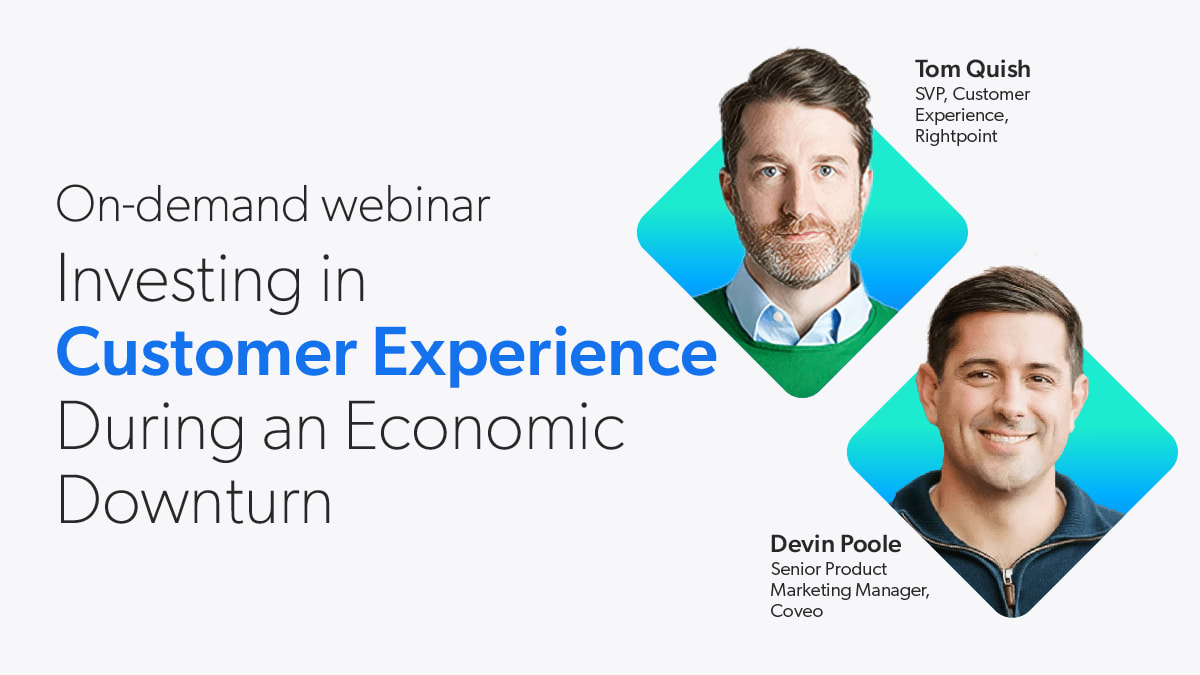
Alright. Hello, and welcome to, today's session, investing in customer experience during an economic downturn. My name's Devin Poole. I'm really happy to be joined today by, my friend and colleague, Tom Quish, here from RightPoint Consulting. Tom, thanks for hopping on the line with us. Thanks for having me. Excited to talk all about customer experience today with you. Yeah. Absolutely. And, you know, what what interesting, and exciting times we're working in these days. Though for most of us who've been in the CX world in the management landscape for quite a while, this, this isn't the first time that we've seen, you know, economic troubles. Right? Although one thing that we're continually learning, continually seeing and hearing from, you know, our clients that we're talking to, experts and analysts in the space, is is that this one does undoubtedly feel a little bit different than it has in the past. So, what we're gonna explore today, what we're gonna talk about, you know, are just some really good tactical, practical tips and and tricks and guidelines that, you know, leaders should take, under advisement as they're thinking about how how do we start to manage it and how do we start to, you know, change and approach the the world slightly differently, as we all prepare for economic downturn? How do we start to, you know, think about our customers differently than trying to keep up the high quality of experience while we're probably all doing a little bit more with less these days. So, let me start with just a couple of, you know, rules for the the road here. Quick agenda. It's not gonna be a complicated one. We'll start by taking a look, out at what's happening in the world. What are we seeing? What are we hearing? And how is that gonna impact the the way that service support and CX leaders start to operate their businesses, start to to think about, the the decisions that you make. As I said, we'll we'll share a framework, Tom, that you've built at RightPoint Consulting that you've used with a lot of your clients to help them, make the the tough decisions that they need to make to put it into perspective. And then, of course, we wanna leave plenty of time for for questions. Now for those of you wondering, do I have to wait until the end? Absolutely not. We've got a a lot of opportunity. We've got a pretty fluid agenda here today. So, at any point, go ahead and find the the q and a button, that you can see along the the Zoom panel who's not used to being on Zoom webinars these days. I don't have to explain where it is. Right? But, find that button. Yeah. You can if you wanna practice, just go ahead and pop in the QA even where you're, you know, dialing in from these days. Say hi. So anytime during the the session, go ahead and ask a question. We'll bring it right into the conversation. We will not share any names, where you're from, anything like that, but, we'll certainly, give the opportunity to ask you a question. We'll answer it here live and in the moment. So, from there, let's jump right into it. You know, starting with sort of the the big question that I think we've all been, talking about thinking about these days, like, are we in a recession? Right? It is somewhat debatable, as we talk about it because certainly there are some indications. There are some, metrics that that we're seeing that say, man, a downturn is likely coming. We heard this starting in the the beginning of twenty twenty two as well. We're about to be facing a recession. No. It'll definitely hit by January this year, right, where some indices, like unemployment remains very low. Right. We're starting to see people who have been laid off. There's lots of tech layoffs, but we're starting to see people who are finding jobs quickly. Inflation remains persistently high. The government keeps raising interest rates. So, you know, Tom, let let me kick it over to you here. I guess, what are some of the things you're seeing, you're you're hearing? And, of course, full disclaimer, at least I know I am not an an economist by trade. Tom, I don't believe you are a writer. But Not at all. You know, what are you hearing out there in the world that's leading you to believe people are gonna make different and tough choices? Yeah. I think my proxy is is the variety of clients that we work with, and I do think there's sensitivity to, you know, the the economy and or, you know, companies are hedging their bets in terms of, you know, where they want to, double down on investment and where they wanna be a little bit more cautious in terms of how they invest and where they invest. So I think we're definitely seeing some sort of cautiousness, within the market, and we're definitely seeing customers, the our clients' customers, sort of acting a little differently than they had previously in terms of purchase, decisions and or, you know, propensity to spend. So I think, definitely some some sort of cautious activity out there in the market is what we're seeing, and and definitely budgets are being packed impacted. And and time to actually pull the trigger on initiatives is is slowing down a teeny bit, in terms of just, you know, ensuring that organizations are are well aligned before they're they're making, you know, big investments in technology or people or processes. Yeah. And let me ask you this. Are you hearing more of, we're gonna just delay this for now sort of indefinitely, or we're delaying for six months, or just rather, you know, we're being a little bit more cautious. We're we're still investing, but, we're putting more scrutiny on our investments. We're putting higher pressure on, the the need to drive ROI when it comes to technology investments and needing a clear ROI factor. What what are you hearing from that standpoint? Yeah. I think it's less less flat out delay and more just taking more time to, ensure that, you know, everybody's bought in across the organization on the investment. So I think just the the checks and balances that have always been in place, I think, people are just going through that, the process a little bit more rigorously these days. Yeah. And, of course, you know, the buying group tends to balloon, during times like this where, as you said, everyone in the organization seems to have an opinion. You know, the the research says it's somewhere between fourteen and twenty three people involved in any decision, to buy a piece of technology, more or less to roll it out, deploy it, and and really bring it in the to full production there. Are you seeing a change in, who's all involved in technology decisions, particularly as it comes to things like the customer experience where everybody owns it, and sometimes nobody owns it all at the same time. Yeah. I think there's a bunch of different models that we're seeing. And, yeah, the even the c suite is becoming more and more complex. Right? I think there's there's new entrance into the c suite. New titles, you know, are being rolled out in terms of chief experience officer. You know, other roles that hadn't existed previously are starting to come into, into fashion. And so I think with that, yeah, you're you're getting more stakeholders involved. You're getting more complexity in terms of the the the digital ecosystem. So I think you are seeing a lot more, forced collaboration across different buying centers within organizations. What once it had been the the remit of of the CIO has now been distributed a little bit to sort of extend into the CMO, CXO, and and other roles within the organization. Even the CHRO, in some cases, is are making sort of technical decisions or informing them at least. Yeah. That they've got an opinion, you know, of course, on what they need and what's gonna work and what's not gonna work for their business. And there's that harmonization, that that's happening. People don't want to invest in lots of different point solutions in different business units. It's looking at that true platform approach that, you know, hey. We we need one provider that can help us to solve multiple problems at a time, that can help us in multiple facets of our business. You know, something we're seeing personally right now at Coveo is a lot of, you know, cross pollination and not due to our outbound efforts, but due to, our clients who we work with, say, you know, in the workplace, space. We're saying, man, we we love what is happening here. Where else can you help us? We we need help in our customer service, and support function. So we're or our website functionality. And so we're seeing a lot of cross pollination who are people who are looking at expanding the the use cases with existing, vendors, starting to to look for more ways to to do that as well as they say, hey. This is a known vendor. This is someone who that who we wanna do business with. And so that that's something that I think we're we're gonna start to see here. You know, if we are truly heading into, you know, recession, if not just a downturn and a slowing of growth, which we certainly have experienced across the last three quarters if you just look at, GDP for the the US economy, Canadian economy, European, as well. And you're seeing, you know, a slowing that that's happening, whether it dips below, to be determined. But, either way, it is, you know, driving some interesting, you know, macroeconomic trends that that we've been tracking here, both on the the business side, and the customer side as well. Right? So we'll start on the left hand side. We've talked about a a a few of these as well. And, you know, Tom, I'll I'll kick it to you to see, you know, which of these is the most pressing and and most, top of mind for the leaders that that you're talking to. Is it, you know, layoffs, or is it truly can't spend another dollar out the door, you know, or just we're not getting the talent that that we see saw before. I know in the financial services sector, that's certainly a big thing where, man, we we used to be able to attract MBAs, and we used to be able to attract, you know, AI and IT minded folks, and they're not looking at classic multichannel banks any longer. So what what are you hearing from the the business and economic side? What what's, you know, giving people the most pause as they think about delaying the decisions, taking longer to decide? Yeah. I think, all of the all of these trends resonate. I think the spend being scrutinized, I think that, again, is, is more about just developing that ROI, and model and and kind of, presenting the business case and ensuring, that executive leadership understands, where that return will Coveo. And and those returns, you know, need to be more immediate than, you know, some of the long term plans and and, strategies that, you know, they might have invested in previously. So I think we're seeing a lot of that, like, where are we gonna get the return? How immediately can we expect that return? And then, you know, we'll green light this initiative. So I think we're seeing a lot of that that, like, speed, in terms of recognizing that value. I think in terms of inflation and interest rates increasing, I do think, you know, on the on the end customer side, that's definitely a consideration. I think we're hearing terms, and I love when new terms are coined, the whole idea of, greedflation, customer perception that prices are going up because companies are being greedy. So even sort of having that shift where, you know, customers who might have been more high income or trading down for value or perceived value, is starting to shift how clients are, you know, looking at targeting and acquiring new, new customers. You know? So almost an opportunistic approach to, driving new, acquisition, via, you know, different markets that might not have been, privy to that organization previously. So I think that's an interesting trend that we're seeing. And then, in terms of, you know, the corporate layoffs and and top talent attraction, I think I think that's kind of a split in terms of some of the clients that we work with. There are some clients that are taking advantage of that. There's a little distrust now because of the tech layoffs within the, you know, the tech space. And so we are seeing some, you know, big OEMs, for instance, that are doubling down on on sort of, you know, attracting or even, you know, publicly stating that they're going to be looking for top talent from, you know, digital product organizations to help drive some significant change and be a catalyst for change within their organization. So I think there are organizations who are doubling down on, again, taking an opportunistic approach to to ingesting this kind of new crop of talent into their organization. Older, you know, organizations that are a little bit more resistant to change, now they have this opportunity to to shift and pivot pretty, dramatically based on a large scale higher, as a result of large scale layoff. So I don't know. It's it's it's been an interesting, time to to watch some of these trends evolve and emerge, but those are the things that I think are most top of mind. Yeah. You know, it it's interesting to to hear you talk about some of those things. You know, certainly, what what's the old I'm I'm gonna attribute it to Churchill, and it may not have been, you know, never waste a good crisis, saying that there is opportunity out there for all of us. And, you know, hearing companies that that are talking about, you know, only taking on good customers, looking at the the customers that they know, are going to be profitable for them and not the folks who are gonna take up a lot of their time and effort, in order to put them in the red. So that they're they're taking that approach of, you know, what's going on? How do we think about every single dollar going out the door? But, you know, in the the ROI that we need. I I know we're seeing from that side of the house, a ton of, call it work coming into our business value assessment team, where they're saying, hey. We we'd love to have you run an assessment, within our organization using our own data, something we offer complimentary to, you know, people that are considering Coveo as a platform, to say, yeah. We're we're gonna help you to get over that hurdle, you know, with the CFO, you know, who is likely looking at every dollar with a finer tooth comb than they did before, and at requesting and requiring, you know, three, four x ROI before they even consider, green lighting a a project that that we see. And then you touched a little on the consumer side of things, right where where folks are adopting more of that, you know, cost cutting behaviors. And it's, I've heard it described as trading down, you know, where before I used to buy a, you know, hundred dollar pair of pants. Now I'm looking at more of the seventy dollar range for a pair of pants because, you know, I wanna make sure that that I'm protecting, where I can. I'm, delaying my own internal purchases as well. Right? Whether it's, you know, in addition to the house or a second or a new car or something like that. And the last one that people are less loyal to brands than they've been in the past. Right? That that is something that is, having a huge impact, on organizations as well. And I'll use that to sort of move us on to the the next, set of slides here. Because if you take a look on the top right hand side, nearly nine out of ten customers say that, you know, that they're more likely to make another purchase after a positive customer service experience. And nearly as many customers say three or fewer negative customer service experiences means they're moving on to another brand. Right? So it it is, putting the spotlight on the the service and support function that when I have a problem, I need help, and that my patience is wearing thin. But if you give me good service, I will reward you with, you know, my dollars. I'll reward you by staying there. And so what we're seeing, you know, sort of left hand side of the page here, you know, some bigger, trends that are happening that, you know, CSS leaders are aligning their strategies to enable, their employees to enhance the customer experience and, you know, get down to what it's always been about in the the service and support function, right, which is solve my problem. So for all the changes, all the, you know, revolutions, evolutions, technology, customers that we've seen, it is nice that the one constant, the thing customers want is just fix my problem and make it easy. Allow me to get back to, you know, using your product. Allow me to get back to the rest of my day in my life, you know, without this disruption. And so, you know, let's talk about a bit here, Tom, of, you know, some of the the business priorities that we've seen put in place for the support and the CX functions, right, is that combination of CX and EX and not treating them as separate things any longer. And, of course, when I talk about EX, really, in a lot of ways, I'm talking about is, you know, RX or rep experience. Like, what's it like to be, you know, in the trenches solving a problem for a customer who's either live on a phone call or a chat or, you know, from the CX side. What what's that like in the digital world? Certainly driving operational excellence, nearly two thirds, of, of leaders. You can see that over on the right hand side, sixty three percent say that that is among their top three priorities. Right? It's still operations, operations, operations, but, you know, that doesn't ring the same as it did ten years ago. And then investing in AI and automation. Right? As you're looking at these priorities and the service initiatives that we're laying out below them around, you know, driving digital channel effectiveness, frontline rep technology investment, and enhancing customer value. You know, what what what is it that, you're hearing from folks that they're, you know, responding to? Right? We're investing in the CX or the frontline rep experience because what? What what what what what what do you see in town? Yeah. No. I think EX the the interplay between EX and CX is definitely something that that, we're deeply sort of involved with. And I think we are seeing a lot of organizations who are interested in sort of understanding that, sort of cyclical nature of, you know, investing in EX that begets greater returns on the CX side. I think, there's a few examples, I think, that are in the wild and probably, you know, highly, highly talked about. I think Chewy comes to mind as a great example. Not a client, but, just a great example of sort of an empowered employee base that creates for an elevated, customer experience. I think when you look at just how they use their data, whether it be call center, service rep, or customer success representative information, to inform or even just purchase information. So, you know, even just funneling some of that, ecomm data and some of the replenishment shopping that their client base tends to, do, by, again, empowering their their customer service reps to, you know, be more delightful in in sort of empowered to to to make decisions on behalf of the brand. They're, you know, ultimately creating this really interesting customer centric kind of buzz around, you know, from a from the agency side, but all all the way to, you know, to the actual customer side. I think, some of the touch points and some of the anecdotes around, you know, a client who or a customer who falls into, basically, you know, unsubscribe from, you know, a a purchase that they had made previously, you know, was a a red flag to a customer service rep that, you know, this pet might have been, you know, have passed. And so how do you then deal with that, in a very human way, and how do you empower that employee to, to reach out to that to that customer in a, you know, brand appropriate way that, you know, comforted that customer and and offered solace to a customer who was, you know, in a time of grieving. So I think those are interesting moments where if you, you know, provide a delightful experience for your employee, they will ultimately, you know, have a more empathetic and and delightful approach to how they deal with your customer. So how are you incentivizing that behavior? How are you, you know, empowering and, you know, establishing a playbook for that sort of behavior to to actually occur, whether it's, you know, the empathetic approach that I mentioned around the, the the loss of a pet or, know, other delightful moments where, you know, birthday cards are sent out with a personal touch or, a customer service rep can offer, you know, a discount on the fly without authorization from a, you know, manager, just because they've been empowered and given the authority to to make those decisions. So there's a lot of talk around EX, empowering just great CX, and I think TUI comes to mind as just a a brand who's who's doing it really well. I think, even just putting that information at their at their fingertips to ensure that, you know, all of that information is is being sort of, directed towards that frontline employee so that they have that line of access, I think, is is a really, important fact too. And I know on the Coveo side, you guys are allowing that to happen, en masse. Yeah. You know, it's about shining that light, and the the word I always use is my situation. Right? Whether it is something that I'm experiencing that's a very human emotive thing that allows that that that drives the contacts to come in, and you can understand that. Or whether it's a a small engagement driver where the company can proactively reach out to a a person about to say, we we know your situation. We we understand that. And the more that, you know, I think of it of yeah. We we are not just shining a flashlight in the dark and hoping that we run into the thing we need, but rather, I pictured as, like, we're in a large professional stadium with the light spot lighting down on us, and we can see everything that that's around us and know where we need to go and and how we need to operate. So, the the more that people are, given the the right information, the more empowered they feel. Then, of course, management attitudes, as well saying, yeah. If someone even if they might have gone too far, and it's not, shame on you. You know, let me smack your hand, but rather, it's a coachable moment. And why, you know, we we love that you're empowered to do this, and here's, some of the the, you know, framework within which we'd like to operate. Just give people guidelines, and then let them be humans. Let them do the thing you hired them to do, which is to help people. Right? And and that's what they love, which at the end of the day pays a huge, you know, broader CX dividend when it comes to the brand and the brand reputation. Consumers time and again in surveys say they would switch brands to someone with a great reputation for customer service. So, you know, you call back Chewy. You're not the first person I've talked to about how great it is to be a customer of theirs, in the the last few months. And, you know, like, think of the the reputational, benefit that they're getting out of this. And numerous people, I'm sure, are flocking to them when they say, yeah. Sure. It's just dog food, but it's way more than that. Right. It is keeping my best friend healthy. My my dog abandoned me in the office today when I started talking. I don't know why. But, she, typically sits and works with me. It's like, that's my favorite colleague right there. So, they understand. Like, this is a company that just gets it in a lot of ways. And I know that you've started to think so much about these intersections, and the combinations between, you know, CX and EX and and PX product experience as well. So, why don't you tell us a bit about what you guys have been working on Brightpoint there and and how it's been so beneficial to the organizations you support? Yeah. No. I think it's a it's a great transition. So, yeah, I think, you know, we talked a little bit about that intersect between customer experience and employee experience and and, again, this lens of of product experience. And when we say product experience, it is that digital product and how do you kind of strategize, you know, around what products are necessary to inform and influence a customer or employee experience. So that is kind of a an aspect of of what we do that, enables us to to think a little bit outside of the, the traditional CX and EX boxes and into sort of more emerging technologies and kind of innovation plays, that can benefit, an organization, whether that's, you know, Internet of things or ARVR, metaversal type activities. Those types of things fall in that product experience bucket. But it's important to have an understanding of, you know, the customer and the employee experience so that we can then make thoughtful decisions around where to enact a meaningful product experience within that journey, whether it's a customer journey or employee journey. So, again, I think this this notion of total experience is is kind of out there. It's something that we've really rallied around, and this is how we bring it to life, you know, across these three sort of pillars, if you will. So, again, the whole thought here is that it is very multidisciplinary. It's bringing these different sort of groups together in a in a very joint fashion to ensure that each aspect of the business is kind of, informing the next. And so yeah, when we talk about that CX and PX and e EX relationship, I think it's important for us to not only map the customer journey and understand sort of where those pain points and sort of opportunity areas might reside, but sort of onion skin or layer on that idea of the employee and what that employee might be doing, where are those touch points, where are those points of interaction through sort of blueprinting and and service mapping. But ensuring that that's, you know, a sort of one in the same sort of capture of, this unified view of not only the customer experience, but but how, you know, we can elevate that employee experience to, benefit that that customer experience. So moments like that, I think, are are are aspects of how we support organizations and and trying to think more holistically around empowering that elevated experience across the board. Yeah. And it it's so important, you know, as you think about these, the the line we I've always thought of, right, is if your employee is having a hard time to figure something out, your customer's gonna feel it. Right? If your product, and especially the the digital products we provide, if they're not set up to to do the things they do well and not optimize in that way, they're gonna be more difficult to use, and they're gonna drive a lot of unnecessary and wasteful interactions within your organization. Right? It's like time spend that you just didn't need to to spend, in order to get to the outcome that we're looking for. Right? So I I love how you guys talk about it. And these things working in unison, working in concert. Right? It it's like an orchestra. If if the woodwind section is off by, you know, an entire measure, well, this thing is just not gonna sound right. It's not gonna work the the way that it should. And too often, right, the the lines that you have here have been hard and fast silos. We've not thought about them as one holistic, thing here as well. And so I know you've been doing quite a a lot of work here with the organizations that you support in in navigating these pressures. So, as you approach this, right, what what are the the biggest rocks that that, you're solving for? Yeah. And we we touched on some of this in sort of the earlier conversation, you know, this notion of increasing complexity, not only, you know, the economic uncertainty that we face and, you know, companies having to deal with the volatility around fluctuations and currency and exchange rates and interest rates and commodity prices, but also technology disruption. I think, you know, we've seen, especially, you know, we keep talking about generative AI and and and, you know, last month metaverse and and whatever the the sort of new technology that's disrupting the way we work. And and, again, I think we'll touch a little bit more on generative AI and and AI in general, to come here. But I think it it is difficult for organizations to really keep up with the fast pace of change. And so, you know, it is, you know, increasingly a part of our role is to is to consult around those things. It's to to help drive experimentation within these organizations, to help, just create awareness and or, adoption of some of these technologies. And in a time of, you know, economic uncertainty, having a little bit of that upfront strategy defined, I think, helps, you know, mitigate some of those risks around investing in the wrong technology and and adopting kind of the wrong approach. So I think, we're definitely seeing a lot of that. I think there are a lot of competitive pressures as well. I think having to navigate, competition from sort of the the known players, but then I'll also, like, in the health care space in particular, know, disruptive start ups, all these kind of net new organizations that are coming up and and, you know, shifting the sands, you know, on, legacy industries. I think, you know, those are fears and or disruptors that we're seeing, as, you know, pressure against some of the organizations that we're working with. And then, of course, you know, regulatory and supply chain complexity, I think, all plays in there as well. So, you know, on that side of the house, the increased complexity is definitely, something that organizations are are navigating. And then, you know, we talked a little bit about this too as what you know, the the idea of the expanding stakeholder base. And and, you know, from a customer perspective, I think, you know, we're seeing a lot of, new technologies emerge and and new customers sort of wanting to interact with companies in different ways via technology. Same with employees. You know, as the companies grow, how do you manage a broader employee base, new skill sets needed to, you know, actually maintain these technologies and investments, and on and on and on. So I think, you know, new stakeholders, new buying centers, new sort of collaborations needing to, exist in order for these organizations to really move forward and and move quickly, I think, is is definitely another sort of theme or trend that we're seeing. And then, you know, we talked about this a lot earlier as well, that that need to sort of measure and show ROI and that accountability, and outcome based sort of model, which has always been the case. But I think there's there's new pressure with with all the data that clients are, you know, generating and and and being able to sift through that and really, create predictive models so that we can really understand the return on some of these investments, I think, so that they can allocate resources efficiently, effectively, and and really make informed decisions, is definitely emerging as, you know, a a trend or a theme and and creates a competitive advantage for those who who are able to really, predict and and model those, strong ROI, case study cases so that they can invest, and really generate that positive return. Yeah. And and that's it. Right? It's understanding where to invest for the future. Right? It may not be about the immediate ROI, the immediate capability that that we're gonna gain, but rather, you know, are we setting ourselves up for the longer term? You know, back in in my consulting days, I used to work on a lot of five year strategic plans with, you know, senior executives. And you started to see those slim down to three year plans, down to one year plans just because of the pace of change, the the pace of innovation. Right? And if you were, you know, probably, what, November twenty twenty one, around that time, doing your strategic plan for the, calendar year twenty twenty two when you had generative AI and the impact of disruption that will have in all levels of business in your strategic plan, kudos to you. I'm gonna guess none of our, attendees on the line had that. Right? So if you did, please, by the way, put it in the q and a. We'd love to talk to you about it. But, the the idea, right, is there are gonna things are gonna happen and continuously happen that we will not be prepared for. So if we're not agile as a business, it's going to, not work out very well, in our favor coming up. So let's move from here into some of those, you know, practical tips that that, you know, we can all start to take under advisement for both the, you know, the the short, the medium, and the long term here as we start to think about setting ourselves up for the the future. And we'll take it in that that total experience, framework, but looking in-depth more at the the employee experience, and the customer experience as well. Starting with employees, you know, that we know that the role of being a frontline employee is far more complex and difficult than it was even just a few years ago. Right? Systems are either outdated or or they're spread all over the place, and there's way too many of them. And, the the focus for support leaders has become, how do I set my people up for success? How how do I consolidate tools? How do I invest in the right things in order to, you know, enable my people to be more productive, to be more empowered, and to stay focused on the customer at the end of the day? You know, so three, things that that we'll talk about here across the page, starting with the box, blue box on the left, you know, about knowledge. And we touched on the this earlier. Right? How powerful knowledge is and the understanding of a customer's situation. Right. How much more powerful it is in a world where, the majority of customers are gonna start in some sort of digital channel, some sort of, you know, self-service channel. How can you understand what that person has done already, what they've looked at, what they've clicked on, what they've looked through, if you're a frontline CSR taking a chat, right, or taking a phone call, you really ought to know that because customers expect it these days. Alright. So giving that full three sixty degree, picture, something we call user actions, here at Coveo. So it's a, you know, a model that you could deploy, with with us that says, hey. We we will track what this person has done. And by the time they present themselves in through your, you know, CRM, you'll have a good idea of what they've done so that you can pick that conversation up in the middle. You can be far more knowledgeable about what they're doing, and what they've done previously. So it's not, let me ask you to start all over because we've all been there as customers. That's a hugely frustrating experience. At the same time, the the frontline rep needs to have knowledge of your own company. Right, knowledge of, what products your customer has and doesn't have. How those products work. What's inherently valuable about those products, based on the way other customers have used them? What what do I know, about this problem that you're solving, and how can I be confident in that knowledge in order to project it to the customer so they trust what what I'm giving them? So on that aspect, Tom, when when it comes to, you know, driving knowledge in, where do you see folks, making the the best bets right now when when it comes to improving the employee experience? Yeah. No. It's a great it's a great question. I think, you know, we talked a little bit about the front frontline worker. And, again, agreed. I think we see this and and hear this time and time again on the retail side, within health care, within within other aspects where, you know, frontline workers urgently need a front end, like a reliable front end. I think, you know, shift workers are already tech technically proficient, but they're often stuck with these kind of antiquated systems and tools. And I think what that creates is kind of a distrust. Like, tell me why I need to use this tool if I don't believe it's going to do what it needs to do to, you know, make my job easier to, again, allow me to present myself in a positive light to a a patient or a client or a customer, then I'm not gonna adopt it. I'm not gonna use it. So I think there is this sort of cyclical approach to, you know, piloting new technologies, creating some distrust amongst frontline workers, and then, you know, ultimately losing adoption of those tools that are meant to benefit the employee. So I think, you know, when when you're starting to look at sort of knowledge as power, if you are able to create tools that consider the experience of every worker, so not just those at desks or working remotely, which, you know, again, was was was a hot topic couple years ago, that's vital to really, you know, driving an empowered workforce, and creating that sort of knowledge here across the board. I think, you know, we we deal with a lot of retailers, and and there's, you know, a handful who, you know, are looking to really empower those sales associates or those, again, frontline, customer facing employees, and there is that sort of benefit to them. If if I am confident in the data that I'm being provided or knowing the client sort of a little bit before they even walk up to me or I walk up to them, you know, within the the floor the showroom floor, then I know that my commission or my, you know, job is gonna be, better off for for having leverage that information. So I think, when you have a little bit of that value exchange, I think, one, you you garner more adoption. Two, you, you know, create a more, you know, happy and or fulfilled employee because there's incentives for them to actually leverage the the data that you're putting putting in front of them and, leveraging the technology that you've invested in, having them adopt. So I think I think that's one aspect. I think we we also see a lot, you know, even in the professional services side, we do a lot of knowledge management work. And, you know, we worked with a professional services firm that saw a hundred percent efficiency gain based on a a knowledge management strategy as well as a design build rollout that happened to involve a pretty robust, Coveo integration. And that game was really, you know, attributed to allocated hours, for roles and and and revenue quantified around kind of growth. So I think, definitely an upside on on sort of offering knowledge as a competitive advantage within an employee base. Yeah. Right. It may just makes sense, especially if you look at Gen z, you know, people who are not just, like, digitally native, but, who are, you know, high high competent digitally native, folks who are entering the workforce and saying, if I don't have the right tools to do my job, I'm not gonna stay in this job very long. So you're just throwing money, at that talent gap that we talked about earlier. And of course, know, one of the big investments to make is in automation and applied AI. So not just, you know, automation for automation's sake, but using intelligence behind it. Right. And some of the the biggest use cases that that we see with our clients right now, are coming from the self-service side. So the the ability to proactively serve up, the personalized information to customers, as they present themselves and as they're logging in to your digital portals. Right? So financial services companies, we work quite a lot with are able to, you know, as someone's on that digital journey, say, I'm, you know, just looking at my, bank account, but you've got some signals, you know, coming from your BI systems, your CRMs, and systems of record that are saying, hey. This person really, really needs to fill out the budgeting tool because we've noticed some changes there. Right? Like, warning signs are coming off. You will proactively pop that in front of that customer. And, hey. We'd recommend you you spend some time in this. Right? And so we're seeing a lot of people that that are investing in that very front end of the customer journey, you know, and doing that in a way that then leads back to, the the employees. And now it's you've come into a branch, if you or or onto the phone to have a conversation with a a licensed financial expert here. And that that employee knows, wow. This person's filled out the budgeting tool. If I know, you know, that this person's done x and y online, you start to see a lot of that shake out in the employees saying, I'm getting more satisfaction, more fulfillment out of my job, you know, because I I get to have better conversations. I don't feel like I'm always on the back foot, when it comes to customers. Of course, on the right hand side here, it's all about optimizing their workflow. So putting the things that that we're investing in, you know, knowledge systems, AI, and automation that can, you know, pull up the the right information based on the, way that the customer typed in their query to a chat. Right ahead. Based on that, we're we're putting the right information in front of you, and not just in front of you, right within your workflow. So say you're working in a system like Salesforce or some other CRM, I don't have to leave that. I I can stay engaged with the customer. Look at as they're chatting, and the right knowledge is gonna pop up automatically, for me based on the the inputs that we're getting from the customer. It's gonna be dynamic as those inputs change. Right? Because often, I don't contact a company until I've got two or three questions that I need to ask, or one question leads to another thing that I didn't think about, right. And those workflows mean I don't have to go out actively searching for it. I don't have to go out to another system to find it. It's all optimized within my my workflow today. Yeah. I'll jump in there. I think the, optimizing workflows just an example that we have with, with a a major retailer, I think, around just improving creative efficiency and efficacy across disparate business units, to gain insights on the creation of assets and or the deployment of campaigns. I think that's one area where, you know, we helped create strategy and or, an ROI model to help, you know, inform some business and investment decisions. Not only, you know, did that allow them as content creators sort of double down on the content that was actually engaging and or converting, but it allowed the business to see, you know, in in which areas should we be investing in time and energy and, personnel to actually, you know, create these assets. And so I guess with generative AI and other sort of, you know, new technologies emerging, some of that will, you know, become more and more efficient. But being able to, again, create workflows based on some of these, you know, new technologies, some of these new investments, I think, is a is a critical component as well. Yeah. And, of course, you mentioned one of the the largest tech disruptions that we've seen, generative AI. What what are you hearing from the the clients you're working with? Apprehension? Are you hearing we're gonna go slow or diving in? Don't know how deep the water is, but I wanna get on the front edge of this thing. Yeah. I think in in a word, I think experimentation is the, is the is the the biggest takeaway. I think there's a lot of curiosity, a lot of cautious optimism again around new technology. I think people know it's gonna be a game changer. It's moving the needle. It might be the most sort of disruptive thing that we see in our lifetimes. But, I think, you know, there's also security risk in in in things that, especially, you know, highly regulated industries are are concerned about. So I think, there are definitely organizations that are, you know, going all in. I definitely think there are organizations that are, you know, taking a little bit more of a a dipping a toe in approach. And in those cases, I think it is, how do we, you know, evaluate different use cases? How do we experiment in a way that's not gonna be, you know, detrimental to to our operation, but so that we can actually, you know, get ahead and and leverage this technology for good and for, you know, profit in the in the near future. So that's that's what we're seeing a lot of is experimentation. How do we experiment with different use cases, whether it be, you know, content creation or, you know, some of the service line applications that we've noted here as well? How do we make our employees more efficient and effective by, you know, having information at the ready, you know, immediately before they even know they need it. I think those are things that we're seeing a lot of, experimentation around. Yeah. I I tell you when we we, went to market with our, you know, cocreation, beta program to say, we're looking for companies who wanna really work with us hand in hand to create this. We had a line out the door of people who were really interested to talk and, you know, our first few have come in and and we're starting to build, together hand in hand with them because that's the way Coveo approaches, you know, technology is that we we wanna make sure that it's gonna work. Of course, we're one of those, handful of companies that that are working with this as well to ultimately, you know, not just jump into GPT, but to provide the right solution, based on what the customer is asking for. Because sometimes they're just querying for a query, and they need a a full link. Other times, the the answer that they're looking for is contained within a couple of different documents, you know, where a GPT type of technology will come in and generate an answer and allow you to reformat that answer and put it in a different, you know, context as well. And so, our approach is being a best of both worlds. Of course, if you wanna, learn more about that, go on the the Coveo website, look and and read about it as well because, of course, it is a step change in the way that we will approach our engagement, both employees and customers. And, of course, speaking of the the customer and the customer experience, right, as we take a look at that in our last couple of minutes. And folks who've got questions, start to throw them in the the q and a now, as well. But customer expectations are on the rise, and, service leaders are leaning in with technologies like generative AI to enable more self-service, but also to, you know, create loyalty, by driving, you know, assisted conversations, by driving seamless multichannel, journeys across different properties as well. And so, Tom, I'm gonna kick it to to you here to talk a bit about, you know, the the age old. Is it retention or acquisition? What what are folks talking about there? How are you helping your clients in Yeah. Times? Yeah. No. I I think depending on, you know, which study you believe or what industry you're in, I think, you know, the notion of acquiring a new customer, being anywhere from five to twenty five times more expensive than retaining an existing one is is kind of, you know, the the benchmark that folks use. I think, I I'd say, you know, both are still relevant, obviously. I think there are more considerations around, investing in kinda retention just in a again, given the the economic headwinds in front of us, I think, that that idea of, you know, trying to understand your current clients or customers better and double down on retaining and engaging with those customers is definitely a focal point, and seems like a a lower cost to invest and and higher return and reward, when done properly. That said, I think there is it is a balance. And I think, you know, the the cost of losing, obviously, is expensive. Losing clients is expensive. But a lot of clients are interested in sort of trying to figure out who that next wave of customers is going to be. So retain the existing kind of loyalist, you know, acquire some net new, but also look for, like, what's next in terms of consumer behavior. And so, you know, we talked a little bit about Gen z upfront. I think, you know, that that's where a lot of clients are investing time and energy is really just understanding, that demographic in particular and and seeing ways and finding ways to, new ways to engage and attract those types of, of customers. We we have a lot of clients in the building material space. So, you know, historically, that industry has focused a lot on channel partners and and pros or or contractors, architects, that sort of thing. In some cases, they were creating content, you know, relevant to a DIY consumer or the end consumer. But I'm we're seeing a lot lot more of those organizations, those types of organizations, putting more time and effort into researching and targeting that DIY consumer, knowing that, you know, a d to c strategy, could augment their, you know, contractor or pro industry pro sort of client base. So bringing in new audiences and really feeding the funnel with new audiences while still paying heed to some of those existing, reliable audiences, I think, is definitely something that we're seeing. So a little bit of a balance between the two. I'd say hedging a little bit more on retention, but still trying to get ahead of, you know, when, you know, a boon would surge, you know, to be ahead of that so that they're ready for that next phase or next wave. Yeah. Yeah. And, you know, let let's jump over the one on the right hand side here, in the last couple of minutes before we open up for questions. Know, because of this idea of digitally human interactions, is so intriguing to me because on one hand, it's, of course, how do you make the digital interaction feel more human with a bit of, you know, personalization in the middle, understanding, hey. We know what you need. We can leverage conversational, AI in order to drive the the right conversations digitally. But it also means how do we move customers along that journey from a digital first mindset into human interactions when and where required. Right? And that pass off of not just the customer, but the information that goes with it as well. Right. So as you think about digitally human interactions here and how they can enable the experience, what's one thing that, you think that the leaders on the phone here really ought to, you know, take to, their next meeting with them? Yeah. And and this this idea of digitally human versus, like, deliberately human is is a concept that a a CXO that we work with regularly at a at a global OEM, I I credit him with. It's it's, I think, a term he coined, but I I I like the idea of of digitally human in that. I think customers are expecting, especially, you know, seeing the news around all the generative AI and kinda large language models. I think, you know, they are expecting efficiencies to be gained from all the new sort of innovations that are happening. And so, there is this notion that, you know, if I, as a customer, am able to get a, a digitally sort of enabled, conversation going, and informing, you know, a rep or something like that on the on the other side of the coin, on the employee side, that my conflict will be resolved or my, you know, needs will be addressed more immediately. So I I do think there is that, expectation now. I think as as customer expectations continue to evolve and and and their expectations of brands continue to increase, that idea that, you know, these digital, impacts will, you know, create for a more efficient and or productive collaboration with the brand, I think, continue to emerge. So where where does that, you know, need to be digitally informed, and where is it, you know, meant to be more human? And that's where I think that sort of hybrid, sort of need is is is something that's definitely top of mind with with consumers. Yeah. Well, with that, we we've come to the top of our time here. Obviously, I think you and I can talk about this all day long, Tom. So for those of you on, the line with us here, thank you, first off, for joining us. Hope that you'll wanna continue the conversation thinking about how you're, you know, building up your EX and your CX and preparing for, the the road that we're gonna travel, ahead here. But, you know, with that, let me thank you again and, wish you all the the well. And, hopefully, we'll talk again soon. Tom, thanks for joining us, and, we'll talk again very soon. Thank you, Devin. Thanks, everyone. Appreciate it. Alright. Bye bye. Take care.
Améliorer votre CX en période de récession
- Le paysage économique actuel et son impact sur le CX
- Pourquoi il est essentiel pour l'entreprise de se concentrer sur le service à la clientèle
- Comment optimiser le libre-service avec une vision CX claire
- Comment la bonne stratégie CX différencie votre entreprise de ses concurrents


Rendez chaque expérience plus pertinente avec Coveo