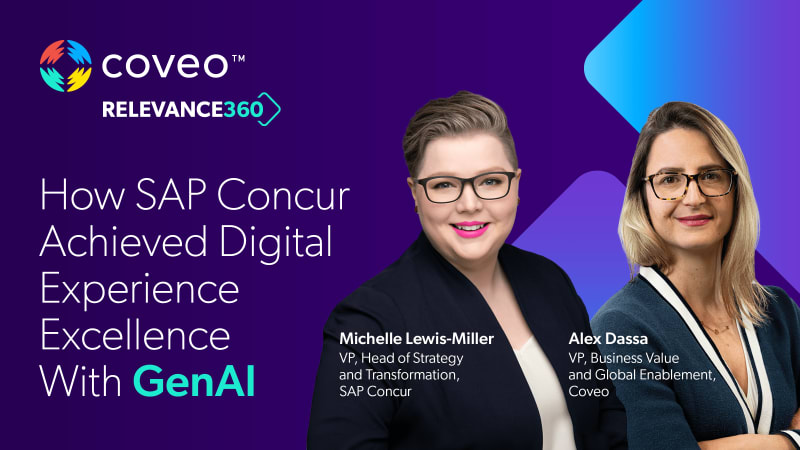
Alright. Thank you so much for joining us, everyone. We're here with Michelle Lewis-Miller from SAP Concur. Michelle, it's so great to see you again. So tell us about SAP. Tell us about your role there. Yeah. So SAP, it's been around for a while, about fifty years and it is the global standard for enterprise resource planning software. So ERP software. It's got about a hundred different solutions covering just about every business function you can think of. And it's the largest it got the largest cloud portfolio out there of any provider. So it's it's a big, big company to work for. Now, it's a big company and so I have two roles instead of one. My my day job is I lead strategy and transformation for SAP Concur technical support. But my night job is that I lead the transformation strategy for self-service for SAP support overall. Awesome. And what do you love about your job? Oh my gosh. No two days are the same. That's probably the thing I love most, but I would say, I have incredible access to new and emerging technologies. I have the privilege to play with them and I get to find really cool innovative ways to use them. Not just cool ways that are new for our industry but ways that are new for the field of technical support overall. It's just a lot of fun. Awesome. And tell us about your team. They are incredibly adventurous, resilient, and patient. Oftentimes, we come up with some really crazy ideas and I say we but I really mean, me. And they are always down to at least hear them out and consider them. And even those ideas aren't easy to implement and they often aren't. They're often risky or difficult. Their passion, their talent, their determination, somehow they manage to get it done. They always seem to find a way. It sounds like you and your team are are very dedicated and passionate about your work. So what what do you wake up in the morning thinking about? Well SAP is headquartered in Germany. So most of my days, I'm starting meetings at six AM and my first thought is coffee. My second thought every day, I wake up thinking, how can I get my son to eat some protein before school? That is a constant struggle. So yeah. Coffee and protein. Coffee and protein. Okay. Take us back to twenty twenty three. Now as a strategist and as a leader in your organization, what were you doing to learn about GenAI? What was the overall thought process there? I was asking a lot of questions at that time. So we're lucky to have some of the industry's best experts in this area working at SAP. And I mean, I was I I don't wanna say I was stalking them, but more or less, I was stalking them. I was hunting down their meetings. I was sending them emails. I was knocking on their doors. I was just trying to understand how this was evolving, the changes that were coming. And I was also using everything I was learning, the answers they were giving me to look really, really hard in our support landscape and just look for opportunities. And and what did you originally see as the opportunity, especially from a a customer experience standpoint? Yeah. Well, we were facing some big challenges. Probably the biggest challenge we had at the time was how can we respect our customers time a little more? And what I mean by that is we have millions and millions and millions and millions of knowledge assets. Many of which are twenty years old, some of them. And our customers are already really familiar with how to self serve using our knowledge search but so many of their issues require clicking into multiple knowledge assets and that takes more time. The answer might be spread across four or five different knowledge assets instead of being found in one. And and that was frankly just taking a lot of their time. And we also were facing a challenge where they would give up because they didn't wanna read through five different knowledge assets and sending us cases. And so even though we had answered their question before, helped other customers with similar issues, we were still getting cases of the same type even though the knowledge articles were out there. And that was slowing down our responsiveness for customers who had new issues or more urgent issues. So it was a lose lose situation where customers who needed help, they were having to get in line. It was taking longer. And, the people who could be self serving weren't. And so that was taking longer for them. Right. And and how did your your team and yourself create action plans around this? Like, take us in into the room. What was what were the the foremost considerations around governance, around, driving CSAT? Like, what what was what was top of mind? Well, you know, SAP does not mess around when it comes to data privacy, security, ethical legal compliance. So for me, the easiest part was getting everyone excited about playing with GenAI, trying out new solutions. I didn't have to work very hard there. Where I had to work hard was for everything else. So we went through five separate governance councils. For example, with Coveo Gen AI covering every legal data security, privacy, compliance topic you can imagine. They were pulling apart the architecture, the usage, where the data was going, who was controlling it. Every single thing you can imagine and making sure that it aligned as well with all of the commitments that we make to our customers. So that that was a huge, huge part of our planning process was just getting through the ringer on the relevant approvals and checks. Right. And and once you had a handle on the governance piece and the approvals and the checks, who who were the stakeholders that you worked with to properly evaluate the different platforms? A whole bunch. You know, I mentioned earlier that we have more than a hundred different solutions at SAP. So every single one of those solutions has a support team associated with it. All of them are impacted with a solution like Coveo Gen AI. So they are all our stakeholders. All of them have a voice into the process. Mhmm. We also have lots of groups outside of SAP support that are impacted anytime we make a change like this to our environment, our support landscape. And finally, we enjoy a really close productive relationship with our SAP IT group, our internal IT group. So, of course, they have an incredibly valuable stake in what we choose to go with and the guidance they offer us on what to deploy and how is a big part of our planning process as well. Mhmm. And now that, you know, so went through governance reviews and bringing in different stakeholders and, SAP lands on Coveo and is using Coveo today. Can you tell us how SAP is using Coveo? So we we use it in a few different ways. And that is evolving and expanding. It seems like every week but we power our knowledge search on SAP for me which is our services and support portal, with Coveo. We also power the SAP Concur support portal with Coveo. And because we don't give customers something we would not use ourselves, all of our support engineers, more than five thousand of them across the company, they use Coveo to search to solve customer issues to get their own questions answered as well. Mhmm. I would say, we're also looking already. We're very much at a rollout phase. So more and more search experiences across SAP are already planning to adopt Coveo and roll it out. So its footprint seems to be getting larger all the time. And have you seen any impact from the ways that you're leveraging Coveo? The the biggest ways that Coveo has impacted your business? Oh, man. It it's really, it's really hard to overstate the impact. We have had it has had a dramatic impact on the ability of our customers to look across, you know, I mentioned millions and millions of knowledge assets. To be able to look across all of them and find what they need, you know. Because often like I said, they're not looking for a needle in a haystack. They're looking for multiple needles in multiple haystacks. Right? So it has dramatically improved their ability to find exactly what they're looking for right at the top of their search results or even better. Just giving them the answer combining all the little pieces from multiple, haystacks into one solution for them. So we we have seen customers who have actually followed up in our NPS surveys, in our customer satisfaction surveys, specifically mentioning the improvement in our search experience. And, we're also seeing the proof in our case volumes. So customers are self serving more often and the case volumes are declining, which gives us much more time to focus on the issues that desperately need attention versus those that can be answered by an existing article. Right. And I I know, you know, having worked closely together with yourself and your team that initially after four weeks of deploying, like, Coveo relevance generative answering, saw a decrease of five percent in cases resulting from search sessions. This was, you know, on top of of that twenty percent decrease in in overall case volume that you experienced after first deploying Coveo for SCP concurrent twenty nineteen. How how are things looking today? When you look at the analytics, how have things evolved from those first four weeks and and what are you seeing in the data? Well, you know, I have to be honest. The results have been so good from that first four week period that I didn't believe them for quite some time. I actually went around to three different analytics departments, pulled in seven different data scientists, and our internal product managers for search. And I'd said prove it to me. Prove that these numbers I'm seeing are real because I'm not gonna go out and say that they're real until I'm convicted that they are. Right? And, that's because that five percent we observed in our first four week test, we ran a fifty fifty AB test. That was great. That was exceptional. Five percent decline in case submits. Well, as of August thirty first, we're, now up to a thirty one percent decline in case submits. Yes, for every thousand search sessions. And I went Barca, if you remember, I talked about respecting our customers time. And probably one of the most powerful impacts we've seen is that when customers are getting a generated answer, they're performing far fewer searches. So we've seen a more than ninety one percent decline in the number of searches customers are performing before they're successful And they're just not going on to create cases after that. So for us, I mean, you really cannot overstate the impact. It's it's it's been massive. That's amazing. I mean, kudos to you and your teams for realizing that type of value. That is monumental. And and not only impacting just the customer experience, but I imagine also having a big big impact on your cost to serve. Can you talk a little bit about that? Yes. So because of the impacts we're seeing to case deflection, related to Coveo Gen AI. So right now we're, we've deployed it to our concur business. We, for the first time, ever in SAP concur history are projecting lower volumes for next year rather than higher even though our revenue is among the highest it's ever been. So that is massive and that frees up capacity resources for us to put toward other projects. We're not having to hire at the same pace at all. It's really helping us make this transformation as a business that would not otherwise be possible. So we're saving millions and millions and millions of dollars, out of this just for the SAP Concur business. And, we're currently planning to roll it out fully across SAP for me, the GenAI experience. And we certainly expect to be saving millions more there too. I mean, that that is the dream. Right? Supporting the growth of the business. And while the business grows, keeping that cost to serve curve flat, if not declining is just, it's it's what we all aspire to do and is very difficult to do so. Congratulations. I feel I feel like I got an early Christmas present. That's what I feel like. Yes. Amazing. And so now looking to the future, what are the ways, that you can see AI and JennyI in particular helping your business going forward? So we have dozens of use cases where we think we can plug in Gen AI and have a really big impact. We want to be looking at the chat space, right? Can we help customers who prefer to chat actually self serve before we connect them with an agent? We have a number of use cases tied up there. We have use cases in our SAP community spaces, right? Where we customers often go there to connect with their peers to get quick answers. Can we actually help them out by supplying a proposed answer right then and there for them on their post? So many different applications that are possible. And I think for us when I think in terms of Coveo Gen AI, we are a little bit playful with it. So we wanna be looking at creative ways to be incorporating it into our tools that we're using within our landscape today. Some ways that maybe are non traditional and experiment with them. But we're also looking at ways that maybe we can bring this into our products. And we have, like I said, more than a hundred solutions. Are there some ways we can be bringing this Gen AI experience right into the product so the customer never needs to come to our portal at all? Wow. Okay. And so exploring all of these different opportunities for how to improve your digital experience, now that you've lived through it, you've delivered monumental results. What advice would you have for someone that's starting out on a similar journey today? I would say, be bold. Take a risk. This is not the time to sit back and let the competition take all the risks. There there's a time and a place for that. Right? There absolutely is. But, the advantages to the first movers here. Right? So you need to you need to get out there. You need to take a risk. You need to start exploring if you aren't doing that already. And I always say the best advocates for whether a solution is a good one or a bad one is your customers. So test it. Let their behaviour tell you whether they like it or not. And, that is a bit of a riskier approach than maybe some businesses are comfortable taking, but it also gives you profound agility and it lets you back up the assumptions you have with real life data. Right. Right. And speaking of risk, one thing we we haven't discussed today is, you know, when, companies that are are looking to achieve the same type of results as you are evaluating, you know, different GenAI, vendors, the element of risk is very strong. Can you share with us what was it about Coveo that either helped you to reassure you on that risk level, or, that that helped you to look at things a bit differently? Well, there were a few key things. So for us, it's very important to remains the controller of the data. It it matters a lot for us that we're able to anonymize data before it's passed to Coveo. Although of course Coveo has quite a bit to offer in the area of anonymization as well. All of that flexibility was absolutely essential or we never would have been able to pass as I said those five levels of governance. Coveo was also very flexible working with us in terms of contracting. So making sure that we were able to balance the risk we were taking on with the rewards that we expected and, Coveo really met us halfway in that conversation. So, you know, SAP, like I said, is the one thing it doesn't play around with is it does not play fast and loose when it comes to security and data. So, just Coveo's flexibility to work within that framework, is in was very beneficial for us. Right. Awesome. Well, congratulations on driving amazing results, with Gen AI for your business. It's been great catching up and learning more about the journey that SAP Concur is on and how, Coveo has played a role. Thank you.