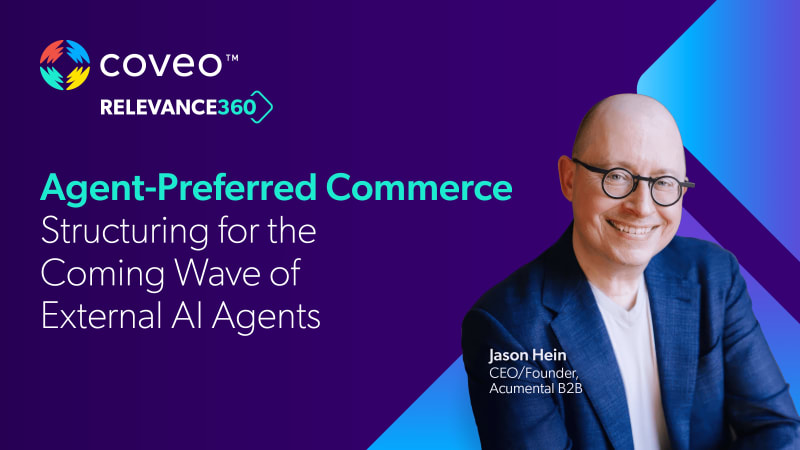
Hello. My name is Jason Hein and I am the Global Director for Product Search and product content with the b two b e commerce association. And I'm here today with the privilege of participating in Coveo's Relevance three sixty session on Agentic preferred commerce, how to structure for the coming wave of external AI agents. So we're here today to talk about a new angle on Agentic and AI, one that opens new possibilities for companies who are selling online but also potential risks. It is a potentially big project to convince your leadership and your bosses that is necessary to start moving forward in this new realm. So the best example that I can think of of something similar is the Canadian Pacific Railway. So back in the eighteen eighties, British Columbia had just agreed to join the Canadian Commonwealth with the proviso that Canada provide a rail line from the east to give access to these new settlers in the west. And this obviously was an incredibly expensive, complicated, and time consuming project, one that took up almost a third of the Canadians, government's budget at the time. So imagine, if you will, going to your boss and saying, hey, I've got this idea of a project that I wanna do. It's only gonna cost one third of our entire operating budget. Oh, and we're not gonna really see any results, any ROI on this for about five years. That's what the people running this project were tasked with doing. So and the whole thing about it is that until it was completed, until the line was actually run to Vancouver, you wouldn't actually see any results. A similar shift is coming right now in this industry with regard to Agentic AI. There are a lot of companies both in commerce and outside of commerce who are starting to do a lot of work now around building agents to accomplish simple repeatable tasks within their own operation, doing things like quality checks, inventory checks. But think of it this way. For every customer that you have, for every supplier that you have, for every partner that you have, remember, they are also going out and building agents to interact with your website. And this is really the challenge that companies have to figure out how to solve. It's not enough to get really good at developing your own agents. It's about building a digital doorway that all of your third party partners can access the information that you are hosting in your system and make the right decisions with it. When you consider how many customers you have and how many suppliers you have and how many partners you have and that all of these agents that they are building, it's their first generation. It's the first time they've made these agents. The odds are that most of them are not gonna do what they want with your site as it is. And so let's say that fifty percent of your customers, fifty percent of your suppliers, fifty percent of your partners create AI agents that work. That means that the other fifty percent are gonna fail. Building an AI agent that one hundred percent goes to your site and operates just based off of whatever data it can scrape from your site, it can infer from your AI, is probably not going to accomplish the goals that your partners, suppliers, and customers want it to. Particularly in a world where, as a recent MIT study revealed, ninety five percent of AI pilot programs are failing. Track record isn't good yet. But this is really an opportunity for companies that do this the right way to make an investment in the infrastructure and the design of your systems to make your sites, to make your domains much easier to use by these external Agentic. And that's really what we're going to talk about today. So let's talk a little bit about what Agentic AI actually does. What are the things that it needs to be able to do to be successful on your site? The first thing that these agents do when they come to your site is they just perceive. It's taking in whatever information you present at different points of the journey, whether that's product information, whether it's services that you offer, whether it's images you're putting up. It's just taking information in. Once it has that information, the next thing that it does is it it's inferring and reasoning, and it's trying to understand this information that's been presented to me. What can I do with this information? Particularly in compliance with the tasks that it has been assigned by its creator. The next thing that it does is once it understands the material that's come in and is, developed an understanding of what that means, it takes action. So, for example, if an agent is designed to come and check inventory on your site, it's going to perceive the product it's been tasked with finding, it's going to look at the amount you have available, it's going to make a reasoning decision. Hey, do you have enough in stock to fulfill the order it knows it needs to fulfill? And if it does, AI, it's going to maybe it'll place the order. Or if you don't have enough, maybe it will send a message back into its system saying insufficient stock available, consider an alternative. But the Nuance thing, what makes Agentic AI really different from the sort of hard coded types of automated scripts in the past is that there is this learning element. Every time an Agentic AI agent comes to your site and tries to accomplish one of its tasks, it's going to learn based on its success rate, not only in terms of what happens in that session, but also in terms of the actions and activities that happen down the line. So for example, if an agent comes to your site, looks for a product, finds a product that it thinks matches the need that it's been tasked with solving, but it turns out not to be AI. And then, that order is eventually returned to that supplier because it's the wrong product. This AI agent is going to remember that transaction and think to itself, oh, okay. I the last time I did a task like this, I tried to take these steps, but it turned out to not work. You might get other instances in the future where that agent will come to your site again and try to look for product, make a reasoning decision about which one is the right product and buy it. And if it's wrong, it will eventually learn that, the experience I'm having on this AI website, on this partner's AI, is not giving me the right perception. It's not giving me the ability to perceive correctly as manifested by the fact that every time I place an order from this supplier, the order gets returned. And that feedback loop of the learning is where the opportunity and the risk to AI, Agentic AI for companies in commerce, really starts to manifest itself. So how do we get ahead of that? So there is a concept called the agent directory. And fundamentally, what it is is it is you can think of it as when I go to a mall, there's usually a directory right inside the door that tells me here's all the stores that are available, here's where they are, and even a little bit of information on what kind of products are sold in those stores. Now, if I'm a very experienced human buyer going into my mall that I go to all the time, I don't need this. I can't think of the last time I went to the mall that I go to and actually went and looked at the directory. But agents, particularly external agents coming from third parties, are not me. They don't eat they don't know what the products are in my mall. They don't even know what the stores are in my mall. And so the point of an agentic directory is to give a little space when those agents first arrive where you can explain, hey, here's everything that we sell and here's all the information you need to know about the products that we sell. This is, what agents need to really properly understand and perceive about your product selection and how to compare products within each category. There's also an interesting element to an agent directory, which is called action models. So not only do agents not necessarily know what the products are that you sell, but they don't necessarily know what your site is optimized for them to do. Are you set up to support their desire to check inventory, compare pricing, update an order status. Like, these are all the sorts of tasks that agents will be AI, and you need to let them know if your site is ready to support all of those kinds of activities. So to support this within the agentic directory, there are really two standards for data or foundational models. One is a product data model, which is really a way of structuring information about not only the categories that you sell, but also the specifications, the details, the nuances that differentiate different skews from one another within a category. The other model is an action model and this is where we sit down and make explicit all of the different tasks that agents are empowered to do within our system. Let's talk a little bit about product data models and what generally is included in them. The first element is a category taxonomy. This is a list of all of the different types of products that you sell. Don't think about it as a list of SKUs just yet. Think about it like the aisles in a grocery store. You start off with, you know, dairy, produce at a high level. And then as you get into an aisle, you'll find, well, here's the ethnic food section. And then within that, oh, here's Mexican, Chinese, Indian, etcetera, etcetera. And you kind of narrow yourself down into more and more specific types of product categories. One area where we most often encounter product taxonomies are honestly when we go to websites and in that left hand menu, we see the category list where you can kind of drill down into it. That is fundamentally a category taxonomy. Once you have your taxonomy completed, the lowest levels or what is called the terminal or leaf node of that taxonomy, this is where we actually load products that we sell. And within each of those, we create what's called an attribution schema. The attribution schema is just a list of attributes. What are all of the features, specifications, details of a product, the values of which help me define and differentiate any two SKUs from each other within that category. This is really how we tell the difference between any two things. Metadata is the information about attribute data that we use to drive digital experiences. What type of attribute is this? Is it a text attribute? A numeric attribute? Is it enumerated, is it Boolean? It's the information that is oftentimes needed by some of the systems that we're operating within, even if it's not immediately used by human users. Now, one of the nice things about product data models is that for a lot of companies now, in fact, an increasing number of them have done some of this work already because you've either participated in or implemented a PIM or an MDM system, into implementation. Building a product data model is generally a significant part of driving a successful PIM implementation. So if you've already done that work, congratulations, you've done a good part of the work needed to drive an agent directory. Action models though are a little newer. And this is generally an area where, companies struggle to understand what this is, particularly in b two b. Not because they don't understand what the tasks are, but because the tasks for so long have been sort of taken as rote. We don't think explicitly about things like check inventory, check stock, request copy of proof of delivery. These are things that people have just sort of been in. They've been trained to do in inside sales or outside sales. Very simple wrote tasks. Those are the types of tasks that generally lend themselves to Agentic best, to be honest. But just the simple act of figuring out what those are and writing them down is this is the first time that has been done by a lot of b two b companies. So the the things that you have to think about when developing an action model are really you have to figure out what the inputs are that are necessary in order to take this action, what the outputs are of this action, what what defines when this action is completed. You have to think about are there sort of permissions or restrictions around who can do these types of tasks, and also what you can think of as sort of a failure option. So in the event that an agent comes and tries to do this action on your site and it can't, what is the alternatives? Does it need to send a message back to that third party saying, hey, this didn't work. Route this to a human to try Agentic. Defining all of these elements for these models is an additional complexity to this process. So between defining what the actions are to begin with and then modeling all of those elements successfully, you can understand how this can be a project that takes some time and resources and thought. So let's take a look at some examples of common action models. So what we've got here is examples of four very common tasks to b two b companies requesting a quote, checking availability, configuring a product, placing an order. And with each of them you can see examples of what an input and what an output looks AI, just to get a sense of how that is. Now in addition to these, a typical action model will also have information on permissions, what kind of users can do these tasks, what kind of agents can do these tasks, and also a fallback position, what happens if this action fails. Now the benefits of doing action models and data models extend not only to the agents from third parties using your site, they also benefit the human users using your site. For example, product data models do two really wonderful things for websites. First of all, they really help to improve the capabilities of your site search, both in terms of making the results more accurate because the product data needed to drive your search engine or your merchandising capabilities is actually there and it's consistent and it's populated. In addition, personalization resources and platforms also benefit from having product data that is more complete and more correct and more clear. Again, all of which are features of having an implemented product data model. Action models, on the other hand, provide a lot of valuable information for companies to optimize the design of their websites for human users. Once we have a list of all of the actions that we know agents are going to be doing and we've made that list explicit, that can also be a really useful input into designing navigation around things like account management, order management, because we now know where all of those things should go. So how do we get started? So the first thing that you want to do when starting to structure your data for Agentic is really make sure that your product data model is robust. Make sure that it your standards for your product taxonomy, your attribution schema, your attribute your your metadata all meet best practices for digital architecture, information architecture, etcetera. Once you set that standard for every category that you have of what what would perfect data look AI, the next step is to actually start to execute it. Now, I'm not naive or an idealist. There are a lot of companies out there, particularly in b two b, who have millions of SKUs. It may not be realistic to go out and expect to get perfect data across every category of product that you sell, but you can start to prioritize and you can make investments in the categories that are most meaningful for your customers so that the categories with the most traffic or the most revenue get the best experience. And then work your way into the long tail as the business justifies. Once you have your product data model set and established, now you can start to move into what I call customer journey mapping to start learning and educating yourself on what types of actions we have to include in the action model. If you don't have robust, clear product data present, it can be difficult to understand how to design the actions for agents to do. If a particular attribute is needed as an input for a specific action, but that attribute isn't available in your product data model, well, then you might need to go and get that done first. This is why generally I suggest it's easiest and most successful to start with your product data and use that to work your way into the action model. Last point. This all sounds like a lot of work. It's a little scary. It can be, particularly for leaders who aren't necessarily digitally savvy yet and it can be very tempting to them to say, you know what? Let's just do this next year. Let's wait. And I think it's important to understand that because we are in this time where agentic, the wave is coming. Just like with the Canadian Pacific, there was a choice that they had to make at that time. British Columbia had specified this is what they wanted, but they could have said, you know what? Let's just wait. Let's let's let them get a little bigger. Let the market get a little bigger. Let's let them figure out what resources they really have and then we'll get started. But you have to consider, the US had completed their first transcontinental railroad in eighteen sixty nine. And in fact, in eighteen eighty nine, they had just finished the Great Northern Railroad which ended in Seattle. If the Canadian Pacific had not gone forward with this investment, this is a little speculative, but it may have become very easy to get access to the US markets for materials and goods, both inbound and outbound, and resulted in a shift of opinion amongst folks in British Columbia that, maybe we shouldn't consider joining with Canada. Maybe we should form a stronger partnership with the US. Competition is a real thing. And given how dynamic the market for Agentic is, it's highly likely that if you don't start to take these actions to build an experience that makes your business more attractive to these agents than your competitors, you could end up losing a lot of money in the long run. My name is Jason Hein with the b two b e a. Thank you for joining us.