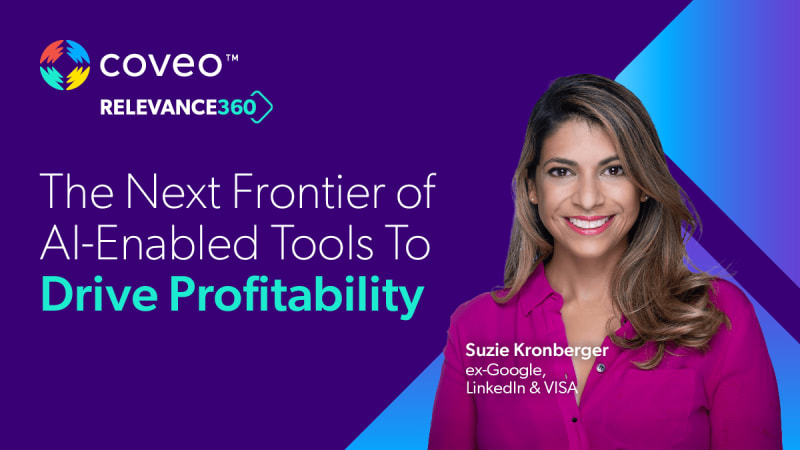
Hi, everyone. Thank you for joining us. I am going to kick things off today with a number. It's a big number, and that number is fifteen point seven trillion. It's how many US dollars AI technology is projected to contribute to the global economy over the next five years. What that means is that AI has arrived and it's here to stay. So let's dive into how it can help retailers drive profitability. First things first, we're going to start with the user. How are they feeling about the current state of their ecommerce shopping experience? Next, I'm going to dive into three opportunities retailers can take advantage of to really transform the user experience and the business. Last, I'll share a few steps to get you started on your AI journey if you haven't already. So let's get started. First, let's see what users are saying about their ecom experience. These three data points I'm gonna share are especially relevant for what we'll discuss today. First, we've got the paradox of choice. More than half feel overwhelmed when faced with too many product options. Many of us have felt this ourselves. It can be anxiety inducing, lead to decision fatigue, and reduced satisfaction in our choice that is even if we manage to make a choice. Nearly half leave when they can't find inspiration through browsing. It's important to remember that inspiration plays a part across multiple parts of the user journey, not just the beginning. So there's a big opportunity here to amplify creativity and fuel imagination across the user experience. Third, most shoppers want personalized experiences. This is not about using PII. It's about extracting a deeper understanding of users' motivations, intentions, and behaviors from first, second, and third party data to serve them better. So there's lots of room for improvement, which is great news because that presents opportunities for retailers to create additional value. Now let's talk about ecommerce objectives. One of the highest compliments a user can give a retailer is something like this. This retailer really understands me like no other. They really get me. Before I went into tech, I spent many years in consumer products, managing household brands where I often talked about delighting my users because that's the type of emotion that translates to a positive impact on primary business KPIs. The objective was for my brand to be the first choice, ideally, the only choice my users would even consider. So how do we use AI to help achieve this objective? Let's talk about what I call the AI supercharged flywheel. Let's start with the discovery of AI generated insights. AI can bring to light insights that may have been in the data but missed, or it may surface new insights because of the improved capabilities it offers. Next, AI can elevate user experiences, providing personalized immersive product experiences, removing obstacles in the search process, and reducing cognitive effort that leads to decision fatigue. These can lead to an overall improved user experience, which can strengthen emotional connections with users, which thereby can translate to increases in key metrics like conversions, profitability, and lifetime value. For anyone still skeptical about AI and whether or not now is the time to adopt it, I'll say this. About thirty years ago, at the dawn of e commerce, there were retailers who thought e commerce was gonna be all hype. We don't need to sell our products on the Internet. We know how that went. So let's not make the same mistake with AI. Today, user expectations are rising really fast with easy access to consumer AI apps like ChatGPT, Claude, DeepSeek, GROC, Perplexity. The search experience has completely changed as users are becoming more and more accustomed to this easier, faster, often more satisfying experience for finding what they need. So as retailers, let's meet them where they're at. Now let's discuss a few AI enabled opportunities. Micro trends are sometimes buried in the data. Yet once found and activated, can be anything from incrementally profitable to transformative for the business. Today, your teams work hard to aggregate, cleanse, query, analyze, visualize, and draw insights from data. This requires time, talent, and funding. Much of it is still manual. Lots of Tableau, Power BI, Excel. There are endless business questions to answer, but constraints mean that they can't all be tackled at once. There are trade offs made in where teams can focus. Even when real time data is available, due to resource constraints, retailers can't necessarily react as quickly as they'd like to. While major trends may land on your radar, micro trends can get lost. Now we have AI enabled tools like customer data platforms, also known as CDPs. CDPs can house your site data, systems data, like your product catalog, pricing, inventory, as well as third party data. It can synthesize diverse data sources, both structured data like customer databases and unstructured data like social media and photos. CDPs can synthesize all of this data, automatically identify and visualize insights drawn from that data, and allow you to easily take action. Let's look at a sample micro trend I've laid out about travel adjacent SKUs. So say you're a retailer that carries travel adjacent SKUs. You've added real time or near real time bookings data sources for airlines and hotels like Barca data or STR global data to your CDP. By analyzing all of this data, your CDP proactively identifies that there's an increase in bookings activity for certain routes. It produces a graphic for you depicting the increase versus prior years along with the forecast for potential impact on demand and current inventory. This information will allow you to, if you choose, adjust your marketing and promotional plans, specifically targeting markets for these popular routes, optimize supply chains accordingly, and activate changes to the user experience on-site and in app. Because CDPs automate much of the manual data analytics work, Your teams can spend more time on value added, strategic, and creative work that AI can't do. Now let's take a look at AI in the shopping experience. Have you ever thought of an item you're considering purchasing where you're open to ideas except for that one color or maybe those two fabrics? Today, you have to go through each predetermined facet and select every option one by one except for that one or those two. Or worse, maybe the one color or material that you don't want isn't even listed as an option, so you can't exclude it. All of this becomes a lot of work for users. Now imagine users having a conversation within your site or an app, AI assistant. Even better, you could train your AI assistant to match the vibe of your retail brand. You'll notice consumer AI apps these days often perform what's called a vibe check. They'll ask you which of the two answers to your question that it offered you prefer the most. So your AI assistant can match and reinforce the tone of your brand, making the conversation feel natural for users. From a user's perspective, the experience on the right is superior because you've removed obstacles. You've reduced the cognitive effort they must expend. You've ascertained their preferences faster and more accurately. From a business perspective, you can now conduct semantic analysis, meaning the relationship between words, context, which includes sentiment analysis, so defining the emotional tone of this natural language data. Combined with on-site and app data, think about all the user insights AI can generate for you to capitalize on. This conversation with an on-site AI assistant reveals so much more about a user than if they had simply entered into the intent or search box long Barca wool coat. And if they've gone through maybe six or seven facets to whittle down product selection. Effective integrated AI assistance like this raise the bar for how users engage with ecommerce. Last but not least, let's talk generative AI. Product carousels and compositions are proven mechanisms for driving upsell, cross sell, and increasing AOV. Personalizing these renderings to individual users is obviously going to be more effective than generic static versions. GenAI can take these to the next level. Let's take a look at how. What's possible now with GenAI tools is groundbreaking. Take OpenAI's Dolly as an example, which translates data from your site into integrated personalized sensory rich experiences or three d digital twins, all embedded in app and on your site. You can present users with engrossing experiences where your products are the heroes in environments that are immersive, dynamic, and personalized to each user. Let's consider our friend from the last slide who's looking for a long wool coat to wear to a formal occasion. This is what they might see today. Now let's reimagine a PDP for the wool coat using GenAI and the information we have from the user's conversation with the AI assistant. For this user specifically, GenAI can depict a moving image of someone running up the stairs at the Met Gala or at the Palais Garnier. This person is wearing the coat from your product catalog that's the best match as well as a tux and shoes that could be cross sell items, and they can hear the crowd in the background. By delivering this custom sensory rich experience to the user, you're centering them in their own aspirations with your products front and center as integral parts of the experience. These experiences are possible because of LLMs trained on your data about your users. For those of you in b to b retail, imagine AR enabled three d experiences combined with instructional content or FAQs. Moreover, smart glasses are gaining traction now. So that may be another useful way to interact with users, especially for complex products or to explain highly technical features. Haptic features are another thing that may arrive years down the road. What we're talking about ultimately is user centric, hyper realistic, sensory rich, shoppable, personalized, moving images designed to inspire and compel users to purchase. Have we heard of innovative ideas like this before? Yes. But with extensive training of LLMs, this is now possible. So we've discussed now what AI can do today and in the near future. Now let's consider what's possible with AI usage in the long term. First, with AI generating more insights faster and with fewer resources than before, it means you could be in a position to innovate faster and better than you have before. With more tools and more data than before, you're more likely to find opportunities to enrich every user touchpoint in new and compelling ways. And since AI allows you to capture and process more user data than before, you may find that you have a potential new revenue stream for selling media on your site and an app. So how can you get started with AI today? First, prepare your back end systems and datasets. You may have antiquated systems, technical debt, data integrity concerns. Creating a road map for addressing these and executing in manageable phases is a great starting point. Second, identify your business priorities that would benefit most from AI. What are the things keeping you up at night that AI can help solve? Third, define your current state using KPIs. This will help put a stake in the ground, establish a baseline to measure progress against as you develop the business case for AI investment and its potential business impact. For those of you still skeptical of AI investment, I'll leave you with this. AI is experiencing exponential growth, and everyday folks are using it for search. Think of where you were with search just a year and a half ago compared to today. Now imagine yourselves a year and a half from today if you've ignored the opportunity AI presents. Now imagine you've ignored AI, but your competitors haven't. In building business cases for AI investment, factoring in opportunity costs is critical. It's not only CapEx and funding for additional resources impacting the p and l. What's quantifiable quantifiable value do you place on missing an opportunity to meet consumer expectations or seeing your biggest competitor beat you to the punch or realizing yesterday was better than today for addressing technical debt? What's the quantifiable value of all of that? What's the cost of playing catch up? I encourage you to take these three steps to heart. They're all things that you can start today. To close, I hope this demonstrated how recent advances in AI can help you optimize your ecommerce today, what the future may hold, and why it's critical to invest in AI now. I wish you the best in delighting your users so that you can hear them say, this retailer really understands me like no other. Thank you for joining, and thank you to Coveo for having me. Feel free to connect with me on LinkedIn and visit my writing on medium, which is pockets and lapels at medium dot com. Thank you.