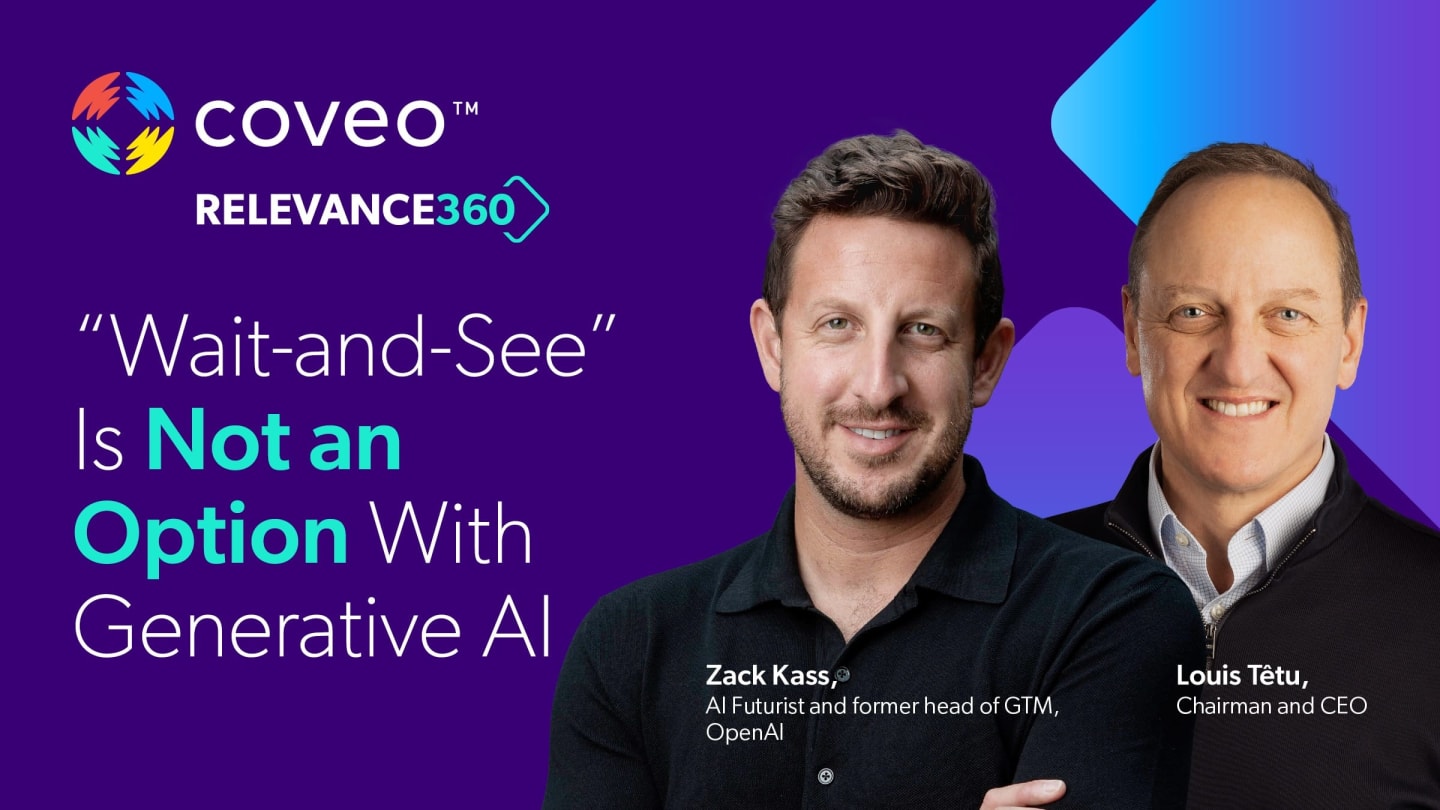
So I'm here today with Zach Cass. Zach with the former head of go to market globally at OpenAI. Zach, it's such a pleasure to be with you today. Thank you for joining us here at Relevance three sixty. Thanks for having me, Louis. Zach, you have so much experience over the years. You've met thousands of enterprises. We just talked about the importance of AI in terms of delivering, better and highly individualized and optimized experiences across the enterprise. And and in fact, we talked about this whole idea of AI or die. First, Zach, give us a bit, for for the benefit of our audience here, give us a bit of our of your background and, and, Coveo the years and, all your experience in the AI scene. Sure. We'll we'll make it as fast as possible because this isn't what anyone signed up to hear about, but I spent fourteen years in AI. I, cut my teeth at a company called CrowdFlower, which became Figure Eight. It was the early data labeling platform run by Lucas Bewald and Chris Van Pelt. They now run Weights and Biases. From there, I went to Lilt, which is also run by two Stanford researchers, also trying to solve, a really big problem in AI, in this case, large language models for the purposes of translation, run by Spence Green. And then, was lucky enough to find my way to OpenAI and got to, I was the her the first go to market hire and got to build, the go to market function from the ground up. And in the process, did two things which were, you know, the joy of my career. One is building that function, at, you know, a generational company, and the other is spending, considerable time with the Fortune one thousand CEOs exploring how AI was going to transform their businesses, you know, practically and also theoretically sort of in a in a very futuristic Wow. Well, that's, that's that's quite an impressive background. And, obviously, as we mentioned before, you've been exposed to thousands of enterprises. Put us in the room with these, these, leading, enterprises that you meet with. What has been the impact of AI and in particular, over over the past year, generative AI, on an enterprise strategy as it relates to digital experiences? Yeah. I think the the first thing to to consider in all of this is for most people in the world, and and and, frankly, a lot of people inside of the industry of of machine learning and and artificial intelligence, the the leaps that we have experienced have come as a surprise. And so we all have to, you know, give ourselves some grace and keep in mind that the shock, may not wear off for a little bit given that we had all sort of made plans for a future that didn't actually include generational well, you know, human altering experience, you know, experience that that we will just we cannot go back from at this point. And so starting from that place gives most boardrooms the the comfort to say, okay. It's okay. This caught us by surprise. And once you get past that factor, you have to start talking about sort of two things. The first and the thing that I always talk to every boarder about is, what does this mean for humanity? Can you believe that this is a good thing, that this is going to lead us to a future of abundance and approach it with an optimistic view? That, I think, actually is a critical step in all this. And then the next is, what does it mean for your business? And, you know, for for for most boardrooms, overcoming the first is a is an obstacle in and of itself because people are filled with fear right now, a lot of uncertainty and curiosity at the very least. And then the second is actually just approaching it like any other, critical strategy. Right? Which is what are what are the threats? What are the opportunities? What are the weaknesses? And in in many cases, so many of these companies are trying to figure out where are all the places we can apply it. And actually half the work is figuring out where should you definitely not apply it. What do you what do you actually what should you leave alone right now? And assuming that you've got, you know, x number of chips to place in the table, let's push them into two bets. And so, ultimately, most of what the work I do boils down to at a boardroom level is, do you feel comfortable with this technology? Do you think you can be excited about this as it as it pertains to the human experience? And what are the two things that your business must do? Because the rest of it, your your vendors are gonna do. You just need to assume that the technology companies that power your business are going to adopt this and and and provide you new economies of scale and new efficiencies. That's that's amazing. And, and and as you said, you know, such a quantum leap. If you think about areas such as websites and commerce, you know, obviously digital commerce and customer service and even work place applications where truly the promise of AI and generative AI is high degrees of individualization and, and certainly a lot of human augmentation. Right? Self-service, gaining proficiency more easily, and etcetera. You know, how do you, how do you think about the use cases? And walk us through the conversations you have with the c suite. And how do you help them, you know, think about the bottlenecks and and and where AI can can can make the biggest impact? Well, I'll start by saying, I think if Chat should be t that the product launch itself taught all of us anything, I think it taught us two things. The first is that the product matters a lot. And we can observe this because GPT three point five, the model that powers ChatGPT or powered it in the beginning, was publicly available for six months prior to the launch of Chat g b t. So OpenAI's, breakthrough wasn't actually a research one. It was an application one. And I remind, executive teams of this constantly when they talk about, well, will everything commoditize? Well, in this case, it was truly an application breakthrough that that sort of propelled OpenAI forward. The second thing that Chat GbT taught us is that the world obviously is moving to a natural language place. People are enamored with the way that they can interact with this product. And what we spend a lot of time talking about with executive teams is sort of, one, how can you build your entire company to become a more natural language environment? Humans wanna interact with the technology, the way that we act, interact with the way we interact with each other. In the same way, Louie, I would never say to you, dinner, Quebec, best. I would ask you, you know, what do you recommend? I'm I'm hungry tonight. What are your favorite places? We actually wanna interact with our technologies that way. And so the extent to which we can redesign our customers' experiences to be much more natural language, we will all sort of arrive at the future state much faster. And then the next thing and sort of the obvious thing here is that the application layer just remains king. Building beautiful product experiences for your customers will continue to be the thing that drives your business forward. And even at some limit where most of our knowledge and skills commoditize, people will wanna interact in environments that are appealing to them and exciting. And these are the conversations that executive teams arrive at. Then it just becomes a course of, you know, strategy as usual. What do you think is going to be the the the major change in business? You know, if you compare a business that is enabled with AI, and and and we've seen some. Right? Over the years, we've seen Netflix, and we've seen Spotify, and we've seen Uber, and and that is, you know, some of the early days of machine learning. But now we're in generative. We're in the world of advice. We're in the world of conversations, human like interactions. If you think about business enabled with that relative to a business that is not, how do you think about the quantum leap? How do you think about the competitive advantage? I think it's gonna become very obvious very quickly to us as consumers who is harnessing this technology effectively and who is not, which is to say, we are about to raise our expectations for what personalization actually means by such an incredible degree. You know, we we we just cannot go back anymore from seeing and experiencing the interaction that ChatGBT provides us in a way that, you know, we would expect with our colleagues. And as a result, we are basically going to demand this from all of the companies that provides provide us good and services, whether it's meal delivery or business intelligence. And I think every company should basically assume that hyper personalization is no longer a dream. It's actually now a a requirement. It's it's basically, the cost of of doing business. And in fact, we're already seeing many companies sort of sprint at this hyper personalization experience, not because they, wanna drive new efficiencies almost, but because the market is demanding it. And I think that we are, truly months away from a world in which companies that don't provide their customers with a natural language, hyper personalized experience, actually becoming dinosaurs, relative to their peers. So the risk, it sounds like, is is not to deploy. The risk is to compete against the company that has made the choice. Right? If you're a CIO, and and and, you know, we all know that Chad GPT obviously took the world by storm. Right? And that, you know, last year, if we think about twenty twenty three, this was a year where companies were trying to distill, you know, what's what's, you know, between hype and reality, I guess, but also how do I apply that? What are the risks, you know, as it relates to data privacy and compliance? And, obviously, what's the cost of all this? And, and what are the the the use cases and the ROI? And, and what does it mean, in fact, for for the business? Now I think I think this is becoming, you know, very real. Right? Companies and and we saw the BCG data earlier that talks about the fact that, you know, that the actual deployment is a top priority for eighty nine percent of the c suite across the world, which is something that, you know, we've never seen certainly. If if you think about all that, it sounds like what you're suggesting here, and could you expand on that, is that the risk of not deploying is much greater than the risk of, of than than all the risks that I just talked about, which today can be solved. And and, and and so this this this is really evolving very quickly. Yeah. Louie, plainly put, it it's it's becoming obvious that this is not just another, hype cycle. This is generational technology that is going to change the human experience at some interesting limit. And in the very near term, just going to change how businesses do work. My message to CIOs is actually even simpler than that, which is I'm not advocating that you make a cloud migration. We're not talking about a major infrastructure switch. We're actually talking about something much, much more approachable that actually even delivers more ROI. And so the the the case that I make in sort of all this is the access to this technology and the opportunity now to make changes in your business. I say to a lot of technology companies, the opportunity to inject the magic that you have been promising to your customers for the last twenty years. Software has been promising to its customers. You actually get to do that now at a very low cost. And the that's good news in many respects because it means, well, you should do it. It also can be bad news because in a lot of markets, it means that if you move slowly, it's actually tantamount to not moving at all. And I really think that in addition to the improvements in the customer experience and the way that our expectations of our cost of our vendors will change, the efficiencies that companies are gonna start gaining alone may actually change market dynamics. I think we're gonna start to see companies lowering their prices meaningfully because their cost of goods and services start to come down. And in that environment, if you're late to the party, you simply get priced out of a market. And we know we we can study economics, the history of it. That that leads to very, very rapid market changes. I'll say this right now, Louis. I predict that the Fortune one thousand will move more in the next ten years than it did in the last one hundred. Zach, I sense that, we could talk, all day about this. And thank you so much for bringing your expertise here, your knowledge, and what you see in the market and all those promising ideas to us and our audience today. We really we really appreciate. This was super interesting. Thank you again.