
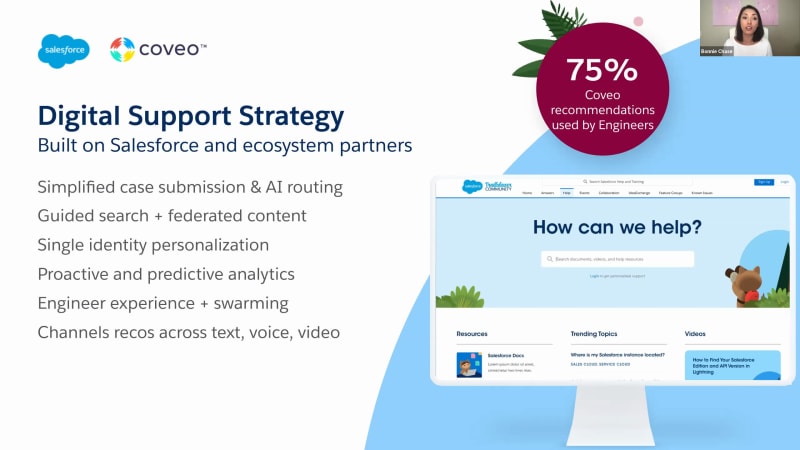
Alright. I think it's time for us to get started. Hello, everyone. Thank you so much for joining our webinar today, scaling relevant support at Salesforce. My name is Bonnie, and I'm director of product marketing here at Coveo. And I'm also thrilled to be joined by our speaker, Madhav Tuttai, who is VP of strategy and operations at Salesforce. I have a couple of quick housekeeping items to cover before we get started. First, everyone is in listen only mode. However, we do want to hear from you during today's presentation. We'll be answering questions at the end of this session, so feel free to send those along using the q and a section on your screen. This webinar is being recorded, and you will receive the recording after the presentation. Now I'm excited to get started, and the topic today is really around scaling relevant support. We've all been facing the challenge of keeping up with the rising and changing expectations of customers, and it's really valuable to learn how leading brands like Salesforce are able to keep up with these imperatives. And in a company of that size, it's important to create a strategy that is not only digital, but is scalable and relevant to each customer. So Madhav has joined us today to share how, they at Salesforce approach creating a digital support strategy. So to kick us off, Madhav, why don't you tell us a little bit about yourself and your team at Salesforce? Thank you, Bonnie. Really excited to be here, and look forward to the discussion. So I've been at Salesforce about a year now. Did a variety of things before, including some time at, Google, startups, and, and other places. My role at Salesforce is really to manage, our strategy and operations team for our global support, organization, and that really means two things. It means, one, my team manages all of our central operations, so things like capacity planning, strategic and financial planning, readiness activities for product launches, things like that. And then I also have a team that is focused specifically on experience improvement at each part of the journey. And and today, we'll talk about some of what that is in conjunction with the big, digital transformation that we're undergoing right now. But I have teams that work on how do we improve the experience, how do we improve our processes, how do we leverage the best technology to really get the best experience both for our external customers, but also for our, internal engineers. So it's a really, really fun, it's a really fun role, and we and we spend a lot of time at the intersection of technology, experience design, and really driving, the best outcomes for our stakeholders. Yeah. That's great. And you have a huge footprint. Can you can you cover a little bit about that? Yeah. Absolutely. So the team is well over three thousand people, globally. We have a few specific hub locations around the world as well where we have concentrations, of folks. We are a single global support organization for all of Salesforce's products, across all of the regions, across all of our customer segments. And so we really run this organization at scale to support every Salesforce customer. We, of course, handle cases both in the human assistant side where you can see we have, you know, over a million cases that we handle a year. And then self-service, which we'll talk about a little bit today, self-service and our digital, digital platforms are a huge source of engagement for us, whether that is our help website, our community forums, Trailhead, many of the other wholesale digital resources that we have. That is a place where customers gather and make sure that they're actually getting the questions that they want, answered. And so that's our that's our support organization, large, and at scale supporting, you know, the hundreds of thousands of Salesforce customers globally. Yeah. And so when we think about the strategy for that self-service experience, you know, can you walk us through the approach at at building that at scale? Because, you know, you you you're all over the globe, millions of interactions, a variety of different types of users. So how do you make sure that you're you're really able to do that well? Yeah. So this was really the key question as we thought about our digital transformation to begin with. And as many folks know and probably many on this call, deciding to embark on this journey of transformation is not easy. Right? We really have to have the right structure behind it, the right investment behind it, the right imperative and executive support to really drive it forward. But as we looked at our overall experience, it was pretty clear to us that there were many, many things about the experience that we felt were inefficient, that we felt were, not making things easy for our customers to really get access to the right content that they needed, get access to the right people that they needed. Similarly, on our support engineer experience, there was a lot of friction involved, a lot of outdated tools, a lot of compromises that we were making in order to deliver on this experience. And so we really thought about this holistically and said, okay. Do we really wanna go, rip the Band Aid and really reframe this experience from scratch, across every single stage of the journey for all of our personas? And that's obviously a big undertaking. Now we decided that we were gonna do that, and then, of course, we hit the pandemic, which, of course, accelerated a lot of things in terms of customer behavior, in terms of our ability to work from anywhere. And so taking all that together and driving this transformation has been an incredible effort. It really started with what you see here on this, on this slide, which is we first really needed to understand the journey. Who are our customers? What are their actual personas? What do they care about? What do they need? What are the jobs to be done? What is the kind of experience they want at every stage of their journey? And so this journey mapping exercise really got us centered on what matters, to our customers, and who do we truly serve? What are the journeys that they're on? And so this took a lot of work, and we partner with organizations, and design and journey mapping firms to do this. And then many, many of our folks, our own engineers, many of our customers were really involved in saying, let's walk through it and really highlight what are the pinpoints, where are the frictions, where are the inefficiencies. And when you do work like this, you end up with a laundry list of, you know, just hundreds of things. And so there's a significant prioritization exercise that follows to say, okay. Let's surely go after the things that we think are gonna be the most impactful, and then over time, really get to a holistic experience that works. Yeah. And I think that's a great point because one of the things that one of the mistakes that people can make is really starting with the technology to solve their issues. But, you know, the approach that you take and and that your team at Salesforce takes is really customer centric. So looking at not not just what what tools do we need, but what are the customers actually doing? How are they really interacting with us, and where are their true pain points? I think can can can shed a lot of light into how to move forward with that strategy. So looking at at the customer perspective, you know, can you continue telling a little bit more about, how you how you look at the outcomes and things like that? Yeah. The the personas and the outcomes to your point really matter, Bonnie. And you're right. Very often in transformations, technology comes first. Our approach on this really is to think about it as both technology led and user obsessed. It's not one or the other, because the truth is there is amazing technology out there. And the technology and the innovations that come out do spur new ideas and new ways in which we can serve customers. So what the technology can do and all the innovation that's occurring is a key point. However, you have to be obsessive about your users. What do they want? Who are they? What are their needs in order to balance it out? Because otherwise, all you're doing is cobbling together a bunch of technology, and you don't really know what's gonna work or what matters and what doesn't. Right? And it really centers around this, which is what are the core jobs to be done for your personas? And what we found, which was quite interesting was in the customer service and support world, what we think of as the resolution journey, which is basically, I have an issue. I need something I need something solved. I have a question. That's the obvious one. Right? When we think of support, we think, hey. We need to resolve things for customers. And so, of course, that jumped out front and center when we thought about our personas. It's like, hey. I come to you because I've got something to resolve. What was really interesting, though, that came up in our research and as we talked to customers was there is a parallel critical journey, which we call education, which is as I am solving issues, I also want to build my expertise. And building my expertise in a sustainable way on your product, on your ecosystem, on what it is that I'm trying to achieve for my business, is an equally important category. And, again, intuitively, this makes sense. Support teams, service teams all over the world are often talking to customers about how do I do this? How do I do that? It's not it's not always, hey. This thing is broken. It's about learning as well. And at Salesforce, that's a big priority for us. Right? Like, when you think about, Trailhead and our investment in education in general, it wasn't surprising to us that both these journey showed up. And when you really add these up is when we feel within the support experience, we can genuinely drive value for our customers. You need these components in order to say, okay. Am I actually driving my own business objectives as a customer, and and able to accomplish the things that I want to? Yeah. And I I love what you have on this slide because on one hand, you know, we we hear a lot about, tactics and activities. But when you're looking at what you're trying to achieve for your customers, you really do have to look at the outcomes that they want from support. And so, you know, I think I I've worked with a few different organizations who they they truly believe that they only had break fix content or a need for break fix, and I and I think it's really important to to recognize that it is more than just break fix that comes through support. So looking at these different intents, being able to grow their proficiency, not just efficiency, that can really add to that value. Absolutely. Well said. Yes. So go ahead and continue. Yeah. Yeah. When we think about in some ways, this is the most important slide, or the thing that we spent the most time on, which is okay. We understand who our personas are. We understand what the journeys and outcomes are. But how do they want to experience, your support or your service? And that is really a key question that then defines what are the things you do. Right? What technologies do you put in? What processes do you improve? How do you design the experience? And it really, for us, boiled down to these two things, which is customers want the experience to be easy, and they want the experience to be expert. And I'll break down exactly what those things mean. Easy means things that I think we all would recognize intuitively, which is less friction in the process, make the experience lower effort than what I typically have to do. For us, there was an easy example of this. We had a, a case intake, case submission process, on our website that was six pages long. And we cut and we were able to cut it down effectively by eighty five percent and still make it an effective process for customers. High speed really matters, which is get my content to me, get my information to me as fast as possible when I'm asking for something. But speed also can push you in the direction of, can we be more proactive? Can we be so fast that we actually get things to customers before they actually ask us for it? Can we actually identify information and data, that we can deliver to them more proactively, without them needing to actually take the step of asking for something? So easy is a big part of our, a part of our experience. Expert actually ties to the point that you made, which is a recognition that in our world, certainly, and I'm sure this is true for many, many organizations, support has really evolved from being a very simple break fix transaction with customers. Customers are able to self serve very, very effectively today. Our success rates on self-service are over ninety percent, which means really most of the straightforward simple things that a customer can do, they are able to do themselves, leveraging self-service capabilities or the community or other resources that they have access to. And so expertise really matters because the degree of complexity of what ends up coming into support channels, has increasingly gone higher, and we've seen that in our data as well. And when we say expertise, we really mean two things. One is our content, whether delivered on self-service or delivered via a human who is an expert, our content has to be deep on our product. We really have to understand what the customer is looking to do, what the product is capable of, and be the experts for, for our own technologies and our own products. And so we've we've, invested significantly, in the amount of certification and the amount of capability building for our teams. We've even organized ourselves to be focused on specific product areas, lined up the same way our product and engineering teams are to really drive that depth and expertise. The second thing you have to be an expert on is the user, and this is where, you know, certainly technologies like Coveo play a really important role. The context that the user is in, the history of what they've done, what have they already attempted, personalizing it to their preferences, personalizing it to what they typically interact with and the kind of content they seem to find more effective to consume. All of that is really critical, and that's under that user context bucket. So, it's a pretty simple slide, but we spent a lot of time really honing this down to say what are the things that matter. Because when we make a technology decision or we make an experience decision, it has to serve one or more of these outcomes. And often, the decision will serve multiple of these, but they really, really have to be aligned to these particular outcomes. So this is this is really, I think the key step in a in a transformation journey is having this list ready so that when you need to make prioritization decisions, when you wanna think about what technologies you wanna invest in, you have a blueprint that you can look at or a set of values you can look at that you can actually say does this satisfy the need or not. Yeah. And this is a really good point because how customers want to experience support may be different than, you know, what you think they may want to. So I've heard a lot of times, you know, chatbots are are the cool thing, and people wanna implement chatbots, but they haven't done their research to see if that's something their customers actually want, to interact with. And just as another example, company like AARP, for example, they still have, older clients who like to write mail in handwritten letters, and that is how they want to experience support. So it's really important to to look from their perspective. You know, I I you mentioned the six page long case submission and, streamlining that a little bit. And I think, you know, it's so funny because a lot of time especially over the last few years, case deflection has been such a huge, metric that people are always looking at. And we're seeing that, it's kind of been taken to the extreme where not only are we trying to, proactively provide content, but in some cases, companies are making it more difficult for people to reach support. And I think, you know, with with the changes that you're making, it's it's not necessarily about keeping customers away. It's making sure that, you know, you have those answers available to them when they need them and that when they're needing to submit a case, they absolutely can do that easily as well. Yes. Absolutely. I think you have to you have to balance out, again, it comes down to your priorities. Right? I would argue and we've actually seen this. Adding more synchronous capability with our customers. Chat is a good example. We've taken up our percentage, of chat significantly now, in our in our customer base. And for that set of issues and for those personas of customers, that is the most effective resolution path. And you actually catch up to it and end up providing a more efficient experience over time if you have the right balance of channels. Yep. So we've talked about a few different things. So, you know, understanding what their current journey is, the outcomes that they're trying to achieve, and how they want to experience, support as well. Can you talk a little bit about, you you know, your current channels and and what what you're doing today, from a technology perspective? Yeah. Fundamentally, I mean, if you think about the customer service journey and the things that we talked about, today, we are all in the content and channels business. That that that is what this business is. We deliver all kinds of different content, documentation. It could be, you know, alert monitors from our infrastructure. It could be videos. It could be all kinds of different forms of content, that we ultimately deliver through these channels. That this is what the business is. And it goes back to the point that you made earlier is you wanna take a very clear lens towards which of these channels matter, which channels do customers want to engage with, which are the things that are driving a better experience for customers. Right? And the answer to your point may not always be, hey. We just need to optimize for case deflection. There's probably a percentage of your cases where a chat or a synchronous capability is actually the more efficient path for for customers, which could then also be the more efficient path for your business. Because all those cases you attempted to deflect, once the customer eventually got to you, they're probably more escalated. You probably end up spending more time with them. So they're actually you do have to take a global view towards what the channel optimization, strategy really looks like. Now what this picture really really shows is from self-service all the way to assisted support, we offer a variety of of channels today, by which we can deliver our content. Prioritizing which of these channels matter to customers, I think, is key. I don't think we all have the answers here. Some of it is experimentation. We've been experimenting with video, interaction, for example. We've been experimenting with, how do we think about health capability within the product, right, to actually really drive proactive addressing of situations. And so there's a lot of work that happens on channels. The interesting thing about channels I would say is, some of it is also what you train your customers to do, and some of it is their preference. So you wanna be careful about splitting those two things. Right? If you provide a frictionless experience on certain channels for customers, customers will gravitate towards that channel as well. So as a service organization, you do have a lot of control over this. A customer will give you a channel preference, but, typically, they're giving you that channel preference because that's the channel in which they've experienced the least friction. And so it is important to continuously experiment with these different channels to see, okay, which one of these are actually driving the values we talked about earlier. Right? Are we lower effort? Are we higher speed? Are we able to truly provide that personalized experience to customers? And let that guide you towards, which channels you wanna experiment with and optimize for. Yeah. And and it and it can be challenging to to manage all of these different channels and and multiple different content sources. And I think that's where something like Coveo comes in to help really streamline that content flow and making sure that that they have access to the information they need when they need it. Can you talk a little bit about, your digital strategy as far as it goes with, you know, how you're implementing Coveo and other solutions to build this out? Yeah. Absolutely. So this is the, this is the where it all comes together slide. Right? So you know your personas. You know what their journeys are. You know what kind of experiences you wanna build. You have a rough idea about what kind of channels you wanna experiment with. Now let's talk about what are we actually doing. What's the technology? What are we implementing? What are the priorities? And this is not obviously the comprehensive list. As I said, that list is hundreds of items long. But this is a few examples of the kind of things that we think are important, and certainly, Coveo, and and our other technology partners play a significant role, in in helping us achieve these objectives. And if you look at things like case submission, we talked about having more intelligence in our routing mechanism, really being able to get customers to the right channels quickly, in a seamless way as possible. Guided search, and if you go back to, you know, an effortless experience that is more personal to customers, we believe that in self-service, we wanna provide a more guided experience to customers. Historically, we've been very much about, disjointed content repositories. Basically, you go and you pick which content and that's what you dig into. But certainly leveraging capabilities like Coveo, driving cross content federation, being able to surface up multiple varieties of content for customers to engage with, really guiding them through what's the problem, what's the issue, let's surface up the right kind of content at the right time, with bots or conversational UI. That is gonna be a big focus for us on the self personalization, I think, is really key. We obviously know a lot about our customers. We know a lot about our journey. But we, like many others, have this very disjointed experience where, hey. You spend a lot of time on our website or you start in Google and then come to our website, spend a lot of time in our content. And then if something doesn't work for you and you wanna go submit a case, well, guess what? You're gonna start from scratch, again. Right? And, like, none of the things that you've done, none of the work that you have, already completed is gonna be relevant when you start that case again. We have to break that. Right? We have to be able to truly personalize the full experience for customers starting from the content that they are served while they're searching all the way through now as they transition through the journey. If they need to talk to somebody, if they need to work with somebody, how do we make that as seamless as possible? So that personalization, I think, is huge. Proactive and predictive analytics is a big focus for us. So providing customers data ahead of an issue. Right? Being able to we obviously run, an infrastructure capability as well at Salesforce. So really being able to provide, the health of their experience, the health of their environment, is big, so that customers can take action ahead of issues happening. Predictive is equally important as a case might come into assisted support, as it's maturing, as things might be going south, as there might be negative sentiments. So we're doing a lot of work on sentiment analysis, on escalation prediction, things like that. The engineer experience and your your stat on the on the slide really shows this. We do use Coveo, for our engineers as well to really drive recommendations to the right content, all of that. Spending a ton of time on really, really driving the right experience for our engineers. And this goes back to the point that you made earlier, which is, our engineers no longer operate in a purely break fix environment. Right? These are folks that are really working on high complex issues, and so you wanna design an experience for them, where they are able to operate like the engineers that they actually are. There's a reason we call them we we call them customer service engineers because that is the level of capability that that people now need in order to be able to do these roles really effectively. So that's also a huge focus for us. And then, of course, we talked about channels, recommending the right channels to customers, sending them to the right place. So plenty, plenty on this list. I'm sure we could spend, you know, a thirty minute conversation on every one of these topics, but but this is some of the things that we're working on and certainly, you know, our our key partners and our key technologies play a play a huge role in actually bringing these experiences to life. Yeah. And and, you know, you mentioned the the disjointed content at first. And I think that that is that's probably, you know, one of the core challenges that a lot of companies face because you can implement a variety of channels. But if people can't access the content that they need and they can't find that information, then it doesn't really solve the problem. So making sure that that they have that access. It's not disjointed. We're breaking those silos and making that seamless experience, for the customers and also for the agents who are helping those customers. Absolutely. Absolutely. I think content optimization is such a key and central theme to any customer service business. Absolutely. I think that requires a tremendous amount of focus. And as you said, both for customers, but also for our for our, engineers to have access to information. Absolutely agree. Right. So in in in that light, you know, I really wanted to just kind of, close on on how, Salesforce uses Coveo in your ecosystem. And, you know, we're in a variety of places really helping to bring that, that unified content experience and stitching together those user insights for the agent experience. Can you tell us a little bit about some of the results that you've seen and and how that's impacted your team, using Coveo in your experience? Yeah. Absolutely. I mean, we've we've seen, a a a a tremendous amount of upside in using the technology from a customer perspective. Our click through rates are up significantly. As I mentioned earlier, self-service success rate is now over ninety percent, and, certainly, partners like Coveo play a significant role in making sure customers have access to the right content and are doing it effectively. What I've been really pleased by also is on the engineer side. We have engineers using recommended content over seventy five percent of the time. That tells me that our ability to search, our ability to recommend content is really, really great, and that's something that we've relied on you all for, significantly. Queries without results is down to well less well below five percent. That's really big, for us as well. So lots of metrics along the way. I think the key message here is as we try to build this more personalized and experience, I think leveraging technology like Coveo, I think is really, really key, to make sure that we are able to actually deliver on that promise. Absolutely. So looking forward, Madhav, you know, you you've got, you know, these steps secreting this digital support strategy. What are you excited about next? Yeah. I mean, I I'm excited about continuing on this journey. I still feel like we are very, very early. We are still scratching the surface, of the kinds of experiences we can build for our customers. We feel like we have a good vision for where we wanna go, but actually taking this, testing it with customers, thinking about what works. There's no question we're gonna learn all sorts of amazing things along the way, whether it's in our engineer experience or our customer experience. And so, this is a long journey, especially at our scale. Anyone that attempts to do these kinds of transformations would tell you. These things definitely take time. They take effort. They take focus. But we could not be more excited because I think the upside here, given the amount of value we provide to customers, I think, is is really, really exciting, and and really potentially, really, really significant impact, for our stakeholders. Awesome. So just to kind of summarize what we talked about today, really thinking about building that scalable support journey. First, understanding what the customers are going through, what their current journey is, you know, and and that may require some cross functional collaboration with other team members, identifying the outcomes that your customers want to achieve, not necessarily, the activities that they need to do, but what are the outcomes that they need to see in that experience? And then, you know, how do they want to have that experience? Then you can really establish the approach, the channels, the content, and all of that, after the fact. So I do wanna invite people to to ask some questions. Feel free to drop them in q and a. I will go ahead and stop sharing, and and we wanna take a few minutes, Madav, to have a a little fireside chat with some questions here. So let's see. The first question, how do you differentiate the content fine tuning for customers versus engineers? Yeah. I'm happy to I'm happy to to jump in on that one. Your personalization models, that you use and what you're actually training, the system to do will absolutely be different depending on the persona and the constituency. Now the good news, of course, here is as we think about what queries customers are using, what queries engineers are using, there can be commonality, in in exactly what we're doing here, for what type of content. So you will definitely in our world, at least, we absolutely learn lessons that apply in both spaces. However, our engineers are obviously using content at a much, much higher degree of depth. Right? And we have to reflect that in the process and how we actually build that experience. So there is fine tuning that you have to do for each persona, but there are commonalities given that it is the same content based typically that you're using. Great. Does Salesforce and Coveo together espouse best practices for implementation? So I can take this one. Yeah. I I would say, you know, Coveo and Salesforce work very closely together. Our, our integration has actually been built with Salesforce in mind. So, with over with almost a decade of development into our Salesforce integration, you know, the tools that we build, are are meant to work really well with Salesforce. We are partners with Salesforce as well. And so with that partnership, we definitely do, create those, joint best practices to make sure that every implementation with Coveo and Salesforce together are smooth. I don't know if you wanna add anything to that, Madam. No. I think that's right. I think it's I think it's really key for such a central piece of technology, to think about it. Of course, Coveo has experience across Salesforce, not just with our customer service team, right, across other teams and, of course, with other customers. So one hundred percent, I think there's a lot of great resources on how best to implement this in tune it. Great. Alright. So we talked about case deflection. What are what are the other key metrics that, that you're looking at besides case deflection? Yeah. So we have key metrics across the entire journey. In self-service, we think about self-service success is really how we think about, the primary metrics, which is our customers using content effectively and actually driving success for themselves. So that is a really, really key metric, on the self-service side. Case deflection is really measured as customers get closer to the case submission journey, and we think about are we actually deflecting cases with real intent to submit a case. So we really have to look at both pieces of that picture. So that matters a lot in self-service. And then, of course, once we start to get into assistant support, we think about traditional metrics. Right? What's our time? How are we escalating things? What is our satisfaction, across the journey, whether it's in self-service, whether it's in assisted support? A lot of work, a lot of work done there on on our KPIs, and which ones matter. Awesome. Alright. The next question. How does KCS shape this collaboration to achieve the basic tenets such as flag it, fix it? Yeah. KCS, is a is a significant source of content for our customers. It is knowledge articles are the number one used content. So if you look at our content types, we have product documentation. We have documentation for developers. We have knowledge articles that are created by support, and other folks. And then we've got video content. We've got other kinds of things. Knowledge articles, and then really driving the KCS process, I think is is probably the most important focus Barca. And the reason is, because the content and knowledge articles typically is written within the context of support. Right? How do I troubleshoot something? How do I solve a problem? How do I actually do this versus more generic product content, which just kinda teaches people about the product. So, we run a comprehensive KCS program, at Salesforce, driving incentives for our engineers to contribute, driving higher quality in our knowledge articles, creating feed feedback loop mechanisms, to improve the the content quality, but also drive content, and feedback back into our product teams to actually solve issues, things like that. So, a lot of work happens, in in really optimizing and managing our KCS process. Yeah. And, you know, from a technology perspective, you know, the way the tools work together is you really you know, you're creating that content in Salesforce and and and setting all of that up there, but Coveo comes in to really make it easier to find that information because it is an AI powered search, making it more discoverable, easier to find, and then stitching together those insights, for the agents so that they can help, resolve those, issues when they encounter those as well. Right. The next question. So you mentioned swarming. How long have you been doing swarming, and do you have any, tips to share there? Yeah. So we're relatively early in our in our swarming journey, but we have come a long way in just a few months. We ran a few pilots around what is what is the right way to swarm, how do we think about the structure on swarming, what are the roles, what are the incentives. And I have to say, those pilots were incredibly revelatory in how do we actually structure a good swarm program. So a few things we learned from that. One is we learned that there is actually a need for a role for someone to monitor, a swarm team. That was a huge takeaway. A second takeaway was, what was the most effective size of a swarm team? You cannot do swarming effectively if you have a hundred people that are trying to swarm at the same time. You really have to chunk it down to smaller sizes. A third big takeaway was what's the incentive structure? There will be this big, push to saying, hey. Let's track every swarm interaction. Let's track every assist, all of that. We actually think that that's difficult to do. In some ways, the most important incentives in swarming are really about creating a team based incentive, a collaborative incentive for people to move it forward. So that was a big lesson. But now having piloted it, having implemented it, we are actually a couple of weeks away from rolling it out across our entire organization. We've seen significant improvements in time to resolve, significant improvements in escalation rates, reduction in transfers, all of that. And the best thing is our engineers absolutely love it. They absolutely love the collaboration. They love the team based work. It really gives our engineers a way in which, again, if you use the content frame, it dramatically increases the efficiency at which the content gets to the customer. Right? In this case, what it's doing is you're basically bringing export content via humans to the customer in the simplest and quickest way possible without needing to hand the customer off. So as a content channel, swarming acts like a kind of as the superpower to really accelerate the time that it takes for relevant content delivered via human to really get to the customer. So strongly recommend. Yeah. And I know that's something that a lot of teams are exploring today. So that that's a great overview. Thanks for sharing that. Next question. Can you talk about driving the overall adoption of web self-service versus email and support? How did you achieve success without pushing users to channels they might not think they would prefer but might be better for them? Yeah. It's a really good question, and I don't think there's one easy answer to this. Some of it is just experimenting with the channel to begin with and trying what happens. Now we obviously have had a long history of education capability on our website. You think about Trailhead. Our community, our Trailblazer community is a highly engaged resource that customers have used for a long time. And so some of this also is precedence in terms of we have established certain channels, over a long period, and customers are already trained to use those channels. Now the effectiveness of those channels is where you can actually experiment quite a bit. So as we think about better search capability, better content awareness, better actual, you know, better guided capability on our website, that helps customers who already know to come to the website. It helps them stay there and actually find the answers without needing to take additional steps. So there is a lot of optimization there. On the experimentation side, though, chat is a good example. Right? We've historically been an asynchronous case submission business. That's really been the business. Right? You go on our portal. You submit a case. Most customers do that. Now in some rare instances, they have to call us if something urgent is going on. But generally speaking, most of the businesses web the case. So there, what we did was we just created a less, you know, a a process with less friction to reach a human via chat just to see what the what the results would be, and that experiment turned out to be wildly successful. Now we all know chat doesn't work for everything. Right? There are complex issues. There are some things that will not work. But for the percentage, that we are looking at, chat was an effective way for us to do it. So that experimentation allowed us to kinda calibrate on what is the right number. Right? We will never live in a world where fifty percent of our customers can use chat. But if only five percent of our customers are using chat, that's probably too low. So you kind of experiment to find the right balance. Right. You mentioned pushing channels to reduce friction even if a customer currently prefers a particular channel. What have you done to promote your preferred channel and change customer behavior? Yeah. So the chat example is a good one, right, where we gave the ability for customers to access it a less you know, provide less friction to get to that to see what happens. So that, I think, is one example of pushing a channel to see what happens. Another example that we're just scratching the surface on is actually in product capability. Right? So when you're in a Salesforce product, when we surface up, you know, your ability to talk to a bot or your ability to access content within that. That's another way to really push the channel, to see how users actually use it. Now the key with in product is in our world, in product is really end user personas, and so we're still trying to figure out between end user personas and the admin persona, which is really our main one. What's the level of engagement as you think about these. Right? There probably is some use there, but I would advocate for as much experimentation as possible. Another one that we did, was on video. So we found as customers were in a chat, there were some conversations that were probably better handled, face to face. And so we started to give customers an option to say, hey. As you're in this chat, as we as we as this conversation is becoming more complex or too complex for a chat, how about we transition to video and have this conversation, you know, and allow for some screen sharing, allow for our ability to interact a little bit more, and got some great results out of that. So, again, targeted depending on the use, depending on the persona, depending on what the customer wants. These kinds of targeted experiments will unveil what are the set of use cases that these channels are most useful for. I hope that answered the question. Yep. And, and and I I I like the idea of experimentation too because it takes an iterative approach. You're not going to get it right necessarily the first time. And we will be sharing the slides, after this. So if you're if you're looking for those slides, we will share those. In scaling a support organization, do you recommend starting with support engineers on service cloud or driving towards self-service first? Yeah. It's a good question. We've actually taken the approach of doing both, which is something that we can do, at our scale. We have, I have a team that is dedicated to self-service and our digital channels, and I have a team that is dedicated to experience improvement in our assisted channels. Similarly, our technology teams, who are the ones we partner with to go and actually implement and develop these technologies, often using Salesforce products, in many of these cases, but also using partners, like Coveo. Those teams are also aligned and focused, on each stage of the journey, and we have parallel tracks that we have to look at. If I was gonna make a trade off between the two things, I I would probably advocate for ensuring you have a baseline experience for your support engineers that really allows them to do their jobs well. You can always continue to push the journey on self-service. We can always get better there. We can always get better content. We can always drive better technology to customers. But I think the engineer experience, particularly in this moment in time, and everyone's situation is different, but we, of course, now have a highly distributed workforce. We've seen an increasing complexity in the number of cases we get. We've seen multichannel needs for customers. And so we do think that the engineer experience, how do we bring cases in effectively, how do we route efficiently, how do we get our engineers up from a capability perspective, things like swarming to really reduce the burden both on customers and on engineers. We have spent a lot of time on the assisted support side because that stakeholder really matters to us. Right? I mean, our support engineers are really the lifeblood, of the operation, and we wanna make sure that they have a good experience. We have things we can do better, but if I was gonna pick one of those things, I would probably start with making sure that your customer service engineers are really having the best experience themselves, which will absolutely reflect on your customer's experience as well. Yep. Yeah. That's a great point. You know, focusing on that agent experience isn't detracting from the customer experience. It feeds right into that. Absolutely. Alright. Can you talk a bit about how how Coveo contributes to content quality? I don't know if this is a question for you or for me. I can share a little bit. Yeah. So, you know, Poveo is a, an AI powered search and recommendation solution. We do capture analytics across channels. So wherever that customer is interacting, whether it's a Salesforce property or not. And so capturing those usage and behavioral analytics and bringing those into our dashboards, bringing those insights into the agent experience really helps you see where those content gaps exist, see how people are using the content, and really help you make decisions on, you know, what changes that you need to make. So, you know, at a high level, I would say that that's part of how Coveo contributes to that. Have you do you have any, stories to share there, Madav, of where you're seeing, seeing an impact with your content? Yeah. I mean, that that this is what the technology is designed to do. Right? It's designed to, like, iteratively continuously get better on what recommendations we're making and how we could personalize it both at an individual customer level, but also overall. And so as we look at those results, we can absolutely draw relationships with which pieces of content are working, which ones are not, how do we assess and improve the actual quality of the content. Customers are finding the right thing, but the content itself was not effective in resolving the particular issue, which then tells us we have to improve the content type, or the actual content quality. So, yes, this is how this is how the technology actually works together. Alright. A couple more questions before we wrap. How do you measure proactive and predictive support success? Yeah. So the two things I put them both on the same bullet, but they're two different things. Proactive is really, do you have instrumentation and telemetry that looks at your product or looks at your infrastructure depending on what your product is, that can actually tell you, hey. A customer is headed towards an issue. Right? In our world, we have a service that we sell called proactive monitoring, which is really looking at the full technology stack, whether it's at the infrastructure level, the platform level, or the application layer to say, hey. We are seeing things here. We have alerts and telemetry that tell us something is going on, that we should get ahead of before it actually turns into a real issue for customers and then creates problems for them. So that is an example of proactive content. Essentially, you're giving customers information literally from the product or from the product stack that allows them to take action. And there we measure success by, are we avoiding issues, in the future? Right? Are we effectively curbing a particular trend and making sure that that doesn't turn into an issue that actually takes a customer down? Are we using that data to make product improvements? Are we actually, creating capabilities for customers that avoid the issue in the first place? So that's how we measure success on on the proactive side. Predictive is really about as a case goes through a case journey, and this mostly applies in the assisted world, not as much in self-service. But as a case goes through the assisted journey, are we seeing a trend towards negative sentiment? Are we seeing a trend towards escalation? And there's a lot of great capabilities out there, that will help, actually point to these are cases that need more attention. And what the predictive tools do basically is they change how your support managers spend their time. So now instead of spending all my time sifting through every case, fine, trying to figure out what happens, these tools basically give you a target that says these are the things you need to go look at, because we are detecting that there's potentially negative sentiment or a negative trend here that needs action. Now you can apply the predictive principle in your self-service journey as well. If you find a customer that is looking at multiple different pieces of content and not really getting there, do you want to now, you know, give them a bot experience or give them a human chat experience saying, hey. It sounds like you've been trying to do this for a while. Can we just help you figure out what's going on? So you can use that predictive principle, really across the journey to build some experiences. Hope that helps. Great. And one more question. What's the biggest hurdle Salesforce had to overcome in their transformation journey? Wow. Let me think. Look. I think, one, you wanna get the journey work done. Right? You wanna understand persona's journey is everything we talked about today. But outside of that, I think the number one thing that matters is your actual operating model for how you drive transformation. And I don't think we figured everything out here either. Right? But this is a massive change management and transformation process. Right? And so you've got, the business constituencies, which I represent. You've got technology providers, which could be our own internal technology teams, our internal IT teams. It could be partners like Coveo. You've got a variety of technology providers. And then you've got the actual stakeholders who are your customers, your, support engineers, and all of that. Right? The operating model by which you actually drive improvement and you drive agility, you drive the ability to experiment, you drive the ability to focus and prioritize. I mean, we've talked about, you know, thirty different things on this call, which things matter, which things matter more, how do you put resources behind them. We spend an unbelievable amount of time, on the actual operation of this. Right? And, yes, we drive good outcomes. We have good ideas. We implement nice technology, all of that. But the running of the transformation process, I would tell you if you go down this journey, you've gotta dedicate the time to it. It cannot be an also job for anybody. It is absolutely front and center. Your interaction with your IT organization, your technology providers, is multiple times a week. This isn't like once a month you get an update on the transformation. This is the thing that you're doing if you decide to go down that journey. So I would strongly advocate if you're gonna go down this path, that you are ready to commit to the amount of time, energy, focus, attention, all of that that this is gonna take, because it will take a long time, and it will require a very, very deep engagement to really make sure that things are moving forward. There will be a thousand decisions to make every day when you start when you start embarking on this journey. Now scare everybody away, though. It is a lot of time. I think that's great. Yeah. And, I mean, you know, that that's that's something sometimes people forget is there is this whole change management operation side of thing that you still need to consider. So, thank you so much, Madoff, for taking the time to speak with us today and sharing your insights, with your strategy at Salesforce. Thank you all for attending, and we will, see you again soon. Really enjoyed it. Thank you, Bonnie. See you. Bye.
Scaling With A Digital Support Strategy at Salesforce

