Dieser Inhalt ist nur in englischer Sprache verfügbar.
Welcome. Welcome. Thank you for joining. Alright. We have a full agenda today. So I'm gonna kick us off. First of all, welcome. Thank you for joining us. My name is Juanita Oguin. I lead product marketing here at Coveo for our service and knowledge division. Really excited to talk innovation, employee experience with you, and I'll be joined today by two of my colleagues, David and Olivier, who you will hear from shortly. Before we jump into today's last new and Coveo session, I just wanna cover a couple of housekeeping items with you. The first is that this session will be recorded, and you will get access to it within the next twenty four to forty eight hours. We also do have a large team of on the call that will be moderating, engaging with you throughout the presentation today. So if you have questions, you wanna learn a little bit more, don't feel free don't be afraid to engage with them. And you can do that in two ways. You can either chat with us in the open chat or else if you have specific questions, which we will cover at the end, you can enter those in the q and a option as well. Now today, we will be talking about current as well as future innovation. So it's important that you always make any buying decisions based off of the based off of publicly available information. Of course, we have to put this disclaimer in front of you today. Now if you joined us, you may have already seen us and heard us thanking you for your support and your trust and your ongoing commitment to us as customers, but I think it's important to repeat it. Thank you to our customers, our partners, our champions, our stakeholders. They really are a big contributing factor to what Coveo is building, and also everything we're doing on a daily basis. So from the team at Coveo, we wanna say thank you. We also wanted to highlight a few great awards as well as new connectivity that we've been able to bring forward over the last few months. The first is being named a leader on the Gartner Magic Quadrant for search and product discovery, which is really exciting. We were also recognized for an AI search innovation award, And you can see a few expanded integrations and connectivity we have including, partnering up with Genesys on the CCaaS contact center as a service space, working with Optimizely. So for for those of you working with marketing departments, being able to unlock that content within your Optimizely CMS. We also were able to become mock certified, which is very exciting to us, which really goes to show that we really try to take a modern composable headless approach, and mock agree. So we're now part of that, alliance. And then lastly, we have an expanded relationship with Salesforce who we have really over a decade of decade of experience with. So Olivia will talk about our expanded connectivity there shortly. And while many in the market are, you know, claiming to have strong proven generative answering, we are really proud to say we've been doing this and proving it with many of our customers. So we're glad to say we've have we have over thirty live implementations of generative answering that's live in production on our customer sites, and you can see just a few examples here from Xero, SAP, Forcepoint, and f five, the business outcomes and improvements we've been able to deliver. These do, these do speak to more of those external self-service, support portals and communities. But, of course, we also have helped improve the experiences for many of our workplace customers as well. And just wanted to call out a significant number here, which is, the decreased cost to serve of eight million euros, which we were able to deliver for SAP in addition to reducing cases by thirty percent. And our team at SAP did cover this in our relevance three sixty. So if you wanna learn a little bit more, we can always share those details with you. Also, we're excited to say, you know, we we don't stop innovating. You may have heard of us speaking about Coveo as a subscription to innovation, and we take this seriously. We if if you're using generative answering today, you would have received an email from us speaking to our fall updates to our generative answering capability. Our generative answering capability, for those of you that are not familiar, is really an out of the box approach to be able to use generative answering on your sites, your portals, your intranets, your chatbots, your agent experiences, so many different sites and locations. And so we've been able to enhance this, and we continuously enhance it. And our latest enhancements include an updated semantic encoder, improved prompt structure, and a new generative model. Now with these improvements, we've been able to deliver a fifteen percent increase in answer rate on average. And, you know, you may be wondering why answer rate or why this is important for those of you that are, you know, out there trying this out. This really means that your end users are able to get what they need, reducing their time to search, and helping them move on to that next task. And so this is an important product metric for us because it lets us know that our that our product and our solution capability is working. So we're very proud of this and proud to bring you these enhanced capabilities, and we'll continue to do so. Now I just wanna cover the state of digital employee experience for a minute. It's one of my my most favorite topics to talk about. Why employee experience matters and what's actually going on. And so I found this great report from Avanti that shared a a number of stats and metrics, but I wanted to share just, three of them with you. The first is that fifty five percent of office workers say negative experiences with workplace technology impact their mood and morale, and I'm sure that a lot of us can relate to this. What's also interesting is that sixty percent of IT professionals say digital employee experience is a buzzword with no practical application at their organizations. We're hoping that if you're here and you're a Coveo customer, this is not the case for you. And lastly, ninety percent of executive leaders say employees have the tools to be productive in a remote or hybrid work environment, which is interesting because only forty six percent of employees agree with this. So execs, ninety percent say, you have what you need. Forty six percent say, I don't think so. So what they show is that there's still room to improve and work to be done to really elevate the employee experiences across organizations. Now I hope if you're here, you also know and you agree with us that great CX is dependent on having great EX. Meaning, if you wanna deliver those great digital customer experiences, it really starts with prioritizing the tools and the technology that you're providing your own employees who are then serving those end customers. And so if you were with us last week, you saw us talk about the end to end customer experience, the fact that it includes many different stages of the buyer journey, including employees who who are customers as well, customers of IT, of course. And so today, we're gonna focus on the agent experience as well as knowledge workers and cover our capabilities from that lens. And just to go a little bit further for those of you maybe newer to Coveo or not sure where to get started, we have customers that use, our search, our AI, across different parts of the enterprise. So here you can see an example of front, middle, and back office use cases. It could be we could help to, elevate sales portals, improve search and findability on the Internet, as well as enhance that internal HR IT, employee self-service, as well as improve the experiences that agents have as well. So you can see, really, there's an ability to truly unify and augment that end to end digital experience, and there are a number of capabilities that we have existing today that you can use to do this in a very modern, headless, composable way. When it comes to new and coveo, this is our chance to showcase all the new things that we've released or developed over the last six months. And we do this twice a year. So this is our fall new and coveo, but we also do this in the spring. And so what you can see here are net new or perhaps stage change, products, so things that we were beta in the spring that are now GA in the fall. But you can see there's a lot of work that's been done, and this is just within the last six months. So everything from improving our generative answering capability that I just spoke about to introducing new AI models and capabilities. Of course, integrations and connectivity is absolutely important for enterprises, which have thousands of applications that need to be connected and integrated. And then on the commerce side, we're making a ton of improvements to the merchandising hub to help merchandisers be self sufficient and make changes fast. Search and UI, of course, is absolutely important because you wanna bring all of these strong capabilities to any UI that you're making available to your employees or perhaps even customers. And lastly, on the back end, there's a few capabilities we'll talk about, which are really around enhanced security and ease of use of the platform across your enterprise. So today, I'm gonna highlight the capabilities, the team and I will speak to you about. From here, I will pass it to David. But if you have questions, please feel free to log those in the chat or q and a. We'll be here monitoring on the back. David, over to you. Thanks, Juanita, and hello, everyone. I'm excited to be speaking in front of you today. Juanita, I'll be taking the screen share. Thank you. So, hopefully, everyone can see my screen properly with no problem. If there are any issues, just let me know. Thank you. So as Rita just mentioned, we've been working a lot of on our on our innovation for the last six months, and one of our main focuses has been relevance generative answering. So in this first part, I'll be focusing on the end user experience. But before I go deeper in terms of where we innovate and what we've added to our offering, I'd like to touch base on all the touchpoints where relevant generative answering is available to you and you can already have access to. So the first one is, in our SaaS based products, where you can we can join the customer experiences and make sure, RGA is available directly within, your in app experiences. It can also be within self-service portals, communities, employee portals to help your customers as as well as employees get answers to be more efficient. We've also added it lately, and we'll talk a bit deeper on that, on the case submission flow, which essentially will help customers, along their journey whilst they try to create, some customer cases. We've also added it to chatbots, where you can use our own turkey solution, and allow you to use your own LLMs within those chatbots as well. And we'll also touch a bit about that, a bit later. And then lastly, in service apps to make sure we support and help your agents solve cases faster, and make sure they can take on and take use those generated answers to, feedback this information, within those support cases. And so with that, we've as I as I was saying earlier, we did provide a few innovation there. Some were available earlier in the year. But in the last few ones that we've been added and one of the ones we're the most excited about is the addition to our case submission workflow. So a part of the one of these additions, it's that's where where it sits apologies, where it's important is, during the case submission flow, we would we wanna make sure we help our users create those cases effectively and efficiently and essentially help them deflect cases. But instead of just showing them links, we want to allow users to get secured, relevant, and generated answers to resolve their issues. And moving from the idea of a case to case submission flow but to a case resolution flow. And so that's something that our professional services team and our partners can help you achieve. But I'm not just gonna leave you hanging with a little screenshot. I wanna show you a quick demo of what that looks like in a quick recording. And so if you look at the customer journey and if I just could play on this little recording, all of our customer journeys, especially the on these portals, starts with a search. And if you think it starts with a search, we provide then this generative, answering, answered response. You can click on the show mores, see the citations, and have access to all the all the great innovations that the general answer component offers to you. But oftentimes, what we hear from our customers is that they instantly and skip this step, and they straight go to the case creation flow. And that could be problematic because in this case, they miss the benefits that generative answering provides you. And so by adding generative answering to, the case submission flow, what it allows them to do is to have access to our case classification model and take this into account as well when they do end up creating those cases. And the idea is to help them deflect as quickly as we can and as efficiently as we can whilst providing them all the context all the context around their query that they're looking for. It leverages the same benefits and outputs with the citations, with the show more options, and the ability to provide feedback within those components as well. So this is something our customers have found already great benefits about, and we've seen some amazing results from that. And it's something we're looking to expand across our customer usage, in the next few months as well. In addition to that, what you would have seen as part of the new elements that are part of our, general events component, and it's something we've heard a lot about, is conversational AI or this chat GPT experience, if that makes sense. But if you go with conversational AI, this can often lead potentially to some dead ends because essentially the conversation just goes on and on and on. And what we believe is that we can create this funnel and make it a bit more precise and offer you some follow-up questions that we believe will help you go and narrow your scope. And so if you start with a question that's broad, we can help you narrow it down and use then those NLM generated answers to provide the right questions to your, to to write follow-up questions to your initial query that are topically relevant, to the initial query? And that's extremely important because then, ideally, it will help you get to, the end of that journey. The solution is currently in beta with a few customers, and we're looking to expand this and hopefully in the next few months, we say push it GA as we move forward, and maturing this solution. Moving on to the next slide. One of the additions as well that you might have heard us talk about in the last few months, is rich text formatting, which is essentially the ability to handle and support a more advanced, text, which could be tables, code snippets, or others. And this, initially, when we did release it, was, it was not, automatically added to your solution. Now it's completely automatic to your solution. So when you do end up setting up RGA with Coveo, these these options are directly available where you'll see so those advanced and more, more, comp competed, sorry, responses as part of the generated answers. And that's something we've received some great feedback on and the solution will continue on maturing as we wanna add more formats, to the generated answers as well. Something that we're extremely excited about is multilingual. And this is something we've heard quite a lot in the last year whilst working with customers. Obviously, we work with customers from all around the world, whether it's from North America, Europe, Asia. And the support for multilingual has been something that's been asked for quite a lot. And this is something we're extremely excited to start sharing with the first, language being available in French, in early betas in the last few weeks, as long as I need to caveat, as long as your content exists in the local language within your Coveo index content. But adding to this and and we'll continue adding to this as we move forward more languages. And we're now happy to share that all of these languages are now available, in beta and can be tested, you know, with with the help of our of our of our support teams. And this is something that's gonna be extremely important, obviously, for EMEA customers who are handling multiple European languages within all of their websites. Now I'm gonna move to something that's a bit more future looking and that's not available today, but it's something we are extremely excited about, have been working really hard at, is a prototype for our context to to our con first contextual, application of RGA. What do we mean by that? And it is something that's extremely important, obviously, for employee experiences and workplace where we can take into consideration, the context of, the user and the context within its query. So in this case, in this screenshot, you can see we can, if we ask the question annual leave policy, we can take it to the into consideration from where. Is it the US? Is it Europe? Is it Canada? Where is that, user from? Second of all, we can take it to consideration how many hours do they have left specific to their own, annual policy, and then obviously the date range that's selected between that. So this is something we're currently prototyping and testing, on our on our end, and we're looking to expand and add more to as we move forward. So we can hope to productize this in the next few months as we continue on testing this and maturing this solution. And that's kind of it for end user experience. It's already a lot, but there's a lot more to come. And this is, some a section that's near and dear to my heart around the admin experience. And with that, with all the advances we've made to our end user experience, there is a need to push the admin experience as well to that because as much as the end user is tidy, neat, and clean, we need the admin experience or the Clear platform experience to match that and allow you to provide more control to the RGA model. And so with that, we're extremely excited to announce, the new knowledge hub, that's currently in closed beta with specific sets of customers, that will aim to provide, much more control around, first of all, RJ responses, whether it's through evaluations and troubleshooting, the ability to have more out of the box reports that works that that are strictly available to you dedicated to your specific interfaces, but also much more as we move forward in those lines. And so I'm not gonna share slides for this. I'm gonna go through a quick demo, and hopefully, I will not be cursed by the demo gods, which I have been lately. So I'll cross my fingers here. But hopefully, you guys can see now my, Chrome page. Fantastic. So here I am currently on the Coveo admin console, the one that you if you haven't seen it, this is a Coveo admin console. If you're one of our customers, you're pretty comfortable and used to this. I am currently in the search base section in my own, demo search page. And what I'll do here is show you very quickly something that's quite new that wasn't there before is the ability to have a drop down at the top and be able to select the knowledge hub. When you would click on the knowledge hub, you get redirected directly to, this new section of, the platform that has its own dedicated section related to RGA specifically right now. Before I go into that, I'll take a step Barca, and I just wanna show you where we focus right now. Our focus right now is in making sure we improve the quality of, RGA results. And that's one of the big things we've heard in the last year is this challenge of understanding why is an answer being generated, what content that is used, which citations, and why, and what is the model. And those questions have been coming over and over again. And this black box has been kind of a challenge for our customers and prospects. And I'm pleased to say that this black box is now opening up, and we're providing much more understanding of how these answers are being generated. And the way to do that today is by just clicking and opening up a basic hosted search page that can be created in literally five seconds. By just opening that up, I can start querying, the the model straight away. And I can ask it the search way. And I can ask it, what is a band saw ball? So our demo org uses a a query pattern that says is that say that uses context about wood. And so by by asking you what is the bandsaw ball, I get a generated answer, the citations, the resource options, and then the ability to provide feedback. But let's say this answer is poor. I can just say, hey. This is not good. I don't like this. You can say, the answer is bad. Is it about the right topic? No. No. No. And I can I'll just for the additional notes, say, demo for, and you and Kavail just so we can find it back in our evaluations. And I can send the feedback to Kavail. So we now have this information, this evaluation within our platform. And I can just go and navigate to the knowledge hub, into what we call the answer manager, which then has my specific configuration that's called david demo. You can create new configuration and, add them to your specific, experience as well. And by just clicking david demo, I can find my latest evaluation, which is right here. And I can find my evaluation, the question that's been asked, the answer that was generated, and then the all the evaluation details that can wait to it, including my additional notes for demo for new incoveil. So great. I was not cursed by the demo gods. In this case, I had my evaluation in my, in my knowledge hub. But you might say, that's not enough. I need something more. So why is this unhelpful? And this is where our what we call the trunk inspector today, name is still in progress. I know we we use the word passages as well. So this is still, in conversation. But, right now, the trunk inspector in this section is not available yet. So I'll go through our demo flow that's in a separate UI at the moment. But in here, let's, again, assume that, our query is unhelpful. I can then decide to understand better how is my document, being split, and how is the query being used by the model itself. So I'll start by the per document inspection where I can say, okay. It will allow you to select which model you wanna you wanna, test on. And then from there, I'll just, on the side, take my document ID that I've saved before. You can simply, find this using the relevant inspector that's available in the Coveo platform here very easily and very quickly. I can just then type in my, item unique ID. And then from there, the model the the trunk inspector will do its thing. And then you will see how the document is then spent per chunk, how it's literally spent, and it will tell you the number, fifty six chunks, for the specific document, and how the model will then start taking those chunks, to start generating an answer. That's great, but that's maybe not enough. And so the next phase is to say, well, for now a specific query. So let's say, again, I take a query that's, a big thumbs down, and I take the specific search ID for that query that, again, can be easily found within the Clearview platform. By just doing a quick fetch again, it will take a few seconds in this case because I'm on the, VPN, the ClearVPN. Now I can officially see the chunk count, the document count, the chunks that resided, and the chunk that passed the threshold, which is fifty six. But more importantly, I can also see which, of these chunks were cited and used and which were sent to GLNN. So in this specific answer for this specific query that's not really related to the the dance of all question, I can see that this chunk was actually used and it was cited. And it's chunk score, which the chunk score is extremely important because it's one of the elements that we use in the similarity threshold to, essentially help, inform the model in terms of the results we wanna provide. And that's just the first step. So now with this, I have enough information to understand what was cited, what was used, and understand why is the model this unique thing. So if it uses a chunks a chunk where there's the wrong context and there's on the right information, I can understand that the model has elucidated or used the wrong content. It could be a reason because there's a knowledge gap and my content is not clean enough. It could be because just the model has not understood the query. So there's multiple reasons why this could be. And we're looking to add those to the trunk inspector as well as we move forward with this. And this is just the first step. As we provide more more tooling, the idea behind this is that you'll be able to have full transparency behind those results and why they're being generated. So I'll move back to my presentation. You guys will have access to slides. So as obviously, you can go back and watch this recording. And as part of the toolkit, you'll have access to slides that details this a bit more, but I will skip this because I've already obviously gone through, the demo itself. With that, so, obviously, we've provided updates to the end user experience for the RGA model. We've provided updates to the admin experience to provide you more control and the ability to understand better why answers are generated. Now we've also obviously provided update to the model itself. And this is something, again, that we've worked, extensively on the last few months and we're extremely proud about is what we call the passage retrieval API or the relevance augmented passage retrieval API. In the past, you might have heard us call it, bring your own LLM or the trunk API, in previous sessions. But the name we've, landed with is, essentially passage retrieval API, but, most of our solutions that are RGA related are relevance augmented. So it makes sense to have that in there. And so the passage retrieval API, we're essentially allowing clients to build their own retrieval augmented generated system, using our best in breed AI search platform. And it comes with enterprise security and connectivity. So you have access to all the bells and whistles that Coveo has, but to be able to essentially build your own rack system. And you can essentially retrieve the best passages in in ready to be used formats for your LLM and then essentially just use that and ground the content for that, with the best knowledge that you have available. And what you see on screen here is a visual representation of that where you have the secure connectivity that Coveo offers, the unified hybrid index that leverages lexical and semantic, search. You have our relevance augmented retrieval capabilities that leverages the search and business rules, the lexical relevance, the behavioral UI models, relevance as well, and the vector embedding similarity as well within that. And all of that then passes through, what we call then the passage retrieval API that can then you can then feed into your own solutions and into your own LLMs and have your own experience created on the back of that. And that's something amazing because, essentially, Coveo does all the heavy lifting for you, and then you just get to benefit get to reap the benefits on the back of it. All the hard part we deal with, and then you just take care and create your own LLM based on this content itself. We recommend going through the docs for this. If if you have any questions or wanna go deeper into this, there's it's a solution we're extremely excited about. As you can see, it's still in beta at the moment and in testing with customers. So as we continue on maturing it, we're hoping to make it more accessible to all of our customer, as we move forward as well with this. And then lastly, on the, AI model side of things, is the improvement we've made to, our vector search capacity. So in the past, as you can see in the table on the right hand side, we were about, at about two million, documents with about twenty million index vector capacity, for the last few, months. However, we have a lot of large customers, and our customer base can go have millions and millions of documents beyond just the two or five two million. So right now, we're extremely excited to support since before, five million documents. And, again, this is just something to caveat, entitled documents. So it's something very important. But the more we add documents, we're not losing quality. So right now, you can have more documents. You can have more chunks, and all of that with the best performance that you're currently used to with, the two million, chunks, documents available. As you can see on this table as well, we're aiming to get to to go up to ten million chunks by twenty twenty five. There are no exact dates, for that, but we will provide more, more updates as we move forward during the year and give you some more precise dates or timelines, as we as we move forward during that year. With that, if I will pass it along to Olivier, and I'll hopefully to talk to you about integrations. Yes. Thank you, David. Very insightful. Love the the the answer manager. I think that's gonna be adding a lot of value to our customer, being able to better understand, you know, all those. LLM and generative AI, model works and provide value. So, alright. So I'm share so, Juanita, I'm gonna get control of your screen. So, as you know, most of, you know, Cavio is a platform. And one way to make sure that we can bring value to our customer is actually to to to offer prepackaged solution within existing existing ecosystems such as, you know, Salesforce, ServiceNow, Genesys, etcetera. So this is what we are calling and we are calling integrations. So I'm gonna give you a a a quick overview of, like, what are the new integration we've been working on and what are the updates of existing ones. So the first one being, quite exciting. This is something we we we started over the last few few months. This is an integration within Salesforce data cloud. So, you know, as you might know, data cloud, is one of the for those of you that were maybe a a Dreamforce this year, data cloud, AgentForest, etcetera, Salesforce are is putting a lot of energy into that that new cloud, which is pretty much, their own, you know, huge data lake. So what we are aiming to do is actually for our customer that would like to leverage, Salesforce functionalities, conversational AI to, Salesforce Einstein Copilot, you know, calculated inside, etcetera. All of the tools that Salesforce give you, there is a way for us I mean, we're we we're gonna be, enabling, enabling you guys to send, unstructured and unstructured and structured data from your Cavio platform all the way to data cloud. What it means, you know, roughly speaking, it's unstructured data. It's all the content that you have within the cover index. So all the text and everything that kind of feed, l and m, everything that can feed search, etcetera. So document, from within the index, you can bring sub subset of it within your Salesforce data cloud and take action, on it, such as, you know, grounding, and shine Copilot for answer, etcetera. So really bringing your external content within the the Salesforce ecosystem. The other part of it being structured data. Structured data is everything that has, is related to user actions. So, you know, from within a Kavio interface, all the click, all the searches are tracked. So this is user you know, using genetics. This is available within our Cavio platform, but we can bring that as well within Salesforce that account. So for your team, for your different business unit to actually make this data actionable and bring them bring that within your own, user action flow. So this is something that we are, currently, opening a beta quite soon. So if you want to know more, just make sure try to contact us, and we can enable discussion towards that. But this is really exciting, and it kind of make our partnership with with Salesforce even even tighter. So, the next one the next integrations, it is something that we did release end of May, this year. So it's been already a couple of months. So just want to make sure that we are bringing that back onto our what's new. It's our integration with with Genesys. Genesys is a call center. This is the leader in the call center space, the biggest in this in the industry. We have an out of the box integration right within Genesys Cloud CX. So every you know, if at your your company, if you're using Genesys to drive your call center, this is, another very good, you know, area where you could bring Cavio in, leverage your external data right within Genesys. And the whole idea here is that what you see on the right hand side, this is our hosted inside panels. So all of that has is managed and designed from within the Cavio platform. And just by going onto the Genesys app foundry, you find Cavio where listed there. We are, we are an official and approved application from Genesys. So you click, contact us. We enable the integration, and your admin can install that quite easily. What we'll give you is actually a very easy way, a very nice way for to empower your agent with all the feature that David was just mentioning a bit earlier. You know? Everything related to, generative answer, everything related to, you know, semantic search, etcetera. So we bring that inside Genesys. So your external content, we can bring it and, you know, deliver it to your to your agent. So everything all the metrics related to average handle time, time to resolution, etcetera, you really want to empower your your contact center agent to be able to close cases as quickly as possible, to have access to the best information, as quickly as possible. So we we enable all of that with our Genesys integration. Again, if you want to know more, we have our official documentation as well as our listing onto the Genesys app. Just looking if there is any question in the chat. Alright. Let's go to the next integration that we've been working on. Again, as, this one is fairly new as well. This is something that we're looking, to open open to open beta with customer quite soon, but we have a pretty good partnership with SAP, service cloud. SAP have a cloud platform, in which we can integrate to our Covio solution. So that is kind of the the the the beauty of it. Like, Covio being a an agnostic platform, all our, all our all of our builder what we call the builder features, every interfaces that we're creating, it's it's pretty easy to bring them inside existing, interfaces and Genesyspin one and SAP is the other one. So, again, the same feature that David mentioned earlier, generate the events or semantic search, all of that is out of the box and available within your SAP service cloud, console. So for your service agent, when a case is coming in, the OSID inside panel, you know, gonna be loaded on the right hand side so the service agent can actually take action, you know, take action quicker, can understand the case, use the case context to deliver the best answer, leverage average leverage conversational AI as well. So, again, this is a fully packaged Coveo solution that bring external content right within your your your service portal. The next one here and this is, you know, this is more on two kind of, the update side but or integration with ServiceNow. We've been partner partner with ServiceNow for many years. We are actually working actively to update our package, that is hosted onto the the ServiceNow, application, marketplace, let's say. So pretty much what we are doing is that, we are updating the package so it can leverage our latest and greatest visual, visual library, headless atomic, as well as making sure that the old the the builder, the hosted components, so it's like hosted search page that that it kind of quickly shown to you, hosted inside panel, you know, that would be available available out of the box within, ServiceNow. So this is we have a dev package already. So if anyone on the call here and or anyone listening to that that recording, you are a customer you are a ServiceNow and Cover customer. We have a the developer package that we can share with you guys and so you can give it a try and and bring that new solution, that new those new Calvio solution within ServiceNow. So really exciting. We're looking to have the finalized package by the end of the year. But, again, in the meantime, we have a developer package available. So OSID inside panel, OSAD search page, atomic library, all of those things gonna be out of the box in that package. And, of course, it will still support our old, or, you know, older GSUI visual library. Both library will still be available within the same package. So if you're still on the old package, don't worry. I mean, the same package will support both, both libraries. So pretty much it's best of both world all within the same package. And going on to the next topic, regarding integrations, it's we did a a quite significant significant update onto our Google Drive connector. You know, Coveo have a wide range of connective of connectors. We can pretty much index every source that you can imagine. Some of them are a bit more complex. Some of them are being, are, you know, more related to, you know, the workplace use case. This one being Google, Google Drive. You know? Everyone's using Google Drive in their enterprise mostly. So we did a significant update to our Google Drive connector. So everything that related to making sure that, the indexing is a little bit more, optimized in terms of not indexing, you know, every folders, better filtering of content, making sure that the the permission and share folder are, you know, a little bit better handled. You know, we we had a lot of feedback over the last few months, more you know, even more with the with RGA and conversational AI. External content is often in the enterprise within Google Drive. Companies want to leverage that to feed their interface. So, really, we we made sure that we we we updated this connector so it's on par with customer expectations. So and and you, easy to use user interface or right within the cover platform, Couple of clicks away, you create your source, you configure it, and as simple as that, you have your Google Drive right within the Kobo index, and then you can distribute it through hosted inside panel search page, etcetera. So that is it for the new integration and the updates in Tableau integration. The last part here, we would like to cover a couple of new updates that we've done, to our search and user interface technologies. And I think one a very interesting one, that lot of, you know, that that this is something that used to be only available into, Salesforce lightning web component for our host for our inside panel for Salesforce, agent cloud. So this is something that we're gonna be delivering to all of our customer, what we call the user actions. As you know, from any Cavio interfaces, we are tracking click and search. You know, when, you know, we we make sure that we provide you guys, the list of action your customer were doing within your own your your your Cavio power interface. So user action was very valuable for service agent. You know, when a case was coming in, through user action, the service agent could have a quick view of what were the latest action that specific user did just before opening that case. So which document did it click on, which searches, which query it has done, etcetera. So really having that visibility of, like, user behavior was adding a lot of valuable context to to the service agent. So this interface that you see on screen here, this is available for every Coverio integration now, through the hosted inside panel. So which mean that in Genesys, in SAP, in ServiceNow, in Salesforce, and pretty much everywhere, where a service agent will engage with cases or, you know, talk you know, a case and and customer questions, this is something, that will be available out of the box. So by the end of the year, we should have that, deployed in in all of those interfaces. So this is very interesting one that lot of customer were asking for over the last few months. And last but not least, as you know, we are we we we shifted to a new, JavaScript, you know, visual interface over the last couple of years, what we call ed less, or atomic ed less atomic, and Quantic for Salesforce. So we are releasing our version three, just lately. So the ed less and atomic version three is available as well as the Quantic version trees available. I mean, new features, you know, the the the the framework has been updated. So this is something you guys should be looking for, give if you want to to bring you, custom made or, you know, Kaveo interface inside your ecosystem. So this is quite exciting, all of that great work that the team has done over the last, few months. So I hope it it makes sense for you guys. And if you have any questions, feel free to to to contact us directly. And on this, I give it back to my friend, Juanita, to for admin and security. Thanks, Olivier. Great updates from you. I'm gonna close this out here with a few, final items. The first being our projects feature, which you may have heard about earlier this year. Our projects feature is essentially a way for us to help our larger enterprise customers that have multiple use cases across the organization better manage their projects. Now we as end users, when we go to sites and we search or even as employees when we go to sites and we search, you know, we want that easy, seamless experience. There's a lot that goes into making that experience world class. And what you can see on this slide is an image of our projects feature, in the admin console. And you can see there are items we are calling resources, but things like reports and crawling modules and insight panels. So many different components that go into creating those advanced search experiences. That's all now made easier, for teams to be able to set up, on their own and become a little bit more self sufficient. So this is going to be GA ing soon. If you haven't tried this out yet, we'd love for you to give it a shot. And, again, the idea here is to make setting up projects a little bit easier, but also giving a little bit more control to those different departments with use cases that, our enterprise customers have. Next is an important one, which is bring your own key, which is currently in beta. We heard from some of our customers, especially those in highly regulated industries, about the importance of being able to have more control over security. And so with bring your own key, we'll be able to give that control to our customers to revoke access to index data while staying compliant and taking advantage of the latest innovations we have to offer. Again, this is in beta in our product, management team. Would love to hear from you. So if this is something that you're interested in or being asked to provide, this is something you can try out, today. Last but not least, we take security seriously. There's many different ways that we approach this. The latest is our new certification, ISO twenty seven thousand eighteen and nineteen. But you can see the other certifications and attestations that we have as well, including being HIPAA compliant. And so there are a number of ways, again, that we take security seriously and also provide this to you. One I did wanna call out because I feel like it kind of gets overlooked as our early binding security method as well, which means when we are indexing your information, we are taking your existing access, control list or your existing permission controls. So multiple layers of added security to make sure that the people that are getting access to the information or the answers, from our Gen AI, can only see the things that they're meant to. So, again, we'll continue to, bring the latest standards here, and let us know if you have any questions on this one as well. With that, that does conclude our new and Coveo webinar series. This was the third. You can again catch our CX and commerce ones on demand. But I did wanna point you to, some upcoming webinars. The first is a special session we're having with Salesforce that we that will air on October twenty fourth, And I'll drop the link here for those of you that use Salesforce, whether you're using Salesforce for your, you know, service cloud agent experience, experience cloud for your sites and employee portals. If you're thinking about, you know, data cloud, agent force, and wondering how Salesforce and Coveo are working together, I would recommend you join that session. And then for those of you just looking to hear from an influencer on customer experience, again, employee experience is a part of customer experience. We we will have a master class with Blake Morgan on November fourteenth, so I'll add that link for you to join here as well. Just a couple last things, for our customers. You know, we have LevelUp. This is our online training where you can, go through some of these updates, get the latest insights and training on how to set these things up yourself. And then we've also updated our new Incovea web page that'll cover all of the items that were on that summary slide. We didn't cover them all today because we kind of spread them out over the three sessions we had over the last week. But you can see everything we have to offer on that new web page as well. With that, I'm going to, stop sharing, and we are gonna open it up to q and a. So it is not too late. If you have questions, I will go through and, just call out or try to answer some of the ones that I know that our team is handling on the back end. So the first I see is around, how how has Coveo's AI powered search been optimized for internal knowledge management and employee workflows in this release? James, thank you for that question. I would love to know a little bit more about your your intent behind that question. And what I would say to this is, you know, Coveo is, an agnostic AI search and generative answering platform. And so a lot of the things you would have seen today are making that search discovery, findability, as well as being able to get access to secure answers much easier for employees. Olivier covered an extensive part of our platform, which is our integrations and connectivity. And a lot of our integrations and connectors are two systems that are used by employees. Things like SharePoint, Google Drive, Slack, Confluence, and other systems that employees commonly work in. We either have native connectors to those or we have universal connectors such as REST API, GraphQL, other ways of connecting to these systems. And so everything we're doing is actually optimizing and enhancing those employee experiences. And then the last thing I will add to that is, we talked a little bit about the UI libraries, being headless, being part of mock alliance. What that really means is that we know enterprises have thousands of applications that your employees use are used to working in, and maybe there's applications you've already invested millions in and and decades in things like an Internet as an example. And so with all of our capabilities and components, you can essentially apply those to your existing systems and applications to make them even higher performing, to bring AI to them, to bring generative answering to them using this agnostic compatible platform from Coveo. So I hope that answers your question. I think our approach in a way is that we know you have these thousands of applications, and so we don't wanna be yet another application that you're adding to your tech stack. Rather, we want to enhance and augment those existing systems and platforms so that you're getting the most out of them, your employees are getting the most out of them, and that they're kinda modernizing those existing systems as well. So I'm happy to chat with you separately on this, but thank you for that question. I'm going to I know our teams answered this in the back end, but there's a question here about whether Coveo has a connector for indexing open text content. So an out of the box connector for OpenText. So I I think Martin answered this, but similarly and I kind of spoke about this in the first question. We say we have over thirty connectors that can connect to hundreds of systems, and we do break them up by native and universal. And so for those native ones, it's, again, like, really embedded into that system, taking those permissions from that system and passing them to our index as well. We also have universal connectors like REST API, GraphQL, as I mentioned. So a number of different ways that we can get content from various systems even if that content is on prem and not in the cloud. You know, being being a search company or having search in our roots, that means we've come up with against numerous types of systems, file formats, and have developed mechanisms to make it easier to bring all of that information into our index and augment and amplify that with our AI and our, you know, search relevancy. So we don't have something out of the box. We from a native connector perspective, we certainly can look to use universal connectors and other, you know, crawling modules as an example. I'm not saying that's the one we would use, but we can look at other methods to to bring in that content to make it findable, searchable, and and AI powered. David, Olivier, any any thoughts or questions from from your end on either these or anything we covered in the presentation? No. One thing that we did in the other session that I really enjoyed is share some of the thoughts that we had on kind of the things that excites us the most in the future. And I will share this, and I will repeat what I said in the last in the other session. If you haven't checked out recession, it's very similar to some of the content within that. But, one one thing that I did add is, the kind of maturing and pushing kind of forward this admin experience, which is something that I work on directly, which is why I'm excited the most about. But, obviously, one of the other things that are extreme that I'm actually excited about is this, personalized answers, which relates very, very tightly with, workplace and employee experiences, obviously. And it's something that will help us get more and more tailored answers to specific, questions and queries, which is something I'd I'd wanna have in my own ex employee experience. And so, as we move forward and as the prototype that I the quick screenshot that I showed kind of matures, we'll hopefully get them be able to show you some demos and, at some point, have this ready for all customers to use. So that's something that's gonna be, extremely valuable in every experience, not just the employee experience in that case. Thank you for that. Olivier, anything you're most excited about? I mean, all all of those, new partnership are really exciting. I mean, to to from my point of view, like, working with Genesys data cloud, those are companies that are adding a lot of value to their customers. So I think bringing Cavio, as well in that mix will will just make the experience, you know, you know, even better, for our customer and as well for the end user. So really excited to, to see to see that on hold. Thank you. I did wanna just call out just in case we are overlooking Ingrid Lee. I don't know if you meant to raise your hand, but we're happy to welcome you for any questions if you did mean to raise your hand. Okay. Again, we wanna thank you for your time. You will get access to this recording as well as, our kit with all of our features and capability capabilities. We hope that this gave you some idea of new things you can bring to your environments, new ways of optimizing those digital employee experiences. And these are things we release ongoing. So new was just our chance to group them all together and catch you up on all of the things we've released over the last six months or things that are coming very shortly. So we'd love to hear from you. Do please feel free to connect with us on LinkedIn. Always happy to do a personalized demo, answer any questions questions you have, or just to connect you to your existing account team members. If you are an existing Coveo customer and you're wondering where you know, who do I speak to about applying some of these things, we can make sure to connect you to the right people, on our side. So with that, I will say thank you to everyone and especially Dave and and Olivier. Thank you so much for joining me. You're welcome. Thank you. Take care. Thank you. Bye bye. Bye.
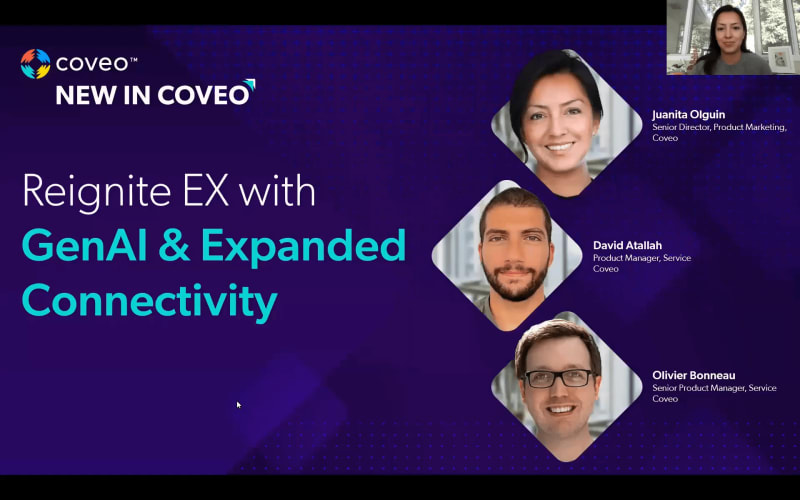
New in Coveo | EX | Fall 2024
Augment digital employee experiences across your existing systems with one platform! Join us to learn how to build a more relevant and connected workplace with the latest GenAI and connector innovations. Give workers accurate answers with conversational GenAI. Learn how to leverage analytics data further and help employees self-service effortlessly.


Make every experience relevant with Coveo