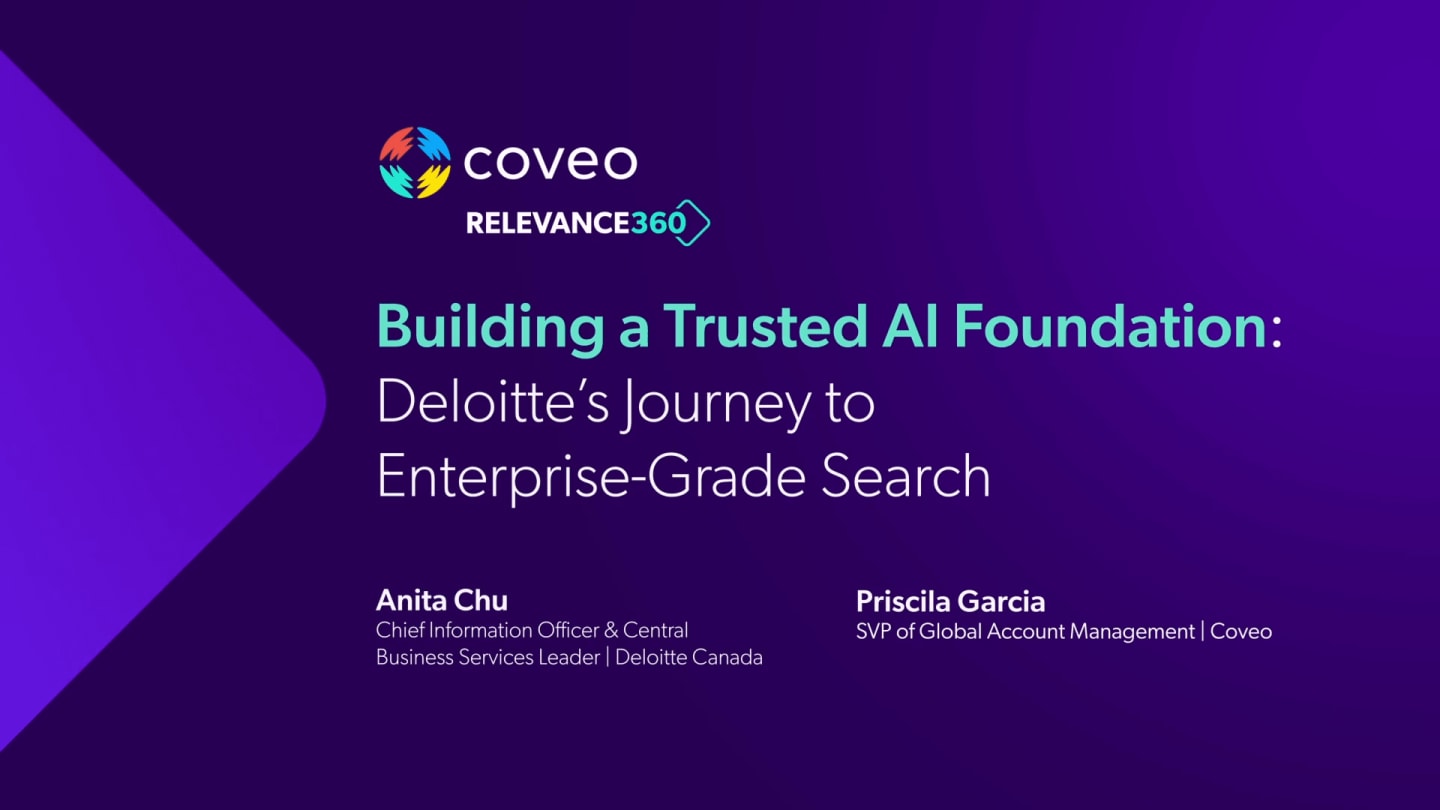
I'm joined by Anita Chew, CIO at Deloitte Canada. So Anita, welcome. And why don't you tell us about your role and your team at Deloitte? Well, you, and I'm really happy to be here. So I'm the CIO at Deloitte, and my job is really to enable all the people at Deloitte. So we're over fifteen thousand strong, and our job is to make sure that we provide the best technical solutions that enable our people to actually deliver for our customers each and every single day. Excellent. So tell us about the challenges or opportunities that led you to an AI search initiative. Well, it's an interesting story for me because we have been dealing with a old intranet site. We have a lot of technical debt, right? And as a result of that, we're dealing with a platform that was over ten years old at the time. And we need to replace our internal intranet site. And so we went out and we asked people, hey, what would we need in a new intranet site to engage and provide the information that people needed? And at that time what we found out was the number one thing that people came back with was it doesn't matter how pretty it's going to be, it doesn't matter what you're looking at doing, the biggest thing is to be able to find the information that you need and for it to be relevant. And so I remember asking people saying, well, you can find information really easily. What do you mean by you can't find information? And so I went in and actually did it myself and started to do some searching on our old intranet site. And it came back with stuff that was from nineteen ninety nine, things that were like really old, no longer relevant, policies and procedures that were outdated. And so we really then went on this search for a new AI search solution. And what we wanted was something that was going to really be enabling a capability to look across multiple platforms. We have a very complex technical system. And so we wanted a search capability that can go and be federated and we can pull together a lot of different knowledge stores across different platforms overall. Interesting, very glad that you went and did that exercise, Anita. So what were the risks of not solving that problem? How did you identify what they were? The biggest risk was productivity overall. So one of the things that we heard repeatedly from people were we were wasting time looking for information, we couldn't find information when we needed to. We could potentially find the wrong information, just like the article that I found from nineteen ninety nine, which no longer is relevant. But also at the same time, you needed to rely on tribal knowledge. So there was a great deal of frustration from our folks around being able to get the information that they needed at their fingertips. And so that's when we actually embarked on taking a look at how do we actually make that experience much better for people. And can you shed some light on the evaluation process? How did you go about it? So the evaluation process was an interesting process because we actually went out and basically did a market scan. We said, well, who are the big players that are out there? And we wanted something that was going be scalable. We wanted something that actually had strong security, a strong security posture in place. Security is really important to us because in our business, it's about trust, right? It's about how do we actually serve not only our customers, but also our people. And so we needed something that was actually going to be trusted, it was a market leader, it would be expandable, scalable, and also could go across a number of different platforms. And so that's kind of how we went about looking at functional and non functional fit. You talk already a lot about the criteria, what functionality mattered the most when evaluating the solutions outside of the security? So when you talk about functions, what was most important? So our overall vision was to be able to go across many platforms. So Deloitte has knowledge stores that exist in all different types of systems, applications, different products. And because knowledge is what we do, right, that's our business, We needed to be able to actually find that information. So what was really critical was something that was expandable, scalable, and something that could be used. And also, that ideally it could be easily, we could find a partner that could work well with us together as we expanded this and look to bring quick ROI. That was the other part of this was we had a very tight timeline because we were replacing end of life technology, and we needed a solution that was actually going to be able to get to market very quickly and actually provide high return on investment. And so those were all critical things that we were looking at when we started to do the search. So there are a lot of people out there, a lot of enterprises that spend a lot of time experimenting with standalone Gen AI solutions. How important was it for you to have that trusted AI foundation that you found in Coveo? Yeah, so Coveo did come out as the choice for us. Coveo just hit, kind of checked all the boxes for us overall. It was important for us to really think about not just necessarily finding, you know, like an experimental or AI type solution, because you could build something if you wanted to. We had other systems that we were looking at. It was really important that we were looking at an enterprise grade solution from, you know, a customer out there. Sorry, an enterprise grade solution from a product out there overall. And that's where Coveo came in. So it was really important for us to have something that was scalable and that was AI ready. And how does then Coveo support your broader AI or your digital transformation, right, strategy? Because it's important for you as a CIO, but also this project is very strategic for you. It is strategic for us. We're replacing a ten year old system, and we're trying to bring it into the modern age. We're trying to improve productivity. We're trying to allow people to find information at their fingertips. And so Coveo was a great solution for us because it was scalable. And I think the other part of it was, is we have been going through the project overall, and Coveo has been a great partner at helping us through some of the bumps along the way. And so it's important that we have that. And from a scalability perspective, we want to start first with a couple of knowledge stores, a couple of key platforms. But we expect to be able to expand that significantly to all the other places where we have knowledge and we have information out there. So then it becomes fully searchable, fully integrated, and people shouldn't need to know where to go to find information. It should just be there and it should be accessible to them whenever they need it. And maybe can you expand a little bit into what type of information, this is not necessarily policies and HR type system, right? What else are you doing? So HR policies, those are some of the things, but also access to different systems. Like where do you go to get, if you needed to enter time, or you needed to go somewhere else, you need the ability to know where to go to get that information. You need to be able to pull down, let's say, a tax slip or a tax form. How do you go find that, right? So we need the ability to not only find the information, but then drive you to where you need to go to take action. And that's where I think having a solution like Coveo helps us with being able to kind of take the next step on our AI journey, right? So really moving beyond finding information to taking a system of action overall. It's very, very interesting and jealous in a way of that transformation that you're going through. What impacts are you expecting to see operationally or financially? How are you gonna measure the success of this transformation? So it's interesting because I think that the most important thing for us is actually to be able to have satisfied people at the firm, right? So we want the people, the employees at Deloitte to be happy, be able to find the information that they need, But we also expect to see productivity increases. So overall, if it takes you time and you're trying to find information, you're going to multiple different places, you have to pick up the phone and bother somebody to say, Hey, how do I find this? You have to use tribal knowledge. That's not really truly productive. And so when we move forward, we're going to look at measurements around, you know, how satisfied are you with the new platform? How satisfied are you with search? How relevant is that search? But also at the same time, has it actually enabled you to be able to get the information more quickly, and then actually taken the next step to be able to do the action more quickly as well? Right. So thank you, Anita. Thank you for sharing the Lloyd's journey, and for showing what a thoughtful and responsible AI adoption, right, looks like at a scale. We're so grateful for your trust and your collaboration, and thank you for coming today and sharing the story with all of us here. Thank you. I'm very pleased to be here. Thanks so much.