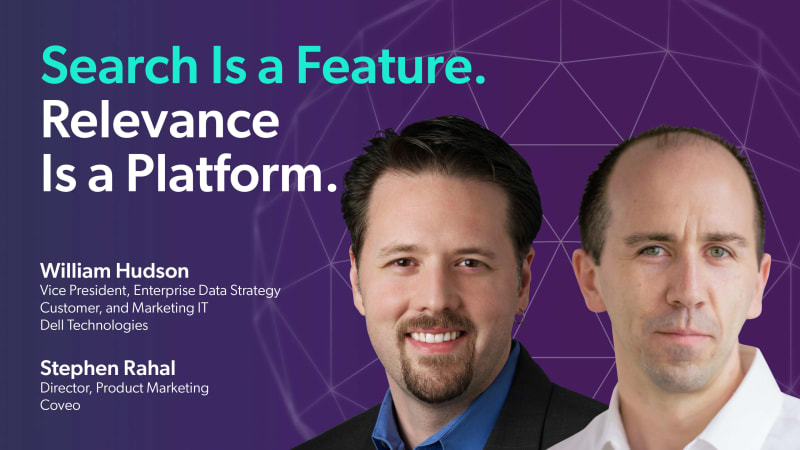
Hello, everyone, and welcome to the technology track for Relevance three sixty, a track that is designed for IT leaders, developers, and tech savvy professionals that are curious about the systems that underlie great experiences. In this session, we hope to accomplish two tasks. One is to unpack the strategies that have helped Dell Technologies create more relevant digital experiences, and the second is to explore the capabilities within the Coveo platform that enable their success. I'm excited to get started, but before we do, one housekeeping item to cover. First, if you're live with us today, we strongly encourage you to ask questions. We'll try and respond to them throughout. But please know that there's a chat for the entire event and a chat for the session itself. So be sure to use the tab for the session specifically to make sure your questions get answered. And if we don't have a chance to to answer your questions, we also have experts in in ask me anything booth. The booth is open during the event and thirty minutes after the event, so feel free to visit and post your questions there as well. So with that, let's get started, and I'll just start sharing my screen. And so when we think about icons in tech and start with a story of digital leadership, and Dell Technologies is very much an icon in tech, a company with a rich history of innovation, of transformation. In many respects, they are pioneers in digital experience, one of the first to bring sales and support to the web. And when you fast forward to today and you think about, the creating a rich creating a more relevant digital experience, Some of the technologies have had a huge impact in in really creating sky high expectations for experiences. We at Coveo, recently commissioned a survey, of consumers around some of the challenges, some of the frustrations with three kinds of experiences. The first around commerce, buying experiences, the second around customer service and support, and the third around employee experience. And some interesting statistics that came out of that study. The first is that forty three percent of customers said they would pay more if they could find out what they were looking for in just a few clicks. So when you think about the buying experience but also the service experience, seventy three percent of customers see they will abandon a brand after three negative service experiences. And so when we think about the skyrocketing set of expectations for digital experience, When we think about bridging the gap between expectations and experiences, I'm excited today to welcome Will Hudson from Dell Technologies to talk about how they continue to lead in this area, to be able to bridge the gap between expectations and experiences. So, Will, so great to see you again. Thanks for joining, Alex and I today for this discussion. Yeah. Thanks, Steven, for having me. I always enjoy talking to you, and it's always fun to, to talk about relevancy and search. So let's start by by just talking about you for a second. By means of introduction, you're the current VP of customer marketing and data strategy. Could you tell the listeners today what that means in terms of customer and employee experience? Yeah. It's actually really interesting because on the surface, you might ask yourself, like, why do those three things belong together, customer marketing and data strategy? And, actually, the solution is is because the customer is at the center of everything that we do. And so understanding and being able to get a holistic picture of our customers is job number one. Marketing generally tends to be the number one and maybe our toughest, our toughest customer in terms of using that data and leveraging it. And then once we have that, making sure that all of the rest of the data in our stack can align to that customer data and can leverage off of it for useful business purposes to enable our customer journeys and experiences. So that's kinda what we do. That's how I think about things. And so when you think about that customer journey, when you think about the technologies that you're currently employing to be able to to orchestrate those journeys on the content side. Many of those applications have have search, have relevancy capabilities baked in. And so for for many, organizations, you can approach relevancy by, by thinking about search in the context of a single application, or you can think about search and relevancy in the context of the complete ecosystem of applications that you're using. So could you talk to us about how how you've approached search and relevant experiences in the context of all the different technologies that are at the foundation of creating those experiences for Dell? Yeah. Actually, it's it's a it's a really good question. And, I have to say, like, we, kinda lucked into our strategy, but also, kind of built it over many years. For us, really what became apparent to us as we were trying to stitch together all of these best of breed point solutions, which I know many of you are probably in the same boat. What became really apparent was our content was really locked in these silos underneath each of the application stacks. And what our users, particularly internal customers and then, again, external customers, what they really wanted was they wanted the relevance that comes from unlocking the content out of all of those silos. And there wasn't really an easy way to do it until we kinda found Coveo. And the the thing that has really where I say we lucked into it, it's it's that Coveo was so easy to use. We just kinda said, like, well, this was really easy to deploy over here on this app. How hard would it be to do it on this one over here? And it has been really easy. The answer is it has been really easy for us. And so, we've kind of built this strategy where, actually, search is the feature that provides relevance across all of our platforms. And that that has been super powerful. And we kinda started that with the internal experience, the internal, employee experience, but we grew it out into the customers, which we realized how effective it was, at bringing together the internal employee experience. You know, we we've been talking about technology. You made a technology choice. Obviously, Dell could have the means, to build, that that old stack, that old experience themselves piecing together, pieces that exist on the in the open source community, but you decided to go forward with a platform like Coveo. Why is that? Why why why would it fit in your plan? Yeah. I cut sorry. I'm laughing because of the story behind that. Like, we can't like I said, it's another kind of luck. It's kind of a story. We we've actually found Coveo at a booth, I think, at Dreamforce or something like that where we where we found these this little, technology partner that that we'd never heard of before, and we kind of said, well, this sounds really interesting. You sound like you have a high quality product. Search algorithms are really hard to develop, especially for internal search. Like, let's just give it a try and see what happens. And when we did that, we deployed it in a limited use case, and we found out, like, woah. For once, what we found a search an internal search vendor that doesn't suck. And so, we kinda said, like, well, what happens if we deploy it for the whole for this whole business that we'll re hit proof of concept? And we did that. We saw some phenomenal results, and we looked back at it. We said, man, this is actually really good, and it was surprisingly easy to deploy. What if we go use it to solve this problem over here? And we kinda grew into it in that way. And so the the funny thing about that, it wasn't an intentional choice. You're absolutely right. We we have the skills and capabilities internally to have developed a solution all on our own. But because of how easy and effective Coveo is, like, it just kind of naturally grew into the the default solution. And now we kinda look, now we kind of approach each, what do I do to get x knowledge in front of employees or customers? Like, the the default answer now is Coveo because it's just so easy. Well, when you when you think about your your role, and and I think from the last time we spoke, it was kinda an expansion of your mandates to take on enterprise data management. And so when you think about, that element of your mandate today, how are you approaching organization, governance of different types of of customer data? Yeah. That's actually a really good point. That's kind of the next evolution of where we wanna take it from a customer relevance perspective is how do we, first of all, how can we apply relevance to our customer data? So bring together all of our different customer data points to bring a greater context and a greater understanding of who our customers are and what they want to do with us. That's that's one aspect that we look at it through. And then the second would be, how do we take all of our customer data that we have and bring it in as context for search and relevance? And so those two kind of facets are, okay, internal out and external in, and they're both super important. And we're actually kinda just starting on that journey. That's not super mature yet. We're we're still kind of proofing some of those points and elements. And so, you know, it's a journey, but we have some great technology, and we have great partnership with Coveo and other technology partners to figure out how, how to go do that. And one of the things that I really appreciate that Louie, I think, talked about on the main stage just now was Covey is super willing to partner with our other partners too. And so it's easy for us all to kinda be a team together and to achieve the result as a team for our customers, which I think is super powerful. It is actually, one of the key elements that has made Kameo so successful in the Dell story is you haven't been shy about going to partner with Salesforce when we needed you to or going to partner with ServiceNow when we needed you to. That was not even an issue. There was no territoriality there, and we really appreciated that. And it makes it it makes it really easy to get the relevance that we're seeking for our customers. Interesting. One thing you mentioned earlier is this is a plan you're exploring. And, you know, we know there's a lot of improvements to be made in the area of bringing data together and just improving the overall experience. And when you think about that plan and you said one thing that I found really interesting is you're looking for partners, not just products. You want to have partners to help you in that journey of stitching that data and together and improving the experience. What are you are you looking for when you buy, you know, products, a partner to empower you to go in that journey? Yeah. That's actually a really good question because we we're very picky about that. We want to partner with other technology companies that are just as concerned about our customers as we are. And I know that that kinda sounds a little trite because you hear people say that a lot, but we take it very seriously. As I mentioned in the anecdote just now, Coveo has been very serious about that, and they have like, there hasn't been any sort of silos or or or moats or anything like that that have prevented us from creating a collaborative environment using Coveo as the centerpiece for search and relevance, but then leveraging our other technologies partners, good work as well. And so that's that's super important. That team mentality, that partnership mentality is super important to us. Obviously, efficacy is also super important to us, so your product has to work. We don't have to worry about that with Coveo, but for sure, that's, that's that's those are the two pieces we really look for. And as you said, I think you're you're still experimenting. The the plan is not clear yet. I'm guessing you're looking for a platform that is open to exploring those ideas, and then you can you can bring the funnel down. Yeah. And that's actually a good point. Thank you for highlighting that. Like, we we when we approach a partnership, we're looking for you to bring your expertise. Right? We're not trying to tell you what we want. We're not trying to be prescriptive. What we're looking for from Coveo and is to bring the expertise around relevance and search, and we're looking for other partners to bring their expertise. From our from where we sit, this is your core product. You're plowing r and d dollars into this. We want you to provide us the expertise about how to actually use this the best way and what is the best way to approach our customers using your product and your technology. If we try to force our vision on you, it doesn't work. That said, obviously, we have, certain restrictions. Like, you guys, have been super helpful, developing a a headless version of your product for us so that we can control all aspects of the UI, which was a big deal for our deployment on the on the Dell dot com. You've been great partners in that. And so there are some elements that we wanna be, prescriptive about, but for the most part, we're looking to you to provide expertise. Yeah. Then I think that that's why you're using the term partner, and it's exactly what we're aiming for. Yeah. And you mentioned something about the technology itself. We know that the the the pivotal labs framework is a key part of how you build technology, how you deploy it. What are you looking for when you when you, you know, you shop for a partner like like Coveo in terms of being able to integrate what we provide into the rest of everything that you have? Yeah. So that's actually a good point in terms of our engineering process, because that is a pretty that is a pretty tight restriction. For those of you not familiar, Pivotal Labs is sort of our, our microservice based cloud architecture. And, we do pretty much everything modern in that in that framework, which means that our technology partners have to give us the APIs and the access to be able to fit into a modern microservice based architecture, modern cloud based architecture. If you don't do that, you can't be our partner. It's pretty much that simple. So and then Coveo has been super participative with that. Like, no problems there at all. And it's actually, something that we wanna Coveo. In fact, right now with the demo with for now, thank you. Thank you, Will, for taking the time, share the the knowledge and your plan about, about all of that was, was really appreciated.