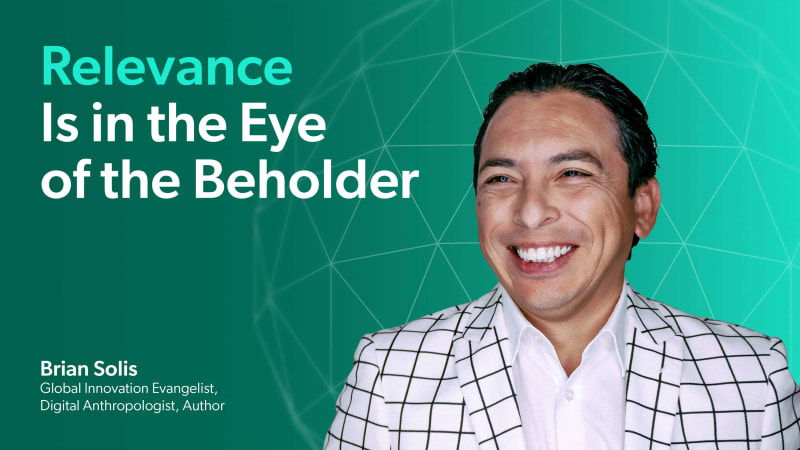
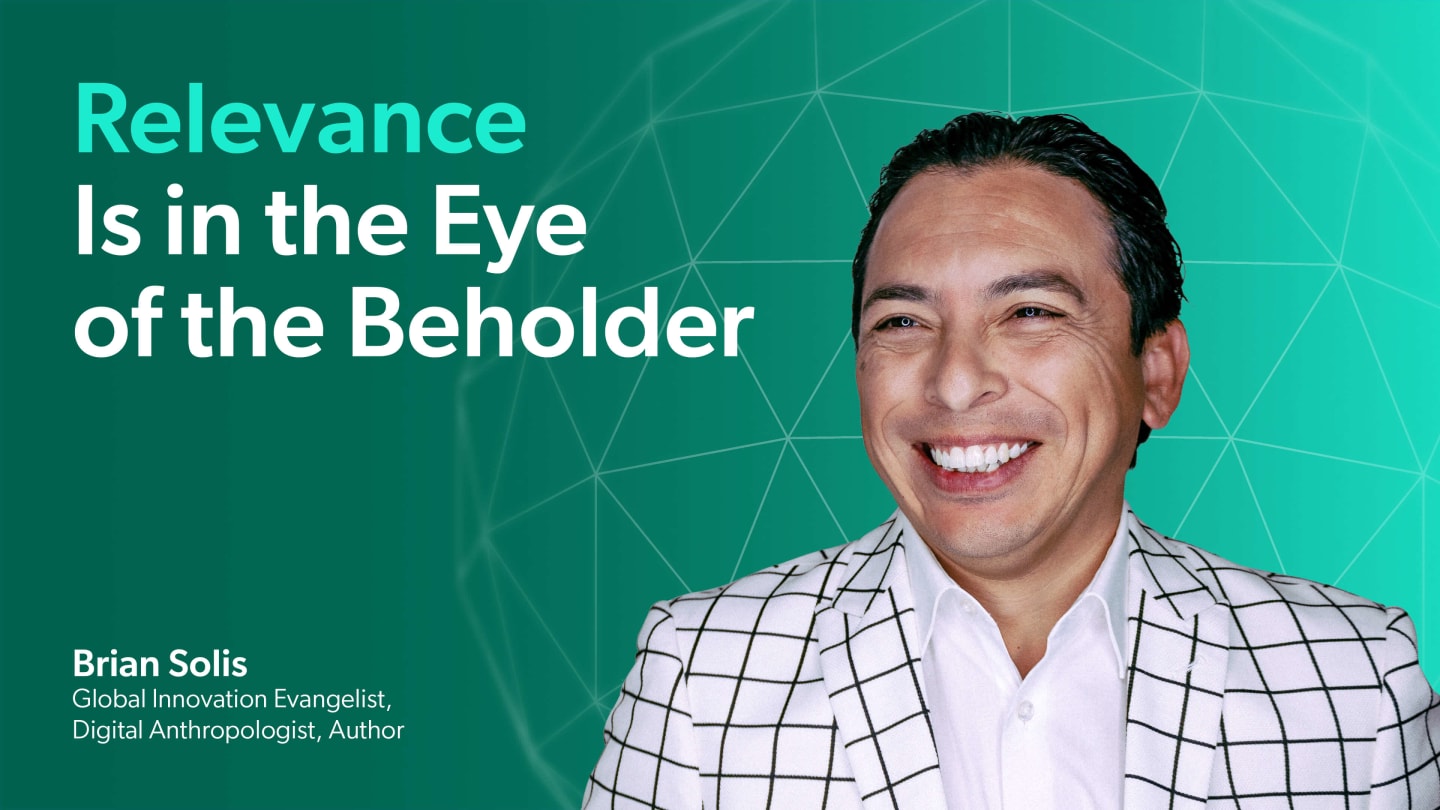
It is it is now my pleasure to bring, another thought leader, Brian Solis, who's global evangelist at, at Salesforce, and, and, really a world renowned, so called, digital anthropologist. And, welcome, Brian, to, to Relevance three sixty. And and, you know, we've been talking offline about relevance, and and I know how passionate you are, about this whole topic. So, you know, I would love your take on relevance and, and the importance of relevance in in the experience economy, Brian. Oh, it's my pleasure. And as you could see, I got the memo about the sweater and the dress shirt so that we can, we can match. You know, relevance is is one of those things, like like words, like empathy, experience, relevance. You know, I know I know how passionate you are about these topics as well. And the thing that I would love to share, you know, as a digital anthropologist and also as a global innovation evangelist is that it's important to remember that relevance is in the eye of the beholder. And that means that as we look at driving growth and innovation in this post pandemic economy, it's important to understand and appreciate how someone else values engagement, how someone else has changed as a result of their values, what are their aspirations. And the beauty of all of this is that data can tell us these things, that AI and automation can help us scale these learnings and these engagements, in ways that weren't possible before, but it really comes down to us, in that intention of how we wanna see people, and also how we want to make people feel as a result of each engagement. And I'll close on this one thought, which is customer experience is probably the number one catalyst driving digital transformation right now. Employee experience is going to be next. But, like relevance, experience is a key partner in all of this in that experience is also in the eye of the beholder, and how someone feels and interprets that engagement, is ours to design, not leave to chance. So relevance, I think, is a key opportunity for us to drive better satisfaction, better growth, better lifetime value, but more importantly, cultivate more meaningful relationships across the board. That that that's so accurate. And in fact, I like to say that in in in the term customer's experience, there is an apostrophe s, which means that the experience the customer is really the owner. The person is really the owner of of the experience. And and when you think about you know, companies are very good very good about talking in the in the digital world about themselves. They're not very good at understanding who they're talking to and talking to people about themselves, about about them, in fact, so as to serve them better. And and so, you know, Brian, in your experience and and and and as you see technology and the evolution of technology in terms of being able to deliver it deliver on that whole notion of data driven empathy, what do you see companies doing, you know, and and what do you think is kind of the the road map for companies to and and and how urgent is this? Well, I'll I'll answer the last part first, which is the sense of urgency is incredible. Data across the board, for example, McKinsey found in the United States that seventy five percent of customers during the pandemic have experimented with a new brand. Essentially, they're experimenting with your competitors. And at least sixty, but as high as eighty three percent of them are expected to stick with that new decision moving forward. So this means that loyalty is up for grabs. Not that it wasn't ever, but at it's it's been dramatically accelerated like digital transformation itself, which means retention. I mean, that's it's huge. And acquisition is also huge as an opportunity. So relevance I mean, talk about timing. Relevance is more important than ever before. But that means that you have to have the intention to not just know your your customer and what matters to them, but have the ability to organize around the customer. So I think one of the biggest trends that we're gonna see here in in twenty twenty one and in twenty twenty two is probably the hardest and and probably the most overdue aspect of transformation we've seen, which is reimagining what a business organization or an operation model needs to look like in order to be relevant around the customer as they become faster, more informed, more engaged, more impatient. And those things are they're able to find those types of services in their favorite apps, their favorite their favorite startups. Whatever it is, there are companies creating these experiences today. So we have the hard work of essentially acting like a startup, but with the greatest purpose of all, which is to get closer to our customers and be more relevant. Yeah. No. Exactly. And, and and I think these you know, obviously, technology changes everything. That's the main difference between obviously, customer centricity is not a new term, but it was very hard to deliver, you know, a million different experiences to a million different individuals, you know, before technology. You know, what do you think is the call to action for companies in terms of, you know, now that AI has been democratized, that, you know, essentially, you know, you know, we're able to, to deliver that, and and and like many companies, you know, that this technology is available to everyone. Yeah. You you said something the last time we spoke that stuck with me, which was, you know, person versus persona. And that reminded me of the need to shift perspective. I think that change has to start with us as individuals, as executives, as decision makers. You've had so many incredible guests on on at the event already, and I think maybe what I'll add is sort of an alternative view. For that for those people watching this now or on demand, you know, any great transformation or any great innovation starts because someone like you decided to see things differently and do things differently as a result. Whereas if we're waiting for someone to tell us what to do, we're on the wrong side of innovation. People have changed. People are changing. We have access to data and insights at scale with the ability to to engage in more meaningful ways at scale. You just have to wanna do it differently. So that means that if you look at the journey as it exists today, if you look at the standards of engagement, if you look at the metrics we employ today to measure success, all of those things are yesterday. Right? And this is about an opportunity for you to be the leader for a new generation of customer relationships, which, of course, will equate to business success and growth, but not at the expense of customers' experiences, but instead at the expense of looking at everything as a cost center, and looking at at at at the world through a lens of rigidity. This is an opportunity to just be great because it's not only the right thing to do, but it's what you want as a customer as well. So I think this is a really important time for for people to lead the change. I I agree. And, and the good news is if if if there is a way if there is a will, there is a way because that that that is accessible. Brian, I think I think we could talk obviously for hours, and, and we will when we, when we see each other next time. But I love the conversation, and it it's so relevant, in fact, and, and timely for businesses. And it's it's a very important topic, obviously. So we'll certainly be exploring, much more, in the coming month. So that said, folks, we have a a a very large audience, listening here. And, and, I just wanna say that, you know, in conclusion, you know and I think I think Brian just expressed it, you know, very well that that sense of, of, urgency, obviously, as it relates to, acting in that sense of, of necessity. You know, we're we have been pursuing this because we believe it's important, because we believe this is about the very survival of of businesses. And, and and we wanna bring AI and relevance to every business and really enable them to deliver the experiences that people expect. And this is profound because in in business, if you can't deliver upon the on the ex on the on on people's expectations, you're obviously gonna be history. But our purpose at Coveo is is really bigger than that. You know, I think I think all of us are are are are are are slowly but surely or or pretty quickly and surely, waking up in a world where there's a lot of polarization, where businesses are increasingly struggling to compete against, the TechFirst leaders who have built all of this themselves over the past two decades. And and the democratization you know, AI and machine learning is not new. What is new here is the democratization, is is AI on top, is the fact that companies like Coveo, we're not the only ones, have been able to use AI, embed that into platforms, and made this packaged and easy so that, effectively, every business can participate, and claim their own awesome in in the experience economy. Because without AI, there's there's really an unfair advantage here, you know, and and and so we think we think that's really the only way to participate and and be relevant in in that experience economy.