


Before a commercial airplane door can close, a piece of AI-driven automation software has already confirmed to the TSA that every passenger is accounted for and everything is in order. That software is workload automation — one of BMC‘s flagship products. It runs quietly in the background of businesses most people never think about, and when it doesn’t work, the consequences ripple fast.
Gregory Kiyoi, BMC‘s Technical Support Director, is responsible for implementing AI capabilities such as AI agents, and automation tools that enhance customer satisfaction and streamline support processes. His team leverages next-generation AI tools, including chatbots, language translation features, and Knowledge Centered Service at BMC. Despite the technological focus, Kiyoi’s primary challenge was reclaiming lost time and improving operational efficiency.

Kiyoi elaborated on integrating enterprise-grade AI for customer service automation during his presentation at Coveo’s Relevance 360: Trust is Currency in the Agentic Era. Below is an abridged version of his insights.
The Hidden Cost of A One-hour Fix
Support organizations often measure success by handle time. A case closed in an hour feels like a win.
But Kiyoi sees the problem differently. “Customers buy solutions,” Kiyoi said. “They are not there to spend all day opening cases, trying to get the solutions to work. They’re there to run their business.”
The issue, he explains, is what happens before the case ever gets opened. By the time a customer logs a support ticket, they’ve typically spent between one and seven days trying to solve the problem themselves—researching, reading documentation, testing fixes, and going in circles.
“We may solve it in an hour and feel great,” he continued. “But their experience is that they’ve spent one to seven days before they even log that case.”
That reframe changed what BMC needed to build. Their goal wasn’t just faster resolution; it was reducing the invisible suffering that preceded every ticket. Self-service had to become genuinely useful, not just technically available.
Enterprise-grade AI for customer support automation can revolutionize this experience. AI customer service, through intelligent enterprise chatbots and AI agents, offers proactive engagement, aiming to resolve issues even before a ticket is created. Advanced tools like AI customer service software enhance customer satisfaction by providing instantaneous solutions and deflecting unnecessary cases.
A one-hour resolution looks efficient in a dashboard. To the customer, it still represents days of frustration. Case deflection only has value if the self-service experience is good enough to actually solve the problem.
Relevant reading: 8 Support Ticket UI Best Practices From Research
From Search Results to Answers
BMC had been running a customer self-service portal built on Coveo’s search capabilities — solid results, a familiar experience. But Kiyoi’s team decided to go further by integrating enterprise AI to enhance customer support automation. They elevated the portal to include Coveo’s Relevance Generative Answering, shifting the experience from a list of links to a direct, cited, step-by-step response through advanced AI customer support.
“Instead of double-clicking into each knowledge article or document, now they can get a really rich generative answer to refocus on their primary tasks,” he explained, highlighting the efficiency of AI tools in improving the customer experience.
The citations matter as much as the answer itself. Customers see exactly where the information comes from, which builds the trust needed to act on it without escalating to a human agent. This enhancement in AI capabilities significantly boosts customer satisfaction and operational efficiency within the service automation framework.

Before launching the portal to customers, BMC’s internal support analysts tested it, uncovering a crucial insight: ingrained keyword-search habits persist.
“We’re creatures of habit, accustomed to keyword searches and error codes,” said Kiyoi. “The journey involved understanding that this is different—it’s about asking questions in natural language for improved results.”
This feedback loop from internal users laid the groundwork for enhanced customer interactions, ensuring a seamless transition when customers engaged with the AI-powered platform, with the system already optimized for delivering superior experiences.
Relevant reading: The Buyer’s Guide to Relevance Generative Answering
One Index, Three Teams
The next expansion came from an unexpected direction. Kiyoi was presenting AI capabilities at a quarterly business review — case summarization, language translation, knowledge generation, and customer service automation — when the professional services organization pulled him aside afterward. They wanted access to the same advanced AI tools.
However, what PS truly needed wasn’t merely case summarization. They sought access to BMC’s unified index: the comprehensive documentation, articles, and institutional information that Coveo had organized for efficient customer support.
The timing was fortunate. Coveo’s MCP integration was in beta, and through their CSM, BMC was able to access these AI systems. Almost immediately, PS connected their Microsoft Copilot Studio agents to the same Coveo index — no new repositories, no separate ingestion pipeline, no duplicated effort, thus enhancing their enterprise AI capabilities for customer interactions.
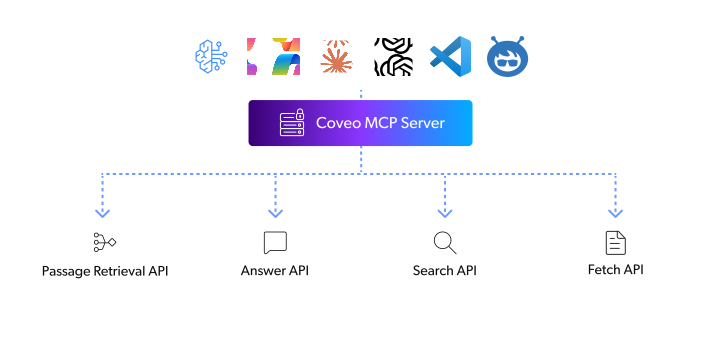
“Instead of having multiple repositories of agents that index this information — the cost of storage, compute power — we’re able to leverage Coveo to do this because we’re already doing it,” Kiyoi said.
The unification had a benefit that went beyond cost: consistency. Whether a customer was talking to a support agent, a customer success manager developing a success plan, or a new R&D hire finding their onboarding curriculum, they were drawing from the same book of record.
“It’s always good to get the same answer when you ask multiple people or sources,” said Kiyoi. “And in this case, it’s agents — they’re a part of our team as well.”
Unlocking Use Cases Across the Enterprise
The impact shows up differently across each part of the business.
In customer support, the key metric is median days to resolve—how long it takes from case open to customer back on their feet, particularly for SaaS environments where downtime is directly felt. Enterprise AI tools for customer service automation significantly reduce this time by streamlining interactions and support inquiries.
In customer success, the change is about the effort required to build success plans; the structured roadmaps that help customers understand what training, consulting, or process changes they need. Enterprise AI transforms this process. Previously, developing one meant hours of research: reviewing cases, hunting for knowledge, synthesizing findings into something actionable.
“This agent’s able to ask a few well-defined questions and provide an acceleration plan as output that they can action straight away,” Kiyoi explained.
In R&D, the value appears in onboarding. New hires need to get productive fast — not over months, but over days and weeks. Pointing BMC’s unified index at enablement and training content meant new employees could immediately surface the right curriculum for where they were and where they needed to go.
What’s Next: AI Agents That Close the Loop
Kiyoi’s team is now building toward something more ambitious: agentic AI workflows that don’t just surface information, but take action.
A common request in customer support is for a debug log — a diagnostic file the service team needs to understand what went wrong. Today, that’s a back-and-forth: the customer uploads the log, a human agent reviews it, a solution is found and communicated. Kiyoi’s team is building AI agents that can handle the entire chain of customer interactions autonomously.
Relevant reading: Agentic AI vs Generative AI: What Is the Difference?
“The customer would be able to self-solve. They upload a log file, the AI agent analyzes it, and advises: you need this latest patch, it solves this problem,” Kiyoi explained. “In a SaaS offering, the AI system may just say: I’ve scheduled this patch to be deployed in your environment. Nobody at BMC was involved.”
The vision is a support experience where the customer’s new team member is an AI agent — one that analyzes, identifies, retrieves the right knowledge, and acts. The support organization shifts its energy to the complex, the unusual, and the relationship-intensive work that enterprise AI tools can’t do.
Advice for Those Just Starting
Building agents, Kiyoi says, is the easy part. The harder problem is trust.
“It’s not just leveraging our investment — it’s a way to build customer trust regardless of the agent, regardless of the information it serves,” Kiyoi said. “That customer getting the trust is what makes them use it, invest their time, and expand that use.”
And the other piece of advice is simpler: talk to your peers. BMC’s expansion from support into professional services, customer success, and R&D didn’t come from a top-down strategy. It came from a QBR conversation, a hallway moment, and a recognition that teams across the business were trying to solve the same problems in different ways.
“There’s significant value in collaborative efforts,” he added. “You might be on a similar path, addressing customer needs—just with different approaches such as leveraging AI automation for support cases versus success plans.”
For BMC, the result is a support organization that doesn’t just resolve cases faster — it’s reducing the invisible days customers spend before they ever ask for help.
Missed Relevance 360? Check out all the discussions, including Kiyoi’s full presentation, on-demand.
Want to meet Coveo experts in person? Find an in-person Relevance 360 event near you.