Dieser Inhalt ist nur in englischer Sprache verfügbar.
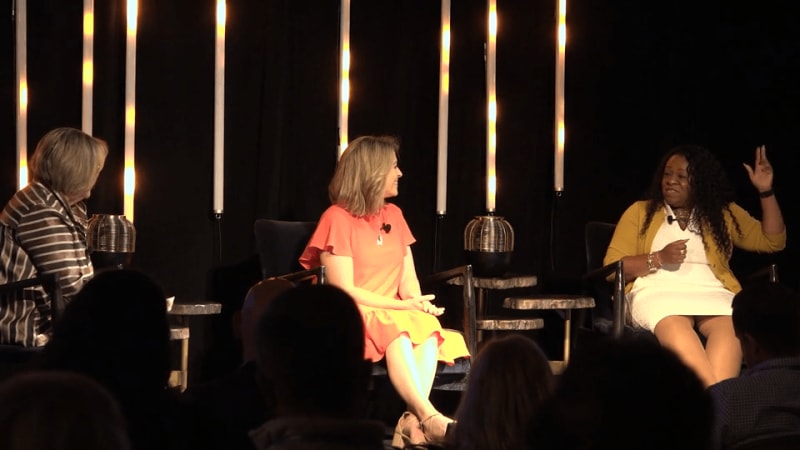
And, certainly welcome. Come on up on stage, Laurel Portner from F5 and Tony Van Winkle from, Adobe. Thank you guys so much for joining us. Yeah. It is a pleasure to be here. Thank you very much. Excellent. Well, you know, there has been so much, sort of talk and discussion around Gen AI, and we're just so excited that you're here to talk with us today about your experience with your teams and everything that has been going on. I do want to just take the time to thank you for, you know, being here today, but also for all of the work that our teams do together. You know, enterprises who have been enabled with self-service success and empowered customer and employee support teams through predictive content and, relevant search experiences are once again entering this new paradigm. I mean, that's, you know, essentially everything that Louie just shared earlier today. And there is certainly an urgency, and we're hearing it and seeing it from all of our customers to really start to implement and and and move forward. And so we wanna talk a little bit about, you know, how you maintain success metrics that you've achieved so far. So we'll we'll start to jump in, but maybe just before we get started, you guys can, you know, tell us a little bit about your roles and the teams that you manage, and, maybe, Tony, I'll let you jump in and and start first. Sure. Thank you. Tony Van Winkle. I lead the digital employee experience at Adobe, and it's just a nice little title that says I help people do their best work throughout their journey, at our company. This in this, portfolio includes a design team, collaboration, productivity applications, all of your endpoints in the enterprise, the support that we give our organization virtually and across fourteen different, countries. We are in thirty six countries, as well as the full HR stack. And so, we wanna create inclusive experiences that help people create, collaborate, and be productive from anywhere. Amazing. And my name is Laurel Portner with f five, and I'm the senior director for, digital services. And digital services sits within the global support organization. F five is, in about twelve different, offices around the globe, and we've got, you know, follow the sun support organization that we support. And my team, helps run the the ownership portal and the knowledge base and also supports the people and process to help, you know, bring those experiences and improve continuously improve those experiences for both customers and for employees. Wow. You guys have your hands full. That's for sure. Never a dull moment. No. No. You know You asked about success measures. Yeah. Exactly. Yeah. I was gonna say, you know, when it comes to the business outcomes that you guys are working towards as well as the success metrics, you know, how, you know, how are you focused on that with your respective teams right now? Yeah. So, I would say that our number one, metric that we're looking at right now is self-service success. And but it's it's with surrounding, you know, other, other metrics like, the voice of the customer and making sure that we're not just focused on a single measure. We're triangulating and looking at at lots of other, metrics. And the employee experience is also something that really tells us, and it's also kind of a canary in the coal mine where it really helps foresee and foreshadow what's going on with our customers. And one of those is that we've seen a shift in the issues that are coming into support, being more complex, being newer. And so we're seeing that because customers are finding answers and they're finding success online, it's really changing how support is is working. And, and that's a that's an interesting challenge and, but it's also exciting and and really shows that, things are things are working. Yeah. Yeah. All of that. And, so based on the breadth of what my role is at Adobe, if you think about the Adobe, mission, which is to change the world through digital experiences, I think every day about changing the world of work through digital experiences. And if done right, you know, the studies have shown again and again that you get better talent outcomes. In other words, your intent to stay, your, willingness to do, your best work and go that extra mile are improved, but business outcomes are improved as well. So, happy employees, happy customers. Absolutely. So your customer success metrics are better. Revenue goes up because those customers are happy. Yeah. But here's the thing, forty years in business, our core value is about innovation. And if I improve that employee experience, we actually get better products and innovation. And as I peel that back, I start to think about the work that Rosanna and David have done around knowledge and search. And so the component there at its base level has been around case deflection, making sure that people can self serve, we can shift left in today's economy. We know we need to do better things with less, and then do some more. So that definitely helps us. But the thing that I'm leaning into myself is moving from SLAs to XLAs, experience level metrics. Mhmm. So how do I start to understand at a deeper level in the enterprise, the fabric that helps get to the root of why are you happy working here? And can I keep you happy working here? And can you do your best work here? And I think that magic comes out of that shift from, you know, the SLA of keeping the service going to the SLA of making sure, that I'm enabling you to do the magic through your human brilliance. Mhmm. Yeah. So interesting. I will say, you know, obviously, both of you and your approach to, you know, working with your teams is so, I wanna say progressive. What are some of the challenges that you see sort of ahead in what you're doing and with your approaches? Yeah. I think that, we are some of the things that we've been working with our teams, lately on are just, you know, thinking about these transform transformations. And and it's so interesting on the the XLM. I just that that to me is is really key in in looking at, you know, how we've been servicing our customers for years. And and so giving giving our teams permission to start to explore, to start to, you know, experiment. And I think that that's been something that, has been, like, this privilege, and it's been, you know, oh, only this team is the innovation team, and they can only do, you know, these things. But it's like, no. It needs to be everywhere. And you everyone needs to come into and especially with AI and the fact that it's we still just are just at the very, very surface of what it can do. And so there are the brilliance that's out there. I mean, I just I see it every day in talking to people. I was like, you did what? You know? It's just, I mean, I I have no idea. And the more people that we can, you know, to can do this learning and sharing, then that to me is is what we need. Yeah. As leaders, we need to capitalize on that, and we need to show them that this is okay. And, especially, you can fail, and you but you're learning. And so tell us what you learned and why it didn't work. Right? And and kinda changing that. So I think that that's a that's a a new thing, especially for leaders, to think about. And so that's that's a challenge that, I'm starting to bring up with a lot more people and say, you know, how are we going to be able to allow people to do some of these things? Yeah. I I think I'll plus one thousand. How's that? I don't even know if that's a thing. Yeah. But, you know, so plus one. Mhmm. And and I one of the things that, fundamentally that I thought about in terms of how to form our organization is what kind of mindset shifts do we need to make? Mhmm. And there were three fundamental shifts. One was moving from project management to product management. And now you're thinking, Tony, you work internally. What does your work have to do with product management? Well, honestly, it's more about the mindset because projects are from one endpoint to another, and you're done with that project, and there you go. Shifting to a product mindset, organization are thinking about the addressable market, and they're thinking about market segments within the organization. In other words, not everyone at Adobe works the same way. Mhmm. And you start to shift the evolution of what you're doing into a product life cycle mindset. The second piece sort of commercially minute ago. And so, the second thing is, you know, we had a lot of hammers looking for a nail. Technology tool belt belts everywhere. Yes. Yes. Yeah. And so, how do you move from technology first to human first? Yeah. And I Coveo what was said earlier. Who's watching? And I think I would replace that with who's working or who am I helped Yes. Helping to work. And then the last piece, because I have a support organization, is moving from what I would call customer support, open and close cases, to customer success. Because you start to answer questions a little bit differently. And a little antidote there is when I started the team, I asked for the customer support metrics, and I said, okay. Give me the most common cases, and I bet you all can guess it was password reset. How many? Password reset. Yes. Now why the heck do you have an open case for prod? Okay. So I said, so how long has it been, you know, that been the top one? Well, it's been top for, like, about a year. Oh, really? Why? Well, you know, we have to cut we have to do okay. Great. Well, what do we need to do in order to turn that around? Because we were starting to think about closing the cases. Reset your password. Reset your password. Well, if you're thinking customer success, what if I enable you to just reset your password by yourself? Yes. What? Enable somebody to fix their own problem? Right. Yeah. Do that. Mhmm. Within months, no password reset cases. Because we started to empower employees because they're really smart people to fix their own problems. Yeah. It's it's amazing how now today, I wanna say every person, every employee, every size of company wants digital experiences where they can self serve. Absolutely. They they want to be able to, you know, have a digital touch point in that journey with their customers. And then, you know, if they need to, for sure, they'll go to the community. They'll use enablement. They'll have, you know, a number of sources. And then really what you touched on earlier about sort of that human first, Like, let's really use our people for that human sort of connection with our customers, our employees, and how we really transform that to be, you know, much more of that advisory relationship kind of experience. So that's really interesting. Yeah. Because they don't wanna call. I mean, ultimately, it's you know, when you think about something that's happening, you're you're interrupted. You're like, oh, what did I do? You know? Mhmm. It's like I I did something wrong. You know? And so now it's really a validation of, was it me, or was it the product, or was it you know? And so that answer is something that, oh, I can do it myself. I can find it myself. I don't have to bother somebody else, or I learned something. That's really what the user is looking for. They don't wanna have to go. And only when it's, okay, this is something I've never seen before Yeah. And no one's ever seen it, then they feel like the hero. Right? Absolutely. And they're like, I found a bug. I found the thing. Yeah. We we talk about this, in a couple of scenarios with my team is is first of all, the the CIO at Cisco had the greatest slide. It said, at home, I live like the Jetsons. At work, I live like the Flintstones. And I was like Oh, that's cool. My god. Wow. And so I'm like, oh. Right? That's awesome. Greatest quote ever. Right. And the reason why is because we're really smart people. And guess what? At home, we have DoorDash. We have Netflix. We have we have all the things. And when we get that new device at home, what happens? We open up the beautiful box, and it works. Yes. It works all by ourselves. There's not the, who was the, the the fix it guy that used to come around? I forgot the old, the guy that used to Maytag. Maytag. So if there's I'm sorry. I'm putting a lot of age on myself. And, yes, yes, I was born before the Internet. And so, but there's not that person hovering around you. So why do you need to do that work? Right. So thinking about products, thinking about customer success, thinking about, like, people are really smart, you start to develop consumer grade experiences. And that's where that thing around consumer grade comes in. Now in light of all of the rapid advances in AI technology, and obviously, you know, we heard about some amazing things from Louis today. How do you envision the potential impact and opportunities that GenAI could bring to, you know, the experiences with your teams and with your customers? Yeah. So, I'm excited, and I'm cautious. Because I'm always cautious. Right? We should all think about privacy, security, ethical, and Accuracy. Yeah. Those are just baselines. Do that. But the opportunity for us to amplify the human experience and help not only at home, at work, in the greater society is really, really, inspiring to me. If I think about what's happening with Khan Academy, if you all are familiar, the basic tenant of this is around access. If I'm able to give people access to information and education, I have now changed people's lives. Mhmm. Right. If I'm able to give those kinds of tools to the workers within the company that says, you know, I'm not replacing you. I'm gonna amplify you. And I'm helping you do your best work by giving you a copilot that can work right alongside of you. I'm increasing quality. I'm increasing your confidence. And, yes, we're gonna verify and then trust. This is a huge opportunity. Right now, we're using things like, GitHub Copilot. And I think about back in those agile days. Yes. Old woman agile. But I think about in those those days where we thought about pair programming. And that's basically what Copilot is is like when you're an engineer and you're using something like GitHub Copilot. Because you're working along, you have a second brain, you're writing code together, co pilots making suggestions, you're verifying and making corrections. Quality goes up, innovation goes up, bottom line goes up. Great stuff. So how do we start to use this in other ways? Our communications, analytics, Mhmm. The way that we can make decisions in the business at a faster rate. Mhmm. So I think there's a ton of opportunity in locks for productivity, but the bigger thing is how do we uplift the human experience? It's always been my goal. Yeah. Absolutely. Yeah. Oh, just on that note, do you have specific metrics or targets or things that you're looking for to Yeah. Measure what that experience change might look like? Yeah. So we're actually at the highest level of our company, we're creating a governance body for generative AI, specifically around rethinking work. And our chief trust officer, our CIO, my boss, our CHRO, and our innovation innovation officer will be chairing that committee. And people like me in my role will be doing the experience, experiments across the enterprise. And the way that we're thinking about this is very similar that we think about solutioning. We use design thinking. We've come up with a process called the infused process. So with design thinking, we're thinking about who's working and what are the personas in the environment. So to answer your question, it's going to be unique to the personas and we want it to be unique to the unlock for the business case. Mhmm. So for example, I have someone that does talent marketing, and they want to use generative AI to make sure that not only messages land correctly internally, but talent marketing messages out of the enterprise into other social channels are really effective. With generative AI, I'm able to give her not only better language in her messages that are inclusive and land better, but the analytic it'll analytics that approve that. So we're thinking about, you know, smaller use cases that are persona specific with a specific business outcome. So that's what the experiments would look like. Hey. Excellent. And what about you, Laurel? So ours are a little bit smaller scale because, we're focused on the support organization. But the, the IT organization does have a a new operating model similar to that where Yeah. We've got, product strategy that Yeah. Is looking at is the intake for for the business cases and and and looking at that. The support organization to me is is interesting because of the there's that fear and and trying to help understand where the fear is coming from and how do we unlock, you know, some of the the time, you know, when you're when you're talking about five. And right now, we're having discussions about what would it take. And, and so the, you know, again, providing more time, providing, you know, paths, learning paths for some of these people that wanna do some of that exploration and understanding, you know, how much to do so that because we also have to keep the lights on, keep the customers happy, and those kinds of things. So, so I'd say those are those are some things that we're we're we're looking at, probably. Excellent. Now I'm Laurel from, like, a knowledge management perspective. You know, we see there's a fear around knowledge management and and work just being replaced. And it was kind of interesting because on my flight out here, you know, I was going through immigration and customs, and you know the customs officer was asking me a number of questions, and and then he said that you know eventually said, and so what exactly does Coveo do? And I said, oh, we're a, you know, machine learning and artificial intelligence platform. And he said, oh, you're coming for my job. So, you know, there is this, I think, you know, natural thought process with some people that they're thinking, well, how is AI gonna replace what I do versus, you know, thinking a little bit differently about how is it gonna change, or how is it gonna evolve what people are doing. So do you have any thoughts about that in terms of how you think, you know, really, knowledge management and and and how that's gonna evolve? Oh, yeah. For sure. And it's it's interesting. I I think about I was thinking about this on the plane as well where, you know, anytime you have just this this massive paradigm shift in new technology that that, you know, comes up, there's there's all this fear around it. And if you think about, you know, electricity and, you know, the wheel, you know, I mean, you can go way back. And there's just it's all about how people, you know, understand what the change means and what they have to do to change. And people don't like to change. And so it's what you know, I've gotta do my job differently, but what does that look like? What am I gonna have to do? What do you what's your expectations of me? But also, what what support do I have? Am I gonna have to do this all on my own? Yeah. Figure it out. And so that's something that my team is has been living for for years because of knowledge centered service, KCS, methodology. It's really transformed how, support does their job as well. And so same type of thing. It's like, oh, if I write it all down, I'm gonna lose my job, and you're not gonna need me anymore. No. No. We're going to give you more interesting work. You're going to you're going to be at the, you know, the bleeding edge of things. You're gonna be able to take on these new things and do what you really love to do, which is tinker and mess with stuff and and, you know, troubleshoot and things like that. You don't wanna copy and paste and answer the same question over and over, do you? And so but it takes people time, and that's that's what, somebody told me the other day. They said, you know what? Your team is probably the most patient, team I have ever run across because you have to have patience. You have to let people change their pace. And that's what I see with AI as well where it gets overwhelming, and you're just like, I don't know if I can do this. And but you need to have we we, started a a coaching program, and it has been just a godsend. I mean, with people, like, in their confidence, they meet with a peer that is not someone it's not their manager, but it's somebody that that they develop a relationship with, and they start to, you know, try new things, but they've got somebody sitting there, you know, showing up for them and saying, you can do it. You know? Let's try this. It's okay. Let's try it in a lower environment. We don't have to you know, we can just fail together. And that, I think, is what we are, you know, really gonna start seeing with, you know, agile knowledge management, KCS, and using some of these great tools to help us get started. Okay. And, Tony, do you see the same sort of concern or fear, you know, at Adobe with, like, hey, as we bring in more AI, as, you know, we're able to create these generative experiences, you know, how does that impact me as an employee with what I'm doing in my role? Yeah. We definitely see that. I in fact, I've seen it throughout my my career journey that every time we go to automate or digitize something in the environment, it's like, well, wait a second. I like my accounting and my debits and credits on paper. It's like, really? We could put it in a spread. Oh, we could automate that. You know what? You don't have to do that anymore. What if we, you know, gave you the analytics, you know? So this is just another evolution in helping people through the change curve. Now I will say, Adobe's released the beta, for, creatives, Firefly. And so you can go in and use generative AI, type in I think the use case that I I spoke about, in London was corgi in Saint James's Park during the coronation of the king, and it will generate an image for you. And people are thinking about this and thinking about creatives and artists, have we replaced people and the artistic and creative process. And the intention here is to really if you think about high production, advertising, and creative processes, we're getting rid of the blank page problem. And we're helping you with a place to start, not the place to finish. And so by creating from text to image or from text to, you know, PowerPoint like, Microsoft is starting to do with o three sixty five Copilot. These are efforts to really, take away the toil of work so that we can, again, free you to do those things that are strategically differentiating for the environment. Yeah. I think the second piece of this is we're going to create new jobs. Yes. Just like any industry transformation that we've seen from the industrial era to mobile to the intranet to now, we're gonna create new jobs. And I think it was said earlier, the prompt engineer, like, if you have a kid in school right now going into computer science, have them take that class. Have them think about that because that is gonna be the new trend. It's gonna be about relevance and prompt engineering is what's gonna help us get a part of that relevance. Yeah. No. Yeah. Alright. How are you talking to your teams about it? So you talked about, you know, the fact that, you know, things are gonna be challenging. There's gonna be new jobs created. We want to, you know, have you more focused on the value at task. Is that just an ongoing dialogue that's happening within, you know, your companies? Or or how how is how does that come back to the teams? Yeah. So one of the things that we did about a year ago was, just on my team in digital services is we, we reached out to everyone and said, what is it that you are doing, and what is it that you are looking forward to doing? And giving them, you know, some things to think about with some prompts. And, and then we had some coffee chats and and to talk about, you know, why did you answer it this way? What do you, you know, what do you mean here? And and it was all about what is probably gonna be going away. And with this, you know, movement, you know, what is it gonna look like? And we went, you know, just maybe three years just to in terms of trying to get them in that mindset. And it was super helpful just to hear about what interests them, what, you know and and we're still using it as we're presenting new strategies and looking at, you know, who can do what, what, you know, work, defining the work. And, we're using a lot of that data that, that we were getting from the employees as well. So Mhmm. Yeah. Yeah. I I do think it's an ongoing dialogue. Yeah. So it's it's, like, proactive, just continuous dialogue and reinforcement and yeah. Exactly. I mean, at the end of the day and and we've done studies in our digital work studies. And at the end of the day, people wanna do meaningful work. Mhmm. They wanna make an impact to the organizations that they serve. And I think a a way to position this is what kind of impact can we make with this? Mhmm. Right. And I think that's the most important question to ask ourselves, which is what problem are we trying to solve? Yeah. And what impact can we have? That's what's a great point. Yeah. Yeah. Absolutely. And also, one of the things that we did as well is we changed job descriptions. Okay. Because what we found is that a lot of them are outdated, and and so you're looking at you know, especially when you're getting new talent and, so you really need to look at what is it that we're looking for in terms of skills and, and also working with local universities Mhmm. To to help us understand what skills are coming out, where they're teaching, and and, in these programs. So Yeah. I think, Laurel, you bring up such a great point. Like, we all, as technology leaders, have, I believe, a call to action to help this next generation. Mhmm. So whether they're interns in your environment or they're just in school now, to really help the transformation for skill building. Yes. And, you know, go to go to your companies, sign them up for reaching out to, improve education and, helping us with this journey with the next generation of AI. Okay. Great. Now, Tony, we've seen examples, obviously, of employee misuse of Gen AI and Chapity. We've all seen the Yes. You know, those examples in the media. What do you think organizations should do to prepare their teams to use this technology responsibly? Yeah. So I believe that there's skill building that we're going to have to do in the enterprise. And I love what Laurel said about creating cohorts. We do this as a practice of organizational change management. So creating cohorts either by persona in your environment, for example, engineers using Gen AI for Coveo development, or communicators using Gen AI for better marketing content and so on and so forth. Mhmm. Create that, and that will accelerate the learning. There is a mantra that we've started to use at Adobe on Gen AI, which is verify then trust. Probably your MBA training or management training said, trust and then verify. Mhmm. That's for humans. Right. With machines, it's verify then trust because the models are not exactly perfect. And I think, you know, this this notion of automation, it's been said, has been around for a long time. And so I think about pilots, autopilot, and copilot. So pilot is, you know, like, I'm driving the plane. I'm doing it. I'm the pilot human being. Autopilot is this thing that happens when we put things, automate them, we leave them alone, we monitor them. When they start to mess up, we intervene, and we help it. Co pilot, which is this next generation, this is what we need to help people with, is that this is a time where, like I said, the pair programming, where we're going to have to verify then trust. You're gonna have some machine working with you. I'm working along. You need to verify then trust the information and move forward. And that type of skill build is is what we're gonna need to really get all of the benefits out of it. It's gonna be strange. Right? Yeah. To let go of, you know, some of that work to a copilot, but come back to it and, you know It's a new muscle. Restructure. It is a new muscle. Yeah. Yeah. I liken it to the, you know, early machine translation, language translation. Right little. You know? Little. You know? Yeah. So yeah. Yeah. Yep. Absolutely. Okay. Now, just moving ahead, is there additional pressure from your leadership and or stakeholders to adopt more A and F faster? And one of the reasons that I sort of asked that question is we're certainly seeing from our customer base just this urgency and this desire to move quickly and and, you know, to understand what is the plan. So, how are you guys feeling about that? What's happening in your organizations? Yeah. I definitely I think that it's this broad ask that is let's, you know, we need to get, you know You wanna be the leader? We wanna be a leader, but not really knowing what that means. Okay. So there's still a lot of confusion, and there's still Yeah. What and I think that, I was talking to somebody, the other day that when you're thinking about some of this new technology, you really a lot of the leaders are are very used to more of an engineering and an outcome mindset where it where it's, I know that I need to get more revenue and I need to get, you know, retain customers and, you know, customer success. And there's there's these things. But if you don't really know what it is what's possible, you need more of a scientific, you know, innovative mindset where I'm not gonna tell I'm not gonna, you know, put any expectations on it. Let's just see where it takes us. And, leaders are uncomfortable with that. It's like, well, I need some time, and I need to build use cases, and I need to you know? Because Absolutely. Yeah. And so right now, we're in the use case, you know, thinking mode. Right? And, and that's a little bit uncomfortable because I can't tie that to one of my, you know and and, frankly, I understand. You gotta tell your shareholders, you know, that here's what we're doing. But, anyway, that's that's kind of where where you guys are at. Yeah. Mhmm. So, I think it's somewhat unique for Adobe because we have a product that's out there that is generative AI products as well as the Photoshop products we announced a few weeks ago. So for us, there is a acceleration in terms of, let's make sure that this product is inclusive, representative, and safe, and, you know, really fosters trust. On the inside, because we have this external, we need to also kind of drink our own champagne. Yeah. Yeah. You know? So that means that, you know, we need to have the acumen ourselves to say, you know, we're willing to live in this new environment where, we're gonna work differently. And so that's why this initiative about rethinking work with GenAI is starting to emerge. And I would say on you know, to be completely honest, we're all learning, and we're all really at the beginning of this journey. If you haven't started start, just, you know, use ChatGDP and, see what happens. It's it's kind of interesting. Know that it's been trained up to twenty twenty one, so it may not give you everything that you want. But, yes. I was listening to Sam Altman and, Greg, on a chat, on a podcast called Possible. And one of their fun things to do is to translate code into poems with chat g t p four. So even and it it sounds a little freakish, but, honestly, just doing things like that gets you used to using this product. Right. And just play with it a little bit. You don't have to get high minded around Yeah. You know, I've gotta do all the things, but just start to play with it in your environment. And and I do think you need to get to the place where you're just like, what is the use case? Yeah. Mhmm. But, you know, short answer on the pressure, sure. We we need to drink our own champagne. We need to be the innovative leaders that really drives our culture at Adobe. Yeah. So it's it sounds like everybody obviously has the interest, the desire to move ahead, but, you know, there that sort of idea that there's a lot of noise and hype is still people are trying to figure this out, and, you know, we need to make sure that we've got the right solution in place. Right. And security Yeah. And privacy is Accuracy, real estate. Yep. Yep. So what strategies and collaborators are you working with today to explore more AI capabilities? So are you you know, is there you you talked a little bit earlier about how, you know, you have a team at Adobe, and and you're a stakeholder of sort of a key team. How how how are you sort of going about that? Yeah. So it's really about, you know, I mentioned the design thinking and human centered design approach, going out to leaders, across the enterprise to say, what's the most relevant, place for us to really experiment and use this? So we're fortunate to have, something we call Lab eighty two. It is a safe place to experiment. And with this, you know, generally, Lab eighty two has been about the physical environment. What we're doing is we're taking some of the thinking of Lab eighty two along with our infused framework to say, how do we now do digital experiences that start to bridge the digital and physical worlds? And that collaboration really requires us to have all the personas in the environment representative and some of the cut across roles represented. And so selecting where we're gonna do these tests, and doing it in a fashion that's kind of a b. Right? We like, I think earlier it was mentioned, like, we we're a business that can't really afford hallucinations. Yes. We we have to have the accuracy. We have to have this. And so, you know, start to define some success criteria and, you know, experiment for a term of time and then have a decision framework. We're also like any business. We we're we're we're not good at just shoveling money away for no reason, so so we're gonna hold ourselves accountable for having a governance practice for our software standards and making sure that it goes through the same pipeline. Because when you do that splash of, you know, this urgency, alright. Yeah. Gen AI. Yeah. That's everything. And, you know, you've got thirty thousand people going, I need to go learn learn it. Everybody goes and buys it, and it's like, no. No. No. No. No. Don't do that. Right. Like, let's try Just be more thoughtful. Them. Yeah. Like, not all of them. You know? So I think some governance practice, but collaborate across your enterprise. Yeah. You'd be surprised, like, you know, it Coveo from a place of curiosity. Yeah. I certainly don't know all the answers. Yeah. Yeah. Yeah. I we have, the office of the CTO that is is developing some some areas of, you know, technology day and, you know, selecting different people for training and things like that, but also, being responsible and and having things, you know, like, you know, a a certification or a not a certification, compliance to, you know, a best practice and and that you are are not going to use this, you know, and you're going to follow the the values of the company. And, and, I mean, they have put out quite a few, communications that says, you know, we need to use this responsibly. Here are, you know, some things that we're following. And so your office of the CTO would sort of be owning Mhmm. You know, decision making around GenAI and and so forth. Yes. Yeah. And yeah. And I I think that there's still there's still some, you know, experimentation that's that's going on as well, but it needs to it needs to be responsible. In mind. Yeah. Yeah. It's yeah. One one of the things just a small add on Yeah. Is, before we released our beta of Firefly, we we tested it with. We encourage every employee, please get on it, and let's make sure that this is, like, the most inclusive Yeah. Accurate application. So we gave feedback to our product teams that they immediately turned around because, you know, we need to make sure it's safe internally before we release it. That's our responsibility. Yeah. And so that's another way that we're thinking about it is how do we include our employee base in testing our own products before we expose it to our customers. Excellent. Now just sort of in closing out, Tony, what would you say are really sort of the key things that you believe need to happen to ready your organization for generative AI? Yeah. Create some kind of innovation forum, and, you know, keep it keep it kinda open and loose. Make sure that you're testing across all the personas in your environment to unlock, issues that they may have, that type of thing. Make sure that you're involving your security, privacy officer, compliance officers. Nobody wants to be in jail at the end of this. Yeah. Let's avoid that. Yeah. Right. And, you know, know that this is something not only for yourself, your company, that this is something that is gonna have a huge effect on society. Mhmm. Right. And yourself, Laurel? Yeah. And I I think that the the the human element of this is something that that I'm really focused on and trying to help, other teams understand what is what is it going to be like for them, to to adopt, you know, new technologies, and how can we help them feel more comfortable with it and, and gain that confidence. So look at really look at the people that have maybe a growth mindset and are have that altruistic because it's it's you know, some of it's gonna be kinda scary, and, and they're gonna need to, you know, have people that that help them through it. So Excellent. Well, thank you both so much. I think we've all sort of learned a ton here today from both of you and your experiences and what you're doing at f five and Adobe. So I will thank you. That was a fantastic discussion, and, I think next we're gonna move to a bit of a break. So thank you both so much for being here. Thank you.
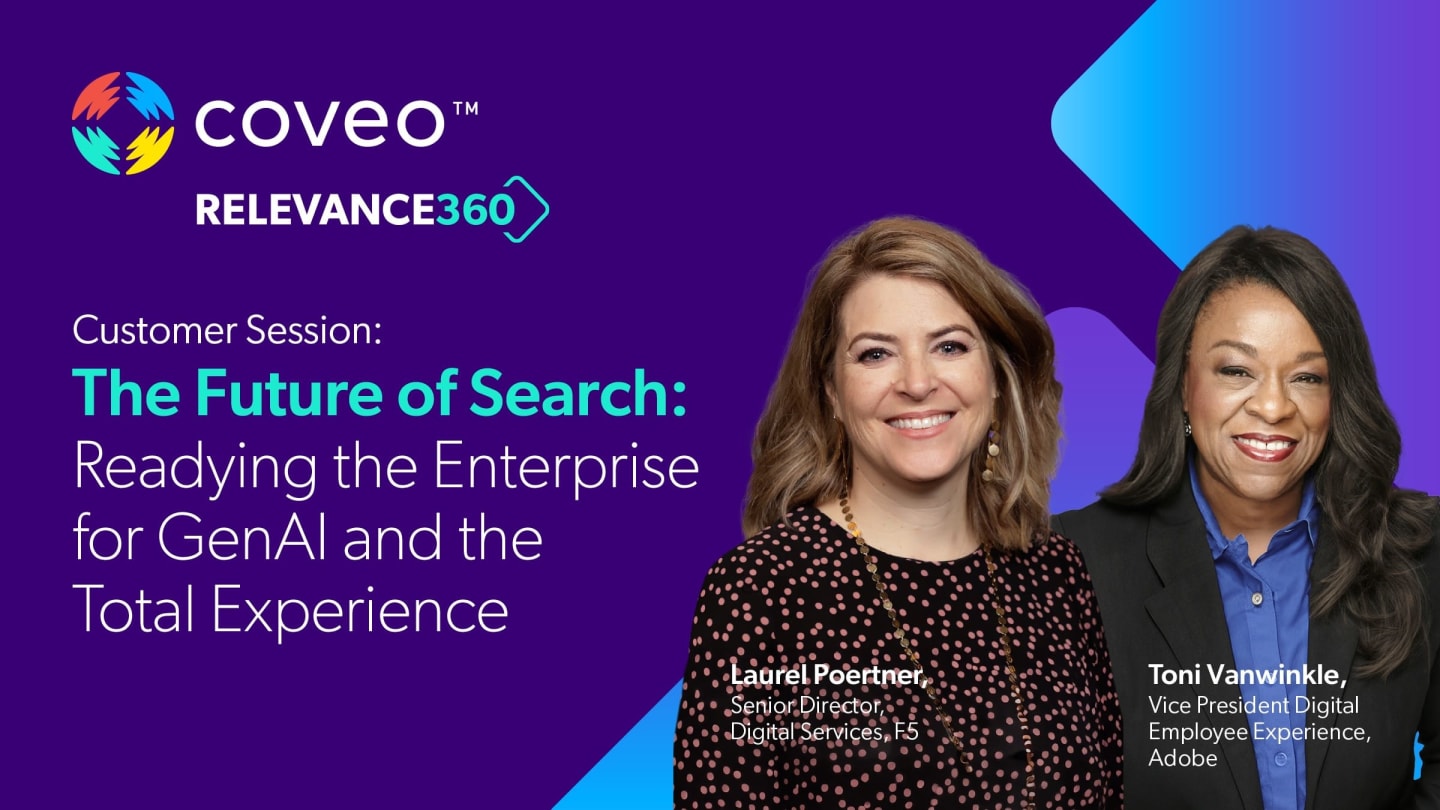
The Future of Search: Readying the Enterprise for GenAI and the Total Experience
For enterprises who have enabled self-service success and empowered customers and employees through predictive content and relevant search experiences - there is an urgency to incorporate Generative AI.
Join Toni Vanwinkle, Vice President, Digital Employee Experience from Adobe and Laurel Poertner, Senior Director, Digital Services at F5 as they discuss their current focus and the future of search experiences and AI.
This session will outline:
- Where to focus and prioritize your teams as they consider this new paradigm
- The potential implications of next-gen intelligence for employee productivity and customer experience
- How to evaluate the benefits of Generative AI in the context of efficiency and cost reduction while growing revenue and increasing profitability


Make every experience relevant with Coveo
